

This hanging toilet paper holder stacks three oval baskets on two simple straps, so spare rolls stay off the floor but within reach. Each basket has an open chevron lace wall with stacked zigzags, a solid tan floor and a thick, rope-like rim.
The palette is calm and natural: cream cotton for the walls, rims and straps, and a warm oatmeal tan for the bases. It suits a boho, farmhouse or minimalist bathroom, and it also works well for washcloths, soaps or small toiletries.
The pattern uses US crochet terms. Each basket measures 7 in (17.8 cm) long, 4.75 in (12.1 cm) wide and 4.25 in (10.8 cm) tall. The assembled holder hangs about 24 in (61.0 cm) from the top of the loop to the bottom of the lowest basket.
Construction is simple. You crochet each basket in one piece, starting with an oval base in tan and then working the cream walls straight up from it. Next you make two flat straps, sew them to the curved ends of all three baskets, join the strap tops into a point and add a small hanging loop.
Finished Size and Construction
- Finished holder: about 7.5 in (19.1 cm) wide including straps, about 24 in (61.0 cm) tall
- Skill level: Intermediate
- Terminology: US crochet terms
- Yarn weight: Worsted weight (#4) cotton
- Hook: 4.5 mm (US 7)
- Number of pieces: 5 (3 baskets, 2 straps), plus a hanging loop worked directly onto the joined straps
- Layout: 3 baskets stacked vertically, 2 in (5.1 cm) apart, on 2 straps
- Piece size: each basket is 7 x 4.75 x 4.25 in (17.8 x 12.1 x 10.8 cm); each strap is 25 x 1 in (63.5 x 2.5 cm)
- Basket height before rim: 3.75 in (9.5 cm)
- Rim depth: 0.5 in (1.3 cm)
Materials
Use a smooth, firm cotton or cotton blend so the baskets keep their shape. Acrylic works, but the walls will be softer and may sag under a full roll.
- Color A, Cream: 150 g / 255 m (walls, rims, straps, hanging loop)
- Color B, Oatmeal Tan: 55 g / 94 m (bases)
These amounts assume yarn with about 170 m per 100 g, and they include a safety margin of about 20%.
Tools:
– 4.5 mm (US 7) crochet hook
– Locking stitch markers (at least 12)
– Tapestry needle
– Scissors
– Measuring tape
– Rust-proof pins and a blocking surface
Abbreviations (US Terms)
- ch: chain
- sl st: slip stitch
- sc: single crochet
- hdc: half double crochet
- dc: double crochet
- inc: 2 sc in the same stitch
- BLO: back loop only
- sk: skip
- sp: space
- st(s): stitch(es)
- beg: beginning
- rep: repeat
Special stitches:
– dc3tog (double crochet 3 together): Yarn over, insert hook in next st, yarn over and pull up a loop, yarn over and draw through 2 loops; rep from * 2 more times (4 loops on hook), yarn over and draw through all 4 loops. Uses 3 sts and makes 1.
– Crab stitch (reverse sc):* Work sc from left to right (right-handed). Insert hook in the next st to the right, pull up a loop, yarn over and draw through both loops.
Gauge and Checkpoints
Gauge: 14 sc x 16 rounds = 4 in (10.2 cm) in sc. In dc, 1 round is about 0.6 in (1.5 cm) tall.
Make one complete basket before you start the others. Check these points as you go:
- After Rnd 9 (base): 7 x 4.75 in (17.8 x 12.1 cm), 70 sts, lying flat
- After Rnd 11: the wall stands upright and the circumference is 20 in (50.8 cm)
- After Rnd 16 (lace): the lace section is about 3 in (7.6 cm) tall
- After Rnd 17: the basket is 3.75 in (9.5 cm) tall
- After Rnd 19: the basket is 4.25 in (10.8 cm) tall
If the base is too big, or ruffles, go down to a 4 mm hook. If it is too small or cups upward, go up to a 5 mm hook. Do not change the stitch counts, because the walls, rim and strap spacing all depend on 70 sts.
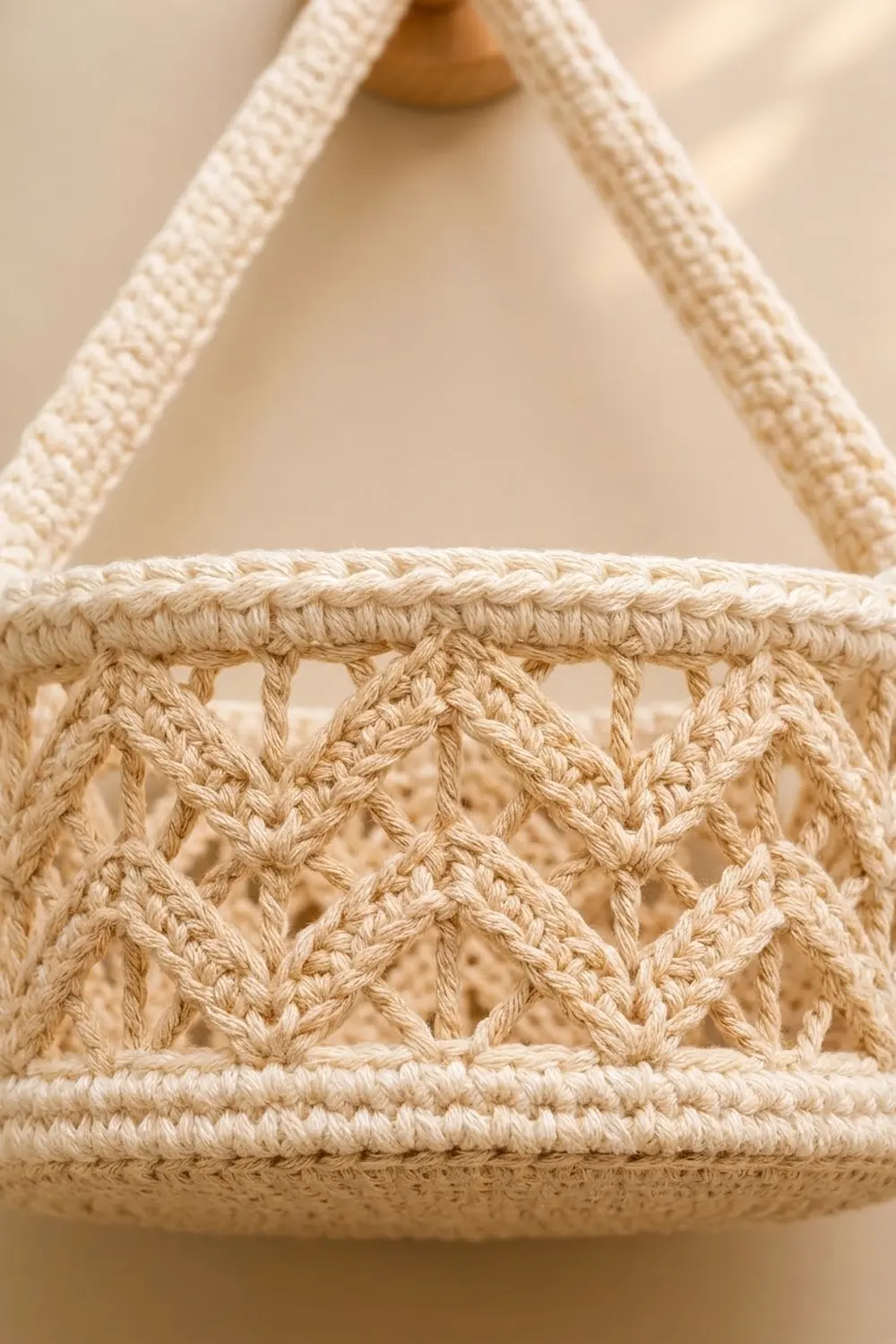
Basket (Make 3)
Oval Base
With Color B, ch 11.
Rnd 1: Sc in 2nd ch from hook and in next 8 ch, 3 sc in last ch. Rotate and work along the opposite side of the foundation: sc in next 8 ch, 2 sc in last ch (the same ch as the first sc). Join with sl st to first sc. (22 sts)
Each round below begins with ch 1 (does not count) and ends with sl st to the first sc. Both straight sides stay at 8 sts, and all increases fall on the two curved ends.
Rnd 2: Inc in first st, sc in next 8, inc in each of next 3, sc in next 8, inc in each of last 2. (28 sts)
Rnd 3: [Sc in next st, inc] once, sc in next 8, [sc in next st, inc] 3 times, sc in next 8, [sc in next st, inc] 2 times. (34 sts)
Rnd 4: [Sc in next 2, inc] once, sc in next 8, [sc in next 2, inc] 3 times, sc in next 8, [sc in next 2, inc] 2 times. (40 sts)
Rnds 5–9: Keep going the same way. Each round adds 1 more sc before every inc than the round before, and you keep sc 8 on each straight side.
- Rnd 5: 46 sts
- Rnd 6: 52 sts
- Rnd 7: 58 sts
- Rnd 8: 64 sts
- Rnd 9 (sc 7 before each inc): 70 sts
Fasten off Color B. Checkpoint: 7 x 4.75 in (17.8 x 12.1 cm). Each straight side has 8 sts and each curved end has 27 sts (8 + 27 + 8 + 27 = 70).
Walls
Rnd 10 (turning round): Join Color A in any st. Ch 1, sc in BLO of each st around, then join. (70 sts) The unused front loops form the cream ridge around the tan floor.
Rnd 11: Ch 1, sc in each st around, then join. (70 sts)
Rnd 12 (first lace round): Ch 3 (counts as dc), ch 1, sk next st, dc in next st, (dc, ch 1, dc) in next st, dc in next st, ch 1, sk next st, dc in next st, dc3tog over next 3 sts. *Dc in next st, ch 1, sk next st, dc in next st, (dc, ch 1, dc) in next st, dc in next st, ch 1, sk next st, dc in next st, dc3tog over next 3 sts; rep from * 5 more times. Sl st to top of beg ch-3. (70 sts: 7 repeats of 10, counting every dc, ch-1 sp and dc3tog as 1 st)
Each repeat uses 10 sts. The (dc, ch 1, dc) peak adds 2 sts and the dc3tog valley removes 2, so the count stays at 70.
Rnds 13–16 (lace rounds): Sl st in next ch-1 sp, ch 3 (counts as dc), ch 1, sk next dc, dc in next dc, (dc, ch 1, dc) in next peak ch-1 sp, dc in next dc, ch 1, sk next dc, dc in next ch-1 sp, dc3tog over next dc, next dc3tog and next dc. *Dc in next ch-1 sp, ch 1, sk next dc, dc in next dc, (dc, ch 1, dc) in next peak ch-1 sp, dc in next dc, ch 1, sk next dc, dc in next ch-1 sp, dc3tog over next dc, next dc3tog and next dc; rep from * 5 more times. On the last repeat, the third leg of the dc3tog goes into the beg ch-3 of the previous round. Sl st to top of beg ch-3. (70 sts each round)
Each peak is worked into the peak below it and each valley over the valley below it, so the zigzag lines stack up the wall.
Checkpoint: 5 lace rounds are about 3 in (7.6 cm) tall.
Rnd 17 (leveling conversion round): Ch 2 (does not count). *Dc in next st, hdc in next 2 sts, sc in next 3 sts (peak), hdc in next 2 sts, dc in next 2 sts (valley); rep from * 6 more times. Join to first dc. (70 sts worked 1-per-existing-st + 0 added = 70)
The tall stitches fill the valleys and the short ones sit on the peaks, so the top edge comes out level. Checkpoint: the basket is 3.75 in (9.5 cm) tall.
The rim (Rnds 18–19) is in the Border section below.
Straps (Make 2)
With Color A, ch 88.
Row 1: Sc in 2nd ch from hook and in each ch across. (87 sts)
Rows 2–4: Ch 1, turn, sc in each st across. (87 sts)
Fasten off and leave a 40 in (101.6 cm) tail for sewing. Checkpoint: 25 x 1 in (63.5 x 2.5 cm).
Make All Pieces
- Color B: 3 bases (Rnds 1–9)
- Color A: 3 sets of walls and rims (Rnds 10–19), 2 straps, 1 hanging loop
Layout, from top to bottom:
           [loop]
            /  \
     strap /    \ strap
          |[ B1 ]|   top basket
          |      |   2 in gap
          |[ B2 ]|   middle basket
          |      |   2 in gap
          |[ B3 ]|   bottom basket
Joining
Mark the straps. Count from the starting chain end of each strap and place markers at these points:
- Sts 1–15: bottom basket, 4.25 in (10.8 cm)
- Sts 16–22: gap, 2 in (5.1 cm)
- Sts 23–37: middle basket
- Sts 38–44: gap
- Sts 45–59: top basket
- Sts 60–82: free diagonal, about 6.5 in (16.5 cm)
- Sts 83–87: overlap at the top, 1.5 in (3.8 cm)
Mark the baskets. On each basket, find the center st of each 27-st curved end (the 14th st) and mark it at Rnd 10 and at Rnd 19.
Sew the straps on. Lay a strap flat against the outside of a curved end, centered on the marked column. The strap is about 1 in (2.5 cm) wide and covers about 4 wall sts. Line up strap sts 1–15 with Rnds 10–19 of the bottom basket, so the strap end sits on the Rnd 10 ridge.
Whipstitch both long edges of the strap to the wall, going through one strap edge st and one wall st (or post) on each pass. At Rnd 19, wrap the yarn 4 times around the strap and rim to make a firm cuff. Repeat for the middle and top baskets, then attach the second strap to the opposite ends.
Tension: Pull each stitch snug, but not so tight that the wall puckers. The strap should lie flat without bunching.
Join the top. Overlap sts 83–87 of the two straps, cross them into a point, and sew through both layers around the edges.
Hanging loop: Join Color A at the tip of the point, ch 12 and sl st back into the tip. Work 18 sc into the loop and sl st to join. Fasten off.
Checkpoint: The holder should hang straight, about 24 in (61.0 cm) tall, with the baskets level and 2 in (5.1 cm) apart.
Border (Basket Rim)
Work the rim on each basket before joining. It is shown here after the Joining section to match the article order.
Border gauge: 14 sc = 4 in (10.2 cm), the same as the base. That means 70 sts give a 20 in (50.8 cm) rim, the same as the base edge.
Rnd 18: Ch 1, sc in each st around, then join. (70 sts: 8 along the front, 27 around one end, 8 along the back, 27 around the other end)
Rnd 19: Ch 1, crab stitch in each st around, then join. (70 sts, per side 8 / 27 / 8 / 27) Fasten off and weave in the end.
Why the math works: The base, walls and rim all have 70 sts. Because the rim has the same circumference as the base, the wall stays vertical and the rim does not flare or pull in. The crab stitch twists each st into a cord, which makes the thick rope edge. It does not add any stitches.
Final Blocking
- Weave in all ends before you block.
- Spray each basket with water until it is damp, but not soaked.
- Stuff each basket firmly with a towel or a toilet roll wrapped in plastic so the walls stand straight.
- Press each base flat on a surface and shape it into an even oval.
- Pin the straps flat and straight, especially along the free diagonals.
- Let everything air-dry completely, which takes 24 hours.
- If you want stiffer walls, use a light spray starch before drying.
Final Quality-Control Checklist
- Each base measures 7 x 4.75 in (17.8 x 12.1 cm) and lies flat
- Each round has 70 sts from Rnd 9 to Rnd 19
- The lace peaks and valleys stack in straight vertical lines
- The top edge is level after Rnd 17
- Each basket is 4.25 in (10.8 cm) tall
- The straps are centered on the curved ends with 2 in (5.1 cm) gaps
- The holder hangs straight at about 24 in (61.0 cm)
- All ends are woven in securely
Troubleshooting
- The base curls up: Too few sts or tight tension. Use a larger hook and check the counts in Rnds 2–9.
- The base ruffles: Your tension is too loose. Go down a hook size.
- The zigzags drift sideways: You did not start the round in the ch-1 sp. Rnds 13–16 must begin with a sl st into the next ch-1 sp.
- The stitch count is not 70: Check that each repeat has exactly one peak and one dc3tog.
- The walls flare out: Rnd 10 was worked in both loops. Redo it in BLO.
- The holder hangs crooked: The straps are offset. Line up the strap markers on both sides again.
Care
Hand wash in cool water with a mild detergent. Reshape the baskets and dry them flat, stuffed with a towel so they keep their shape.

Final Notes
Everything is built on one measurement chain. The 14 sc = 4 in (10.2 cm) gauge gives a 70-st base of 7 x 4.75 in (17.8 x 12.1 cm). Those 70 sts carry through the walls and rim, so each basket finishes at 4.25 in (10.8 cm) tall with a 20 in (50.8 cm) rim. The 87-st straps then set the 2 in (5.1 cm) gaps and the total hanging length of about 24 in (61.0 cm). If you check the gauge, the base and the stitch counts, the rest will fall into place.
Happy crocheting!