

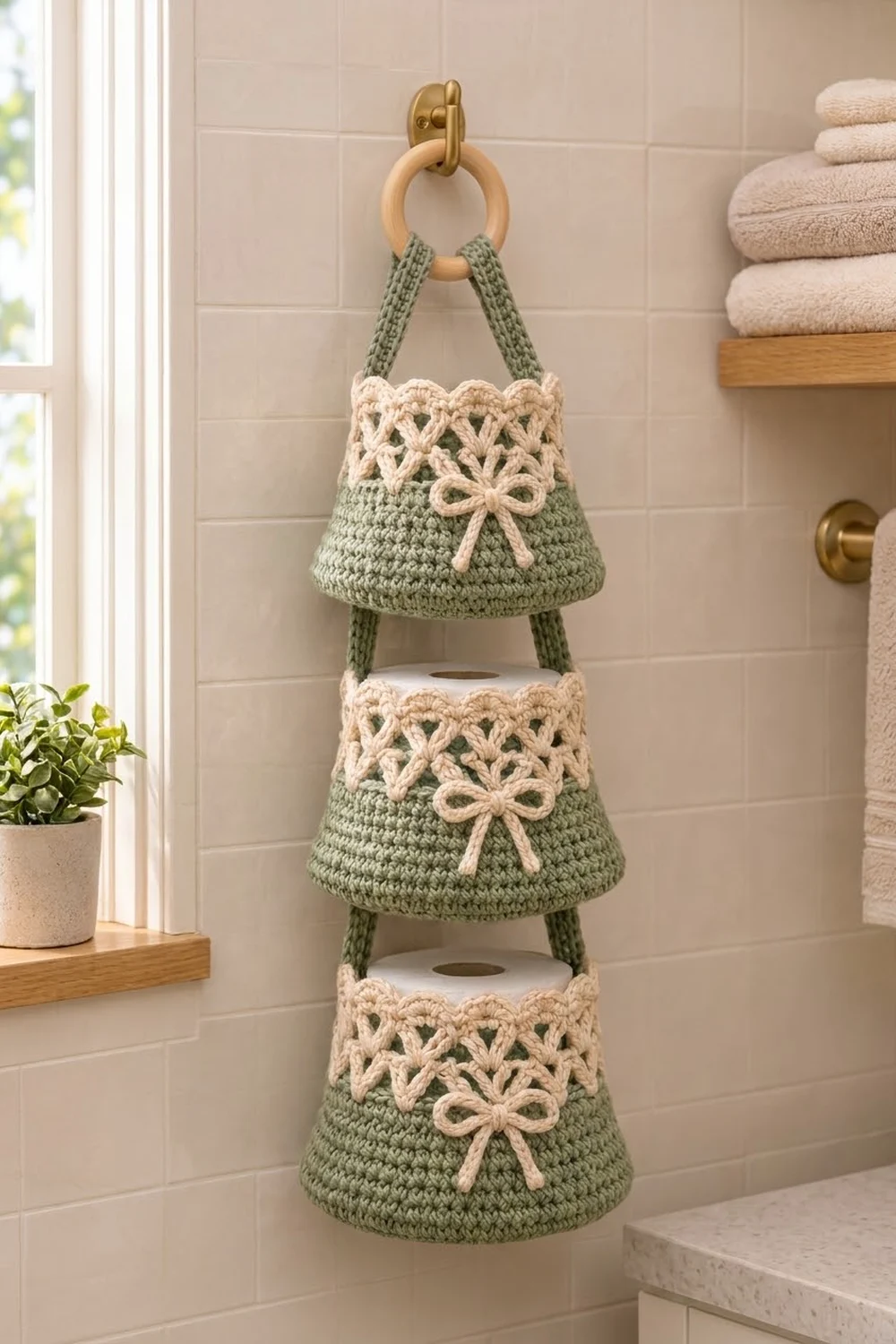
This hanging holder stacks three bell-shaped pockets, one above the other, on two slim green straps that meet at a wooden ring. Each pocket holds one standard toilet roll. The lower body is solid sage-green single crochet that flares out toward a wide, flat base, so each pocket looks like a small bell.
The top of each pocket is a cream lace band of stacked V-stitches, finished with a soft scalloped edge. A cream crocheted cord tied into a bow sits at the center front of each pocket, just below the lace. The sage and cream colors feel festive without being loud, so the holder suits a holiday bathroom and still looks good the rest of the year.
The pattern uses US crochet terms. The finished holder measures about 25.5 in (64.8 cm) from the top of the ring to the bottom of the lowest pocket. It is about 6.5 in (16.5 cm) wide at its widest point. Each pocket is 5 in (12.7 cm) tall with a 6 in (15.2 cm) base.
Construction is simple. You work each pocket in the round, starting with a flat circle base, and shape the bell body with two decrease rounds. Then you add the cream lace band. Finally, you make three slip-stitch cord bows and two long straps. You sew the straps to the sides of the pockets and fold them around the ring.
Finished Size and Construction
- Finished size: about 25.5 in (64.8 cm) long x 6.5 in (16.5 cm) wide
- Skill level: Easy-intermediate
- Terminology: US crochet terms
- Yarn weight: Worsted (#4), cotton or cotton blend
- Hook: 5.0 mm (US H-8)
- Number of pieces: 3 pockets, 3 bows and 2 straps, plus 1 purchased ring
- Layout: 1 column of 3 pockets, stacked vertically
- Pocket size: 6 in (15.2 cm) base diameter, 5 in (12.7 cm) tall
- Size before lace band: green body 3.2 in (8.1 cm) tall
- Lace band depth: 1.8 in (4.6 cm), including the scallops
Materials
Choose a smooth worsted-weight cotton. Cotton holds the bell shape, stands up to bathroom humidity and shows V-stitch lace clearly. Acrylic also works, but the pockets will be softer and may sag under the weight of a roll. Avoid fuzzy or highly textured yarn, which hides the lace lattice.
- Sage green: 100 g, about 170 m (186 yd)
- Cream: 50 g, about 85 m (93 yd)
Tools:
- 5.0 mm (US H-8) crochet hook
- One 3 in (7.6 cm) wooden ring (a sturdy metal ring of the same size also works)
- Tapestry needle
- 4 to 6 locking stitch markers
- Scissors and a tape measure
- Rust-proof pins and a blocking mat
These quantities include a margin of about 25 percent for gauge differences, swatching and sewing tails.
Abbreviations (US Terms)
- ch: chain
- sl st: slip stitch
- sc: single crochet
- dc: double crochet
- sc2tog: single crochet 2 together
- BLO: back loop only
- sp: space
- st(s): stitch(es)
- rnd(s): round(s)
Special stitch: V-stitch (V). Work (dc, ch 1, dc) in the same stitch or space.
Gauge and Checkpoints
Gauge: 14 sc x 15 rnds = 4 in (10.2 cm) in sc worked in the round.
Make one complete pocket before you start the others. That first pocket is your real gauge swatch, and it also shows you whether a roll fits.
Checkpoints:
- After Rnd 11, the base measures 6 in (15.2 cm) across and lies flat.
- After Rnd 23, the green body stands 3.2 in (8.1 cm) tall and the opening measures about 4.9 in (12.4 cm) across.
- After the lace band, the pocket is 5 in (12.7 cm) tall.
- A standard roll is about 4.25 in (10.8 cm) wide and 4.5 in (11.4 cm) tall. It should slide in with a little room to spare.
If your base is too big, switch to a 4.5 mm hook. If it is too small or cups upward, switch to a 5.5 mm hook. Fix your gauge before you work the body, because every later count depends on the 66-stitch base.
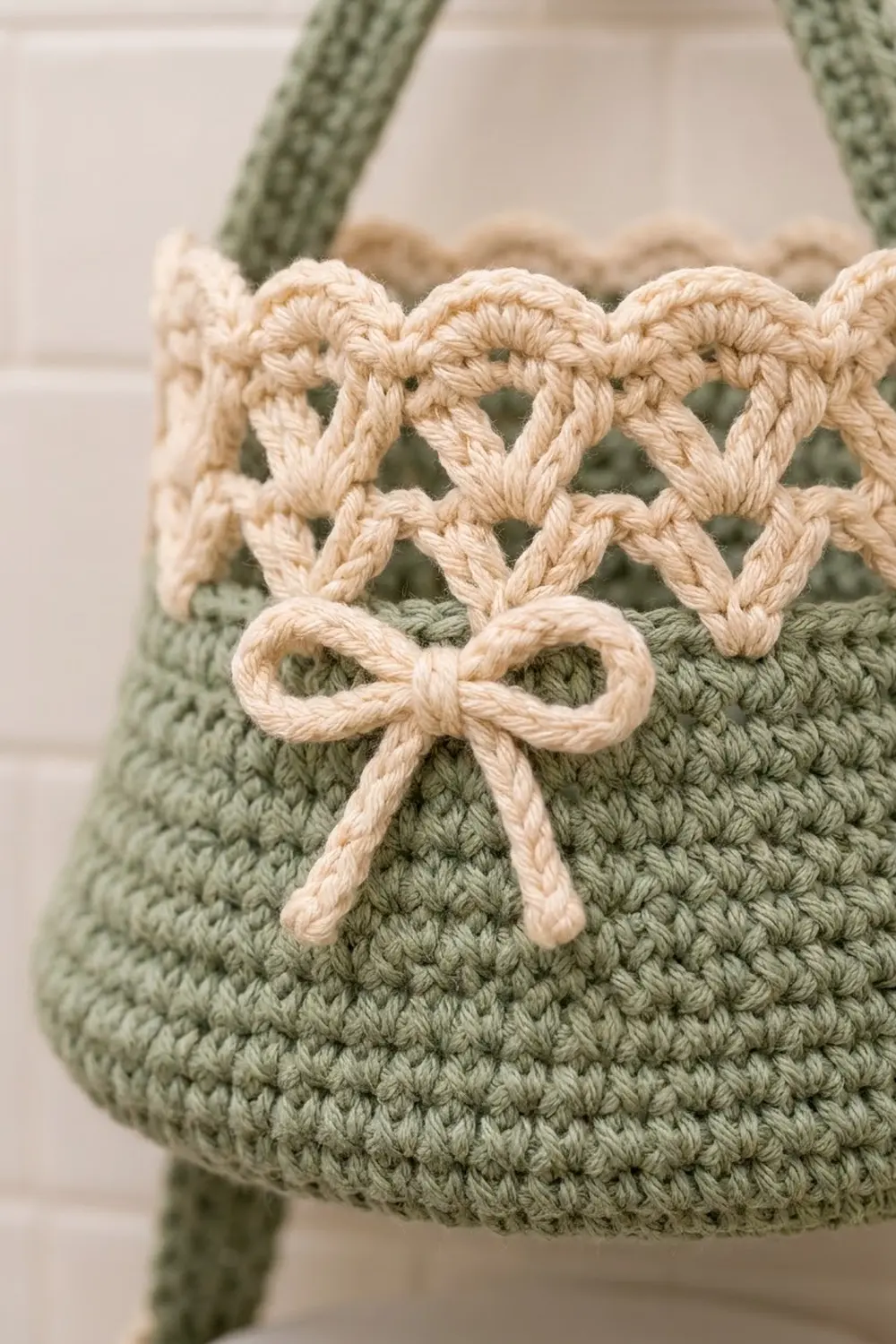
Pocket (Make 3)
Base
With sage green, work in continuous rounds. Place a marker in the first stitch of each round and move it up as you go.
Rnd 1: Make a magic ring, 6 sc in ring. (6 sts)
Rnd 2: 2 sc in each st around. (12 sts)
Rnd 3: Sc 1, 2 sc in next st 6 times. (18 sts)
Rnd 4: Sc 2, 2 sc in next st 6 times. (24 sts)
Rnd 5: Sc 3, 2 sc in next st 6 times. (30 sts)
Rnd 6: Sc 4, 2 sc in next st 6 times. (36 sts)
Rnd 7: Sc 5, 2 sc in next st 6 times. (42 sts)
Rnd 8: Sc 6, 2 sc in next st 6 times. (48 sts)
Rnd 9: Sc 7, 2 sc in next st 6 times. (54 sts)
Rnd 10: Sc 8, 2 sc in next st 6 times. (60 sts)
Rnd 11: Sc 9, 2 sc in next st 6 times. (66 sts)
The base now measures 6 in (15.2 cm) across. At 14 sc per 4 in, 66 sts make a circumference of about 18.9 in (48.0 cm), which matches a 6 in circle.
Bell Body
Rnd 12: Sc in BLO of each st around. (66 sts) This round makes a crisp fold between the base and the wall.
Rnds 13–15: Sc in each st around. (66 sts)
Rnd 16 (decrease): Sc 9, sc2tog 6 times. (60 sts)
Rnds 17–19: Sc in each st around. (60 sts)
Rnd 20 (decrease): Sc 8, sc2tog 6 times. (54 sts)
Rnds 21–23: Sc in each st around. (54 sts)
Sl st in the next st to smooth out the step at the end of the round. Fasten off the green.
The two decrease rounds pull the wall inward, so the pocket is wider at the base than at the top. This gentle taper creates the bell shape. Stacking the decreases directly above each other gives clean lines. If you want the decreases completely hidden, offset them by 4 sts instead. Before moving on, set the pocket on the table. It should stand upright on its own with the wall leaning slightly inward.
Lace Band and Scallop Edge
The lace band works as each pocket’s border. You work it directly onto the 54 green stitches of Rnd 23.
Border gauge: One V-stitch repeat covers 3 sts, which is about 0.86 in (2.2 cm). Since 54 ÷ 3 = 18, the band holds exactly 18 repeats with nothing left over.
Band Rnd 1: Join cream in any st. Ch 1, sc in each st around, join with sl st to first sc. (54 sts)
Band Rnd 2: Ch 4 (counts as dc and ch 1), dc in same st, sk 2 sts, V in next st 17 times, sk 2 sts, join with sl st to 3rd ch of ch-4. (18 V-sts)
Band Rnd 3: Sl st into first ch-1 sp. Ch 4 (counts as dc and ch 1), dc in same sp, V in ch-1 sp of next V 17 times, join with sl st to 3rd ch of ch-4. (18 V-sts)
The V-stitches stack directly on top of each other and form the open diamond lattice.
Band Rnd 4 (scallops): Sl st into first ch-1 sp. Ch 1, sc in ch-1 sp of V, 5 dc in the gap between this V and the next V 18 times, join with sl st to first sc. (18 sc + 90 dc = 108 sts, 18 scallops)
Fasten off and weave in all ends on the inside.
Why the math works: Band Rnd 1 keeps the full count of 54, so the cream sits flush against the green. Band Rnds 2 and 3 each place 18 V-stitches over 54 sts, so the band neither flares out nor pulls in. In Band Rnd 4, each scallop sits over one 3-stitch repeat. The 5-dc fan spreads into the open gaps of the lace, so it doesn’t ruffle.
Bow Appliqué (Make 3)
With cream, ch 45. Sl st in the back bump of the 2nd ch from hook and in each ch across. (44 sl sts)
The cord is about 10 in (25.4 cm) long and firm enough to hold a neat loop. Tie it into a bow with two loops and two tails. Adjust the bow until it measures about 2.25 in (5.7 cm) across, with tails about 1.25 in (3.2 cm) long. Leave the yarn tails attached for sewing.
Straps (Make 2)
With sage green, ch 4.
Row 1: Sc in 2nd ch from hook and in next 2 ch. (3 sts)
Rows 2–97: Ch 1, turn, sc in each st across. (3 sts)
Fasten off, leaving a 24 in (61.0 cm) tail for sewing.
Each strap is about 0.9 in (2.3 cm) wide and 25.9 in (65.8 cm) long. Counting from Row 1, mark these sections with stitch markers:
- Rows 1–19: lowest pocket (Pocket 3)
- Rows 20–23: gap, about 1.1 in (2.8 cm)
- Rows 24–42: middle pocket (Pocket 2)
- Rows 43–46: gap, about 1.1 in (2.8 cm)
- Rows 47–65: top pocket (Pocket 1)
- Rows 66–87: rise to the ring, about 5.9 in (15.0 cm)
- Rows 88–97: ring wrap, about 2.7 in (6.9 cm)
Check: 19 + 4 + 19 + 4 + 19 + 22 + 10 = 97 rows.
Make All Pieces
- Sage green: 3 pocket bodies, 2 straps
- Cream: 3 lace bands, 3 bows
Layout (front view, ring at top):
        [ ring ]
        /      \
   strap      strap
   | Pocket 1 |
   |   gap    |
   | Pocket 2 |
   |   gap    |
   | Pocket 3 |
Joining
Method: Use the green tail to whipstitch each strap to the outside wall of each pocket. Sew through both strap edges.
Placement: On each pocket, find two opposite points. On Rnd 12, there should be 33 sts between the markers on each side (66 ÷ 2). On Band Rnd 1, there should be 27 sts between them on each side (54 ÷ 2). Line up the strap between these markers so it runs straight up the side.
Matching strap rows to pocket rounds: Strap Row 1 sits at the base fold (Rnd 12) of Pocket 3. Strap rows 1–19 run up the wall to the top of Band Rnd 3, leaving the scallops free. Ease the strap rows evenly along the green body. On the lace, catch the strap into each V-stitch post so the openwork stays visible.
Repeat with rows 24–42 on Pocket 2 and rows 47–65 on Pocket 1. Attach the second strap to the opposite side of each pocket in the same way.
Tension: Sew snugly but not tightly. If the strap puckers, you’re pulling too hard. If a pocket tilts forward when it holds a roll, add a second line of stitches along both strap edges.
Ring: Bring both straps up so that rows 66–87 angle inward toward each other. Fold rows 88–97 of each strap over the ring from front to back, side by side. On the back, sew the last row flat to rows 78–87.
Size checkpoint: Hang the holder empty. It should measure about 25.5 in (64.8 cm) from the top of the ring to the base of Pocket 3. The gaps between pockets should be about 1.1 in (2.8 cm).
Finally, sew a bow to the center front of each pocket, halfway between the straps and directly below the lace band on green Rnd 23. Tack down the knot and each loop so they stay flat.
Final Blocking
- Wrap a toilet roll in plastic film and put it in each pocket.
- Lightly mist the lace bands and bows with water until they are damp but not soaked.
- Use your fingers to ease each scallop into an even arch.
- Pin the bow loops and tails into shape on the pocket.
- Lay the holder flat on a mat with the straps straight and parallel.
- Let it dry completely, for at least 12 hours.
- Remove the rolls and plastic, then hang the holder.
Final Quality-Control Checklist
- Each base lies flat and measures 6 in (15.2 cm) across.
- Each body has 54 sts at Rnd 23 and stands 3.2 in (8.1 cm) tall.
- Each band has 18 V-stitches and 18 scallops.
- All three pockets are 5 in (12.7 cm) tall.
- Each strap has 97 rows and hangs straight.
- The gaps between pockets are the same size.
- The bows are centered and tacked down.
- All ends are woven in on the inside.
Troubleshooting
Base cups or ruffles: Your increases are drifting. Recount against the stitch totals, and change hook size if needed.
Roll won’t fit: Your gauge is tight. Remake the pocket with a larger hook. Or skip the Rnd 20 decrease and work Rnds 20–23 with 60 sts. In that case, use 20 V-stitches in the band, since 60 ÷ 3 = 20.
Lace band flares: Band Rnd 1 probably has extra sts. Recount to 54.
Scallops ruffle: Work 4 dc instead of 5 in each gap.
Pockets tilt: The strap seams are too short. Sew the full 19 rows onto each pocket.
Holder hangs crooked: One strap is longer than the other. Count the rows and match the markers.
Care
Hand wash in cool water with mild soap. Press out the water in a towel, reshape the pockets and lay flat to dry. Do not tumble dry.
Final Notes
Every measurement in this pattern builds on the one before it:
- The 66-stitch base makes a bell 6 in (15.2 cm) across.
- Two decrease rounds bring the opening down to 54 sts, about 4.9 in (12.4 cm) across.
- 54 sts divide into 18 V-stitch repeats for a lace band of 1.8 in (4.6 cm). This makes each pocket 5 in (12.7 cm) tall.
- Two 97-row straps join the three pockets with even gaps of 1.1 in (2.8 cm), for a finished holder of about 25.5 in (64.8 cm).
Check your gauge on the first pocket and count every round, and the rest will follow.
Happy crocheting!