

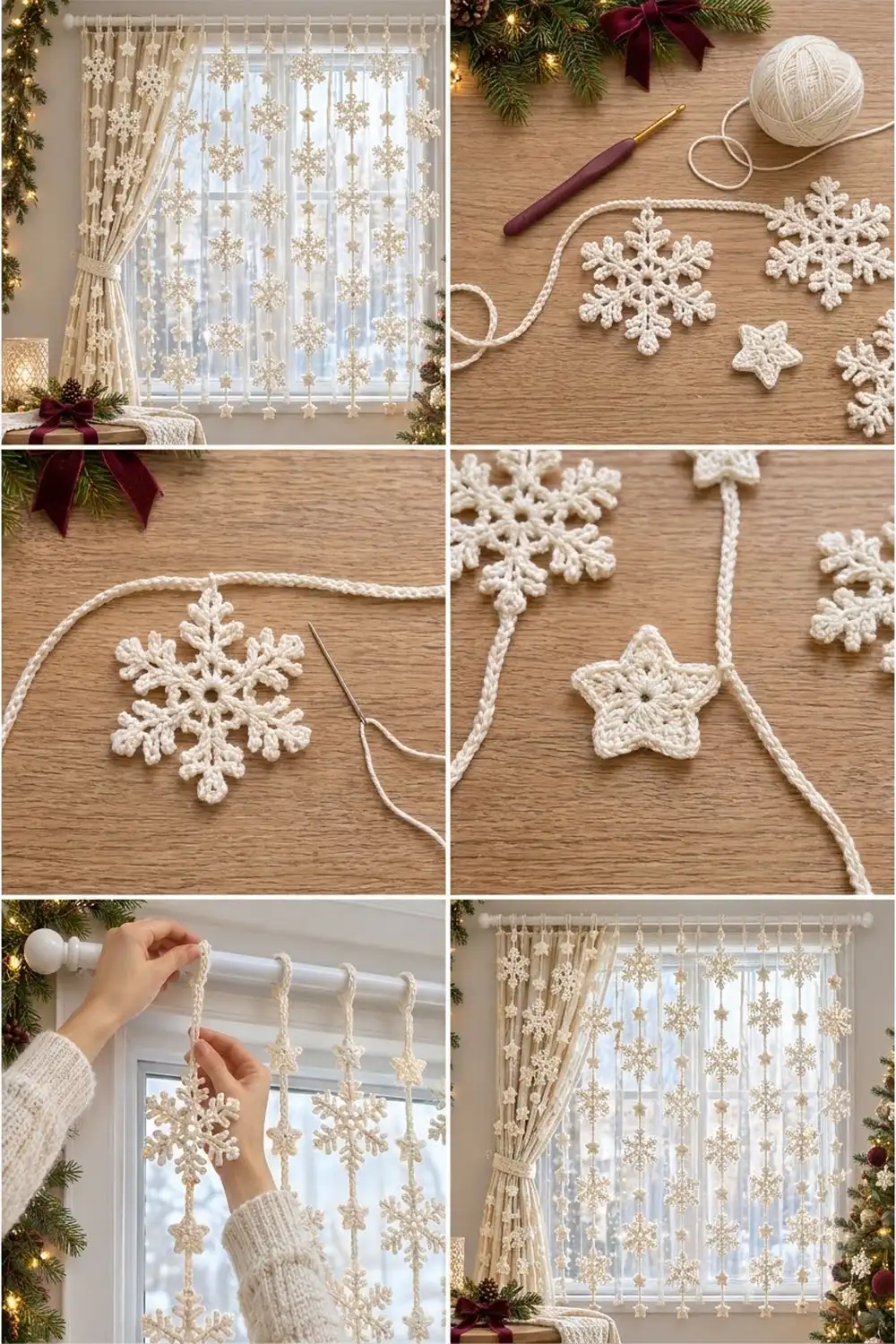
The Frost Fall Curtain is a window curtain made of long hanging strands. Each strand is a slim crocheted cord with lacy six-point snowflakes and small, puffy five-point stars alternating along it. On a rod, the strands look like snow falling past the glass, and light shows through every gap.
The whole curtain uses one color, a soft ivory cream. A single shade keeps the look calm and wintry, so the stitch texture does the work: open snowflake arms with branched tips, solid stars with rounded edges and firm cords between them. This pattern uses US crochet terms.
The finished curtain is 48 in (121.9 cm) wide and hangs 50 in (127.0 cm) from the base of the rod loops. It has 12 strands spaced 4 in (10.2 cm) apart. Each snowflake is 4 in (10.2 cm) from tip to tip, and each star is 2 in (5.1 cm) from its top tip to its lower notch.
You crochet every motif separately first. Then you make a slip-stitch cord with a hanging loop for each strand and sew the motifs to the cord at marked stitches. The strands alternate between two types, which staggers the snowflakes in a checkerboard across the window.
Finished Size and Construction
- Finished size: 48 in (121.9 cm) wide x 50 in (127.0 cm) drop, not counting the loops
- Skill level: Easy-intermediate
- Terminology: US crochet terms
- Yarn weight: DK (#3) cotton
- Hook: 3.5 mm (E-4)
- Number of pieces: 60 snowflakes, 60 stars and 12 cords
- Layout: 12 strands, alternating Strand A and Strand B, with 10 motifs on each strand
- Piece size: snowflake 4 in (10.2 cm) tip to tip; star 2 in (5.1 cm) tip to notch
- Size before border: each strand body is 50 in (127.0 cm), which is 250 cord stitches
- Border depth: there is no fabric border. The “border” is the heading of 12 hanging loops, each 6 in (15.2 cm) around.
Materials
Yarn: Use a smooth, mercerized or combed DK cotton of about 50 g / 115 m per ball. Cotton keeps snowflake points crisp, takes starch well and won’t fuzz.
- Ivory cream: 450 g (1,035 m), which is 9 balls
- Snowflakes: about 3 g (6.9 m) each, 180 g (414 m) in total
- Stars: about 2 g (4.6 m) each, 120 g (276 m) in total
- Cords: about 5 g (11.5 m) each, 60 g (138 m) in total
These quantities include a margin of about 25% for gauge differences, sewing tails and swatches.
Tools:
– 3.5 mm (E-4) crochet hook
– Tapestry needle
– About 20 locking stitch markers
– Rust-proof pins and a blocking mat
– Spray starch
– Measuring tape
– A curtain rod up to 1.5 in (3.8 cm) in diameter
Abbreviations (US Terms)
- ch: chain
- sl st: slip stitch
- sc: single crochet
- hdc: half double crochet
- dc: double crochet
- sk: skip
- sp: space
- st(s): stitch(es)
Special stitches
- Picot: ch 3, sl st in 3rd ch from hook.
- Short branch (SB): ch 6, sl st in 4th ch from hook, sl st in next 2 ch. This makes a 2-st stem with a ch-3 loop at the end.
- Long branch (LB): ch 7, sl st in 4th ch from hook, sl st in next 3 ch. This makes a 3-st stem with a ch-3 loop at the end.
- Slip-stitch cord: sl st into the back bump of each foundation chain. The result is a firm, flat cord that doesn’t stretch.
Gauge and Checkpoints
Before anything else, make one snowflake, one star and a 20-st cord swatch. Block all three, then measure them.
- Cord gauge: 5 sl sts = 1 in (2.5 cm), so the 20-st swatch should be 4 in (10.2 cm) long.
- Snowflake after Rnd 1: 1.25 in (3.2 cm) across
- Snowflake after Rnd 3: 2.25 in (5.7 cm) from corner to opposite corner
- Snowflake, finished and blocked: 4 in (10.2 cm) from tip to opposite tip. Each arm extends about 0.875 in (2.2 cm) past the hexagon.
- Star, finished and blocked: 2 in (5.1 cm) from top tip to lower notch, and about 2.5 in (6.4 cm) at its widest point
If your motifs are too big, switch to a 3.25 mm hook. If they are too small, use a 3.75 mm hook. You can set the cord gauge separately: if 20 cord sts measure more than 4 in (10.2 cm), use a smaller hook for the cord only, and if they measure less, use a larger one. Each motif’s height has to match its stitch span on the cord, so gauge matters here.
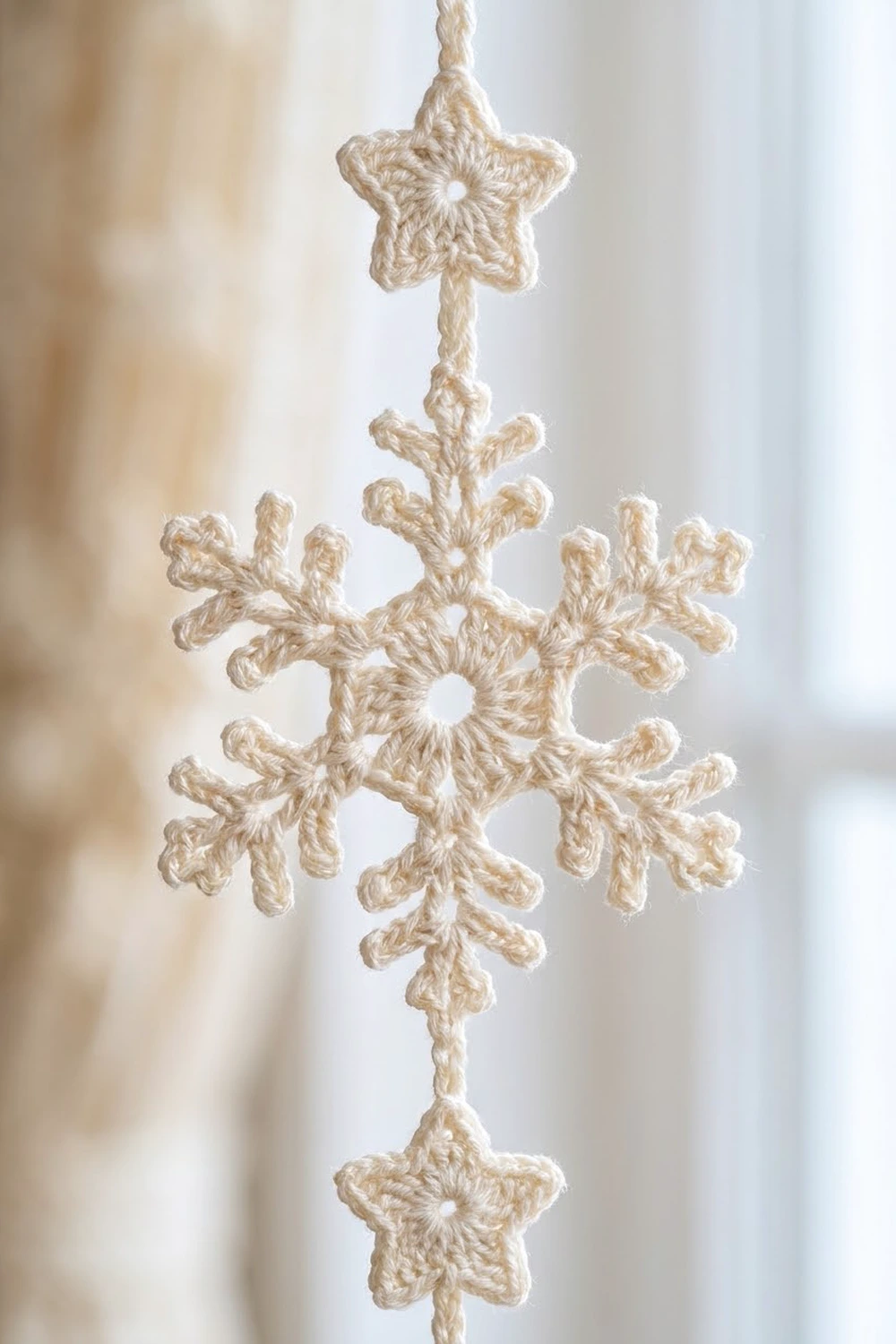
Snowflake (make 60)
The snowflake has an open center ring, a solid hexagon and six branched arms, with small picots between the arms.
Rnd 1: Ch 6, sl st in first ch to form a ring. Ch 3 (counts as dc), work 17 dc in the ring, sl st in top of ch-3. (18 dc)
Rnd 2: Ch 1, sc in same st, ch 5, sk 2 dc. Sc in next dc, ch 5, sk 2 dc. Repeat from * 4 more times. Sl st in first sc. (6 sc, 6 ch-5 sps)
Rnd 3: Sl st in first ch-5 sp. Ch 3 (counts as dc), then work (2 dc, ch 3, 3 dc) in the same sp. (3 dc, ch 3, 3 dc) in next ch-5 sp. Repeat from * 4 more times. Sl st in top of ch-3. (36 dc, 6 ch-3 corner sps)
Each side of the hexagon now has 6 dc: 3 from each corner group.
Rnd 4 (arms): Sl st in next 2 dc and into the ch-3 corner sp.
*Arm: sc in the corner sp, then ch 12. Sl st in 4th ch from hook to make the tip picot. Sl st in next 2 ch of the spine. Work SB twice. Sl st in next 3 ch of the spine. Work LB twice. Sl st in next 3 ch of the spine. Sc in the same corner sp.
Side: sc in next 3 dc, picot, sc in next 3 dc.*
Repeat from * 5 more times. Sl st in first sc and fasten off, leaving a 10 in (25.4 cm) tail.
Spine check: After the tip picot, 8 spine ch remain. You sl st in 2 + 3 + 3 = 8 of them, so each arm returns exactly to its base.
Rnd 4 total: 48 sc (12 corner sc + 36 side sc), 6 side picots and 6 arms. Each arm has 1 tip picot, 2 short branches near the tip and 2 long branches near the center.
Weave in the starting tail. Keep the final tail for joining.
Star (make 60)
The star is solid, with five rounded points, a small center hole and an sc edging that gives it a puffy outline.
Rnd 1: Make a magic ring. Ch 1, work 10 sc in the ring, sl st in first sc. Pull the ring snug but leave a small hole. (10 sc)
Rnd 2: Ch 1, work 2 sc in each st around, sl st in first sc. (20 sc)
Rnd 3 (points): Ch 1, sc in first 2 sts.
Point: ch 5, sc in 2nd ch from hook, hdc in next ch, dc in next 2 ch. Sk 2 sts of Rnd 2, sc in next 2 sts. Repeat from * 3 more times.
Make one more point, sk the last 2 sts and sl st in first sc. (5 points, 10 sc)
Stitch check: 2 + (4 x 4) + 2 = 20 Rnd 2 sts used.
Rnd 4 (edging): Ch 1, sc in first 2 sc.
Work 4 sc evenly up the side of the point. Work (sc, ch 2, sc) in the tip ch. Work 4 sc evenly down the other side. Sc in next 2 sc. Repeat from * 4 more times, but stop the last repeat after the second side of the point. Sl st in first sc and fasten off, leaving a 10 in (25.4 cm) tail.
Rnd 4 total: 60 sc and 5 ch-2 tips (12 sc per point repeat)
The 2 sc between the two lower points form the lower notch.
Cord (make 12)
- Ch 30, sl st in first ch to form the hanging loop. (30-ch loop)
- Ch 251. Sl st in the back bump of the 2nd ch from hook and in each ch across, working back to the loop. (250 sl sts)
- Sl st in the base of the loop. Fasten off and weave in the ends.
Number the cord stitches from the loop base (st 1) down to the free end (st 250). At 5 sts per inch, the body is 50 in (127.0 cm) long.
Make All Pieces
- Ivory cream snowflakes: 60 (5 per strand)
- Ivory cream stars: 60 (5 per strand)
- Ivory cream cords: 12
In the spans below, S = snowflake and * = star.
Strand A
– Lead: sts 1–10
– S 11–30, * 41–50, S 61–80, * 91–100, S 111–130, * 141–150, S 161–180, * 191–200, S 211–230, * 241–250
Strand B
– Lead: sts 1–10
– * 11–20, S 31–50, * 61–70, S 81–100, * 111–120, S 131–150, * 161–170, S 181–200, * 211–220, S 231–250
Each gap between motifs is 10 sts, or 2 in (5.1 cm). Both strand types add up the same way: lead 10 + snowflakes 5 x 20 + stars 5 x 10 + gaps 9 x 10 = 250 sts.
Layout grid (strands 1–12 from left to right):
Strand:  1  2  3  4  5  6  7  8  9 10 11 12
Type:    A  B  A  B  A  B  A  B  A  B  A  B
Row 1:   S  *  S  *  S  *  S  *  S  *  S  *
Row 2:   *  S  *  S  *  S  *  S  *  S  *  S
(rows keep alternating, 10 rows in all)
Row 10:  *  S  *  S  *  S  *  S  *  S  *  S
Joining
Method: Use each motif’s tail to whipstitch it to the cord, going through both loops of the cord’s sl sts.
Stitch-to-stitch logic:
- Snowflake: Turn it so one arm tip points straight up and another points straight down.
- Sew the top tip picot to the first st of its span (st 11 on Strand A).
- Sew the center ring to the middle sts of the span (sts 20–21).
- Sew the bottom tip picot to the last st of the span (st 30).
- The 4 in (10.2 cm) snowflake now covers exactly 20 sts.
- Star: Turn it so one point faces up.
- Sew the ch-2 top tip to the first st of its span (st 41 on Strand A).
- Sew the lower notch to the last st of the span (st 50).
- The 2 in (5.1 cm) star covers exactly 10 sts.
To move between tacking points, weave the tail through the back of the motif. The cord runs behind each motif, so hang the curtain with that side facing the glass.
Tension: Lay each cord flat, without stretching it, and mark the first and last st of every span before you sew. Each motif should lie flat between its markers. If a motif buckles, block it again before sewing rather than forcing it into place.
Size checkpoint: Each strand should measure 50 in (127.0 cm) ± 0.5 in (1.3 cm) from the loop base to the bottom of its last motif.
Border
This curtain has no fabric border. Its edge finish is the heading, which is the row of 12 hanging loops.
Border gauge: the same as the cord gauge, 5 ch = 1 in (2.5 cm).
Heading count: 12 loops x 30 ch = 360 ch in total, with nothing added between strands.
- Top edge: 12 loops at 4 in (10.2 cm) centers, so 11 x 4 in = 44 in (111.8 cm) from the first loop to the last.
- Side edges: Strands 1 and 12. Their snowflakes reach 2 in (5.1 cm) past the cord on each side, so the curtain measures 44 + 2 + 2 = 48 in (121.9 cm) across.
- Bottom edge: st 250 of each cord, at the tip of the last motif. There is no fringe.
Why the math works:
- Each 30-ch loop is 6 in (15.2 cm) around. A 1.5 in (3.8 cm) rod is about 4.71 in (12.0 cm) around, so each loop has about 1.29 in (3.3 cm) of slack and slides easily.
- On neighboring strands, a snowflake always sits beside a star. Half a snowflake, 2 in (5.1 cm), plus half a star, 1.25 in (3.2 cm), is 3.25 in (8.3 cm). That is less than the 4 in (10.2 cm) spacing, so the motifs never overlap.
Final Blocking
- Wet-block all motifs before joining. Soak them in cool water, then press them in a towel to remove excess water.
- Pin each snowflake to 4 in (10.2 cm) tip to tip. Put a pin in each tip picot, then spread the branch loops evenly.
- Pin each star to 2 in (5.1 cm) tip to notch, with a pin in each ch-2 tip.
- Spray with starch and let them dry completely, about 6–12 hours.
- Steam each cord lightly and hang it with a small weight so it dries straight.
- Hang the joined curtain, mist any curled arms and reshape them with your fingers.
Final Quality-Control Checklist
- 60 snowflakes, each with 6 arms, 24 branches, 6 tip picots and 6 side picots
- 60 stars, each with 60 sc and 5 ch-2 tips
- 12 cords, each with 250 sts and a 30-ch loop
- Strand types alternate A, B, A, B across the rod
- Every motif is tacked at its top and bottom, and every snowflake also at its center
- Every strand measures 50 in (127.0 cm) ± 0.5 in (1.3 cm)
- No ends show from the front
Troubleshooting
- The snowflake cups or ruffles: Rnd 3 is too loose. Work tighter dc or go down a hook size.
- The arms curl: This is normal before blocking. Starch the arms and pin every branch loop.
- The star points lean: Work exactly 4 sc on each side of every point.
- The cord twists: Work only into the back bumps. Wet the cord and dry it with a weight attached.
- A strand is too long: The cord gauge is loose. Remake the cord with a smaller hook instead of removing stitches.
- Motifs crowd each other: Reset the loops so they sit at 4 in (10.2 cm) centers.
Care
Hand wash in cool water with a mild detergent, lay flat to dry and re-starch the snowflakes as needed. For storage, roll the strands loosely around a tube.
Final Notes
Every measurement in this curtain builds from the cord gauge of 5 sts = 1 in (2.5 cm). A 4 in (10.2 cm) snowflake takes 20 sts, a 2 in (5.1 cm) star takes 10 sts and each gap takes 10 sts. Together they make a 250-st, 50 in (127.0 cm) strand. Twelve strands at 4 in (10.2 cm) spacing make a 48 in (121.9 cm) curtain. Check your gauge on the first snowflake, star and cord, and the rest will fit.
Happy crocheting!