

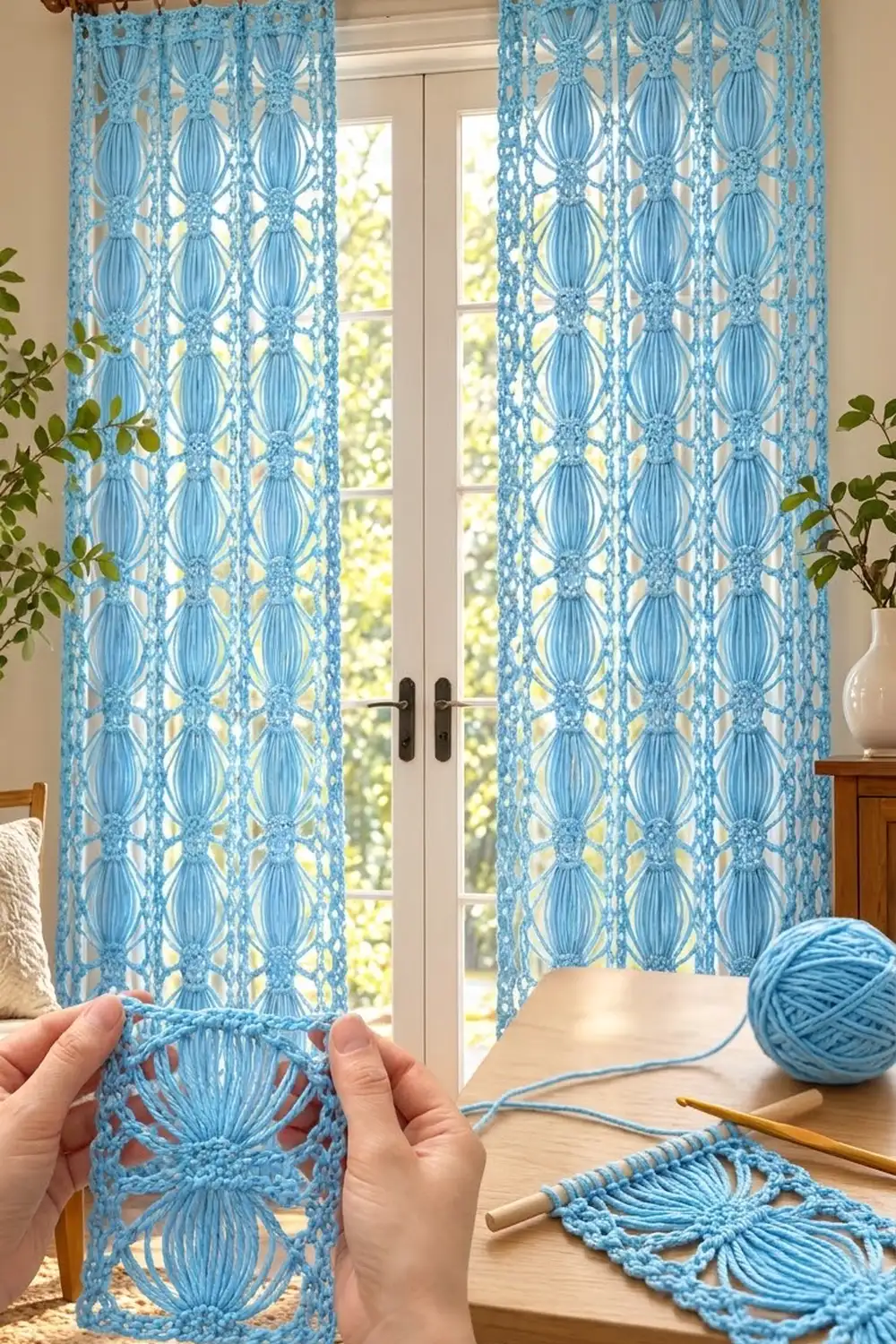
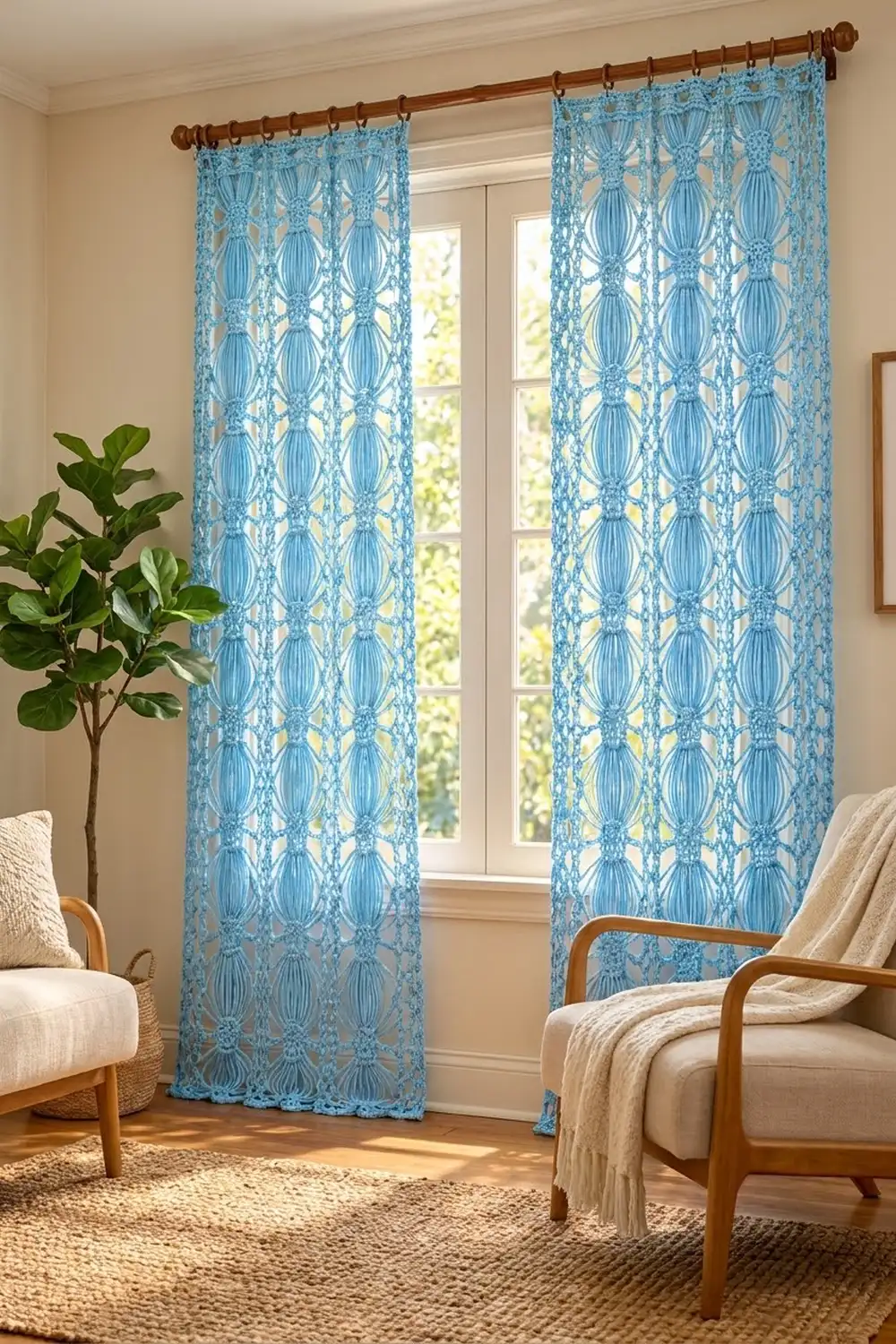
Skylantern is an airy lace curtain built from tall strips of broomstick lace. Each strip has a center column of long loops pinched into a chain of rounded “lanterns,” with open chain lattice on both sides. When the panels hang in a sunny window, light comes through every loop.
The sample is worked in a single sky-blue worsted cotton, which gives the loops a soft, rope-like shine. The style is relaxed and coastal, and it suits bedrooms, sunrooms, and French doors. This pattern uses US crochet terms throughout.
Each finished panel measures 25.5 in × 82.75 in (64.8 × 210.2 cm). A pair covers 51 in (129.5 cm) of width.
You make each panel from 4 identical strips. Every strip is a broomstick lace spine edged with 3 rounds of lattice. You join the strips with a flat slip-stitch seam, then finish the panel with a 3-round border. To get the pair in the photo, make 2 panels.
Finished Size and Construction
- Finished panel size: 25.5 × 82.75 in (64.8 × 210.2 cm)
- Skill level: Intermediate (basic broomstick lace)
- Terminology: US
- Yarn weight: Worsted (#4), cotton or cotton blend
- Hook: 5.0 mm (H-8)
- Loop tool: 1.5 in (3.8 cm) diameter dowel or broomstick lace pin
- Number of pieces: 4 strips per panel (8 strips for the pair)
- Layout: 4 strips across × 1 strip down
- Strip size: 6 × 81.25 in (15.2 × 206.4 cm)
- Panel size before border: 24 × 81.25 in (61.0 × 206.4 cm)
- Border depth: 0.75 in (1.9 cm) on every side
Materials
Pick a smooth worsted cotton or cotton blend at about 170 m per 100 g. Cotton shows the loop definition clearly and drapes well. Mercerized or twisted cotton gives the most crisp, rope-like lanterns. Avoid fuzzy yarns, which blur the loops.
Yarn (one color):
- Sky Blue: 300 g (510 m / 558 yd) per panel
- Sky Blue: 600 g (1020 m / 1115 yd) for the pair
Tools:
- 5.0 mm (H-8) crochet hook
- 1.5 in (3.8 cm) dowel, at least 14 in (35.6 cm) long
- Tapestry needle
- Stitch markers
- Measuring tape
- Blocking towels or mats and rust-proof pins
- About 10 curtain clip rings per panel
The yarn amounts include a margin of roughly 10% for gauge swatches and small differences in tension.
Abbreviations (US Terms)
- ch – chain
- sc – single crochet
- sl st – slip stitch
- rev sc – reverse single crochet (crab stitch)
- st(s) – stitch(es)
- sp(s) – space(s)
- rnd – round
- RS / WS – right side / wrong side
- rep – repeat
Special stitches
Long loop (LL): Insert the hook in the stitch, yarn over, and pull up a loop. Lengthen the loop and slip it onto the dowel. Do not work it off.
Gather: Insert the hook through all the loops on the dowel at once and slide them off together. Yarn over and pull through the whole bundle, then ch 1. This ch 1 does not count as a stitch. Then work the stated number of sc into the bundle.
Gauge and Checkpoints
Base gauge: 16 sc and 16 rows = 4 in (10.2 cm) in sc with a 5.0 mm hook.
Test strip: Before you commit to 8 full strips, make one short strip. Work Rows 1–3, then work Rows 4–7 four times. Then work strip Rnds 1–3, using 4 arcs on each long side in place of 26.
- After Row 3, the knot is 0.75 in (1.9 cm) tall, and the 12-sc row is about 3 in (7.6 cm) wide.
- Each lantern of loops is 2.25 in (5.7 cm) tall, and the knot that follows is 0.75 in (1.9 cm). One full repeat is 3 in (7.6 cm).
- With 4 lanterns, the spine is 12.75 in (32.4 cm) long.
- After Rnd 3, the test strip is 6 in (15.2 cm) wide and 15.25 in (38.7 cm) long. Each long side has 48 sts.
If it’s too big: Go down half a hook size. Gather each loop bundle more firmly. If the lanterns are too tall, use a slightly thinner dowel.
If it’s too small: Go up half a hook size, and keep your sc relaxed. If the lanterns are short, check that each loop sits snugly on the dowel, not pulled tight.
Strip Spine (Make 4 per Panel)
You work the spine flat in rows. Loop rows are never turned.
Row 1 (RS): Ch 7. Sc in the 2nd ch from the hook and in each ch across. Turn. (6 sc)
Row 2: Ch 1, sc in each st. Turn. (6 sc)
Row 3: Ch 1, 2 sc in each st. Do not turn. (12 sc)
Rows 1–3 make the bottom knot.
Row 4 (loop row): Lengthen the loop on your hook and slip it onto the dowel. That is loop 1. Working back across Row 3, make 1 LL in each of the next 11 sts. (12 loops on the dowel)
Row 5 (gather): Gather all 12 loops. Work 6 sc into the bundle. Turn. (6 sc)
Row 6 (knot): Ch 1, sc in each st. Turn. (6 sc)
Row 7 (increase): Ch 1, 2 sc in each st. Do not turn. (12 sc)
Rows 4–7 make one lantern plus the knot above it.
Work Rows 4–7 a total of 26 times. The last row is Row 7, which leaves 12 sc across the top. Fasten off.
Checkpoint: The spine has 26 lanterns and 27 knots, counting the bottom knot. It measures 78.75 in (200.0 cm) long.
Strip Lattice Edging
Hold the spine with the RS facing you and the foundation chain at the bottom. You will use 4 corner points, all on knot edges:
- Corner A: right side of the bottom knot
- Corner B: right side of the top knot
- Corner C: left side of the top knot
- Corner D: left side of the bottom knot
Rnd 1 (side arcs): Join the yarn with sc at Corner A, working around the edge of the middle row of the bottom knot.
- Long side 1: Ch 11, sc around the edge of the middle row of the next knot. Rep from * 26 times. The last sc is Corner B.
- Top end: Ch 5, sc in the space between the 6th and 7th sts of the top row. Ch 5, then sc at Corner C.
- Long side 2: Rep the long-side sequence 26 times. You end at Corner D.
- Bottom end: Ch 5. Sc between the 3rd and 4th sts of Row 1, working into the foundation chain. Ch 5, then sl st to the first sc.
(56 sc, 52 ch-11 arcs, 4 ch-5 arcs)
Rnd 2 (lattice): Ch 1. Work (sc, ch 7, sc) in the same st (Corner A).
- Long side 1: Ch 7, sc in the 6th ch of the next ch-11 arc, ch 7, sc in the next sc. Rep from * 25 times. Then ch 7, sc in the 6th ch of the last arc, ch 7. Work (sc, ch 7, sc) in Corner B.
- Top end: Ch 5, sc in the 3rd ch of the next ch-5 arc. Ch 5, sc in the center sc. Ch 5, sc in the 3rd ch of the next arc. Ch 5. Work (sc, ch 7, sc) in Corner C.
- Rep the long side and the end along the remaining two sides. Finish the bottom end with ch 5, then sl st to the first sc.
(Each long side: 52 ch-7 sps. Each end: 4 ch-5 sps. Plus 4 corner ch-7 sps. Total: 116 sps.)
Rnd 3 (seam edge): Sl st into the corner ch-7 sp, then ch 1.
- Each corner ch-7 sp: 7 sc. The 4th sc is the corner st. Mark it.
- Each long-side ch-7 sp: 5 sc.
- Each end ch-5 sp: 4 sc.
Sl st to the first sc and fasten off.
Per long side, including both corner sts: 3 + (52 × 5 = 260) + 3 + 2 = 268 sts
Per short end, including both corner sts: 3 + (4 × 4 = 16) + 3 + 2 = 24 sts
Round total: 2 × 260 + 2 × 16 + 4 × 7 = 580 sts
Checkpoint: The strip measures 6 × 81.25 in (15.2 × 206.4 cm). On the long sides, you should have 10 sc for every 3 in (7.6 cm) lantern repeat.
Make All Pieces
- Per panel: 4 strips, about 60 g (102 m) of Sky Blue each
- Per pair: 8 strips
Lay out each panel with the RS up:
+--------+--------+--------+--------+
|   S1   |   S2   |   S3   |   S4   |
| 6 in   | 6 in   | 6 in   | 6 in   |
| wide   | wide   | wide   | wide   |
+--------+--------+--------+--------+
  Top and bottom edges: 24 sts per strip = 96 sts
  Total width: 24 in (61.0 cm)
Before you join, check that all strips have their foundation ends at the bottom so the lanterns line up across the panel.
Joining
Method: Flat slip-stitch seam.
- Lay S1 and S2 side by side with the RS up, matching marked corner sts at the top and at the bottom.
- Join the yarn in S1’s corner st. Work 1 sl st through the inner (back) loop of S1’s st and the inner loop of S2’s matching st.
- Continue stitch to stitch: 268 sts on S1 to 268 sts on S2, corner to corner. Each knot level should sit directly beside its neighbor, 10 sts per repeat on each strip.
- Join S3 to S2, then join S4 to S3, the same way. That makes 3 seams per panel.
Tension: Keep the sl sts as loose as the sc they join. Pull up slightly larger loops if needed. A tight seam shortens the panel and puckers the lattice.
Checkpoint: The joined panel measures 24 × 81.25 in (61.0 × 206.4 cm), and all knot levels line up straight across.
Border
Border gauge: On the top and bottom edges, about 4 sc per in (2.5 cm). On the long sides, you keep the strip’s long-edge spacing of 10 sc per 3 in (7.6 cm), so you work 1 sc per existing st and never pick up extra.
Starting counts:
- Top and bottom: 4 strips × 24 sts = 96 sts each, including both panel corner sts. No sts are added at the seams.
- Long sides: 268 sts each, including both corner sts.
- Perimeter: 2 × 96 + 2 × 268 − 4 shared corners = 724 sts
Rnd 1: With the RS facing, join with sc in the st after a panel corner. Sc in each st around, working 3 sc in each panel corner st. Where two strip corners meet at a seam, work 1 sc in each corner st, with no extra sts. Sl st to the first sc.
(724 existing sts + 2 extra at each of 4 corners = 732. Per side, including corners: top and bottom 98, long sides 270.)
Rnd 2: Ch 1. Sc in each st around, working 3 sc in each corner center st. Sl st to the first sc.
(732 + 8 = 740. Per side: top and bottom 100, long sides 272.)
Rnd 3: Ch 1. Rev sc in each st around, with no extra sts at the corners. Sl st to the first st and fasten off.
(740 sts. Per side unchanged: 100 and 272.)
Why the math works: Each strip’s 24 end sts already include its own corner sts. Four strips placed side by side therefore give exactly 96 sts, and the seams add nothing. The only growth in the border comes from the corner increases, 2 per corner per round. That adds 0.75 in (1.9 cm) of depth on every side, so the panel finishes at 25.5 × 82.75 in (64.8 × 210.2 cm).
Final Blocking
- Weave in all ends along the sc edges, away from the lantern loops.
- Soak the panel in cool water with a little wool wash for 15 minutes.
- Press out the water. Don’t wring it. Roll the panel in towels to remove more moisture.
- Lay it flat on towels or mats. Pin it to 25.5 × 82.75 in (64.8 × 210.2 cm), placing pins in the border every 4 in (10.2 cm).
- Use your fingers to straighten the loops in each lantern so they bow evenly from knot to knot.
- Open each lattice sp into a neat diamond.
- Let the panel dry completely, then hang it.
Final Quality-Control Checklist
- Each panel has 4 strips, and each strip has 26 lanterns and 27 knots.
- Each lantern has 12 loops, and each gather has 6 sc.
- Each strip’s long sides have 268 sts, and its short ends have 24.
- The 3 seams lie flat and the knot levels align across the panel.
- The border counts are 732, 740, and 740, with crisp corners.
- The panel measures 25.5 × 82.75 in (64.8 × 210.2 cm).
- Both panels hang at the same length.
Troubleshooting
Uneven loop lengths: Keep every loop resting on the dowel without stretching it. Gather all 12 loops in one firm motion.
Lanterns twist sideways: Don’t turn the work after Row 4 or Row 7. Check that you are gathering from the same end every time.
Lattice puckers: Your ch-11 or ch-7 lengths are too tight. Go up a hook size for the chains only.
Strips differ in length: Count the lanterns on each strip, and block all strips to 81.25 in (206.4 cm) before joining.
Seam ridge shows: Work through the inner loops only, and keep the sl sts loose.
Curtain grows while hanging: Cotton drops over time. Hang the panel for 48 hours before you trim the rod height or fix the clip spacing.
Care
Hand wash cool or machine wash on a delicate cycle in a mesh bag. Reshape and dry flat; don’t tumble dry, because heat can pull the loops out of shape.
Final Notes
The measurement chain is simple:
- Lantern repeat: 3 in (7.6 cm)
- Spine: 78.75 in (200.0 cm)
- Edged strip: 6 × 81.25 in (15.2 × 206.4 cm)
- Joined panel: 24 × 81.25 in (61.0 × 206.4 cm)
- Bordered panel: 25.5 × 82.75 in (64.8 × 210.2 cm)
Check each stage as you go, and both panels will match. Happy crocheting!