

The Golden Sunwheel Curtain Panel is built from spoked wheel motifs that look like little suns when light comes through them. Solid mustard and solid cream motifs alternate in a checkerboard, and the grid finishes with a scalloped fan hem and simple tab tops.
The palette is warm and mid-century: deep mustard gold and soft cream. All seams, the border, the fan scallops and the tabs are worked in mustard, which frames the motifs and holds the panel together visually.
This pattern uses US crochet terms. One finished panel measures 37.5 in (95.3 cm) wide by 74.5 in (189.2 cm) long from the top edge to the tips of the scallops. The tabs add a hanging loop of about 3 in (7.6 cm).
The construction is simple. You make 72 identical motifs, 36 in each color, and join them with slip stitches into a grid 6 motifs wide by 12 motifs tall. Then you add a two-round border all the way around, a fan scallop along the bottom edge and seven tabs along the top. For a pair of curtains, make two panels.
Finished Size and Construction
- Finished size: 37.5 in x 74.5 in (95.3 cm x 189.2 cm), not including the tab loops
- Skill level: Intermediate
- Terminology: US crochet terms
- Yarn weight: Worsted (#4), cotton or cotton blend
- Hook: 5.0 mm (US H-8)
- Number of pieces: 72 motifs per panel (36 mustard, 36 cream)
- Layout: 6 motifs across x 12 motifs down, in a checkerboard
- Motif size: 6 in x 6 in (15.2 cm x 15.2 cm)
- Size before border: 36 in x 72 in (91.4 cm x 182.9 cm)
- Border depth: 0.75 in (1.9 cm) on all sides, plus 1 in (2.5 cm) of scallops at the bottom
Materials
Use a smooth, mercerized or matte worsted cotton. Cotton keeps the spokes crisp, hangs straight and won’t fuzz in sunlight. Avoid very stretchy acrylics, because a long panel can grow under its own weight.
- Color A, Mustard Gold: 800 g, about 1,440 m (based on 180 m per 100 g)
- Color B, Cream: 600 g, about 1,080 m
Tools:
– 5.0 mm (US H-8) crochet hook
– Tapestry needle
– Locking stitch markers
– Rust-proof pins and blocking mats or a clean carpet
– Spray bottle
– Measuring tape
The yarn quantities include a margin of about 10–15% for gauge swatches and differences in tension. For a pair of panels, double everything.
Abbreviations (US Terms)
- ch: chain
- sl st: slip stitch
- sc: single crochet
- hdc: half double crochet
- dc: double crochet
- tr: treble crochet
- sp: space
- sk: skip
- MR: magic ring
- RS / WS: right side / wrong side
- BLO: back loop only
Special stitch: Fan. Work (dc, ch 1) 8 times, then dc, all in the same stitch. That makes 9 dc spokes with 8 ch-1 spaces between them, forming a half-wheel.
Gauge and Checkpoints
Make one motif and block it before you start the rest. This curtain has 72 motifs, so a small error in each one adds up to inches across the panel.
Motif gauge: One blocked motif measures 6 in x 6 in (15.2 cm x 15.2 cm).
Checkpoints:
– After Round 1: the center disc is about 1.5 in (3.8 cm) across.
– After Round 3: the wheel is about 3.75 in (9.5 cm) across.
– After Round 4: the square is about 5 in (12.7 cm) on each side.
– After Round 5: the motif is 6 in (15.2 cm) on each side.
If your motif is too big, go down to a 4.5 mm (US 7) hook. If it is too small, go up to a 5.5 mm (US I-9) hook. If only the wheel is off but the square is fine, check that your Round 2 chains aren’t tighter or looser than your dc.
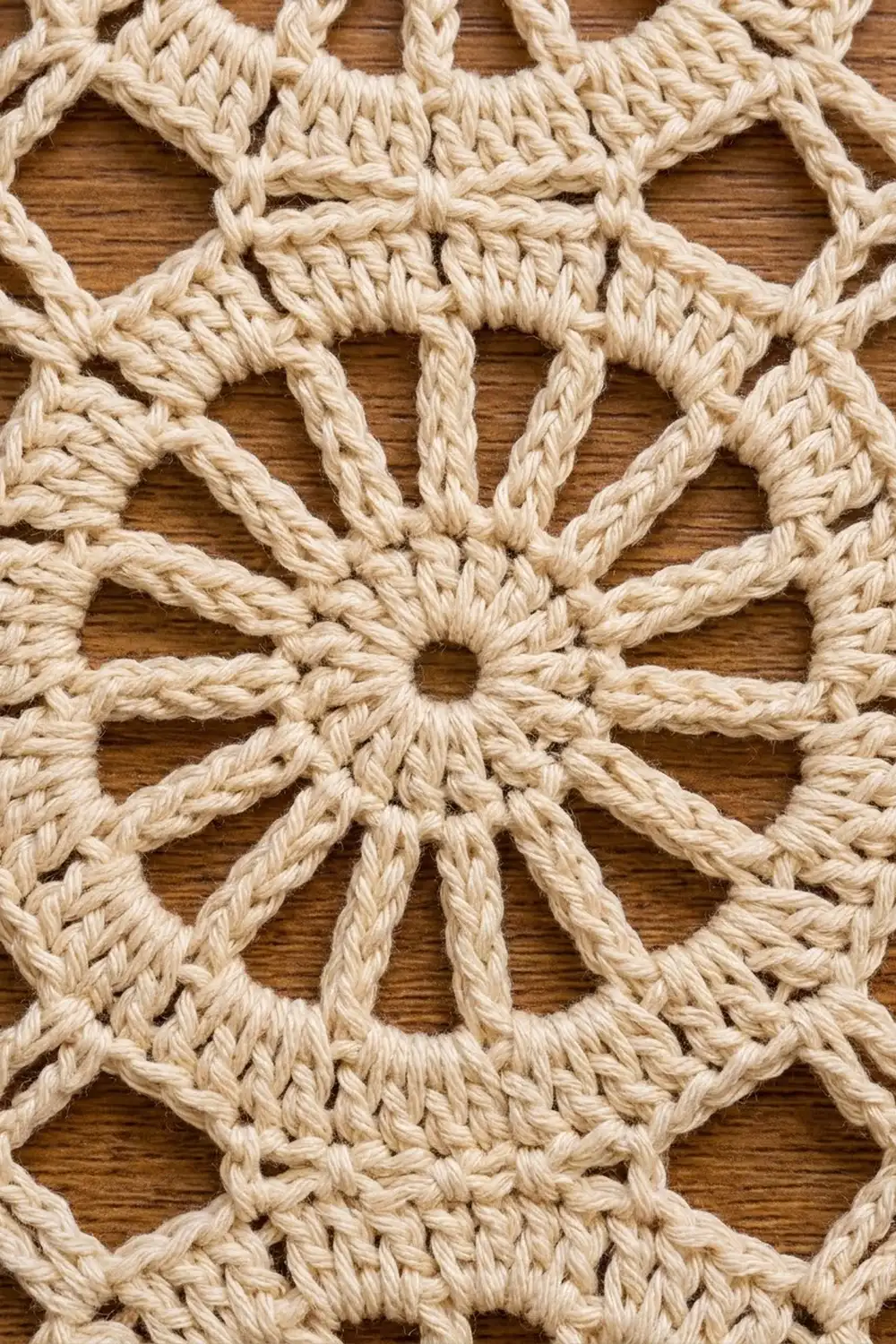
Motif (Make 72)
Make 36 motifs entirely in Color A and 36 entirely in Color B. Each motif is worked in a single color.
Round 1: Make a MR. Ch 3 (counts as dc), work 15 dc in the ring and sl st to the top of the ch-3. Pull the ring closed. (16 dc)
Round 2 (spokes): Ch 5 (counts as dc and ch 2). Dc in the next dc, ch 2. Repeat from * 14 more times, then sl st to the 3rd ch of the beginning ch-5. (16 dc, 16 ch-2 sps)
Each dc in this round is one spoke of the wheel.
Round 3 (wheel rim): Sl st into the first ch-2 sp. Ch 1 and work 3 sc in each ch-2 sp around. Sl st to the first sc. (48 sc)
This solid sc ring is the rim of the wheel. Do not work into the dc spokes.
Round 4 (squaring): This round squares the circle. Each quarter of the round uses 12 sc.
Ch 4 (counts as tr). Work (tr, ch 2, 2 tr) in the same st to make the first corner. Then work tr in the next st, dc in the next st, hdc in the next st, sc in each of the next 5 sts, hdc in the next st, dc in the next st and tr in the next st (11 sts).
Work (2 tr, ch 2, 2 tr) in the next st, then tr, dc, hdc, sc in each of the next 5 sts, hdc, dc, tr. Repeat from * 2 more times. Sl st to the top of the beginning ch-4.
Count: 60 sts and 4 corner ch-2 sps. That is 15 sts per side between corner spaces (2 tr + 11 sts + 2 tr).
Round 5: Sl st in the next tr and into the corner ch-2 sp. Ch 3 (counts as dc) and work (dc, ch 2, 2 dc) in the same sp. Dc in each of the next 15 sts.
Work (2 dc, ch 2, 2 dc) in the next corner sp, then dc in each of the next 15 sts. Repeat from * 2 more times. Sl st to the top of the ch-3 and fasten off.
Count: 76 dc and 4 corner ch-2 sps.
Per-side definition: Each side has 19 dc: 2 corner dc, 15 side dc and 2 corner dc. The 19 includes that side’s corner dc. The ch-2 corner space is not a stitch.
Weave in the ends on the WS, then block each motif to 6 in (15.2 cm) square.
Make All Pieces
- Color A (Mustard): 36 motifs
- Color B (Cream): 36 motifs
Layout grid, viewed from the RS (A = mustard, B = cream). Row 1 is the top of the curtain.
Row 1:  A B A B A B
Row 2:  B A B A B A
Row 3:  A B A B A B
Row 4:  B A B A B A
Row 5:  A B A B A B
Row 6:  B A B A B A
Row 7:  A B A B A B
Row 8:  B A B A B A
Row 9:  A B A B A B
Row 10: B A B A B A
Row 11: A B A B A B
Row 12: B A B A B A
Lay out all 72 motifs on the floor before joining, and check that no two same-color motifs touch side to side.
Joining
Method: Slip stitch join in BLO, using Color A.
- Hold two neighboring motifs RS together, with the edges to be joined lined up.
- Join Color A with a sl st through both corner ch-2 sps.
- Sl st through the back loop of each pair of matching dc. That is 19 sl sts, one for each dc on each motif, stitch to stitch.
- Sl st through the next pair of corner ch-2 sps.
Join the motifs into 12 horizontal strips of 6 motifs each, working each strip continuously from motif to motif. Then join the strips to each other along the long seams, again matching 19 dc to 19 dc per motif. Where four corners meet, sl st through all the corner spaces at once.
Tension: Keep the slip stitches as loose as your dc. A tight seam pulls the panel in and makes a cupped ridge. If your seams are tight, go up one hook size for joining only.
Size checkpoint: The joined grid should measure 36 in x 72 in (91.4 cm x 182.9 cm). The seams add no stitches and no measurable width.
Border
Border gauge: About 16 dc = 5 in (12.7 cm), which is 3.2 dc per inch. That matches the motif rate of 19 dc per 6 in (15.2 cm).
Round 1 (sc): With the RS facing, join Color A in the top-right outer corner ch-2 sp. Ch 1 and work (sc, ch 2, sc) in the same sp. Sc in each dc around.
At each seam, skip the two joined corner spaces and go straight from the last dc of one motif to the first dc of the next. Work (sc, ch 2, sc) in each outer corner sp. Sl st to the first sc.
- Top and bottom: 6 motifs x 19 = 114 sc + 2 corner sc = 116 sc per side
- Left and right: 12 motifs x 19 = 228 sc + 2 corner sc = 230 sc per side
Round 2 (dc): Sl st into the corner sp. Ch 3 (counts as dc) and work (dc, ch 2, 2 dc) in the same sp. Dc in each sc around, working (2 dc, ch 2, 2 dc) in each corner sp. Sl st to the top of the ch-3. Do not fasten off if you are right-handed and the bottom corner is close by; otherwise, fasten off.
- Top and bottom: 116 + 4 = 120 dc per side
- Left and right: 230 + 4 = 234 dc per side
- Total: 708 dc
Rounds 1 and 2 together add 0.75 in (1.9 cm) on every side, which brings the panel to 37.5 in x 73.5 in (95.3 cm x 186.7 cm).
Bottom Scallop
Row 1: With the RS facing, join Color A in the bottom-right corner ch-2 sp. Ch 1 and sc in the same sp.
Sk 5 dc, work a Fan in the next dc, sk 5 dc, sc in the next dc. Repeat from * 9 more times. The last sc lands in the 120th dc, which is the final corner dc. Leave the bottom-left corner sp unworked.
Count: 10 Fans (90 dc) and 11 sc.
Row 2 (rim): Ch 1 and turn. Sc in the first sc.
Sc in the next dc, then (2 sc in the next ch-1 sp, sc in the next dc) 8 times, which is 25 sc around the Fan. Sc in the next sc. Repeat from * 9 more times and fasten off.
Count: 1 + (10 x 26) = 261 sc
Each scallop is about 3.75 in (9.5 cm) wide and adds 1 in (2.5 cm) of depth.
Top Tabs (Make 7)
The tabs are worked directly into the 120 dc of the top edge, counting from the first dc after the top-right corner sp. Tab 1 uses dc 1–6, Tab 2 uses dc 20–25, Tab 3 uses dc 39–44, Tab 4 uses dc 58–63, Tab 5 uses dc 77–82, Tab 6 uses dc 96–101 and Tab 7 uses dc 115–120. That leaves 13 dc between neighboring tabs.
Row 1: With the RS facing, join Color A in the first dc of the tab. Ch 1 and sc in the same st and the next 5 sts. (6 sc)
Rows 2–24: Ch 1, turn and sc in each sc across. (6 sc)
Fasten off, leaving a 12 in (30.5 cm) tail.
Each tab is 1.9 in (4.8 cm) wide and 6 in (15.2 cm) long. Fold it to the WS and sew the last row across the base of the same 6 stitches on the back of Round 1. That makes a loop of about 3 in (7.6 cm).
Why the Math Works
- Grid edges: Each motif side has 19 dc and the seams add nothing, so the grid gives 114 sts across and 228 sts down.
- Border corners: Each round adds exactly 2 sts per side at each corner, so the top and bottom grow from 114 to 116 to 120.
- Scallops: Each scallop repeat uses 12 dc, and 120 / 12 = 10 repeats exactly.
- Tabs: Seven tabs of 6 dc plus six gaps of 13 dc gives 42 + 78 = 120.
Final Blocking
- Weave in all remaining ends along the seams, on the WS.
- Lay the panel flat on mats or a clean carpet with the WS up.
- Pin the four corners to a rectangle of 37.5 in x 73.5 in (95.3 cm x 186.7 cm) at the top of the scallops.
- Pin each of the 10 scallops so the tips reach 74.5 in (189.2 cm) from the top edge.
- Pin along the seam lines every 6 in (15.2 cm) so the grid stays square.
- Mist evenly until damp, then pat each wheel flat so the spokes sit straight.
- Let it dry completely, usually 24 hours, before you unpin it.
- Pin the tabs flat separately, so they dry straight.
Final Quality-Control Checklist
- [ ] All 72 motifs measure 6 in (15.2 cm) square
- [ ] Every motif has 16 spokes and 19 dc per side
- [ ] The checkerboard matches the layout grid, with no same-color neighbors
- [ ] All seams are smooth on the RS, with no puckering
- [ ] Border Round 2 has 120 dc on the top and bottom and 234 dc on each side
- [ ] There are 10 even scallops, each with 9 spokes and a solid rim
- [ ] There are 7 tabs, evenly spaced with 13 dc between them
- [ ] The panel measures 37.5 in x 74.5 in (95.3 cm x 189.2 cm)
- [ ] All ends are secured and trimmed
Troubleshooting
The wheel cups or ruffles. If it cups, your Round 2 chains are too tight. If it ruffles, they are too loose. Adjust them to match the height of your dc.
Motif corners won’t sit square. Check the Round 4 sequence. The tr must sit next to each corner, and the 5 sc must sit at the middle of each side.
Motifs differ in size by color. Different dye lots or brands can work up differently. Use a different hook size for the color that measures off.
The border waves. You probably worked into the joined corner spaces at the seams. Rip back and skip them.
The border pulls in. Your border stitches are too tight. Go up one hook size for Rounds 1–2.
The scallops don’t fit evenly. Recount the bottom edge. It must have exactly 120 dc.
The panel stretches when hung. Re-block it, and choose a firmer cotton next time.
Care
Hand wash in cool water or machine wash on a gentle cycle in a mesh bag. Dry flat and re-block to 37.5 in x 74.5 in (95.3 cm x 189.2 cm).

Final Notes
The finished size depends on one measurement chain. Each motif is 6 in (15.2 cm), so 6 x 12 motifs make a 36 in x 72 in (91.4 cm x 182.9 cm) grid. The border adds 0.75 in (1.9 cm) per side, and the scallops add 1 in (2.5 cm), for a final size of 37.5 in x 74.5 in (95.3 cm x 189.2 cm).
The stitch counts follow the same chain: 19 dc per motif side becomes 114, then 116, then 120, which divides exactly into 10 scallops and 7 tabs. Measure your first motif carefully, and the rest of the panel will come out the right size.
Happy crocheting!