

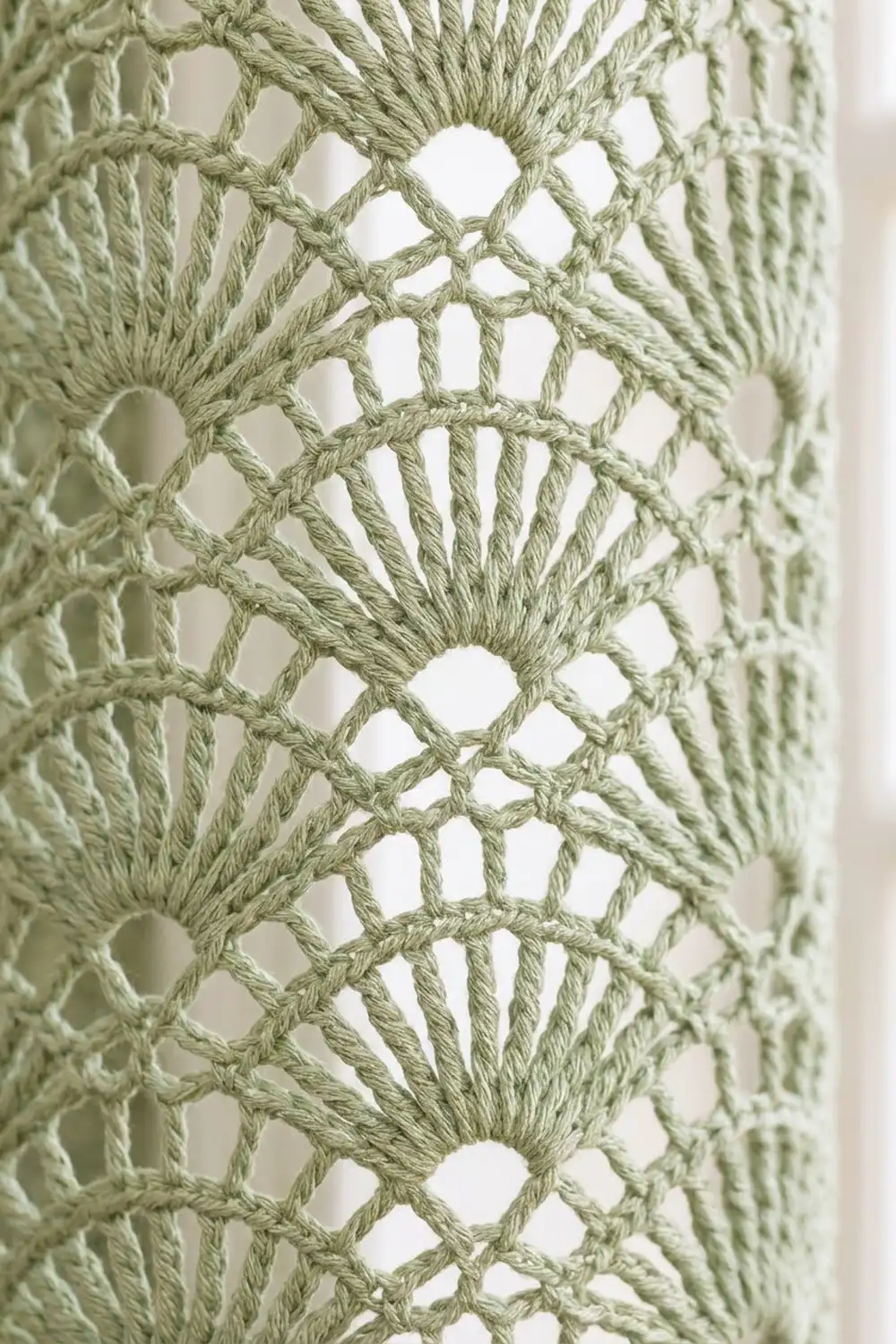
This curtain panel is an airy lace in soft sage green. Rows of fans open upward across the whole panel, and each tier sits halfway between the fans of the tier below, so the fabric looks like overlapping shells. Light passes through the open chain spaces, and the solid fans still give the window some privacy.
The bottom edge ends in deep scallops that line up with the fan columns. A narrow solid band runs across the top, and seven crocheted tabs hang the panel from a rod. The style is relaxed and cottage-inspired. It suits a sunny living room or bedroom.
The pattern uses US crochet terms. One finished panel measures 36.5 in (92.7 cm) wide by 78.5 in (199.4 cm) long, not counting the tab loops. The photo shows a matching pair hanging on one rod. Each panel is its own single piece, so you make the pattern twice for a pair. There is no joining.
The construction is simple. You work the lace body flat in rows from the bottom up. Then you add a leveling row and a solid sc band, crochet the tabs off the band, work a scalloped border into the foundation chain, and finish each long side with sc edging.
Finished Size and Construction
- Finished size (one panel): 36.5 in (92.7 cm) wide x 78.5 in (199.4 cm) long, excluding tabs
- Skill level: Intermediate
- Terminology: US crochet terms
- Yarn weight: DK / light (3), cotton or cotton blend
- Hook: 4.0 mm (US G-6)
- Number of pieces: 1 per panel (the photo shows 2 identical panels hung as a pair)
- Layout: one rectangular lace panel worked in rows, 12 fan repeats wide
- Piece size before border: 36 in (91.4 cm) x 77.25 in (196.2 cm), body plus top band
- Border depth: scalloped bottom border 1.25 in (3.2 cm); side edging 0.25 in (0.6 cm) per side
- Tabs: 7 tabs, each 1.75 in (4.4 cm) wide and 7 in (17.8 cm) long, folded into 3.5 in (8.9 cm) loops
Materials
Yarn: Choose a smooth, mercerized or combed cotton in DK weight. Cotton shows the fan texture crisply, and it stretches less on the rod than acrylic does. Avoid fuzzy or very splitty yarns, because they blur the lace.
- Sage green: about 1,000 g / 2,300 m per panel (for example, ten 100 g skeins of 230 m each). For a pair, double this to 2,000 g / 4,600 m.
These quantities include roughly a 10% margin for the gauge swatch and small differences in tension. Buy all the skeins for both panels from the same dye lot.
Tools:
- 4.0 mm (US G-6) crochet hook
- Tapestry needle
- 8 locking stitch markers
- Tape measure
- Blocking mats or a large clean towel-covered surface
- Rust-proof pins
- Spray bottle
- Curtain rod up to 1.5 in (3.8 cm) in diameter
Abbreviations (US Terms)
- ch – chain
- sl st – slip stitch
- sc – single crochet
- hdc – half double crochet
- dc – double crochet
- tr – treble crochet
- sk – skip
- sp(s) – space(s)
- st(s) – stitch(es)
- RS / WS – right side / wrong side
- rep – repeat
Special stitches:
- Fan: (dc, [ch 1, dc] 6 times) in the same st. A Fan has 7 dc and 6 ch-1 sps. The 3rd and 4th ch-1 sps are its center.
- Half Fan: (dc, [ch 1, dc] 3 times) in the same st. A Half Fan has 4 dc and 3 ch-1 sps.
Gauge and Checkpoints
Gauge: 1 fan repeat (12 foundation chains) = 3 in (7.6 cm) wide. Row 1 = 0.75 in (1.9 cm) tall. One 4-row repeat (Rows 2–5) = 3 in (7.6 cm) tall. Measure after a light steam or wet block.
Test swatch first: Ch 38 and work Rows 1–9 below, which gives 3 repeats wide and 2 repeats tall. Block it. It should measure 9 in (22.9 cm) wide x 6.75 in (17.1 cm) tall.
- Too big: go down to a 3.5 mm hook.
- Too small: go up to a 4.5 mm hook.
- Width correct but height off: keep the hook. Add or remove 4-row repeats to reach the target length. Each repeat changes the length by 3 in (7.6 cm).
Checkpoints during the panel:
- After Row 1: 36 in (91.4 cm) wide
- After Row 33 (8 repeats): 24.75 in (62.9 cm) long
- After Row 65 (16 repeats): 48.75 in (123.8 cm) long
- After Row 101 (25 repeats): 75.75 in (192.4 cm) long
- After the top band: 77.25 in (196.2 cm) long
Measure on a flat surface, not while the panel hangs from your lap.
Lace Body
Foundation: Ch 146. That is 12 repeats x 12 ch + 1 + 1 turning ch.
Row 1 (RS): Sc in 2nd ch from hook, sk 5 ch, Fan in next ch, sk 5 ch, sc in next ch; rep from * across. Turn. (12 Fans, 13 sc)*
Row 2 (WS): Ch 5 (counts as dc + ch 2), sc in 3rd ch-1 sp of next Fan, ch 3, sc in 4th ch-1 sp of same Fan, ch 2, dc in next sc, ch 2; rep from * across, ending the last rep at . Turn. (13 dc including the beginning ch, 12 ch-3 sps)*
Row 3 (RS): Ch 3 (counts as dc), ([ch 1, dc] 3 times) in first dc, which makes the first Half Fan. Sc in next ch-3 sp, Fan in next dc; rep from * 10 more times. Sc in last ch-3 sp, then work a Half Fan in the 3rd ch of the beginning ch-5. Turn. (11 Fans, 2 Half Fans, 12 sc)*
Row 4 (WS): Ch 1, sc in first dc, ch 2, dc in next sc, ch 2, sc in 3rd ch-1 sp of next Fan, ch 3, sc in 4th ch-1 sp of same Fan; rep from * 10 more times. Ch 2, dc in last sc, ch 2, sc in 3rd ch of beginning ch-3. Turn. (12 dc, 11 ch-3 sps, 24 sc)*
Row 5 (RS): Ch 1, sc in first sc, Fan in next dc, sc in next ch-3 sp; rep from * across, ending with Fan in last dc and sc in last sc. Turn. (12 Fans, 13 sc)*
Row 5 matches Row 1 exactly. The fans of Row 3 sit between the fans of Rows 1 and 5, and that creates the offset shell pattern.
Rows 6–101: Rep Rows 2–5 another 24 times, for 25 repeats in total. You end on a Row 5 (fan row). Do not fasten off.
Top Band
Row 102 (leveling row, WS): Ch 4 (counts as tr), ch 2, hdc in 3rd ch-1 sp of next Fan, ch 2, hdc in 4th ch-1 sp of same Fan, ch 2, tr in next sc; rep from * across. Turn. (13 tr, 24 hdc, 36 ch-2 sps)*
The tr reaches up to the height of the fan tops between the fans, so the edge becomes straight.
Row 103 (RS): Ch 1, sc in first tr, 3 sc in next ch-2 sp, sc in next hdc, 3 sc in next ch-2 sp, sc in next hdc, 3 sc in next ch-2 sp, sc in next tr; rep from * across, working the last sc in the top of the beginning ch-4. Turn. (1 + 12 x 12 = 145 sc)*
Rows 104–105: Ch 1, sc in each st across. Turn. (145 sc)
The band is 1.5 in (3.8 cm) deep. Fasten off.
Tabs
With RS facing, count across Row 105 and place markers on the first st of each tab: sts 1, 24, 47, 70, 93, 116, and 139. Each tab is 7 sts wide, and the 6 gaps are 16 sts each. Check: 7 x 7 + 6 x 16 = 49 + 96 = 145.
Each tab: Join yarn in a marked st, ch 1, sc in the same st and in the next 6 sts. Turn. (7 sc) Ch 1, sc in each st across. Turn. Rep this row until the tab has 28 rows, or 7 in (17.8 cm). Fasten off and leave a 12 in (30.5 cm) tail.
Fold each tab to the WS. Sew its last row along the base of the tab, on top of Row 103. This forms a 3.5 in (8.9 cm) loop.
Border
Border gauge: 3 sc per inch (9 sc per 3 in / 7.6 cm) along row ends.
Bottom scallops, Row 1 (RS): With RS facing, turn the panel upside down and join yarn in the free loop of the first foundation ch, under the first sc of Row 1. Ch 1, sc in the same ch, sk 5 ch, 9 dc in next ch (the one under a Fan), sk 5 ch, sc in next ch (the one under an sc); rep from * across. Turn. (12 scallops of 9 dc, 13 sc)*
Bottom scallops, Row 2 (WS): Ch 1, sc in first sc, sc in next dc, [ch 2, sc in next dc] 8 times, sc in next sc; rep from * across. (1 + 12 x 10 = 121 sc, 96 ch-2 loops)* Fasten off.
The scallops are 1.25 in (3.2 cm) deep.
Side edging (each long side, RS facing): Join at the bottom corner and work sc evenly along the row ends up to the top of the band:
- Bottom border rows: 2 sc in the end of Row 1 and 1 sc in the end of Row 2 (3 sc)
- Body Row 1: 2 sc (2 sc)
- Each repeat of Rows 2–5: 3 sc in the Row 2 end, then 2 sc in each of the Row 3, Row 4, and Row 5 ends (9 sc per repeat x 25 = 225 sc)
- Top band: 3 sc in the Row 102 end, then 1 sc in each of Rows 103–105 (6 sc)
Total per side: 3 + 2 + 225 + 6 = 236 sc. Fasten off. Repeat on the other long side.
Why the math works: The bottom border places one scallop under each of the 12 Fans, and each scallop uses exactly 12 foundation chains. That gives 12 x 3 in = 36 in (91.4 cm), the same width as the body, so the hem neither ruffles nor pulls in. The side edging has 236 sc over 78.5 in (199.4 cm), which is 3.0 sc per inch and matches the border gauge. The edge lies flat and does not ripple.
Final Blocking
- Weave in all ends along solid stitches, such as the fan dc or the band sc, never across open chain spaces.
- Soak the panel in cool water for 15 minutes. Gently squeeze out the water. Do not wring it.
- Roll the panel in towels to remove as much moisture as you can.
- Lay it flat and pin the outline to 36.5 in (92.7 cm) x 78.5 in (199.4 cm).
- Pin each of the 12 scallop points down evenly. Open each Fan so its rays spread.
- Pin the tabs flat so the loops dry straight.
- Let the panel dry completely before you unpin it, which takes 24–48 hours.
- Hang it for a day, then re-measure. Cotton may relax up to 1 in (2.5 cm) in length.
Final Quality-Control Checklist
- Width is 36.5 in (92.7 cm) at the top, middle, and hem.
- Length is 78.5 in (199.4 cm) from the band to the scallop tips.
- There are 25 full lace repeats, ending on a fan row.
- Row 103 has 145 sc, and each tab is 7 sts wide.
- There are 7 tabs, evenly spaced with 16 sts between them.
- There are 12 scallops, each centered under a fan column.
- Each side edging has 236 sc and lies flat.
- All ends are secured in solid stitches.
- Both panels of a pair match in length within 0.5 in (1.3 cm).
Troubleshooting
- Panel narrows as you go: The ch-2 and ch-3 sps are too tight. Loosen your chains or use a 4.5 mm hook for the mesh rows only.
- Fans cup or curl: Your dc are tighter than your chains. Relax the yarn hand while working the Fans, then block firmly.
- Stitch count is off in Row 3 or Row 5: Check that each Fan is worked into a dc and each sc into a ch-3 sp. Count your Fans after every fan row.
- Hem ruffles: You probably worked the scallops into the wrong chains. Each 9-dc scallop must sit under a Fan base, with exactly 5 skipped chains on each side.
- Sides wave: You have too many sc in the edging. Recount against 9 per repeat.
- Sides pull in: You have too few sc in the edging, or your tension is tight. Use a larger hook for the edging only.
- Tabs twist on the rod: Sew them squarely, keeping the last row of the tab parallel to Row 103.
- Panel grows when hung: Re-block, and hang it on the rod dry. If needed, remove one repeat on a future panel.
Care
Hand wash in cool water with a mild detergent and dry flat, reshaping the scallops. Do not tumble dry or hang the panel while it is wet, because the weight of the water stretches the lace.

Final Notes
Everything starts from one measurement: a fan repeat 3 in (7.6 cm) wide and 3 in (7.6 cm) tall. Twelve repeats give the 36 in (91.4 cm) width. Row 1 plus 25 repeats gives 75.75 in (192.4 cm), and the top band brings the panel to 77.25 in (196.2 cm). The scalloped border adds 1.25 in (3.2 cm) for the full 78.5 in (199.4 cm) length, and the side edging finishes the width at 36.5 in (92.7 cm). If your swatch matches, every count in this pattern lands where it should. Make a second panel the same way for the pair shown.
Happy crocheting!