

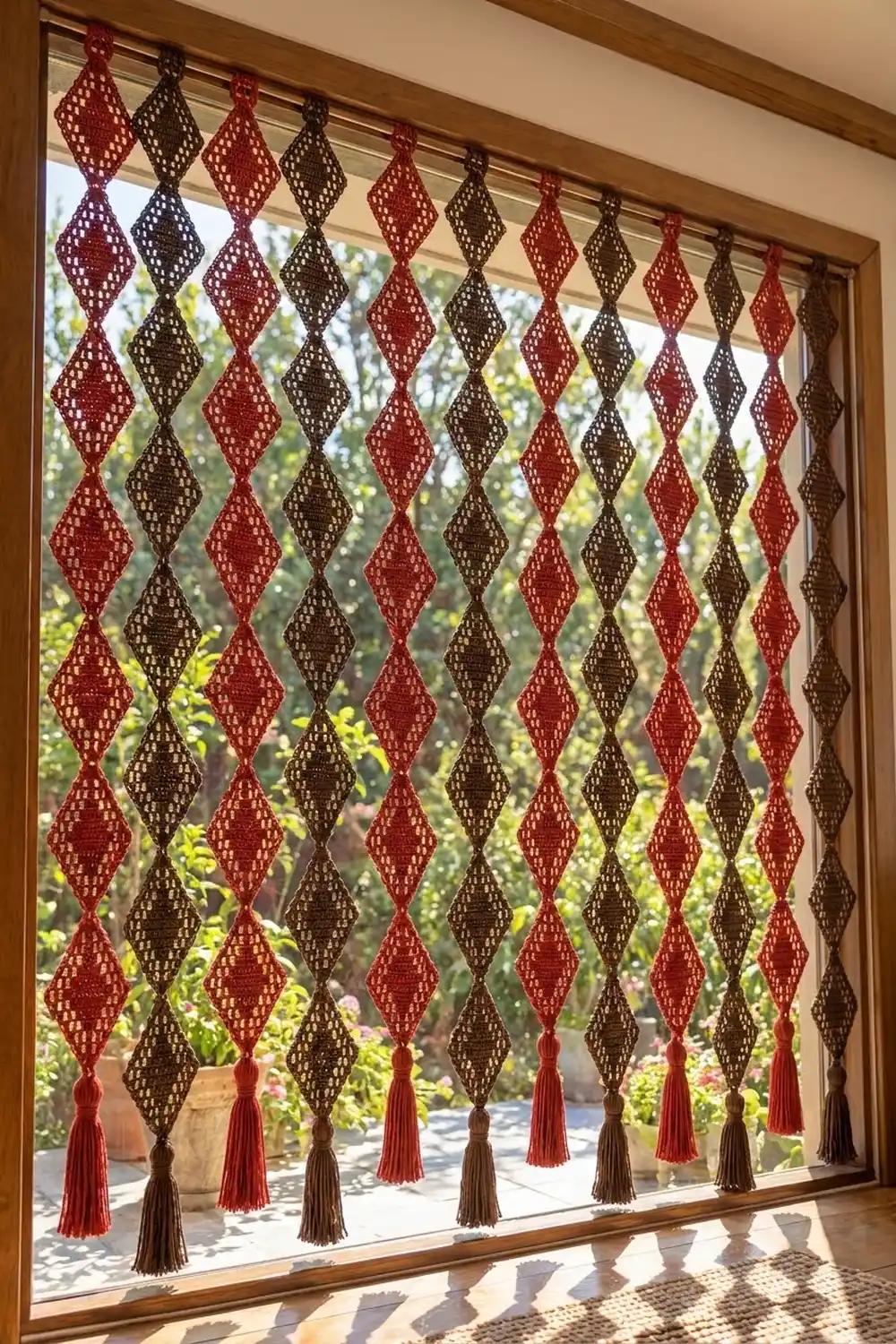
This curtain is made of long strands of filet crochet diamonds hung side by side in a window. Each diamond has an open mesh frame two squares deep around a solid diamond center. The diamonds join tip to tip into vertical strands, and each strand ends in a thick tassel.
The colors are warm brick red and chocolate brown. Each strand is one color, and the colors alternate across the window. Light shines through the mesh and the solid centers stay dark, so the window shows bold, graphic diamonds.
The pattern uses US crochet terms. One diamond measures 4.75 in x 5.65 in (12.1 cm x 14.4 cm) after edging. One strand is 48.85 in (124.1 cm) of joined diamonds, or about 55.1 in (140.0 cm) from the top of the hanging loop to the end of the tassel. Twelve strands spaced 5 in (12.7 cm) apart cover 59.75 in (151.8 cm).
You work each diamond in filet rows from the bottom tip to the top tip. Then you join nine diamonds tip to tip and work one sc border around the whole strand, adding the hanging loop and the tassel loop in that same round.
Finished Size and Construction
- Finished diamond: 4.75 in x 5.65 in (12.1 cm x 14.4 cm)
- Diamond before border: 4.5 in x 5.4 in (11.4 cm x 13.7 cm)
- Border depth: 0.125 in (0.3 cm) on every edge
- Strand body: 4.75 in x 48.85 in (12.1 cm x 124.1 cm)
- Strand before border: 4.5 in x 48.6 in (11.4 cm x 123.4 cm)
- Skill level: Intermediate
- Terminology: US
- Yarn weight: Sport (2) mercerized cotton
- Hook: 3.25 mm (US D-3)
- Number of pieces: 108 diamonds, joined into 12 strands
- Layout: 12 strands x 9 diamonds, with strand colors alternating
- Tassels: 12, each 5 in (12.7 cm) long
Materials
Use a smooth, mercerized sport-weight cotton of about 155 m per 50 g. Cotton keeps the mesh crisp and does not stretch much when it hangs. Avoid fuzzy or very stretchy yarns, which blur the squares and droop over time.
- Brick Red: 260 g / 800 m (6 strands and 6 tassels)
- Chocolate Brown: 260 g / 800 m (6 strands and 6 tassels)
One strand uses about 112 m: about 8 m per diamond, 26 m for the border, and 12 m for the tassel, plus a little for joining. These quantities include a margin of about 19% for gauge differences and swatching.
Tools:
– 3.25 mm (US D-3) hook
– Tapestry needle and scissors
– Stiff card 5.5 in (14.0 cm) tall, for the tassels
– Blocking mats, rust-proof pins, and a spray bottle
– Tape measure
– Curtain rod or tension rod up to 0.75 in (1.9 cm) in diameter
Abbreviations (US Terms)
- ch – chain
- sl st – slip stitch
- sc – single crochet
- dc – double crochet
- dtr – double treble crochet (yo 3 times, insert hook, pull up a loop, [yo, pull through 2 loops] 4 times)
- sp – space
- blk – block
- RS – right side
Special stitches (filet):
– sp: ch 2, skip the next 2 sts, dc in the next dc.
– blk: dc in each of the next 2 sts, dc in the next dc.
– inc-beg (adds 1 square at the start of a row): ch 7, turn, dc in the stitch at the base of the ch-7. The first 2 ch form the bottom bar of the new square, the next 3 ch form its outer side, and the last 2 ch form its top bar.
– inc-end (adds 1 square at the end of a row): ch 2, dtr in the same stitch as the last dc. The dtr is the outer side of the square. It leans outward until you block it.
– dec-beg (removes 1 square at the start of a row): turn, sl st in each of the next 3 sts, ch 5 (counts as dc + ch 2), skip 2 sts, dc in the next dc.
– dec-end (removes 1 square at the end of a row): stop after the dc that closes the second-to-last square, leaving the last square unworked.
A filet row with n squares has 3n + 1 stitches, counting every dc and every ch.
Gauge and Checkpoints
Gauge: 1 filet square = 0.5 in wide x 0.6 in tall (1.3 cm x 1.5 cm).
Make one complete diamond before the others, and measure it at these points:
- After Row 1: 0.5 in x 0.6 in (1.3 cm x 1.5 cm)
- After Row 3: 2.5 in wide x 1.8 in tall (6.4 cm x 4.6 cm)
- After Row 5: 4.5 in wide x 3.0 in tall (11.4 cm x 7.6 cm)
- After Row 9: 4.5 in x 5.4 in (11.4 cm x 13.7 cm), tip to tip
Too big? Go down 0.25 mm in hook size, or make your chains tighter. Loose ch-2 bars are the most common reason squares come out too wide.
Too small? Go up 0.25 mm in hook size. If only the height is short, pull up the first loop of each dc a little taller.
A strand has 81 rows, so even a small gauge error adds up to a big difference in length. Check the test diamond carefully.
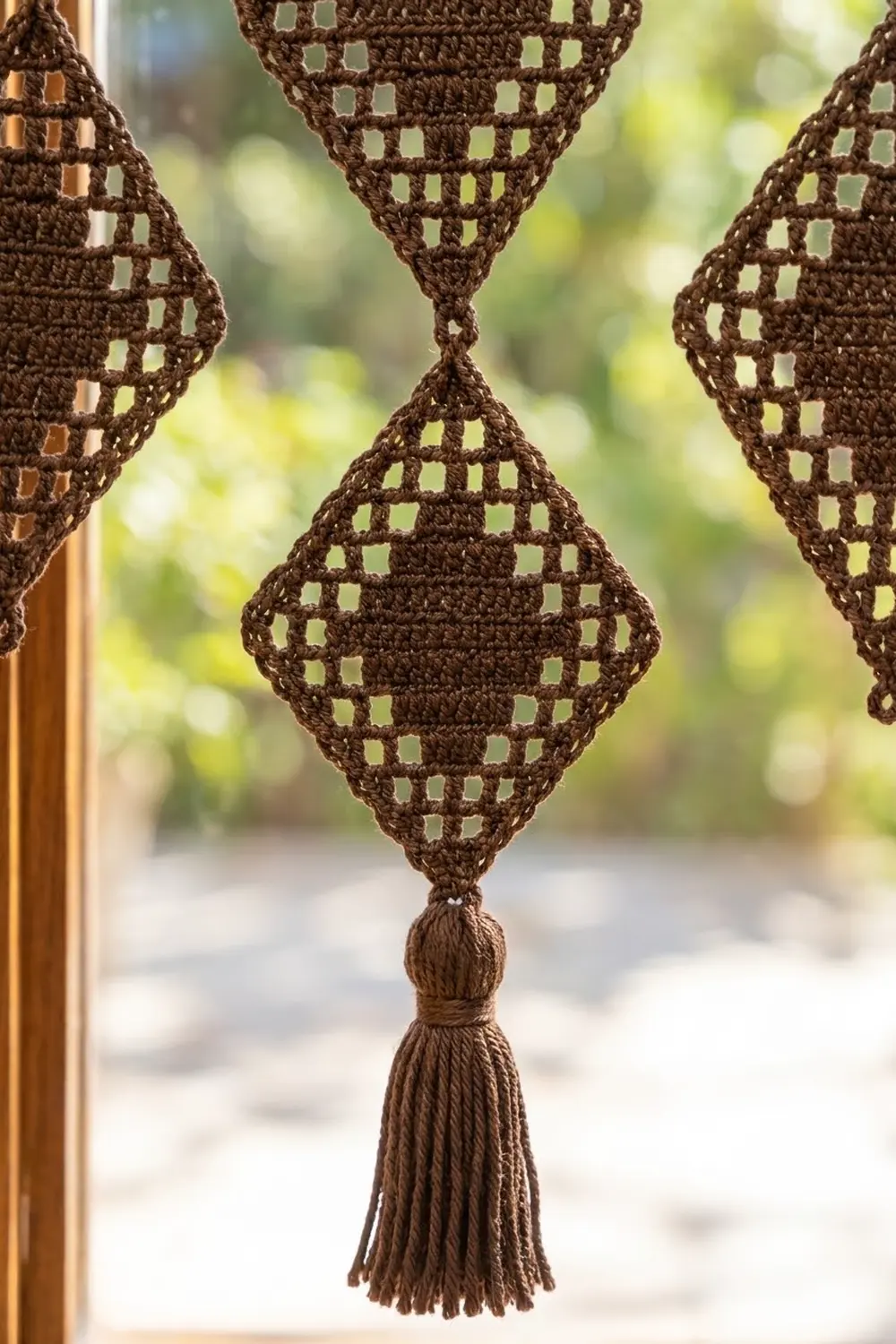
Diamond (make 108)
Work back and forth in rows. Every row begins and ends with a sp. The squares form an open frame two squares deep around a solid diamond of blocks.
Foundation and Row 1 (RS): Ch 8, dc in 8th ch from hook. Of the 7 skipped chains, 2 form the bottom bar, 3 form the outer side, and 2 form the top bar. (1 sp; 4 sts)
Row 2: Inc-beg, ch 2, skip next 2 ch, dc in next ch (the top corner of the Row 1 square), inc-end. (3 sp; 10 sts)
Row 3: Inc-beg, sp, blk, sp, inc-end. (sp, sp, blk, sp, sp: 5 squares; 16 sts)
Row 4: Inc-beg, sp, blk 3 times, sp, inc-end. (sp, sp, 3 blk, sp, sp: 7 squares; 22 sts)
Row 5: Inc-beg, sp, blk 5 times, sp, inc-end. (sp, sp, 5 blk, sp, sp: 9 squares; 28 sts)
From here on, work the last dc of each row into the top of the previous row’s edge stitch. That is either the dtr or the 5th ch of an inc-beg ch-7.
Row 6: Dec-beg, sp, blk 3 times, sp, sp, dec-end. (sp, sp, 3 blk, sp, sp: 7 squares; 22 sts) Where a sp sits over a blk, ch 2, skip the 2 dc, and dc in the next dc.
Row 7: Dec-beg, sp, blk, sp, sp, dec-end. (sp, sp, blk, sp, sp: 5 squares; 16 sts)
Row 8: Dec-beg, sp, sp, dec-end. (3 sp; 10 sts)
Row 9: Dec-beg, then stop. (1 sp; 4 sts) Fasten off and weave in the ends.
Square check: 1 + 3 + 5 + 7 + 9 + 7 + 5 + 3 + 1 = 41 squares. That is 13 blocks (1 + 3 + 5 + 3 + 1) and 28 spaces. The stitch counts follow 3n + 1 in every row: 4, 10, 16, 22, 28, 22, 16, 10, 4.
Make All Pieces
- Brick Red: 54 diamonds (6 strands x 9)
- Chocolate Brown: 54 diamonds (6 strands x 9)
Here is the layout as seen from the room (R = red, B = brown). Each column is one strand, from top to bottom:
Row 1:  R B R B R B R B R B R B
Row 2:  R B R B R B R B R B R B
Row 3:  R B R B R B R B R B R B
Row 4:  R B R B R B R B R B R B
Row 5:  R B R B R B R B R B R B
Row 6:  R B R B R B R B R B R B
Row 7:  R B R B R B R B R B R B
Row 8:  R B R B R B R B R B R B
Row 9:  R B R B R B R B R B R B
Tassel: R B R B R B R B R B R B
Joining
Join the 9 diamonds of each strand tip to tip. Keep RS facing and all Row 1 tips pointing down.
Method: With matching yarn, hold the lower diamond’s Row 9 top bar (the ch-2 of the final ch-5) against the upper diamond’s Row 1 bottom bar (foundation ch 2–3). Insert the hook through both bars and sl st. Ch 1, insert through both bars again, and sl st. Fasten off.
Stitch-to-stitch logic: Each join connects one ch-2 bar to one ch-2 bar. Both bars sit in the center of a single square, so the diamonds line up on one straight line.
Tension: Keep the join firm. A loose join lets the diamonds swing, and a tight one puckers the tips.
Checkpoint: The joins add no length. Three joined diamonds measure 16.2 in (41.1 cm), and a full strand of 9 measures 48.6 in (123.4 cm). Each strand has 8 joins, for 96 joins in total.
Border
Border gauge: 5 sc = 1 in (2.5 cm) along the edge.
Each row-end step rises 0.6 in and moves out 0.5 in, so it is about 0.78 in (2.0 cm) long on the diagonal. Four sc per step gives about 5 sc per inch, which matches the gauge, so the edge lies flat.
Counts per diamond, on each long side of the strand:
– Lower diagonal (steps of Rows 1–4): 4 sc per step = 16 sc
– Side point (Row 5 step): (2 sc, ch 2, 2 sc) = 4 sc + ch-2
– Upper diagonal (steps of Rows 6–9): 4 sc per step = 16 sc
– Total: 36 sc per diamond per long side. The side-point group is counted on its own and is not part of either 16-sc diagonal.
Border Round (RS): Join the strand color with sc in the Row 1 bottom bar of the lowest diamond. Ch 3 for the tassel loop, then sc in the same bar.
Work up the right side. For each diamond, work 16 sc, then (2 sc, ch 2, 2 sc) at the side point, then 16 sc. At each join, go straight on to the next diamond’s Row 1 step. Do not add any stitches at the joins.
In the top diamond’s Row 9 top bar, work (sc, ch 20, sc) for the hanging loop. Work down the left side the same way. Sl st to the first sc and fasten off.
Stitch count: 9 diamonds x 36 sc = 324 sc per long side. With the 2 sc at each tip, the total is 324 + 324 + 2 + 2 = 652 sc, plus the ch-3 loop, the ch-20 loop, and 18 ch-2 side points.
Why the math works: Each long side is 9 copies of the same 36-sc diamond side, and the joins add nothing. The border adds 0.125 in (0.3 cm) on every edge, which takes the strand from 4.5 in x 48.6 in to 4.75 in x 48.85 in (12.1 cm x 124.1 cm).
Tassel (make 12, one per strand in its color): Wrap yarn 40 times around the 5.5 in (14.0 cm) card. Thread a tie through the ch-3 loop and under the top of the wraps, then knot it tightly. Cut the wraps at the bottom. Wrap the neck 0.75 in (1.9 cm) below the top and knot it. Trim the tassel to 5 in (12.7 cm).
Final Blocking
- Soak each strand in cool water for 10 minutes, then roll it in a towel to press out the water.
- Lay it RS up on blocking mats.
- Pin the tips of each diamond on a straight center line, 5.65 in (14.4 cm) apart.
- Pin each pair of side points 4.75 in (12.1 cm) apart.
- Square up the leaning inc-end squares so each one measures 0.5 in x 0.6 in (1.3 cm x 1.5 cm).
- Check that the strand is 48.85 in (124.1 cm) long.
- Let it dry completely, then comb and trim the tassel.
Final Quality-Control Checklist
- [ ] Every diamond has 41 squares: 13 blocks and 28 spaces
- [ ] Each diamond measures 4.75 in x 5.65 in (12.1 cm x 14.4 cm)
- [ ] 8 firm joins per strand, all on the center line
- [ ] 36 sc per diamond on each side, 652 sc in total
- [ ] Hanging loop and tassel loop are secure
- [ ] Each strand is 48.85 in (124.1 cm), give or take 0.25 in (0.6 cm)
- [ ] Each tassel is 5 in (12.7 cm) long and matches its strand
- [ ] All ends are woven in
Troubleshooting
The diamond leans to one side. The inc-end dtr may be too short, or worked in the wrong stitch. Work it into the same stitch as the last dc, and pull up its loops taller.
The squares come out as rectangles. Adjust your dc height or the tightness of your ch-2 bars until you match the 0.5 in x 0.6 in gauge.
The border ruffles. Check that you have 4 sc per step and not 5, or use a hook 0.25 mm smaller for the border.
The border pulls tight. Use a hook 0.25 mm larger for the border, but keep 4 sc per step.
The strands are uneven in length. Count the rows in each diamond, then re-block any long strands.
The tassels look thin. Wrap the card 50 times instead of 40.
Care
Hand wash in cool water with mild soap, and dry flat pinned to size. Avoid bleach and long periods of strong direct sun so the brown doesn’t fade.
Final Notes
Every measurement depends on the one before it. A 0.5 in x 0.6 in (1.3 cm x 1.5 cm) square makes a 4.5 in x 5.4 in (11.4 cm x 13.7 cm) diamond. Nine joined diamonds make a 48.6 in (123.4 cm) strand. The 0.125 in (0.3 cm) border brings the strand to 4.75 in x 48.85 in (12.1 cm x 124.1 cm). Twelve strands spaced 5 in (12.7 cm) apart cover 59.75 in (151.8 cm). If the square is right, everything after it will be right too.
Happy crocheting!