

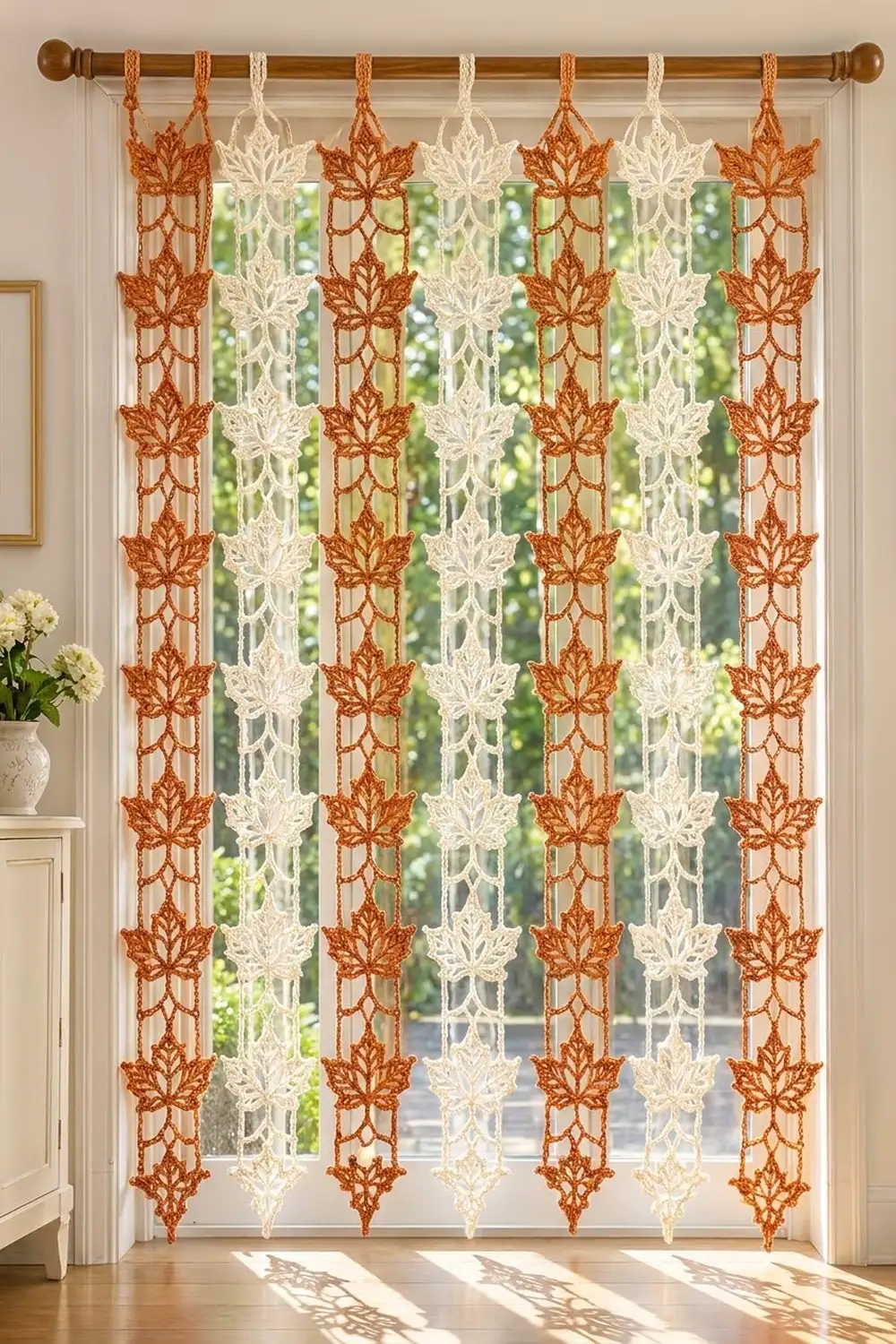
This curtain hangs from a rod like a lace door panel and is made of openwork maple leaves. It has seven vertical strips, and each strip is nine leaves joined end to end by thin chain bars. Four strips are burnt orange and three are cream. The colors alternate across the rod, and light shows through every leaf.
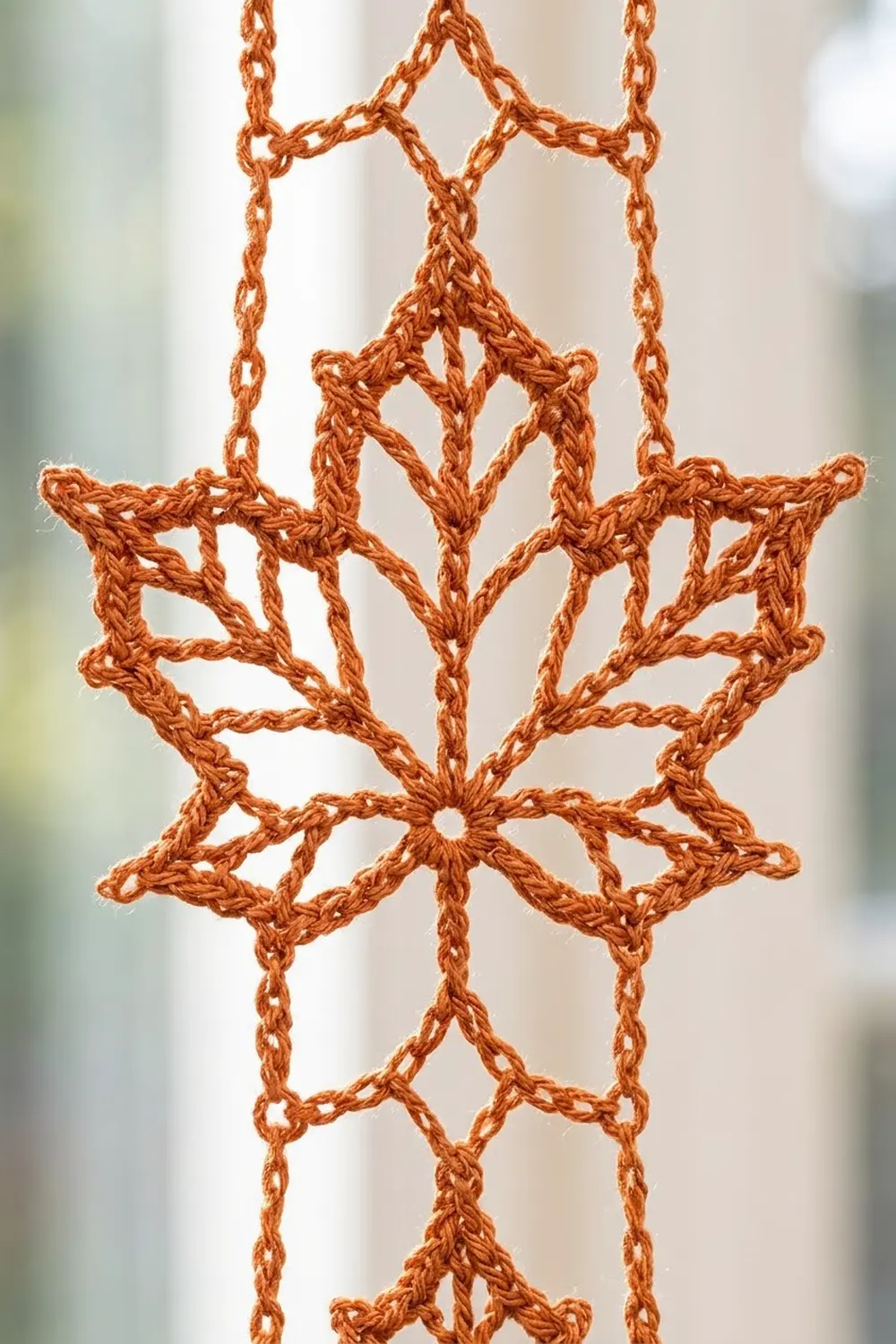
Each leaf is drawn in chain. A small center ring sends out five slip-stitch veins and a stem. Chain frames turn the veins into pointed lobes. A final round of single crochet adds tiny picot points along each lobe side.
The pattern uses US crochet terms. One leaf measures 4.5 in (11.4 cm) wide by 5 in (12.7 cm) tall. Each strip is 59 in (149.9 cm) long including its hanging loop. Seven strips hung 1 in (2.5 cm) apart fill 37.5 in (95.3 cm) of rod.
You crochet the first leaf of each strip on its own. Every later leaf joins to the one above it during its last round, using three doubled chain bars. Leaf 1 gets a hanging loop. The strips are never sewn to each other.
Finished Size and Construction
- Finished size: 37.5 in (95.3 cm) wide on the rod x 59 in (149.9 cm) long
- Skill level: Intermediate
- Terminology: US crochet terms
- Yarn weight: DK / light worsted (#3) cotton
- Hook: 3.5 mm (E-4)
- Number of pieces: 63 leaves (36 orange, 27 cream), joined into 7 strips of 9 leaves
- Layout: 7 separate strips side by side, colors alternating O-C-O-C-O-C-O
- Piece size: one leaf is 4.5 in (11.4 cm) wide x 5 in (12.7 cm) tall
- Size before border: after Round 3, one leaf is 4.3 in (10.9 cm) wide x 4.8 in (12.2 cm) tall
- Border depth: the Round 4 edging adds about 0.2 in (0.5 cm) all around; no extra border goes around the strips
- Leaf pitch: 6.5 in (16.5 cm) from one leaf’s top tip to the next leaf’s top tip
Materials
Use a smooth mercerized or combed cotton in DK weight. Cotton keeps the picot points crisp and stops the chain bars from stretching under their own weight. Fluffy yarns blur the veins, so avoid them.
- Color A, burnt orange: 200 g / 440 m (4 balls of 50 g / 110 m)
- Color B, cream: 150 g / 330 m (3 balls of 50 g / 110 m)
One leaf with its joining bars uses about 9 m of yarn. The quantities above include a margin of about 20% for the test leaf, tails, and hanging loops.
Tools:
- 3.5 mm (E-4) crochet hook
- Tapestry needle
- Scissors
- 2 stitch markers
- Rust-proof pins and foam blocking mats
- Spray bottle
- Measuring tape
- Curtain rod at least 40 in (101.6 cm) long and no more than 1.25 in (3.2 cm) in diameter
Abbreviations (US Terms)
- ch – chain
- sl st – slip stitch
- sc – single crochet
- sk – skip
- sp(s) – space(s)
- st(s) – stitch(es)
- rep – repeat
Special stitches:
- Picot: ch 3, sl st in 3rd ch from hook.
- Vein: ch 10, sl st in 2nd ch from hook and in each of next 8 ch (9 sl sts). The skipped ch is the vein tip.
- Stem: ch 11, sl st in 2nd ch from hook and in each of next 9 ch (10 sl sts). The skipped ch is the stem tip.
- Lobe frame: ch 9, sl st in the tip ch of the next vein, ch 3, sl st in the same tip ch, ch 9, sk next 2 sc of Round 2, sl st in next sc.
Gauge and Checkpoints
Gauge: 20 ch = 4 in (10.2 cm), measured with the chain lying relaxed.
Make one complete test leaf first. Chain lace is very sensitive to tension, and the joining bars only line up if every leaf matches.
Checkpoints:
- After Round 1: the ring is 1 in (2.5 cm) across.
- After Round 2: each vein is 1.8 in (4.6 cm) long. From the top vein tip to the stem tip, the leaf is 4.8 in (12.2 cm).
- After Round 3: the leaf is 4.3 in (10.9 cm) wide x 4.8 in (12.2 cm) tall.
- After Round 4: the leaf is 4.5 in (11.4 cm) wide x 5 in (12.7 cm) tall, pinned flat.
- After two leaves: from the top tip of Leaf 1 to the top tip of Leaf 2 is 6.5 in (16.5 cm).
Too big? Change to a 3.25 mm hook. Too small? Change to a 3.75 mm hook. Don’t change the chain counts. The bar lengths are calculated from the leaf size.
Leaf Pattern (Make 1 Test Leaf)
The leaf has six spokes around the center ring. Going clockwise from the top: Vein 1 (top, 12 o’clock), Vein 2 (upper right, 2 o’clock), Vein 3 (lower right, 4 o’clock), Stem (6 o’clock), Vein 5 (lower left, 8 o’clock), and Vein 6 (upper left, 10 o’clock).
Ring: Ch 6, sl st in first ch to form a ring.
Round 1: Ch 1, 18 sc in ring, sl st in first sc to join. (18 sc)
Round 2 (veins): Ch 1. Sc in next sc, make a Vein, sc in each of next 2 sc; rep from * 5 more times, making the Stem instead of a Vein on the 4th repeat. Sl st in first sc to join. (18 sc, 5 veins, 1 stem)
The Round 2 stitches form six groups of 3 sc. In each group, the vein grows from the first sc. The last sc of each group is the “base sc,” and it sits just before the next spoke.
Round 3 (lobe frames): Sl st in each of next 2 sc. You are now on the base sc between Vein 1 and Vein 2.
- Work a lobe frame over Vein 2.
- Work a lobe frame over Vein 3.
- Sl st in each of next 3 sc to pass the Stem without framing it.
- Work a lobe frame over Vein 5.
- Work a lobe frame over Vein 6.
- Work a lobe frame over Vein 1. Its last sl st lands in the base sc where the round started, which closes the round.
(5 lobe frames: 10 ch-9 sps and 5 ch-3 tip sps; the Stem stays bare)
Each frame runs from one base sc up to a vein tip and back down to the next base sc. Neighboring lobes meet at the ring, which makes the deep notches of a maple leaf.
Round 4 (edging): Start from the base sc where Round 3 ended. Edge each lobe frame like this:
- In the first ch-9 sp: 5 sc, picot, 5 sc.
- In the tip ch-3 sp: 2 sc, ch 3, 2 sc.
- In the second ch-9 sp: 5 sc, picot, 5 sc.
- Sl st in the base sl st.
Edge the lobes over Veins 2 and 3. Sl st in each of the next 3 sl sts beside the Stem. Then edge the lobes over Veins 5, 6, and 1. The last sl st closes the round.
(Per lobe: 24 sc, 2 picots, 1 ch-3 tip. Whole leaf: 120 sc, 10 picots, 5 ch-3 tips.)
Fasten off. Weave the ends along the veins so they’re hidden. The picots form each lobe’s side points, and the ch-3 forms its sharp tip.
Make All Pieces
Each strip is a single color.
- Color A (orange): 4 strips x 9 leaves = 36 leaves
- Color B (cream): 3 strips x 9 leaves = 27 leaves
- Total: 63 leaves
Layout from the front (O = orange leaf, C = cream leaf):
Strip:  1  2  3  4  5  6  7
Leaf 1  O  C  O  C  O  C  O   <- hanging loops
Leaf 2  O  C  O  C  O  C  O
Leaf 3  O  C  O  C  O  C  O
Leaf 4  O  C  O  C  O  C  O
Leaf 5  O  C  O  C  O  C  O
Leaf 6  O  C  O  C  O  C  O
Leaf 7  O  C  O  C  O  C  O
Leaf 8  O  C  O  C  O  C  O
Leaf 9  O  C  O  C  O  C  O
Make Leaf 1 of each strip like the test leaf and add its hanging loop (see Border and Edge Finish). Join Leaves 2 to 9 as you go.
Joining
Leaves are joined only within a strip. Each new leaf joins during its own Round 4, using three doubled chain bars.
Work Rounds 1 to 3 of the new leaf as usual. In Round 4, three tips are worked differently, and everything else stays the same.
Upper right tip (Vein 2): In the tip ch-3 sp: 2 sc, ch 20, sl st in the tip ch-3 sp of Vein 3 (lower right) on the previous leaf, ch 20, 2 sc in the same tip sp of the new leaf.
Upper left tip (Vein 6): In the tip ch-3 sp: 2 sc, ch 20, sl st in the tip ch-3 sp of Vein 5 (lower left) on the previous leaf, ch 20, 2 sc in the same tip sp.
Top tip (Vein 1): In the tip ch-3 sp: 2 sc, ch 8, sl st in the stem tip ch of the previous leaf, ch 8, 2 sc in the same tip sp.
The new leaf still has 120 sc and 10 picots. Three of its ch-3 tips are replaced by bars.
Why these bar lengths work: On each leaf, the lower lobe tips sit 1.25 in (3.2 cm) below the center, and the upper lobe tips sit 1.25 in (3.2 cm) above it. With a 6.5 in (16.5 cm) pitch, the side gap is 6.5 − 2.5 = 4 in (10.2 cm), which is exactly 20 ch at gauge. The stem tip and top tip each sit 2.5 in (6.4 cm) from the center, so the center gap is 6.5 − 5 = 1.5 in (3.8 cm). The 8 ch center bar measures 1.6 in (4.1 cm). That extra 0.1 in (0.3 cm) of slack keeps the stem from puckering.
Tension advice: Chain the bars at the same tension as your gauge chain. Tight bars cup the leaves, and loose bars let them twist. Keep the right sides of both leaves facing you when you join.
Size checkpoint: After three leaves, measure from the top tip of Leaf 1 to the top tip of Leaf 3. It should be 13 in (33.0 cm). A finished strip without its loop is 57 in (144.8 cm): 9 leaves x 5 in (12.7 cm) = 45 in (114.3 cm), plus 8 center bars x 1.5 in (3.8 cm) = 12 in (30.5 cm).
Border and Edge Finish
There is no separate border around the strips. Round 4 is the finished edge, and the hanging loops finish the top.
Border gauge: 10 sc in a ch-9 sp measure 2 in (5.1 cm). That matches the ch-9 sp plus its anchor stitch: 10 chain widths at 5 ch per inch.
Edging counts per lobe:
- Side 1: 10 sc + 1 picot
- Tip: 4 sc + 1 ch-3 point
- Side 2: 10 sc + 1 picot
- Lobe total: 24 sc, 2 picots, 1 tip
- Leaf total: 5 lobes x 24 sc = 120 sc
Why the math works: Each side of a lobe frame spans about 10 chain widths, and the 10 sc fill it one-for-one, so the edge lies flat without ruffling or cupping. The picot comes after 5 sc, which puts a side point halfway along each lobe. The tip has 2 sc on each side of its ch-3, so it stays sharp.
Hanging loop (Leaf 1 of each strip only): In Round 4, in the top tip sp (Vein 1), work 2 sc, ch 24, 2 sc. The loop measures about 4.8 in (12.2 cm) around. It fits over the rod and adds 2 in (5.1 cm) to the strip’s length, for a total of 57 + 2 = 59 in (149.9 cm).
Final Blocking
- Weave in all ends.
- Lay one strip flat, right side up, on the blocking mats.
- Set the length to 57 in (144.8 cm), from the top tip of Leaf 1 to the stem tip of Leaf 9.
- Pin each leaf to 4.5 in (11.4 cm) x 5 in (12.7 cm), with a pin in every lobe tip and every picot.
- Pin each center bar straight at 1.5 in (3.8 cm), and keep each pair of side bars parallel.
- Mist until the yarn is damp but not dripping.
- Let it dry fully, at least 12 hours.
- Repeat for all 7 strips.
Final Quality-Control Checklist
- 63 leaves in total: 36 orange and 27 cream
- Every leaf has 5 framed lobes, 1 bare stem, 10 picots, and 120 sc in Round 4
- Each strip has 9 leaves, 8 center bars, and 16 side bars
- Every center bar is ch 8 each way, and every side bar is ch 20 each way
- No twisted bars
- Each strip is 57 in (144.8 cm) without its loop and 59 in (149.9 cm) with it
- All 7 strips hang at the same length
- All ends are woven in and trimmed
Troubleshooting
Leaf cups. The Round 4 sc are too tight. Work exactly 10 sc per ch-9 sp and loosen your tension a little.
Lobes are wavy. The Round 3 frames are too loose. Go down half a hook size for Round 3 only.
Strip is too long. The bars are looser than your gauge chain. Remake them more snugly, or chain 1 fewer on each pass of the side bars.
Strip twists when hung. One leaf was joined while flipped. Undo its Round 4 and rejoin with both right sides facing you.
Stem pulls up. The center bar is too short. Add 1 ch to each pass.
Care
Hand wash in cool water with mild soap, roll in a towel to press out the water, and dry flat, pinned to shape. Don’t hang the curtain while it’s wet, because wet cotton stretches.
Final Notes
Every measurement in this curtain follows from the gauge. A gauge of 20 ch = 4 in (10.2 cm) gives a 4.5 in (11.4 cm) x 5 in (12.7 cm) leaf. One leaf plus a 1.5 in (3.8 cm) center bar gives a 6.5 in (16.5 cm) pitch. Nine leaves make a 57 in (144.8 cm) strip, and the loop brings it to 59 in (149.9 cm). Seven strips 1 in (2.5 cm) apart fill 37.5 in (95.3 cm) of rod.
Check your test leaf against the checkpoints, keep your chain tension even, and the leaves will line up from top to bottom.
Happy crocheting!