

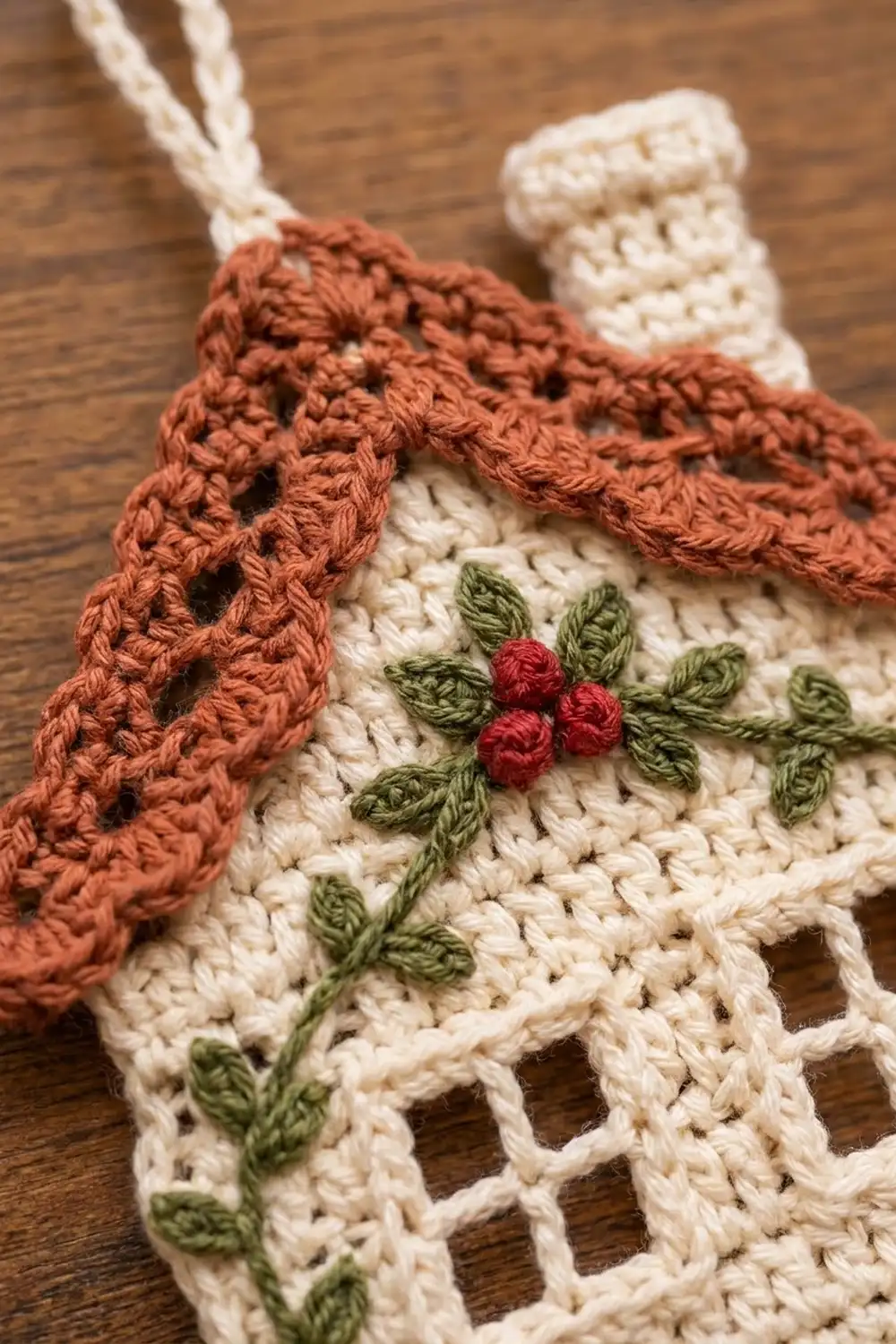
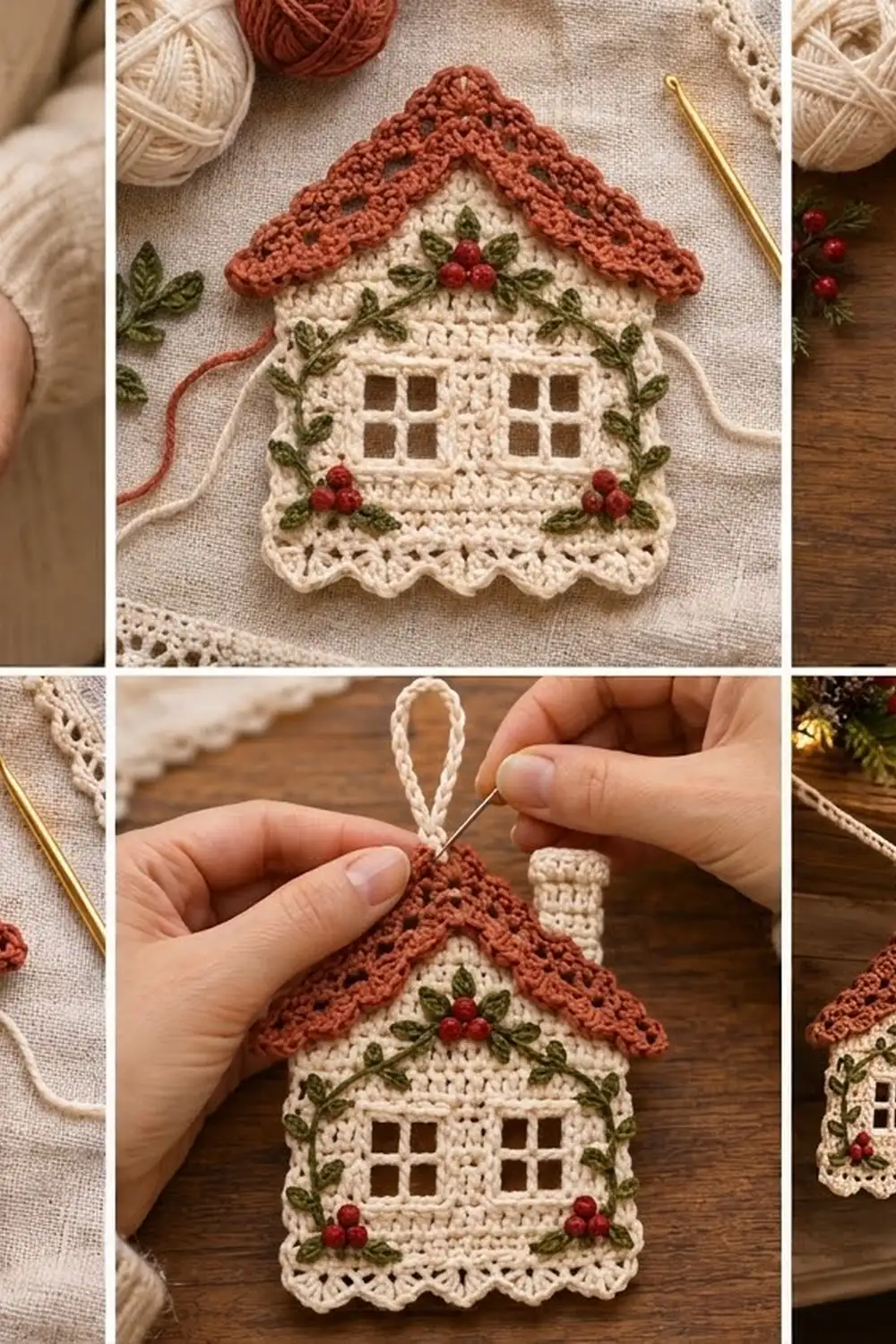
The Holly Cottage Ornament is a small cream house with a lacy rust roof, two open windows, and a scalloped hem. It is finished with a sage-green vine and clusters of red berries. It looks like a cottage from an old Christmas card, and it hangs nicely on a tree, a door knob, or a gift.
The palette has four colors: warm cream for the walls, chimney, and loop; rust/terracotta for the roof; sage green for the vines; and berry red for the holly. The style is soft and vintage, and the openwork gives it some light and texture.
This pattern uses US crochet terms. The finished ornament measures about 4.5 in (11.4 cm) wide at the walls, 5.5 in (14.0 cm) across the roof eaves, and 6.5 in (16.5 cm) tall without the loop. With the loop it is about 8.0 in (20.3 cm) tall.
You’ll work the body flat from the bottom up, putting the windows in as filet spaces, then decrease to form the gable. Next you’ll add a two-row border to the sides and bottom. The roof and chimney are worked separately and sewn on. The loop, berries, and embroidery come last.
Finished Size and Construction
- Finished size: 4.5 in (11.4 cm) wide at the walls × 6.5 in (16.5 cm) tall, plus a 1.5 in (3.8 cm) loop
- Skill level: Easy-Intermediate
- Terminology: US
- Yarn weight: DK / light (#3), cotton or cotton blend
- Hook: 3.5 mm (E-4)
- Number of pieces: 1 ornament (body, roof, chimney, cord loop, and 9 small berries, all sewn into one piece)
- Layout: a single ornament; no joining needed
- Body size before border: 4.2 in (10.7 cm) wide × 5.2 in (13.2 cm) tall
- Border depth: about 0.15 in (0.4 cm) on each side and 0.6 in (1.5 cm) along the bottom
- Roof depth: 1.0 in (2.5 cm)
Materials
Use a smooth mercerized or combed cotton in DK weight. It shows the filet windows clearly and blocks to crisp points. Acrylic will work, but the shells won’t hold their shape as well.
- Cream: 20 g, about 45 m (49 yd): body, border, chimney, and loop
- Rust/terracotta: 8 g, about 18 m (20 yd): roof
- Sage green: 4 g, about 9 m (10 yd): vines and leaves
- Berry red: 3 g, about 7 m (8 yd): berries
Tools: 3.5 mm (E-4) hook, tapestry needle, sharp embroidery needle, scissors, stitch markers, rust-proof pins, a blocking mat, and a spray bottle.
These quantities include a margin of roughly 25% for your swatch and the sewing tails.
Abbreviations (US Terms)
- ch – chain
- sl st – slip stitch
- sc – single crochet
- dc – double crochet
- sk – skip
- sp – space
- st(s) – stitch(es)
- FLO – front loop only
- RS – right side
Special stitches:
– dc3tog (double crochet 3 together): [Yarn over, insert in next st, pull up a loop, yarn over, pull through 2 loops] 3 times, yarn over, pull through all 4 loops on hook. This decreases 3 sts to 1.
– dc5tog: Work as dc3tog, but over 5 sts, then pull through all 6 loops.
– Shell: 5 dc in the same st.
Gauge and Checkpoints
- dc gauge: 20 sts × 10 rows = 4 in (10.2 cm), so 1 dc row = 0.4 in (1.0 cm)
- sc gauge: 20 sts × 24 rows = 4 in (10.2 cm)
Before you start, make the body up to Row 3 as a test and measure it.
- After Row 3: 4.2 in (10.7 cm) wide × 1.2 in (3.0 cm) tall
- After Row 8: 4.2 in (10.7 cm) × 3.2 in (8.1 cm)
- After Row 13: 5.2 in (13.2 cm) tall at the peak
- Roof after Row 1: each half measures 3.4 in (8.6 cm) along the foundation
- Chimney: 1.0 in (2.5 cm) × 1.5 in (3.8 cm)
If your piece is too big, go down half a hook size. If it’s too small, go up half a size. Only change the hook; keep the stitch counts as written so the roof still fits the gable.
Body (Cream)
The body is worked in turned rows. The ch-3 at the start of a row counts as a dc. The ch-2 at the start of a decrease row does not count.
Row 1: Ch 23. Dc in the 4th ch from hook (the 3 skipped ch count as the first dc) and in each ch across. Turn. (21 sts)
Row 2: Ch 3, dc in each st across. Turn. (21 sts)
Row 3: Repeat Row 2. (21 sts). Measure: 4.2 in (10.7 cm) wide.
Row 4 (windows): Ch 3, dc in next 2 sts, ch 2, sk 2, dc in next st, ch 2, sk 2, dc in next 5 sts, ch 2, sk 2, dc in next st, ch 2, sk 2, dc in last 3 sts. Turn. (13 dc and 4 ch-2 sps; 21 positions)
Check: 3 + 2 + 1 + 2 + 5 + 2 + 1 + 2 + 3 = 21. Each window is one dc divider between two 2-st panes.
Row 5: Ch 3, dc in next 2 dc, ch 2, dc in next dc, ch 2, dc in next 5 dc, ch 2, dc in next dc, ch 2, dc in last 3 sts. Turn. (13 dc and 4 ch-2 sps)
The ch-2 from Row 4 now forms the horizontal bar in the middle of each window, giving 2 × 2 panes.
Row 6 (closing row): Ch 3, dc in each dc and 2 dc in each ch-2 sp across. Turn. (13 dc worked into dc + 8 dc worked into spaces = 21 sts)
Rows 7–8: Repeat Row 2. (21 sts). Measure: 4.2 in (10.7 cm) × 3.2 in (8.1 cm).
Gable:
Row 9: Ch 2 (does not count), dc3tog over the first 3 sts, dc in each st to the last 3 sts, dc3tog over the last 3. Turn. (1 + 15 + 1 = 17 sts)
Row 10: Repeat Row 9. (1 + 11 + 1 = 13 sts)
Row 11: Repeat Row 9. (1 + 7 + 1 = 9 sts)
Row 12: Repeat Row 9. (1 + 3 + 1 = 5 sts)
Row 13: Ch 2, dc5tog. (1 st). Fasten off.
Each gable row removes 2 sts from each side, which is 0.4 in (1.0 cm) wide, over a row that is 0.4 in (1.0 cm) tall. That gives a clean 45° slope about 2.9 in (7.4 cm) long on each side.
Roof (Rust)
Row 1: Ch 36. Sc in the 2nd ch from hook and in the next 16 ch, 3 sc in the next ch (the peak), sc in the last 17 ch. Turn. (17 + 3 + 17 = 37 sc)
Row 2 (eyelets): Ch 4 (counts as dc + ch 1), sk next sc, dc in next sc. Repeat [ch 1, sk 1, dc in next] until you reach the center peak sc. In the center sc, work (dc, ch 2, dc). Then repeat [ch 1, sk 1, dc in next] to the end. Turn.
(20 dc, 18 ch-1 sps, 1 ch-2 peak sp; each half has 10 dc and 9 ch-1 sps)
Row 3 (shell edge): Ch 1, sc in the first dc. Then work [shell in the next dc, sc in the following dc] 4 times, skipping the ch-1 sps. In the peak ch-2 sp, work (3 dc, ch 2, 3 dc), skipping the last dc before and the first dc after the sp. On the second half, work [sc in the next dc, shell in the following dc] 4 times, then sc in the 3rd ch of the turning ch. Fasten off and leave a 12 in (30.5 cm) tail.
(Each half has 5 sc and 4 shells; 10 sc, 46 dc, and 1 ch-2 sp in total)
Each roof half is 3.4 in (8.6 cm) long against a 2.9 in (7.4 cm) gable slope. The extra 0.5 in (1.3 cm) makes the eave overhang.
Chimney (Cream)
Row 1: Ch 6, sc in the 2nd ch from hook and in each ch across. Turn. (5 sc)
Rows 2–8: Ch 1, sc in each st. Turn. (5 sc)
Row 9 (cap): Ch 1, work in FLO: 2 sc in the first st, sc in the next 3, 2 sc in the last. (7 sc). Fasten off and leave a tail.
Hanging Loop (Cream)
Ch 25, then sl st in the 2nd ch from hook and in each ch across. (24 sl sts). This makes a cord about 3.5 in (8.9 cm) long. Fold it in half and leave both tails.
Berries (Red, make 9)
Make a magic ring, ch 1, and work 6 sc into the ring. Sl st to the first sc and fasten off. Pull the ring closed, then thread the tail through the 6 top loops and cinch them so the berry rounds into a ball. Each berry is about 0.25 in (0.6 cm) across.
Border (Cream)
Border gauge: 2 sc per dc row-end, and 1 sc in the base of each foundation st.
Row 1: With the RS facing, join cream with a sc at the top of the right wall edge (the end of Row 8). Work 15 more sc down the side. (16 sc on the right side)
Along the bottom, work 3 sc in the base of the first st, 1 sc in the base of each of the next 19 sts, and 3 sc in the base of the last st. (3 + 19 + 3 = 25 sc; the bottom count includes both corner groups)
Work 16 sc up the left side to the top of Row 8. Fasten off. (16 + 25 + 16 = 57 sc)
Row 2 (scallops, bottom only): Join with a sl st in the center sc of the bottom-right corner. Ch 1, sc in the same st. Work [sk 1, shell in next, sk 1, sc in next] 6 times. The last sc lands in the center sc of the opposite corner. Fasten off.
(7 sc + 6 shells/30 dc)
Why the math works: At 5 sc per inch, 16 sc cover 3.2 in (8.1 cm), which is exactly the height of 8 dc rows, so the sides lie flat. The scallop repeat needs a multiple of 4 plus 1, and 25 = (4 × 6) + 1, so you get 6 even scallops that start and end on the corners. The body ends up 4.5 in (11.4 cm) wide and 5.8 in (14.7 cm) tall.
Assembly and Embroidery
- Chimney: Pin it onto the right gable slope about 0.75 in (1.9 cm) in from the right eave. Its lower edge should sit 0.5 in (1.3 cm) below the slope. Whipstitch it in place.
- Roof: Center the roof’s peak over the body’s peak. Lay the foundation edge 0.25 in (0.6 cm) inside each gable edge so it covers the base of the chimney. Each eave should overhang the wall by about 0.5 in (1.3 cm). Whipstitch through the foundation loops.
- Loop: Sew both cord ends to the back of the roof peak so a 1.5 in (3.8 cm) loop stands above it.
- Vine: Thread an 18 in (45.7 cm) strand of green. Using chain-stitch embroidery, start 0.4 in (1.0 cm) above the left scallops. Run the vine up the left wall, arch it over the windows to the center of the gable around Row 11, and mirror it down the right side.
- Leaves: Work 6 lazy-daisy leaves along each half of the vine, alternating sides. Add 4 leaves around the top center point and 2 at each lower end. (20 leaves)
- Berries: Sew a cluster of 3 berries at the top center and another cluster at each lower end of the vine. (9 berries)
Final Blocking
- Weave in all the ends except the sewing tails you’ve already used.
- Spray the ornament until it is evenly damp.
- Pin it to 4.5 in (11.4 cm) wide at the walls and 6.5 in (16.5 cm) tall.
- Square the windows by pinning through the corners of the panes.
- Pin each roof shell and each hem scallop to a rounded point.
- Pin the roof peak and both eaves so the slopes are symmetrical, about 5.5 in (14.0 cm) across.
- Leave it to dry completely, then unpin.
Final Quality-Control Checklist
- The walls measure 4.5 in (11.4 cm) and the overall height is 6.5 in (16.5 cm).
- Both windows are fully open with 2 × 2 panes.
- There are 6 even scallops at the hem.
- Each half of the roof has 4 shells, and the peak shell is centered.
- The eaves overhang evenly on both sides.
- The chimney stands straight above the right slope.
- There are 20 leaves and 9 berries, and the arch is symmetrical.
- The loop is secure and centered.
Troubleshooting
- The windows look slanted: You probably worked into a chain instead of the dc after a ch-2. Check the positions against the Row 4 count.
- The gable leans to one side: Make sure both dc3togs in each gable row use exactly 3 sts.
- The hem ruffles: You may have worked extra sc on the bottom. Recount to 25.
- The roof is too short for the gable: Your sc gauge is tight. Remake the roof with a hook half a size larger.
- The sides are wavy: Use exactly 2 sc per row-end.
- The berries are floppy: Cinch the top loops tighter before sewing.
Care
Hand-wash in cool water, press out the water in a towel, and reshape and pin it flat to dry. Store it flat so the roof shells keep their shape.
Final Notes
Everything in this pattern rests on the gauge. Twenty-one dc at 5 sts per inch make a 4.2 in (10.7 cm) wall. Eight rows bring it to 3.2 in (8.1 cm), and the gable brings it to 5.2 in (13.2 cm). The border makes it 4.5 in (11.4 cm) wide and 5.8 in (14.7 cm) tall, and the roof brings the full height to 6.5 in (16.5 cm). If you check each step as you go, your cottage should finish to the right size.
Happy crocheting!