

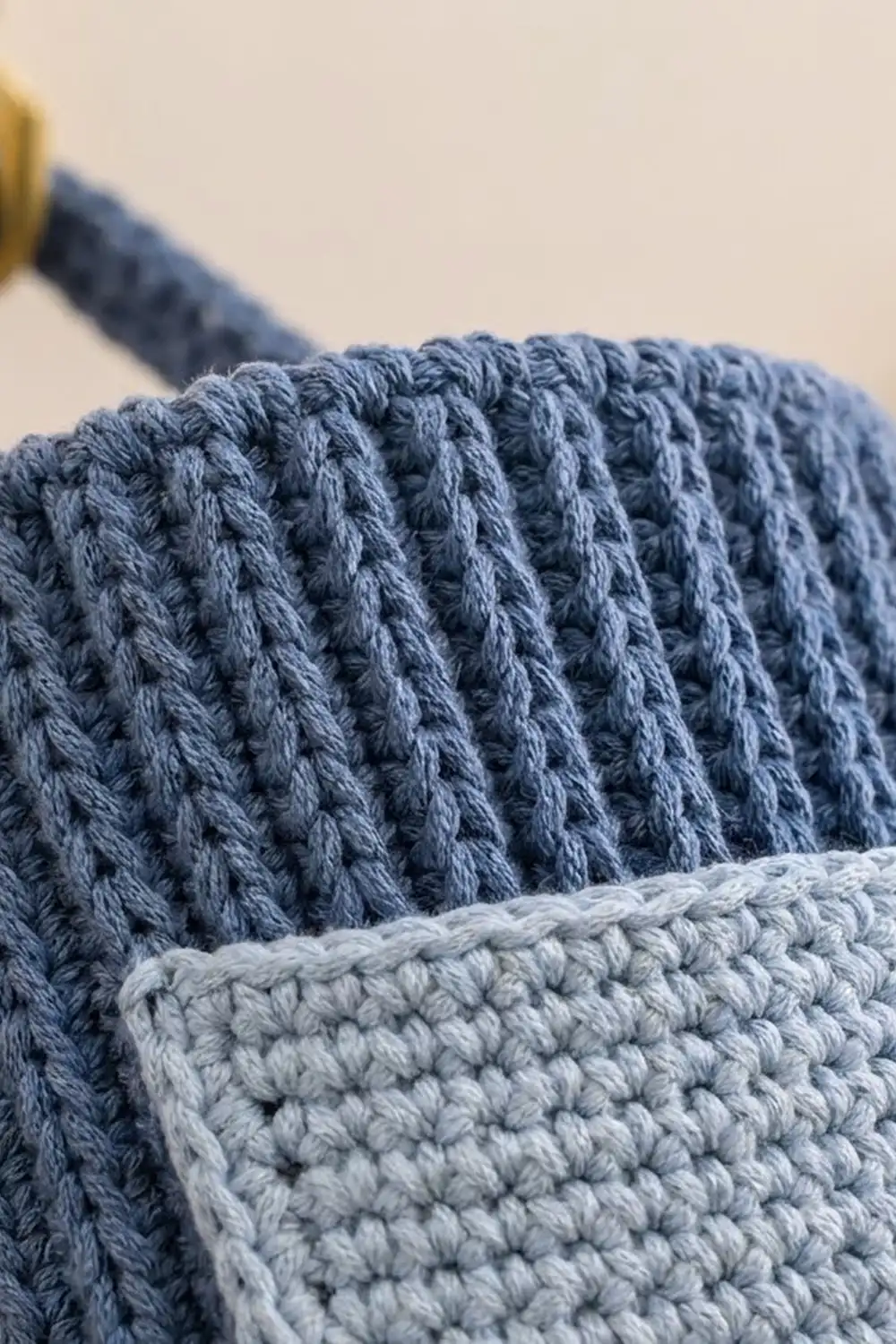
The Hydrangea Bedside Hanging Basket is a soft, sturdy caddy that hangs from a wall hook or a bedpost. It keeps your phone, glasses, and evening book within easy reach. The deep body has vertical knit-look ribs, and a contrast pocket on the front holds the small things.
The colors are calm and coordinated. The body and strap are worked in denim blue, and the pocket is a pale sky blue. The ribbed texture comes from the waistcoat stitch, a single crochet variation that looks like knitting but is worked with an ordinary hook.
This pattern uses US crochet terms. The finished basket measures about 8.3 in (21.1 cm) wide when flattened and 9 in (22.9 cm) tall. The strap loop rises about 5.5 in (14.0 cm) above the rim.
You start with an oval base worked in joined rounds. A back-loop round turns the base edge up into a crisp fold. The walls are worked straight up in waistcoat stitch, and two plain rounds finish the rim. Then you work a flat strap and a shaped pocket separately and sew both to the body.
Finished Size and Construction
- Finished size (flattened): 8.3 in wide × 9 in tall (21.1 × 22.9 cm)
- Total hanging height including strap: about 14.5 in (36.8 cm)
- Skill level: Easy-intermediate
- Terminology: US
- Yarn weight: Bulky (#5) cotton or cotton blend
- Hook: 6.0 mm (J-10)
- Number of pieces: 3 (body with base, strap, pocket)
- Layout: Pocket centered on the lower front; strap ends sewn inside the rim at the two side folds
- Pocket size: 6 in × 3.7 in (15.2 × 9.4 cm)
- Body size before rim: 8.3 in wide × 8.3 in tall (21.1 × 21.1 cm)
- Rim (border) depth: 2 rounds, about 0.6 in (1.5 cm); pocket edging is 1 round, about 0.3 in (0.8 cm)
Materials
Choose a firm bulky cotton or cotton blend of about 150 m per 100 g. Cotton holds the basket’s shape and shows the ribs clearly. Soft acrylic will work, but the basket will slump unless you work tightly.
- Denim blue (body and strap): 160 g / 240 m
- Light blue (pocket): 20 g / 30 m
Quantities include a margin of about 15 percent for your gauge swatch and seaming.
Tools:
– 6.0 mm (J-10) crochet hook
– Locking stitch markers (4)
– Tapestry needle
– Scissors
– Measuring tape
– Rust-proof pins and a blocking surface
Abbreviations (US Terms)
- ch: chain
- sc: single crochet
- sl st: slip stitch
- BLO: back loop only
- inc: 2 sc in the same stitch
- st(s): stitch(es)
- rnd(s): round(s)
- ws: waistcoat stitch
Waistcoat stitch (ws): Insert the hook through the center of the V of the stitch below, between its two vertical legs, so that it comes out the back of the fabric under the top loops. Yarn over, pull up a loop, yarn over, and pull through both loops on the hook. Each ws sits directly over the one below, which builds the vertical ribs.
Gauge and Checkpoints
Gauge: 12 sts and 13 rnds = 4 in (10.2 cm) in sc or ws, worked in the round.
Before starting the full body, test the gauge by working the base and the first 10 wall rounds. The base is part of the body, so nothing is wasted if the gauge matches.
Checkpoints:
– After Rnd 5 (base): about 6.5 in × 3.25 in (16.5 × 8.3 cm), 50 sts.
– After Rnd 15: walls measure 3.1 in (7.9 cm) from the base fold.
– After Rnd 32: walls measure 8.3 in (21.1 cm), and the flattened width is 8.3 in (21.1 cm).
– Pocket after Row 10: 5.3 in wide × 3.1 in tall (13.5 × 7.9 cm).
If your piece is too big, go down one hook size. If it is too small, go up one hook size. The waistcoat stitch tightens easily, so pull each loop up to the height of the hook shaft. Keep the stitch counts as written and change only the hook.
Body
Oval Base
With denim blue, ch 13.
Rnd 1: 3 sc in the 2nd ch from hook, sc in next 10 ch, 3 sc in last ch. Rotate the work and, along the opposite side of the foundation ch, sc in next 10 ch. Join with sl st to the first sc. (26 sts)
Rnd 2: Ch 1 (does not count as a stitch here or in later rounds). [Inc] 3 times, sc in next 10, [inc] 3 times, sc in next 10. Join. (32 sts)
Rnd 3: Ch 1, [sc in next st, inc] 3 times, sc in next 10, [sc in next st, inc] 3 times, sc in next 10. Join. (38 sts)
Rnd 4: Ch 1, [sc in next 2, inc] 3 times, sc in next 10, [sc in next 2, inc] 3 times, sc in next 10. Join. (44 sts)
Rnd 5: Ch 1, [sc in next 3, inc] 3 times, sc in next 10, [sc in next 3, inc] 3 times, sc in next 10. Join. (50 sts)
The base should lie flat. If it cups, your gauge is tight; if it ruffles, it is loose.
Walls
Rnd 6 (fold round): Ch 1, sc BLO in each st around. Join. (50 sts)
The unworked front loops form a crisp ridge, and the fabric begins to turn upward.
Rnd 7: Ch 1, ws in each st around. Join. (50 sts)
Rnds 8–32: Repeat Rnd 7. (50 sts per round)
You have now worked 27 wall rounds (Rnds 6–32). Joining every round with a sl st and ch 1 keeps the ribs vertical instead of letting them lean the way a spiral would. Check the second gauge checkpoint after Rnd 15 and the third after Rnd 32.
Do not fasten off. The rim is worked next, in the Border section.
Strap
With denim blue, ch 49.
Row 1: Sc in the 2nd ch from hook and in each ch across. Turn. (48 sts)
Rows 2–4: Ch 1, sc in each st across. Turn. (48 sts per row)
Fasten off, leaving a 16 in (40.6 cm) tail for sewing. The strap measures 16 in × 1.2 in (40.6 × 3.0 cm).
The rounded bottom corners are shaped by increasing in the first rows.
With light blue, ch 13.
Row 1: Sc in the 2nd ch from hook and in each ch across. Turn. (12 sts)
Row 2: Ch 1, inc in first st, sc in next 10, inc in last st. Turn. (14 sts)
Row 3: Ch 1, inc in first st, sc in next 12, inc in last st. Turn. (16 sts)
Rows 4–10: Ch 1, sc in each st across. Turn. (16 sts per row)
Do not fasten off. Before the border, the pocket measures 5.3 in wide × 3.1 in tall (13.5 × 7.9 cm).
Make All Pieces
| Piece | Color | Quantity |
|---|---|---|
| Body with base | Denim blue | 1 |
| Strap | Denim blue | 1 |
| Light blue | 1 |
Front-view layout:
      /‾‾‾‾‾ strap ‾‾‾‾‾\
     |                   |
  [ rim  Rnds 33–34       ]
  [ ribs  ribs  ribs      ]
  [   [  light blue   ]   ]
  [   [    pocket     ]   ]
  [ ribs  ribs  ribs      ]
  [_____ base fold _______]
Joining
Finding the sides: Flatten the body so that the two 10-stitch straight sections of the base lie front and back. The two folds at the left and right edges are the sides. Mark the rim stitch at each fold.
Strap: Place 1 in (2.5 cm) of each strap end inside the rim at a marked side fold, with the strap lying flat against the inside wall. Using the strap tail and the denim blue yarn, whipstitch around all four edges of each overlap through Rnds 32–34. Work each stitch through one full stitch of the body, then through the strap edge. Make sure the strap is not twisted. The visible loop is 14 in (35.6 cm) long.
Pocket: Center the bordered pocket on the front. Its bottom edge should sit on Rnd 10, about 1.2 in (3.0 cm) above the base fold, and its top edge reaches about Rnd 21. The pocket covers about 18 of the 25 front ribs, leaving 3 or 4 ribs free on each side. Pin it in place.
With light blue, whipstitch through the outer loop of each border stitch and the ws directly beneath it. Sew the left side, the bottom, and the right side, and leave the top open. That is 34 border stitches sewn: 10 + 14 + 10.
Tension: Pull each stitch just snug. If you pull too hard, the ribs pucker and the pocket wrinkles. After sewing, lay the basket flat. It should still measure 8.3 in (21.1 cm) wide.
Border
The border has two parts: the body rim and the pocket edging. Both use the main gauge of 3 sc per inch (2.5 cm).
Body Rim
Rnd 33: Ch 1, sc in both loops of each st around. Join. (50 sts: 25 front + 25 back)
Rnd 34: Ch 1, sc in each st around. Join. (50 sts: 25 front + 25 back)
Fasten off and weave in the end.
Why the math works: The base finishes with 50 stitches, and every wall and rim round keeps exactly 50. With no increases or decreases, the walls rise straight. Flattened, each side has 25 stitches at 3 stitches per inch, which gives 8.3 in (21.1 cm), the stated finished width. The plain sc rounds stop the ribs from flaring and firm up the edge where the strap is anchored.
Pocket Edging
Continue from the end of Row 10. Ch 1, then work one round as follows:
- Top: 3 sc in the first st, sc in next 14, 3 sc in the last st. (20 sts)
- First side: Sc in each of the 10 row ends. (10 sts)
- Bottom: Working along the foundation ch, 2 sc in the first ch, sc in next 10, 2 sc in the last ch. (14 sts)
- Second side: Sc in each of the 10 row ends. (10 sts)
Join with sl st to the first sc. (54 sts)
Fasten off, leaving a 30 in (76.2 cm) tail for sewing.
Why the math works: The top row has 16 stitches. Adding 2 extra stitches at each top corner (3 sc in one stitch instead of 1) gives 16 + 4 = 20. The bottom has 12 foundation chains plus 1 extra stitch at each softly curved corner, so 12 + 2 = 14. Each side gets one sc per row end, 10 per side. The total is 20 + 10 + 14 + 10 = 54. The edging adds about 0.3 in (0.8 cm) on every side, which brings the pocket to 6 in × 3.7 in (15.2 × 9.4 cm).
Final Blocking
- Weave in all ends securely, tracing the path of the stitches.
- Mist the whole basket lightly with water until it is damp, not soaked.
- Stuff the body with a rolled towel to fill it into a smooth cylinder.
- Pat the base flat and press the fold ridge into a sharp edge.
- Smooth the ribs so that they run straight up from the base.
- Smooth the pocket flat against the body and round the bottom corners with your fingertips.
- Lay the strap flat and pin it straight.
- Let it dry completely, then remove the towel.
Final Quality-Control Checklist
- The base has 50 stitches and lies flat.
- The base fold is crisp all the way around.
- The ribs run vertically and do not lean.
- The walls measure 8.3 in (21.1 cm) before the rim.
- The flattened width is 8.3 in (21.1 cm).
- The total height is 9 in (22.9 cm).
- The rim has 50 stitches and does not flare.
- The pocket edging has 54 stitches, with rounded bottom corners.
- The pocket is centered, sits on Rnd 10, and is open at the top.
- Both strap ends are sewn 1 in (2.5 cm) inside the rim at the side folds, and the strap is not twisted.
- No yarn ends are visible.
Troubleshooting
The ribs lean diagonally. You are probably working in a spiral. Join every round with a sl st and ch 1.
The waistcoat stitch is too hard to insert the hook into. Your loops are too tight. Pull each loop up taller, or use a hook 0.5 mm larger for the wall rounds only.
The base cups or ruffles. Check that you have 50 stitches after Rnd 5, then adjust your hook size.
The basket flares at the top. You have extra stitches. Count each round and bring it back to 50.
The pocket puckers. It was sewn too tightly. Remove the seam and resew it with gentler tension.
The strap stretches. Sew the overlap through all three rim rounds. You can also add a fifth row of sc to the strap for extra firmness.
Care
Hand wash in cool water with mild soap, press out the water in a towel, and reshape. Dry flat over a rolled towel.

Final Notes
The measurements build on each other. The 50-stitch base sets a flattened width of 8.3 in (21.1 cm). Twenty-seven wall rounds give 8.3 in (21.1 cm) of height, and the 2-round rim brings the total to 9 in (22.9 cm). The 16-stitch pocket grows to 6 in × 3.7 in (15.2 × 9.4 cm) with its 54-stitch edging and fits neatly across the front. The 16 in (40.6 cm) strap leaves a 14 in (35.6 cm) loop for hanging. If you hit each checkpoint, the finished basket will match.
Happy crocheting!