

The Ivory Bloom holder is a four-tier hanging organizer that keeps spare toilet rolls tidy and within reach. Each basket has a solid round base, a square lace mesh wall, a lace flower on the front and a firm rolled rim. Short ringed straps connect the baskets, and the whole column hangs from a single hook.
The holder uses one color, a soft cream or ivory, so the texture does most of the work. The solid bands frame the open mesh, and the flower stands out clearly against the grid. The style is calm and classic and suits a bathroom with natural textiles and light walls.
This pattern uses US crochet terms. Each basket measures 5¼ in (13.3 cm) across and about 4.6 in (11.7 cm) tall. Hung on the wall, the finished holder is about 32 in (81.3 cm) long.
Each basket is worked from the bottom up in one piece. You start with a flat circle, turn the wall up with a back-loop round, and work a solid band, a mesh band, another solid band and a crab-stitch rim. Then you make and sew on a flower, make four straps and two bail cords, and assemble everything.
Finished Size and Construction
- Finished size (hanging): about 32 in (81.3 cm) long × 5¼ in (13.3 cm) wide
- Skill level: Intermediate
- Terminology: US
- Yarn weight: Worsted (#4) cotton
- Hook: 4.5 mm (US 7)
- Number of pieces: 14 (4 baskets, 4 flowers, 4 straps, 2 bail cords)
- Layout: 1 column of 4 baskets, 2 in (5.1 cm) apart
- Piece size: each basket is 5¼ in (13.3 cm) across × 4.6 in (11.7 cm) tall
- Size before border: each basket wall is 4.4 in (11.2 cm) tall
- Border depth: 0.2 in (0.5 cm) crab-stitch rim
Materials
Yarn: Use a smooth worsted-weight cotton or cotton blend. Cotton holds the cylinder shape and stretches less than acrylic under the weight of the rolls. The quantities below assume about 170 m per 100 g (186 yd per 3.5 oz).
- Cream/ivory: 180 g, about 306 m (335 yd)
This quantity includes a margin of about 35% for your gauge swatch and any unpicking.
Tools:
– 4.5 mm (US 7) crochet hook
– Stitch markers (at least 4)
– Tapestry needle
– Scissors
– Measuring tape
– Blocking pins
– A spray bottle
– A 4½ in (11.4 cm) wide jar or rolled towel, used as a blocking form
Abbreviations (US Terms)
- ch – chain
- sl st – slip stitch
- sc – single crochet
- hdc – half double crochet
- dc – double crochet
- tr – treble crochet
- inc – 2 sc in the same stitch
- BLO – back loop only
- MR – magic ring
- sp(s) – space(s)
- st(s) – stitch(es)
- rev sc – reverse single crochet (crab stitch)
Reverse single crochet (rev sc): Work from left to right (right to left if you crochet left-handed). Insert the hook into the next stitch to the right, yarn over, pull up a loop, then yarn over and pull through both loops. This makes the rolled, corded rim.
Picot: Ch 3, then sl st in the 3rd ch from the hook.
Gauge and Checkpoints
Gauge: 16 sc × 18 rounds = 4 in (10.2 cm). In dc, 2 rounds = 1 in (2.5 cm).
Make one complete basket before you start the others. It is your real gauge test, and every later measurement depends on it.
Checkpoints:
– After Rnd 6: the base is about 2¾ in (7.0 cm) across and lies flat.
– After Rnd 11: the base is 5¼ in (13.3 cm) across, and its outer edge measures 16.5 in (41.9 cm) around.
– After Rnd 14: the bottom band is about 0.7 in (1.8 cm) tall.
– After Rnd 20: the mesh band is 3 in (7.6 cm) tall, and each opening is about ½ in (1.3 cm) square.
– After Rnd 23: the wall is 4.4 in (11.2 cm) tall.
If your basket is too big: go down half a hook size (4 mm). If it is too small: go up half a size (5 mm). Change the hook rather than the stitch count. The 66-stitch count is what makes the mesh repeat come out evenly.
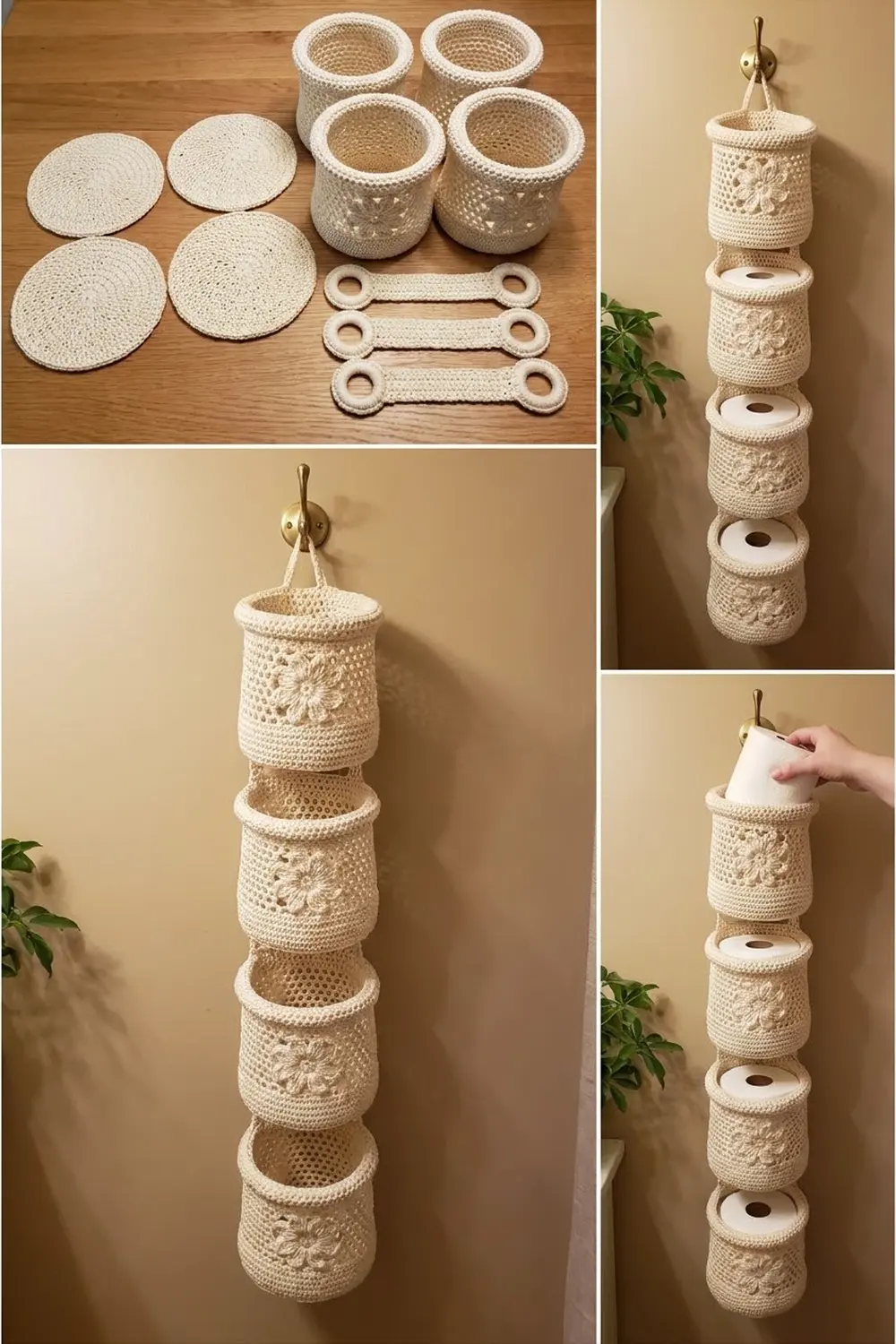
Basket (make 4)
Base
Rnd 1: In a MR, ch 1, 6 sc. Don’t join; place a marker in the last st and move it up each round. (6 sts)
Rnd 2: Inc in each st around. (12 sts)
Rnd 3: Sc in next st, inc 6 times. (18 sts)
Rnd 4: Sc in next 2 sts, inc 6 times. (24 sts)
Rnd 5: Sc in next 3 sts, inc 6 times. (30 sts)
Rnd 6: Sc in next 4 sts, inc 6 times. (36 sts)
Rnd 7: Sc in next 5 sts, inc 6 times. (42 sts)
Rnd 8: Sc in next 6 sts, inc 6 times. (48 sts)
Rnd 9: Sc in next 7 sts, inc 6 times. (54 sts)
Rnd 10: Sc in next 8 sts, inc 6 times. (60 sts)
Rnd 11: Sc in next 9 sts, inc 6 times. (66 sts)
At the end of Rnd 11, sl st in the next st to even out the step. From here on, join every round.
Bottom Band
Rnd 12: Ch 1, sc in the BLO of each st around, then sl st to the first sc. (66 sts) The unused front loops make a ridge that turns the wall upward.
Rnds 13–14: Ch 1, sc in each st around, then sl st to the first sc. (66 sts each round)
Mesh Band
Rnd 15: Ch 4 (counts as dc + ch 1), skip the next st, dc in the next st, ch 1, skip the next st 32 times. Sl st in the 3rd ch of the beginning ch-4. (33 dc + 33 ch-1 sps = 66 sts)
Rnds 16–20: Ch 4 (counts as dc + ch 1), dc in the next dc, ch 1 32 times. Sl st in the 3rd ch of the beginning ch-4. (33 dc + 33 ch-1 sps each round)
The dc columns line up straight, which gives you 33 square openings in each round.
Top Band
Rnd 21 (conversion round): Ch 1, sc in the same st as the join and in the next ch-1 sp. Then sc in the next dc, sc in the next ch-1 sp 32 times. Sl st to the first sc. (33 sc in dc + 33 sc in sps = 66 sts)
Rnds 22–23: Ch 1, sc in each st around, then sl st to the first sc. (66 sts each round)
Don’t fasten off. The rim is worked from this loop (see Border).
Lace Flower (make 4)
Rnd 1: In a MR, ch 1, 8 sc. Sl st to the first sc and pull the ring tight. (8 sts)
Rnd 2: Ch 1, sc in the next st, ch 3 8 times. Sl st to the first sc. (8 sc + 8 ch-3 sps)
Rnd 3 (petals): In each ch-3 sp, work (sc, hdc, dc, tr, picot, tr, dc, hdc, sc). Sl st to the first sc. (8 petals; 64 sts + 8 picots)
Fasten off and leave a 20 in (50.8 cm) tail. The flower measures 3 in (7.6 cm) across from picot tip to picot tip, which matches the height of the mesh band.
Strap (make 4)
Row 1: Ch 5, sc in the 2nd ch from the hook and in each remaining ch, then turn. (4 sts)
Rows 2–9: Ch 1, sc in each st, then turn. (4 sts each row)
First ring: At the end of Row 9, ch 8 and sl st in the first sc of Row 9 to make a loop across the strap end. Ch 1 and work 16 sc over the ch-8 loop, then sl st to the first sc. Fasten off.
Second ring: Join the yarn at one corner of the foundation chain. Ch 8 and sl st in the opposite corner. Ch 1, work 16 sc over the loop, then sl st to the first sc. Fasten off and leave a 16 in (40.6 cm) tail.
The strap body is 1 in (2.5 cm) wide × 2 in (5.1 cm) long. Each padded ring is about 1 in (2.5 cm) tall, so the whole strap is 4 in (10.2 cm) long.
Bail Cord (make 2)
Ch 23, then sl st in the 2nd ch from the hook and in each remaining ch. (22 sl sts) Fasten off and leave a 10 in (25.4 cm) tail. Each cord is about 4½ in (11.4 cm) long.
Make All Pieces
All pieces are cream:
– 4 baskets
– 4 lace flowers
– 4 straps
– 2 bail cords
Layout (top to bottom):
      [hook]
        |
    Strap A (hanging strap)
        |
   /  bail cords  \
   [ Basket 1 ]
        |  Strap B
   [ Basket 2 ]
        |  Strap C
   [ Basket 3 ]
        |  Strap D
   [ Basket 4 ]
Joining
Finish the rim (see Border) on all four baskets before you start joining.
1. Flowers. Choose a dc column as the front center of each basket. Pin a flower over the mesh, centered on that column and between Rnds 15 and 20. Use the flower’s tail to tack the center ring to the mesh. Then tack each picot tip and the tr stitches at the widest point of each petal to the nearest dc or ch. Keep the stitches small and on the wrong side of the mesh.
2. Marking. On each basket’s rim, mark the back center: the st directly opposite the flower center. On Basket 1, also mark the two side points, 16 sts to the left and 17 sts to the right of the back center. These two sts are 33 sts apart, so they sit exactly opposite each other.
3. Connector straps (B, C, D). For each pair of baskets, lay the strap’s top ring flat against the outside back of the upper basket, centered over the 1 in (2.5 cm) closest to the base. Whipstitch all the way around the ring, going through the ring’s sc and the wall’s sc. Then lay the bottom ring against the outside back of the lower basket, covering the top 1 in (2.5 cm) of the wall including the rim, and sew it on the same way. Since 1 in (2.5 cm) of the strap overlaps each basket, 2 in (5.1 cm) of strap shows between the baskets.
4. Bail and hanging strap (A). Sew one end of each bail cord to a marked side point on Basket 1’s rim, working 3–4 stitches through the rim and the top band. Pass the free ends of both cords through Strap A’s bottom ring and sew each cord back onto itself for ¾ in (1.9 cm). The bail stands about 3½ in (8.9 cm) above the rim. Strap A’s top ring goes over the hook.
Tension: Sew firmly enough that the ring doesn’t lift away from the basket, but not so tightly that the sc band puckers. Cotton doesn’t recover from overtightening, so stop pulling as soon as the seam lies flat.
Size checkpoint: Hang the holder empty. Measured from the top of Strap A’s ring to the bottom of Basket 4, it should be about 32 in (81.3 cm). This total is the hanging strap (4 in, 10.2 cm), the bail (about 3½ in, 8.9 cm), four baskets (4.6 in, 11.7 cm, each) and three gaps (2 in, 5.1 cm, each).
Border
The border is the rolled crab-stitch rim on each basket.
Border gauge: rev sc matches sc at 4 sts per 1 in (2.5 cm), so it adds 0.2 in (0.5 cm) of height without changing the circumference.
Rnd 24: Continue from the loop left at the end of Rnd 23. Ch 1 and work rev sc in each st around, then sl st to the first rev sc. (66 sts) Fasten off and weave in the end.
Why the math works: Rnd 23 has 66 sts and is 16.5 in (41.9 cm) around. Working exactly one rev sc in each st keeps 66 sts at the same gauge, so the rim measures 16.5 in (41.9 cm) and lies flush with the wall. It won’t flare or pull in. With the rim, the basket is 4.4 + 0.2 = 4.6 in (11.7 cm) tall.
Final Blocking
- Weave in all ends before blocking.
- Spray each basket until it is damp but not soaked.
- Slide a 4½ in (11.4 cm) jar or rolled towel inside the basket.
- Square up the mesh by eye so the dc columns run straight up.
- Pat the base flat against a table.
- Pin each flower’s picots outward against the form so the petals lie open.
- Leave everything to dry completely, which usually takes 12–24 hours.
- Lay the straps flat, pin them to 1 in × 4 in (2.5 cm × 10.2 cm), and let them dry.
Final Quality-Control Checklist
- Each base lies flat and is 5¼ in (13.3 cm) across.
- Each basket wall has 66 sts and 33 open squares per mesh round.
- All four baskets are 4.6 in (11.7 cm) tall, within ¼ in (0.6 cm).
- Each flower is centered on the front, with all 8 picots tacked down.
- Each strap ring is sewn on all the way around, with no loose edges.
- The bail cords are opposite each other, so the top basket hangs level.
- Visible gaps between baskets are 2 in (5.1 cm).
- No ends are visible.
Troubleshooting
The base ruffles: Your tension is loose for this hook. Use the next size down for Rnds 1–11 only.
The base cups upward: Your tension is tight. Use a hook half a size larger for the base, and check that every inc round has 6 increases.
The mesh columns slant: Start each mesh round from the join, and work the first dc into the dc, not into the ch-sp.
The basket leans when hung: The connector straps aren’t centered at the back. Re-mark the back center opposite the flower and sew the straps again.
The straps stretch: Add a row of sl sts along both long edges of each strap, or use a firmer cotton.
The flower curls: Block it pinned open, and tack the tr stitches as well as the picots.
Care
Hand wash in cool water with mild soap, press out the water in a towel, and dry the baskets on a jar so they keep their shape. Don’t tumble dry.

Final Notes
The measurement chain depends on gauge. At 16 sc per 4 in (10.2 cm), a 66-stitch base is 5¼ in (13.3 cm) across. The same 66 stitches carry up the wall to give 33 open squares, and the crab-stitch rim keeps exactly 66 stitches. Each basket ends up 4.6 in (11.7 cm) tall. Four baskets, three 2 in (5.1 cm) gaps, the bail and the hanging strap add up to about 32 in (81.3 cm). If your first basket meets its checkpoints, the other three will match.
Happy crocheting!