
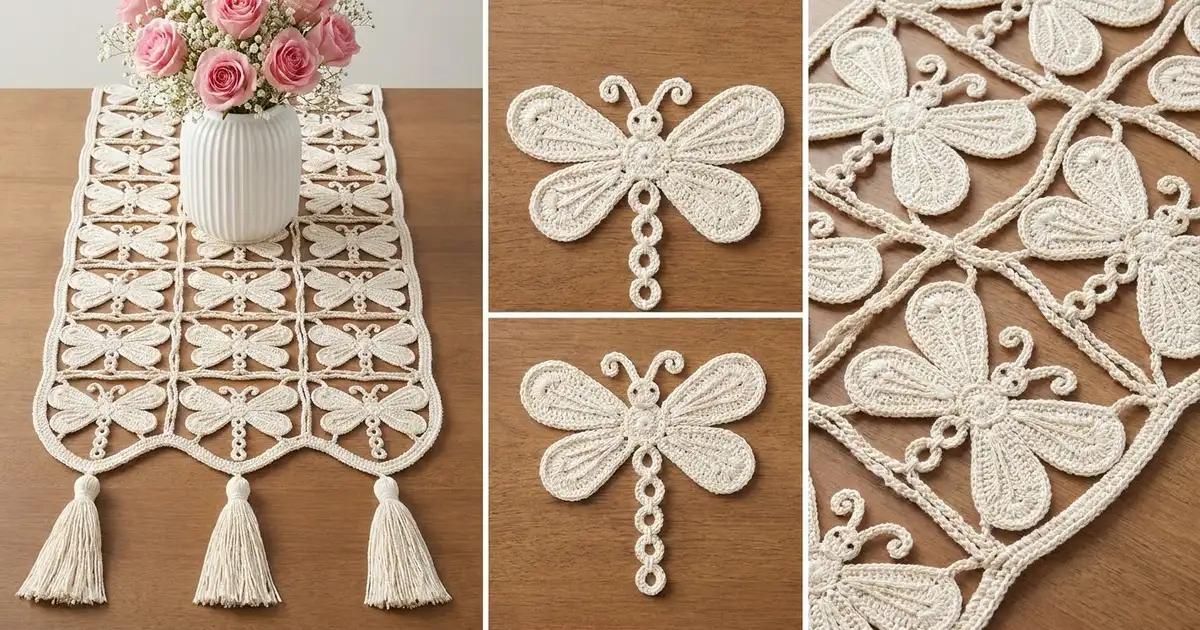
This runner is a field of small ivory dragonflies. Each one sits inside a cord-like frame and is joined to its neighbors to make a light, open lattice. Every dragonfly has a beaded chain-link tail, a tiny head with two curled antennae, and four teardrop wings filled with fanned “vein” stitches. Three tassels finish each short end.
The whole piece uses one color, a soft ivory cotton, so the texture does all the work. It suits a farmhouse table, a spring centerpiece, or a quiet, neutral room. All instructions use US crochet terms.
Before tassels, the finished runner measures 14.3 x 36.8 in (36.3 x 93.5 cm). Each motif is a 4.5 in (11.4 cm) square, and the tassels add about 3.5 in (8.9 cm) at each end.
Construction is easy to follow. Make 24 identical dragonfly motifs in the round and square each one with a frame of sc-wrapped chain loops. Join them 3 wide by 8 long with slip-stitch seams, then add a two-round sc border and the tassels.
Finished Size and Construction
- Finished size: 14.3 x 36.8 in (36.3 x 93.5 cm), plus tassels
- Skill level: Intermediate
- Terminology: US crochet terms
- Yarn weight: DK (3) mercerized cotton
- Hook: 3.5 mm (E-4)
- Number of pieces: 24 identical dragonfly motifs
- Layout: 3 motifs wide x 8 motifs long
- Piece size: 4.5 in (11.4 cm) square, 23 sts per side
- Size before border: 13.5 x 36 in (34.3 x 91.4 cm)
- Border depth: 0.4 in (1.0 cm), 2 rounds of sc
Materials
Choose a smooth, mercerized DK cotton. It shows the veins and chain links crisply and blocks flat. Avoid fuzzy or very soft acrylic, which blurs the lace and stretches over time.
- Ivory cotton DK: about 500 g / 1100 m (motifs about 336 g, seams about 27 g, border about 50 g, tassels about 19 g)
- 3.5 mm (E-4) crochet hook
- Tapestry needle
- At least 4 stitch markers
- Scissors
- A 4 in (10.2 cm) piece of stiff card for the tassels
- Blocking mats, rustproof pins, and a spray bottle
These amounts include a margin of about 15% for gauge differences and swatching.
Abbreviations (US Terms)
- ch – chain
- sl st – slip stitch
- sc – single crochet
- hdc – half double crochet
- dc – double crochet
- tr – treble crochet
- sp – space
- st(s) – stitch(es)
- RS / WS – right side / wrong side
Special stitches
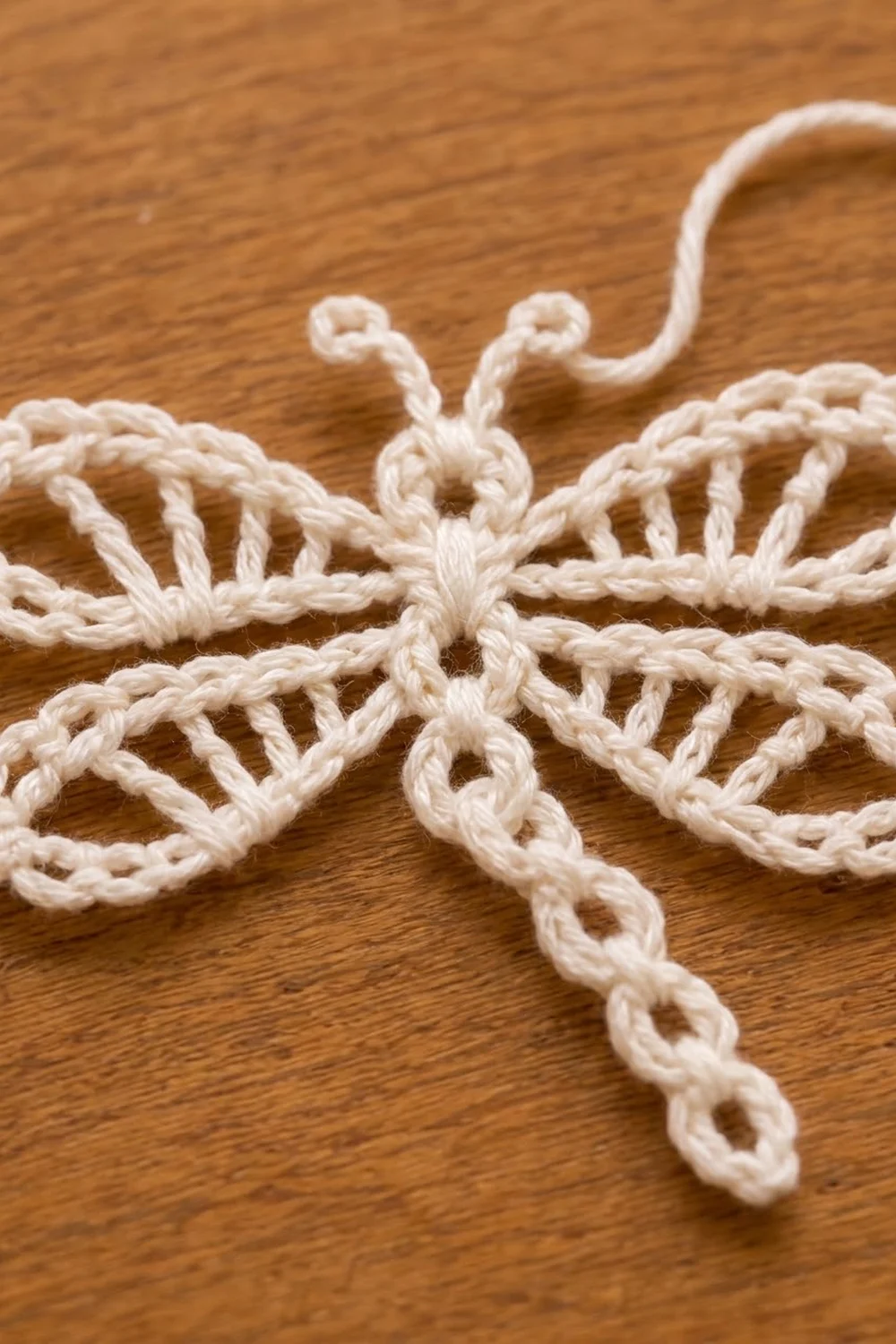
- Curl: Ch 7, sl st in the 4th ch from hook, then sl st in each of the next 3 ch. This makes one antenna with a tiny looped tip.
- Link: Ch 6, sl st in the 1st ch of this ch-6. This closes a 5-ch ring. Start the next link from that sl st.
Gauge and Checkpoints
Make one complete motif before anything else. It is your gauge swatch.
Gauge: 23 sc = 4.5 in (11.4 cm) along one side of a blocked motif, or about 5.1 sc per 1 in (2.5 cm).
Checkpoints:
- After Rnd 1: The center ring is about 0.75 in (1.9 cm) across.
- After Rnd 2: The wingspan is about 4 in (10.2 cm), and head to tail tip is about 4 in (10.2 cm). Each wing is about 1.75 in (4.4 cm) long.
- After Rnd 3: The relaxed frame is about 4.25 in (10.8 cm) across. The chains will look loose until you wrap them in Rnd 4.
- After Rnd 4 (blocked): 4.5 in (11.4 cm) per side, within 0.25 in (0.6 cm).
If your motif is too big: Go down to a 3.25 mm hook, and check that your Rnd 4 sc aren’t stretched. If it is too small: Go up to a 3.75 mm hook. Change the hook size, not the chain counts, because the joining and border math depend on the stitch counts.
Dragonfly Motif (Make 24)
Center Ring
Ch 4, sl st in the first ch to form a ring.
Rnd 1: Ch 1, 12 sc in ring, sl st in first sc. (12 sc)
Place a marker in the first sc. Number the sts 1 to 12 clockwise:
- st 1 is the head
- st 3 is the upper-right wing
- st 5 is the lower-right wing
- st 7 is the tail
- st 9 is the lower-left wing
- st 11 is the upper-left wing
Rnd 2: Features
Rnd 2 is one continuous trip around the ring. Work each feature from a single sc, then sl st along to the next one.
Head and antennae (st 1): Curl, ch 2 (head sp), Curl, sl st in st 1. The ch-2 sp between the antennae is the head anchor.
Sl st in st 2, sl st in st 3.
Upper-right wing (st 3):
- Ch 14, sl st in st 3. (ch-14 loop made)
- Vein pass: Ch 1. Working into the ch-14 loop (around the chain), work 2 sc, hdc, ch 1, dc, ch 2, dc, ch 2, tr, ch 2, tr, ch 2, tr, ch 2, dc, ch 1, hdc, 2 sc. (12 sts, 5 ch-2 sps, 2 ch-1 sps) Sl st in st 3.
- Outline pass: Turn. Ch 1. Working back across the vein pass, sc in each st, 1 sc in each ch-1 sp, and 2 sc in each ch-2 sp. In the middle (2nd) tr only, work (sc, ch 3, sc) instead of 1 sc. Sl st in st 3. (25 sc and 1 ch-3 tip picot)
The tall tr in the middle of the loop push the outline into a teardrop, and the spaces between the stitches look like wing veins. The ch-3 picot is the wing-tip anchor.
Sl st in st 4, sl st in st 5.
Lower-right wing (st 5): Work as for the upper-right wing. Sl st in st 6, sl st in st 7.
Tail (st 7):
- Link 5 times. (5 links)
- Work 8 sc into the last link to cover it fully. The 4th of these sc is the tail anchor.
- Sl st into the joint above. Work 4 sc into each of the next 4 links, pushing them to one side of each ring.
- Sl st in st 7.
The tip link is fully covered and the others are half-covered, which gives the tail its beaded chain look.
Sl st in st 8, sl st in st 9.
Lower-left wing (st 9): Work as for the upper-right wing. Sl st in st 10, sl st in st 11.
Upper-left wing (st 11): Work as for the upper-right wing. Sl st in st 12, sl st in st 1. Fasten off.
Check: 4 wings, 2 antennae, 1 head sp, and 1 tail of 5 links. Measure against the Rnd 2 checkpoint.
Rnd 3: Frame Loops
With RS facing, join yarn with sc in the ch-3 picot of the upper-right wing (anchor A1).
Ch 19, sc in lower-right wing picot (A2). Ch 9, sc in tail anchor (A3). Ch 9, sc in lower-left wing picot (A4). Ch 19, sc in upper-left wing picot (A5). Ch 9, sc in head ch-2 sp (A6). Ch 9, sl st in first sc.
(6 sc, 2 ch-19 loops, 4 ch-9 loops; 6 + 38 + 36 = 80 sts and chains)
Rnd 4: Square Edge
Ch 1. 3 sc in A1 (corner), 19 sc into ch-19 loop, 3 sc in A2 (corner), 9 sc into ch-9 loop, sc in A3, 9 sc into ch-9 loop, 3 sc in A4 (corner), 19 sc into ch-19 loop, 3 sc in A5 (corner), 9 sc into ch-9 loop, sc in A6, 9 sc into ch-9 loop, sl st in first sc. Fasten off.
Count: 12 corner sc + 38 + 36 + 2 = 88 sc.
Per side (including both corner sts):
- Right and left sides: 1 corner + 1 + 19 + 1 + 1 corner = 23 sts
- Top and bottom: 1 corner + 1 + 9 + 1 + 9 + 1 + 1 corner = 23 sts
Check: 4 x 23 = 92, minus 4 shared corners = 88. ✓
Working the sc into each loop (not into each chain) wraps the chain and gives the frame its rope-like cord texture. Mark the middle sc of each 3-sc corner group.
Make All Pieces
Make 24 motifs in ivory, using about 14 g / 31 m each. Weave in ends as you go. Lightly block each motif to 4.5 in (11.4 cm) before joining, because identical squares make the seams much easier.
Layout (3 wide x 8 long, with every head at the top):
Row 1:  [D] [D] [D]
Row 2:  [D] [D] [D]
Row 3:  [D] [D] [D]
Row 4:  [D] [D] [D]
Row 5:  [D] [D] [D]
Row 6:  [D] [D] [D]
Row 7:  [D] [D] [D]
Row 8:  [D] [D] [D]
Joining
Method: A flat slip-stitch seam through the outer loops.
- Hold two motifs WS together with edges lined up, corner marker to corner marker.
- Join yarn through both corner sts. Sl st through the outer loop of each matching pair of sts: the first corner, then each of the 21 side sts, then the far corner. (23 sl st per seam)
- Fasten off.
First join the 3 motifs of each row (2 seams per row, 16 seams total). Then join the 8 rows to each other along their long edges, with 69 sl st per seam (3 x 23), for 7 long seams.
Stitch-to-stitch logic: Every side has 23 sts, so each st meets exactly one partner. You don’t skip or add any sts at the seams. Where four corners meet, they line up neatly because each corner sc sits at the same point.
Tension: Keep the sl st as loose as your Rnd 4 sc. Tight seams pull in the lattice and make the runner narrower than its edges. If needed, use a 3.75 mm hook for joining only.
Size checkpoint: A joined row of 3 measures 13.5 in (34.3 cm). Two rows measure 9 in (22.9 cm) tall, and four rows measure 18 in (45.7 cm). The fully joined runner measures 13.5 x 36 in (34.3 x 91.4 cm).
Border
Border gauge: The same as the motifs, about 5.1 sc per 1 in (2.5 cm). Each sc round is about 0.2 in (0.5 cm) deep.
Starting counts: Each short end has 3 x 23 = 69 sts, and each long side has 8 x 23 = 184 sts. Both counts include the runner’s corner sts. Each motif gives all 23 of its edge sts, including the corner sts next to a seam. Nothing is added at the seams.
Rnd 1: With RS facing, join yarn in a runner corner st. Work 3 sc in each runner corner and 1 sc in every other st around, sl st in first sc.
- Short ends: 69 + 2 = 71 sts
- Long sides: 184 + 2 = 186 sts
- Total: 502 + 8 = 510 sc
Rnd 2: Ch 1, sc in each st around, with 3 sc in the middle sc of each corner group, sl st in first sc. Fasten off.
- Short ends: 71 + 2 = 73 sts
- Long sides: 186 + 2 = 188 sts
- Total: 510 + 8 = 518 sc
Why the math works: Each round adds 2 sts per side, one at each corner. At 5.1 sc per in, that is about 0.4 in (1.0 cm) of length. That matches the 0.2 in (0.5 cm) of depth the round adds at each end of that side, so the corners stay square and flat. After two rounds, 73 sts = 14.3 in (36.3 cm) and 188 sts = 36.8 in (93.5 cm).
Tassels (Make 6)
Wrap yarn 30 times around the 4 in (10.2 cm) card. Tie the top with a 10 in (25.4 cm) strand and cut the bottom loops. Wrap the neck 0.5 in (1.3 cm) below the top, then trim to 3.5 in (8.9 cm).
On each short end, attach tassels to st 14, st 37, and st 60 of the 73 border sts. These sit directly below the tail (or above the head) of each end motif. They are centered: each outer tassel is 14 sts in from its corner, and st 37 is the exact middle.
Final Blocking
- Weave in all remaining ends along the frame cords, not through the wings.
- Soak the runner in cool water for 10 minutes, then press out the water in a towel. Do not wring.
- Lay it flat on blocking mats and pin the four runner corners to 14.3 x 36.8 in (36.3 x 93.5 cm).
- Pin along each seam line so every motif sits at 4.5 in (11.4 cm).
- Pin each wing tip into its square corner, and open each wing so the veins fan out evenly.
- Shape the antenna curls and straighten each tail with your fingers.
- Let it dry completely, for at least 24 hours. Comb and trim the tassels last.
Final Quality-Control Checklist
- Every motif has 88 sc in Rnd 4, with 23 sts per side.
- Every wing has a ch-3 picot tip and evenly spaced veins.
- All 24 heads point the same direction.
- Every seam has 23 sl st per motif edge, with no puckering.
- Border Rnd 2 has 73 sts per short end and 188 per long side.
- The runner blocks to 14.3 x 36.8 in (36.3 x 93.5 cm).
- Tassels are centered on sts 14, 37, and 60 and trimmed to 3.5 in (8.9 cm).
- No ends show in the wings or tails.
Troubleshooting
- Wings cup or ruffle: Your tr are too tall or the ch-14 loop is too tight. Chain more loosely; don’t add sts.
- The frame pulls the dragonfly out of shape: Your Rnd 3 chains are too tight. Chain loosely and let blocking open the frame.
- The motif is a rectangle, not a square: Recount Rnd 4. The side loops need 19 sc and the top and bottom loops need 9 sc each.
- The tail curls: Pin it straight while damp, and check that each half-covered link has exactly 4 sc.
- The border ruffles: You have extra sts on a side. Recount against 71 and 73 for the ends, or 186 and 188 for the sides.
- The border cups: Your sc is tighter than in your motifs. Go up 0.25 mm for the border.
- Seams form a ridge on the RS: Join with WS together, through the outer loops only.
Care
Hand wash in cool water with mild soap, then dry flat and reshape while damp. A warm iron through a pressing cloth will freshen the lace.

Final Notes
The measurements build on each other simply. One motif is 23 sts and 4.5 in (11.4 cm) per side. Three motifs make 69 sts and 13.5 in (34.3 cm), and eight make 184 sts and 36 in (91.4 cm). The two border rounds add 4 sts and 0.8 in (2.0 cm) to each dimension, for a finished runner of 14.3 x 36.8 in (36.3 x 93.5 cm). Check your first motif carefully and every later step will fall into place.
Happy crocheting!