
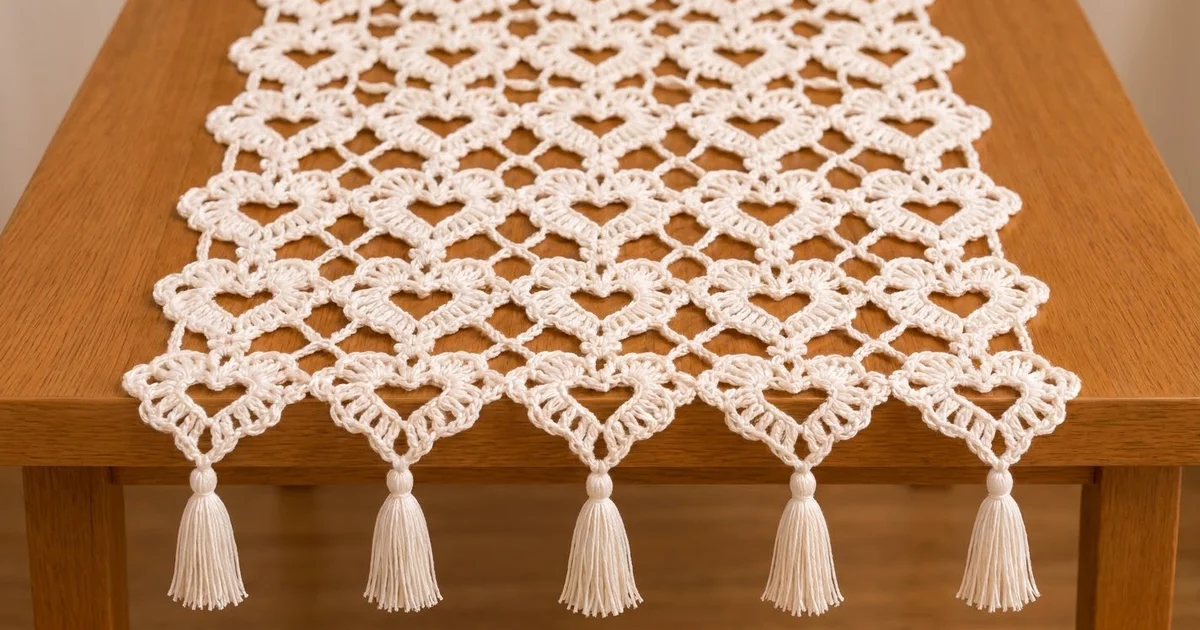
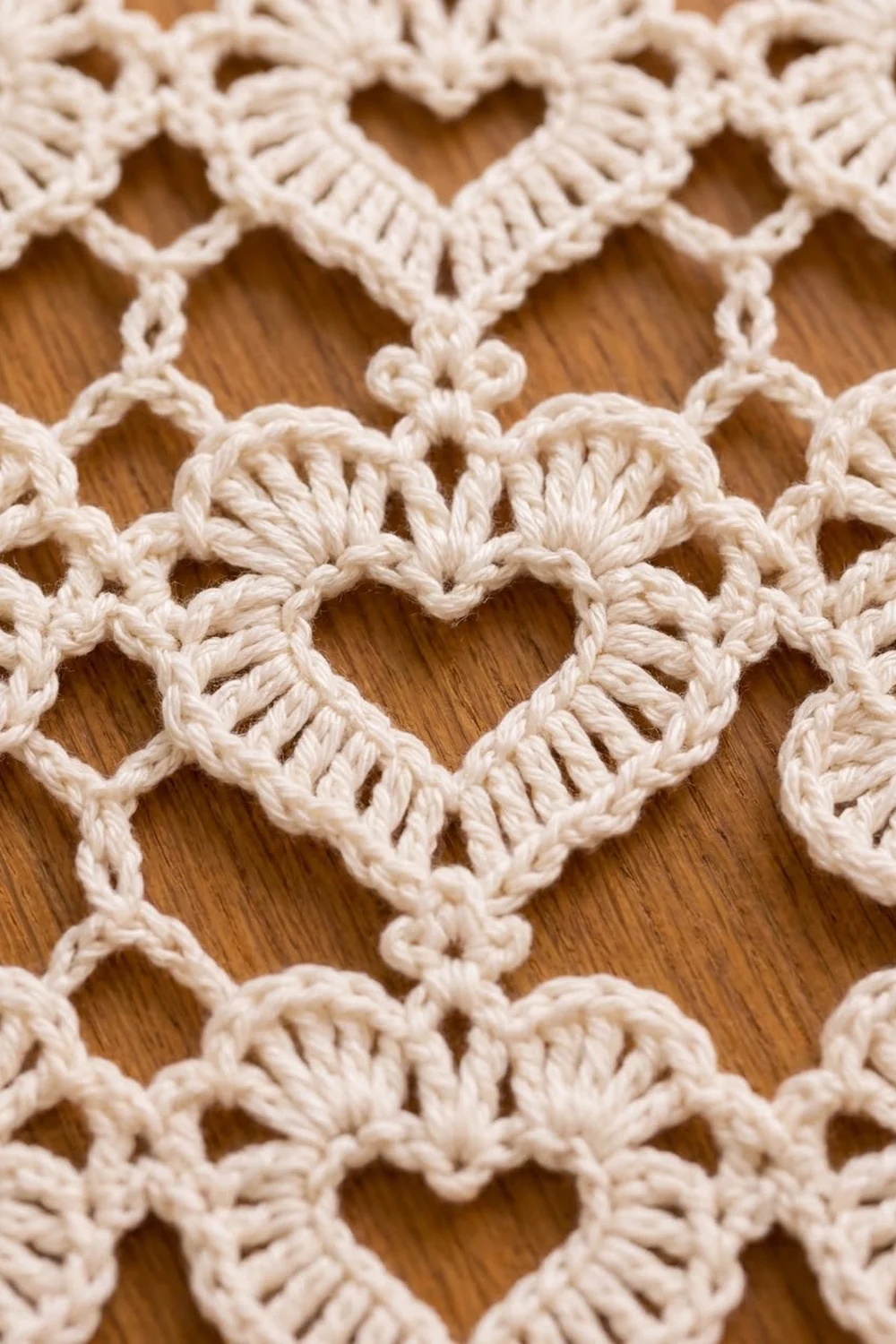
This runner is made of small lace hearts joined into one long panel. Each heart has an open center outlined in chain, a fan of treble stitches in each upper lobe, a ladder of double-crochet spokes down the lower half, and a small three-loop trefoil at the top and bottom points. The diamond-shaped gaps between the hearts are part of the design and keep the runner light and airy on wood or linen.
The sample uses one color, a soft ivory cotton, and the three tassels at the end use the same yarn. The look is romantic and vintage. It works for a wedding table, Valentine’s Day, or everyday use.
This pattern uses US crochet terms. The finished runner measures 13.5 in (34.3 cm) wide by 45 in (114.3 cm) long. The tassels hang another 4 in (10.2 cm) below the end.
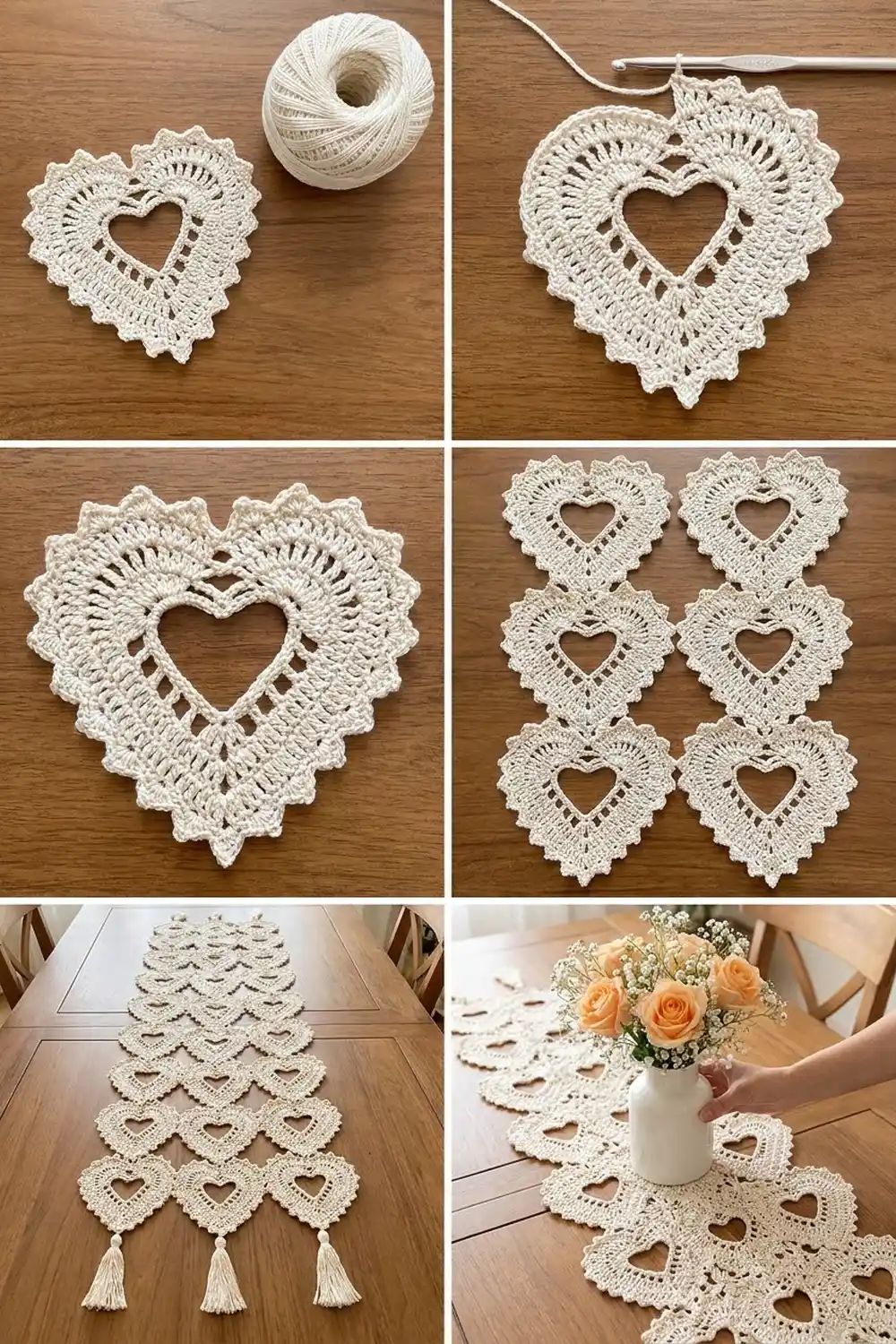
The construction is simple. You make 30 identical four-round heart motifs and join them as you go in the last round, 3 hearts across and 10 rows long. There’s no separate border because the scalloped last round of each motif forms the edge. The tassels go on last.
Finished Size and Construction
- Finished size: 13.5 in x 45 in (34.3 cm x 114.3 cm), plus 4 in (10.2 cm) tassels
- Skill level: Intermediate
- Terminology: US
- Yarn weight: DK (#3) cotton
- Hook: 3.5 mm (E-4)
- Number of pieces: 30 heart motifs
- Layout: 3 motifs wide x 10 motifs long
- Motif size: 4.5 in x 4.5 in (11.4 cm x 11.4 cm), measured fan to fan and trefoil to trefoil
- Size before border: 13.5 in x 45 in (34.3 cm x 114.3 cm)
- Border depth: 0 in (0 cm), because Round 4 of each motif is the edge
Materials
Use a smooth mercerized or combed DK cotton with about 120 m per 50 g. Cotton holds the lace shape and blocks crisply. Avoid fuzzy yarns, which blur the open heart centers.
- Ivory (one color only): 110 g / 265 m total
- Motifs: about 6.5 m (2.7 g) each, or 195 m (81 g) for all 30
- Tassels: about 7.5 m (3.1 g) each, or 23 m (10 g) for all 3
These amounts include a margin of about 20 percent for gauge differences, tails, and a test motif.
Tools:
- 3.5 mm (E-4) crochet hook
- Tapestry needle
- Scissors
- Stitch markers (2)
- A 4.5 in (11.4 cm) piece of stiff cardboard for the tassels
- Blocking mats, rustproof pins, and a spray bottle
- Measuring tape
Abbreviations (US Terms)
- ch chain
- sl st slip stitch
- sc single crochet
- dc double crochet
- tr treble crochet
- sk skip
- sp(s) space(s)
- st(s) stitch(es)
- rep repeat
- RS right side
Special stitches
- 3-tr cluster (3-tr cl): *Yarn over twice, insert hook in st, pull up a loop, (yarn over, pull through 2 loops) twice; rep from * 2 more times in the same st. Yarn over and pull through all 4 loops on the hook.
- Trefoil (tref): Ch 4, sl st in 4th ch from hook (first loop), (ch 3, sl st in same base ch) 2 times. This makes 3 small loops. The second loop is the middle loop.
- Joining trefoil (join-tref): Ch 4, sl st in 4th ch from hook, ch 1, sl st in the middle loop of the neighbor’s trefoil, ch 1, sl st in same base ch, ch 3, sl st in same base ch.
- Joining ch-2 loop (join-2): Ch 1, sl st in the matching ch-2 loop of the neighbor motif, ch 1.
Gauge and Checkpoints
Gauge is measured on a motif, not a swatch. Make one complete heart, block it, and measure it before you start the other 29.
- After Round 2: the inner heart is about 2 in (5.1 cm) wide.
- After Round 3: the piece is about 3.75 in (9.5 cm) wide across the fans.
- After Round 4 (blocked): 4.5 in (11.4 cm) wide across the fans and 4.5 in (11.4 cm) tall from top trefoil to bottom trefoil.
If your motif is larger than 4.75 in (12.1 cm), go down to a 3.25 mm hook. If it’s smaller than 4.25 in (10.8 cm), go up to a 3.75 mm hook. Being off by 0.25 in (0.6 cm) per motif adds up to 2.5 in (6.4 cm) over the length of the runner, so don’t skip this check.
Heart Motif (Make 30)
Work the first motif on its own. Work every other motif the same way through Round 3, then join it to its neighbors during Round 4 (see Joining).
Round 1 (foundation ring): Ch 36, sl st in first ch to form a ring, taking care not to twist. (36 ch)
Round 2 (heart outline): Ch 1. Working in each ch: (sc, ch 3, sc) in first ch for the point; sc in next 17 ch; sl st in next ch for the top dip; sc in last 17 ch. Sl st in first sc to join.
Count: 36 sts worked 1 per ch + 1 extra sc at the point = 37 sts (2 point sc, 34 side sc, 1 sl st), plus 1 ch-3 point sp.
Place a marker in the sl st at the dip. Each side now has 17 sc between the point and the dip. Number them #1 to #17 in the direction you work.
Round 3 (spokes, fans, and center column): Sl st in the ch-3 point sp. Ch 3 (counts as dc), (dc, ch 2, 2 dc) in same sp. This is the point shell.
First side: Ch 1, sk the second point sc and side sc #1, dc in sc #2, (ch 1, sk 1 sc, dc in next sc) 4 times, ending in sc #10. Sk sc #11 and #12, 9 tr in sc #13 for the fan, sk sc #14 and #15, sc in sc #16, sk sc #17.
Center: (3-tr cl, ch 3, 3-tr cl) in the marked sl st. This makes the raised column between the lobes.
Second side: Sk sc #1, sc in sc #2, sk sc #3 and #4, 9 tr in sc #5, sk sc #6 and #7, dc in sc #8, (ch 1, sk 1 sc, dc in next sc) 4 times, ending in sc #16. Sk sc #17 and the first point sc, ch 1, sl st in top of beginning ch-3.
Count: 4 shell dc + 10 spoke dc + 18 tr + 2 sc + 2 clusters = 36 sts, plus 10 ch-1 sps, 1 ch-2 point sp, and 1 ch-3 center sp.
Check each side: 1 skipped + 9 sts for the spokes + 2 skipped + 1 for the fan + 2 skipped + 1 sc + 1 skipped = 17 sc used. The two sides mirror each other.
Round 4 (scalloped edge): Sl st in next dc and in the ch-2 point sp. Ch 1, (sc, tref, sc) in same sp.
First side: (Ch 3, sc in next ch-1 sp) 5 times. Ch 3, sc in first tr of fan, (ch 2, sc in next tr) 8 times. Ch 3, sk the sc.
Center: (Sc, tref, sc) in the ch-3 sp between the clusters.
Second side: Ch 3, sk the sc, sc in first tr of fan, (ch 2, sc in next tr) 8 times. Ch 3, sc in next ch-1 sp, (ch 3, sc in next ch-1 sp) 4 times. Ch 3, sl st in first sc to join. Fasten off and weave in the ends.
Count: 32 sc, 14 ch-3 loops, 16 ch-2 loops, and 2 trefoils. Each side has 14 sc, 7 ch-3 loops, and 8 ch-2 loops. The point and the center each add 2 sc and 1 trefoil.
On each side, number the fan ch-2 loops 1 to 8 in the order you work them. On the first side, loops 2 and 3 sit at the widest point of the heart. On the second side, the matching loops are 7 and 6.
Make All Pieces
You need 30 motifs, all in ivory:
- Ivory: 30 motifs (finish the first one completely, then join the other 29 during Round 4)
Layout (rows run along the length of the runner, and every heart points toward the tasseled end):
        Col A   Col B   Col C
Row 1   [ 1 ]   [ 2 ]   [ 3 ]
Row 2   [ 4 ]   [ 5 ]   [ 6 ]
Row 3   [ 7 ]   [ 8 ]   [ 9 ]
Row 4   [10 ]   [11 ]   [12 ]
Row 5   [13 ]   [14 ]   [15 ]
Row 6   [16 ]   [17 ]   [18 ]
Row 7   [19 ]   [20 ]   [21 ]
Row 8   [22 ]   [23 ]   [24 ]
Row 9   [25 ]   [26 ]   [27 ]
Row 10  [28 ]   [29 ]   [30 ]  <- tassels hang from these points
Joining
Join as you go in Round 4. The joins stay flat and nearly invisible, and there’s no sewing.
Side joins (between columns): A motif in Column B or C joins to the motif on its left. Work its Round 4 as written until you reach the second side’s fan. Work fan loop 6 as a join-2 into the left neighbor’s first-side loop 3. Then work fan loop 7 as a join-2 into the neighbor’s loop 2. Finish the round as written.
Point joins (between rows): A motif in Rows 2 to 10 joins to the motif above it. At the center, work (sc, join-tref, sc), connecting its middle loop to the middle loop of the bottom trefoil on the motif above. The point of the upper heart now meets the top of the lower heart tip to tip.
Stitch-to-stitch logic: Each join replaces the middle of an existing loop with a sl st. A join-2 still has 2 ch and a join-tref still has 3 loops, so no stitches are added or lost. Every motif keeps its edge counts of 32 sc, 14 ch-3 loops, and 16 ch-2 loops.
Join totals: 10 rows x 2 column seams x 2 loops = 40 side joins, and 9 row seams x 3 columns = 27 point joins.
Tension advice: Keep each joining sl st as loose as your normal chain. If you pull it tight, the hearts tilt toward each other and the diamonds between them close up. Lay the work flat every few joins to check.
Size checkpoint: After Row 1, the strip should measure 13.5 in (34.3 cm) across when lightly stretched. After Row 3, it should be 13.5 in (34.3 cm) long. Fix any drift now rather than at the end.
Border
This runner has no added border. Round 4 of each motif is the finished edge, and the tassels finish the end.
Border gauge: The scalloped edge is about 0.3 in (0.8 cm) deep, the same as Round 4 on every motif.
Edge counts per side:
- Each long side: 10 motifs x 1 outer side each = 140 sc, 70 ch-3 loops, and 80 ch-2 loops.
- Each short end: 3 motifs, showing 3 trefoils with diamond gaps between them.
Why the math works: Every join sits inside an existing loop and adds no stitches, so each long edge is exactly 10 copies of one motif side. That gives an even, repeating scallop with no puckers.
Tassels (make 3):
- Wrap the yarn 30 times around the 4.5 in (11.4 cm) card.
- Thread a 12 in (30.5 cm) strand under the wraps at the top and tie it tightly.
- Cut the wraps along the bottom edge.
- Wrap a 6 in (15.2 cm) strand tightly around the bundle 6 times, 0.75 in (1.9 cm) below the top, and knot it. Bury the ends inside the tassel.
- Trim the bottom evenly so the tassel measures 4 in (10.2 cm).
- Use the top tie to attach one tassel to the middle loop of the bottom trefoil on motifs 28, 29, and 30. Knot it securely and hide the ends inside the tassel.
Final Blocking
- Soak the runner in cool water for 15 minutes, then roll it in a towel and press out the water. Don’t wring it.
- Lay it flat on blocking mats, right side up.
- Pin the four corners to 13.5 in x 45 in (34.3 cm x 114.3 cm).
- Pin every top and bottom trefoil so the hearts sit in straight columns.
- Pin the widest fan loops along the outer edges so each long side is straight.
- Use your fingers to open each inner heart into a clear heart shape with a rounded top and a sharp point.
- Spray lightly and let it dry completely, at least 24 hours.
- Unpin it, then comb the tassels straight and trim any uneven strands.
Final Quality-Control Checklist
- 30 motifs in a 3 x 10 grid, all pointing the same way
- Each motif has 2 fans of 9 tr and 5 spokes per side
- Every side join is at fan loops 2/3 and 7/6
- Every point join connects the middle loops of two trefoils
- Width is 13.5 in (34.3 cm) and length is 45 in (114.3 cm)
- Long edges are straight with no puckers
- 3 tassels, each 4 in (10.2 cm), hang from the final row
- All ends are woven in securely
Troubleshooting
Heart looks round instead of heart-shaped: Check Round 2. The sl st at the dip must sit directly opposite the point, with exactly 17 sc on each side.
Fans ruffle: Your tr may be too loose. Try a smaller hook for Round 3 only.
Spokes slant: Make sure you skip only 1 sc between spoke dc.
Runner curves to one side: A motif was joined at the wrong fan loops. Undo that motif’s Round 4 and rejoin at loops 6 and 7.
Diamonds look closed: Your joining sl sts are too tight. Rework them more loosely.
Tassels look thin: Wrap 35 times instead of 30 and allow about 1.3 m of extra yarn per tassel.
Care
Hand wash in cool water with mild soap and dry flat, pinning lightly if needed. You can press the cotton with a cool iron under a pressing cloth, but don’t press the tassels flat.
Final Notes
The measurement chain is short and reliable. The inner heart is 2 in (5.1 cm) wide after Round 2. The fans reach 3.75 in (9.5 cm) after Round 3, and the finished motif is 4.5 in (11.4 cm) after Round 4. Three motifs across make 13.5 in (34.3 cm), and ten rows make 45 in (114.3 cm). The 4 in (10.2 cm) tassels finish the end. If your first motif matches gauge, the rest of the runner will too.
Happy crocheting!