

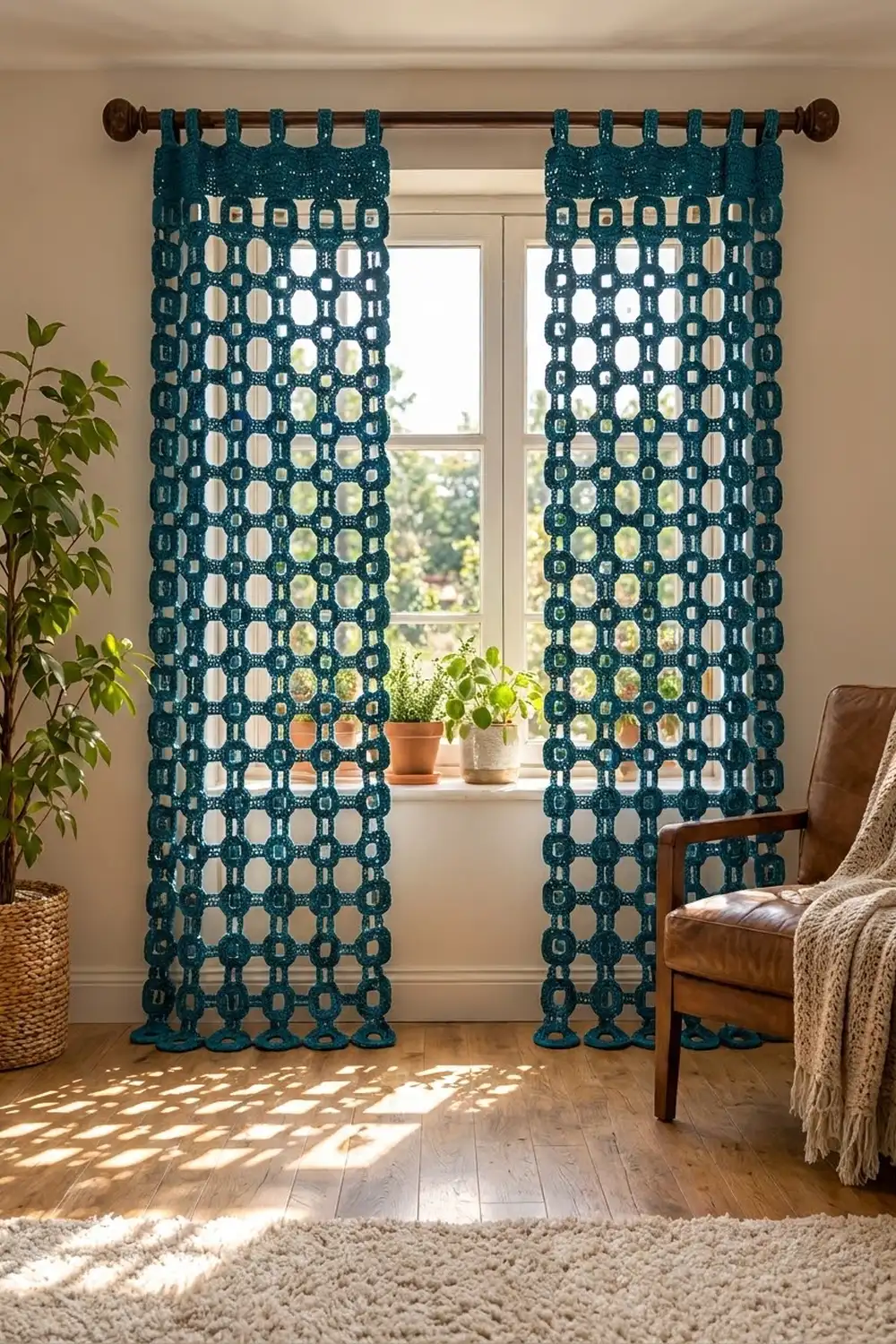
The Lagoon Links Curtain is made from small square rings with soft, rounded corners. They are linked into hanging strands and finished with a solid header band and tab tops. Light passes through every open center, so a plain window gets a graphic, airy screen that still gives some privacy.
The sample is worked in one deep teal worsted cotton. A single color shows off the chunky rings and the stitch texture. It suits boho, coastal, and mid-century rooms, and it photographs beautifully in afternoon sun.
This pattern uses US crochet terms. Each finished panel measures 30 in (76.2 cm) wide and 81.75 in (207.6 cm) long from the top of the header to the bottom ring. The tab loops add about 3 in (7.6 cm) above the header. The pattern covers one panel; make two for a pair, as shown.
Construction is simple and repetitive. You crochet many identical square ring motifs, then link them into vertical strands with short 3-stitch straps. Next you work a solid header band and join all the strands to its lower edge in one stitch-to-stitch row. Last, you add tabs to the top edge and block.
Finished Size and Construction
- Finished panel size: 30 in (76.2 cm) wide x 81.75 in (207.6 cm) long, plus about 3 in (7.6 cm) of tab loop
- Skill level: Easy to intermediate (easy stitches, many repeats, careful joining)
- Terminology: US crochet terms
- Yarn weight: Worsted (#4), cotton or cotton blend
- Hook: 5 mm (H-8)
- Number of pieces per panel: 126 square ring motifs, 119 link straps, 1 header band, 5 tabs
- Layout: 7 strands across, 18 motifs per strand
- Motif size: 3.5 in (8.9 cm) square, center opening about 1.5 in (3.8 cm)
- Motif size before trim round: 3 in (7.6 cm)
- Link depth: 0.75 in (1.9 cm)
- Header (top border) depth: about 6 in (15.2 cm)
Materials
Choose a smooth, firm worsted cotton or a cotton/acrylic blend. Cotton hangs straight and doesn’t stretch much, which matters on a long curtain. Avoid very soft, fuzzy, or loosely plied yarns because they hide the stitch texture and can grow lengthwise.
- Deep teal: 2,700 g / 4,590 m (5,020 yd) for two panels, based on 100 g / 170 m (186 yd) balls. That’s 1,350 g / 2,295 m (2,510 yd) per panel.
Each motif uses roughly 7 g / 12 m (13 yd). The quantities include a margin of about 15% for gauge differences and swatching. Buy all the yarn from one dye lot.
Tools:
– 5 mm (H-8) crochet hook
– Tapestry needle
– Stitch markers
– Scissors
– Measuring tape
– Rust-proof pins and a large blocking surface (foam mats or a carpeted floor with a clean sheet)
– Spray bottle
– Curtain rod, up to 1.25 in (3.2 cm) in diameter
Abbreviations (US Terms)
- ch – chain
- sl st – slip stitch
- sc – single crochet
- hdc – half double crochet
- dc – double crochet
- st(s) – stitch(es)
- sp – space
- RS / WS – right side / wrong side
Special stitch – joining sc: Insert the hook through the header stitch and then through the motif stitch held behind it, yarn over, and pull through both. Finish as a normal sc. One joining sc joins one header stitch to one motif stitch.
Gauge and Checkpoints
Base gauge: 14 sc and 16 rows = 4 in (10.2 cm). Header gauge: 14 hdc and 10 rows = 4 in (10.2 cm).
Before you commit, make one motif and measure it flat without stretching. You’ll repeat it 126 times per panel, so a small error multiplies quickly.
Motif checkpoints:
– After Round 1: about 2 in (5.1 cm) across
– After Round 2: 3 in (7.6 cm) across
– After Round 3: 3.5 in (8.9 cm) across, opening about 1.5 in (3.8 cm)
If your motif is too big, go down 0.5 mm in hook size. If it is too small, go up 0.5 mm. Even 0.25 in (0.6 cm) of extra width per motif adds 1.75 in (4.4 cm) across the strands of one panel. It also adds 4.5 in (11.4 cm) of length to each strand.
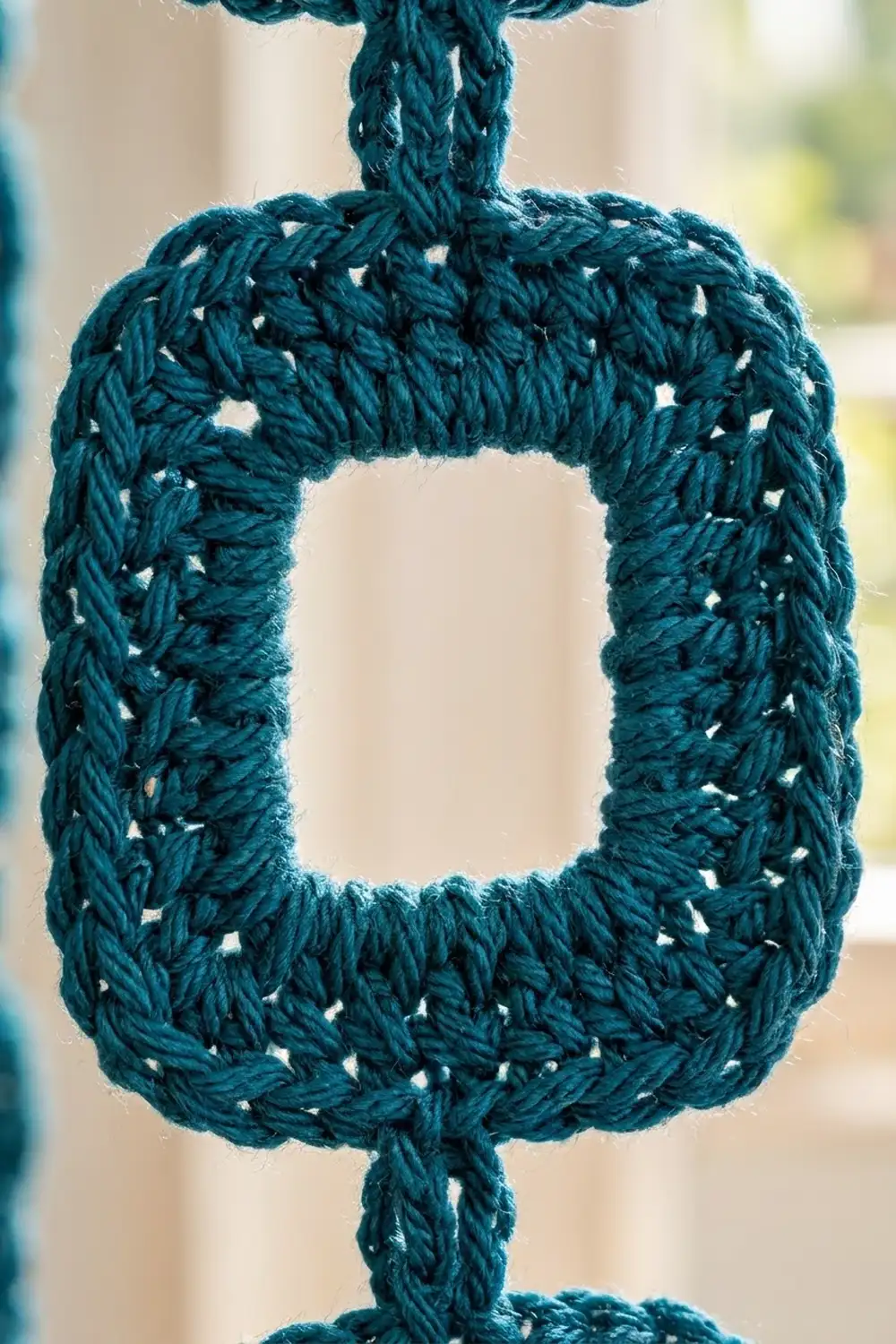
Square Ring Motif (make 126 per panel)
The motif is worked in the round on the RS throughout. Don’t turn.
Foundation: Ch 24 and sl st in the first ch to form a ring, taking care not to twist the chain. This ring forms the square opening.
Round 1 (conversion round): Ch 1. Working into each ch (not around the ring), sc in next 5 ch, 3 sc in next ch; rep from * 3 more times. Sl st in first sc to join.
Count: 24 sts worked 1-per-ch + 8 extra corner sts = 32 sc. The middle sc of each 3-sc group is a corner center*. Mark it.
Round 2 (growth round): Ch 3 (counts as dc). Dc in each st around, working 3 dc in each corner center sc. Sl st in top of ch-3 to join.
Count: 32 sts worked 1-per-st + 8 extra = 40 dc. Move the markers to the middle dc of each 3-dc corner.
Round 3 (trim round): Ch 1. Sc in each st around, working 3 sc in each corner center dc. Sl st in first sc to join. Fasten off and weave in the ends.
Count: 40 sts worked 1-per-st + 8 extra = 48 sc.
Side count: Each side now has 11 side stitches between two corner center stitches. The 4 corner centers are counted separately: 4 x 11 + 4 = 48. The links and the header join use only these 11 side stitches. The corners stay free, which keeps them softly rounded.
Spreading the increases as 3 stitches per corner on every round gives the rounded-square look shown, rather than sharp points.
Linking the Strands
Each strand is 18 motifs joined by 17 short straps. Lay the motifs in a column, RS up. Call the bottom side of the upper motif the “lower side” and the top side of the next motif the “upper side.”
Link strap:
– Row 1: With RS facing, join yarn in the 5th of the 11 side sts on the lower side of the upper motif. Ch 1, sc in the 5th, 6th, and 7th side sts. (3 sc, centered on the side’s 6th, middle stitch)
– Rows 2–3: Ch 1, turn, sc in each sc. (3 sc)
– Joining: Ch 1, turn. Hold the next motif so its upper side touches the strap. Working through the strap and the 5th, 6th, and 7th side sts of that side together, sl st in each of the 3 sts. Fasten off.
Three rows of sc give a strap 0.75 in (1.9 cm) long. Center spacing from one motif to the next is 4.25 in (10.8 cm).
Strand checkpoint: After 6 motifs, a strand should measure 24.75 in (62.9 cm). A finished strand of 18 motifs measures 18 x 3.5 in + 17 x 0.75 in = 63 in + 12.75 in = 75.75 in (192.4 cm).
Keep the strap tension the same as your motifs. Tight straps pucker the sides of the rings. Loose straps make strands of different lengths.
Make All Pieces
Per panel:
– 126 motifs (7 strands x 18 motifs)
– 119 link straps (7 strands x 17 links)
– 1 header band
– 5 tabs
For a pair, double everything: 252 motifs, 238 links, 2 headers, 10 tabs.
Layout grid (one panel, M = motif, | = link):
[==========  HEADER BAND, 105 sts  ==========]
  M   M   M   M   M   M   M     row 1
  |   |   |   |   |   |   |
  M   M   M   M   M   M   M     row 2
  |   |   |   |   |   |   |
  ...  rows 3 to 17 repeat  ...
  |   |   |   |   |   |   |
  M   M   M   M   M   M   M     row 18
Make all 7 strands before starting the header. Lay them side by side and check that their lengths match within 0.25 in (0.6 cm).
Joining the Strands to the Header
The strands are joined to the header’s foundation edge with one row of joining sc. Each strand’s top motif is joined 1-to-1: 11 motif side sts to 11 header sts.
Header Row 1 (foundation): Ch 106. Sc in 2nd ch from hook and in each ch across. (105 sc)
Work the header (see next section) first, then come back to its foundation edge.
Joining Row: With RS of the header facing and the foundation edge at the top, join yarn in the first foundation loop at the right. Ch 1, sc in the first 5 loops. Hold the top motif of the next strand behind the header, upper side at the edge. Work a joining sc through the next foundation loop and the 1st side st of the motif. Repeat in each loop for all 11 side sts. Sc in the next 3 loops only. Repeat from * 5 more times. Work 11 joining sc into the 7th strand, then sc in the last 5 loops. Fasten off.
Count: 5 + (7 x 11) + (6 x 3) + 5 = 5 + 77 + 18 + 5 = 105 sc. That matches the header width exactly. No extra stitches are added at the seams.
The 3 free stitches between strands, plus each motif’s free rounded corner stitches, leave a gap of about 0.5 in (1.3 cm) between rings.
Tension tip: Work the joining sc at your normal tension. Lay the header flat every two strands. If the edge ruffles, you’re pulling too loose; if it draws in, ease up.
Size checkpoint: The joined edge should measure 30 in (76.2 cm), the same as the header.
Header Band (Top Border) and Tabs
Border gauge: 14 hdc and 10 rows = 4 in (10.2 cm), so 105 sts = 30 in (76.2 cm).
Row 1: Foundation sc row, already worked above. (105 sc)
Rows 2–15: Ch 1, turn. Hdc in each st across. (105 hdc each row). Ch 1 doesn’t count as a stitch. These 14 rows add 5.6 in (14.2 cm).
Row 16: Ch 1, turn. Sc in each st across. (105 sc). Don’t fasten off.
The header is now about 6 in (15.2 cm) deep. It is slightly tighter than the motifs and gives the curtain a steady top edge.
Edge round (optional, for neat sides): Ch 1, then work 1 sc in the end of each sc row and 2 sc in the end of each hdc row down each short side. Sl st to finish. This doesn’t change the 105-stitch top or bottom counts.
Tab placement across Row 16 (105 sts):
3 free + [7 tab + 16 free] x 4 + 7 tab + 3 free = 3 + 92 + 7 + 3 = 105.
Each tab: Join yarn in the first tab stitch.
– Row 1: Ch 1, sc in the 7 tab sts. (7 sc, 2 in / 5.1 cm wide)
– Rows 2–24: Ch 1, turn, sc in each sc. (7 sc)
At 16 rows per 4 in (10.2 cm), 24 rows measure 6 in (15.2 cm). Fold each tab to the WS of the header and sew its last row along the line of Row 14. The result is a loop about 3 in (7.6 cm) deep that fits a rod up to 1.25 in (3.2 cm) across.
Why the math works: The header has the same 105 sts on every row. The joining row places 7 strands of 11 sts with fixed 3-st gaps and 5-st edges. The tab row uses 35 tab sts and 70 free sts. All three totals are 105, so nothing gets stretched or gathered.
Final Blocking
- Weave in all the remaining tails, running each one through at least 2 in (5.1 cm) of stitches.
- Lay the panel flat on your blocking surface, RS up.
- Pin the header to 30 in (76.2 cm) wide and 6 in (15.2 cm) deep.
- Straighten each strand so that it hangs down from the header. Pin each motif at its 4 corners to 3.5 in (8.9 cm) square.
- Check that the panel measures 81.75 in (207.6 cm) from the top of the header to the bottom of the last row of rings.
- Mist with water until damp, but not soaked.
- Let it dry completely, at least 24 hours, before unpinning.
- Hang it. Cotton settles a little over the first week, so check the length after that.
Final Quality-Control Checklist
- Every motif has 48 sts and measures 3.5 in (8.9 cm).
- All corners are rounded, not pointed.
- Every strand has 18 motifs and 17 links, each 0.75 in (1.9 cm).
- All strands measure 75.75 in (192.4 cm).
- The header measures 30 in (76.2 cm) wide and about 6 in (15.2 cm) deep, with 105 sts per row.
- The joining row has 105 sc with 11 joined sts per strand.
- 5 tabs are evenly spaced and sewn down securely.
- No twisted motifs. Every RS faces the same way.
- All ends are woven in and trimmed.
Troubleshooting
Motif is round instead of square: Check that you placed 3 sts in each corner center on every round. Missing a corner increase pulls that side into a curve.
Center opening is closing up: Your foundation chain is too tight. Chain with a hook 0.5 mm larger, then switch back for Round 1.
Motif cups or waves: Cupping means your dc are short; waves mean they’re tall. Adjust your tension, or change hook size by 0.5 mm.
Strands are different lengths: Measure every link. A single extra row in one strap adds 0.25 in (0.6 cm). Rework any strap that doesn’t match.
Header ruffles at the joining row: Recount it. Each strand should take exactly 11 joining sc, never 12 or 13.
Curtain twists when hung: Not all the motifs are facing RS out. Block again, pinning each ring flat.
Care
Hand wash or machine wash on a gentle cold cycle in a mesh laundry bag. Then reshape and dry flat. Don’t hang it to dry while wet, as the weight can stretch the strands.
Final Notes
Each part of the measurement chain builds on the one before it. Your gauge of 14 sc = 4 in (10.2 cm) gives a 48-st motif of 3.5 in (8.9 cm). Eighteen motifs and seventeen 0.75 in (1.9 cm) links make a 75.75 in (192.4 cm) strand. Seven strands of 11 joined sts each fit exactly into a 105-st, 30 in (76.2 cm) header. The 6 in (15.2 cm) header brings the panel to 81.75 in (207.6 cm), and the tabs add about 3 in (7.6 cm) of hanging loop. If you check each stage, the finished panel will come out right.
Happy crocheting!