

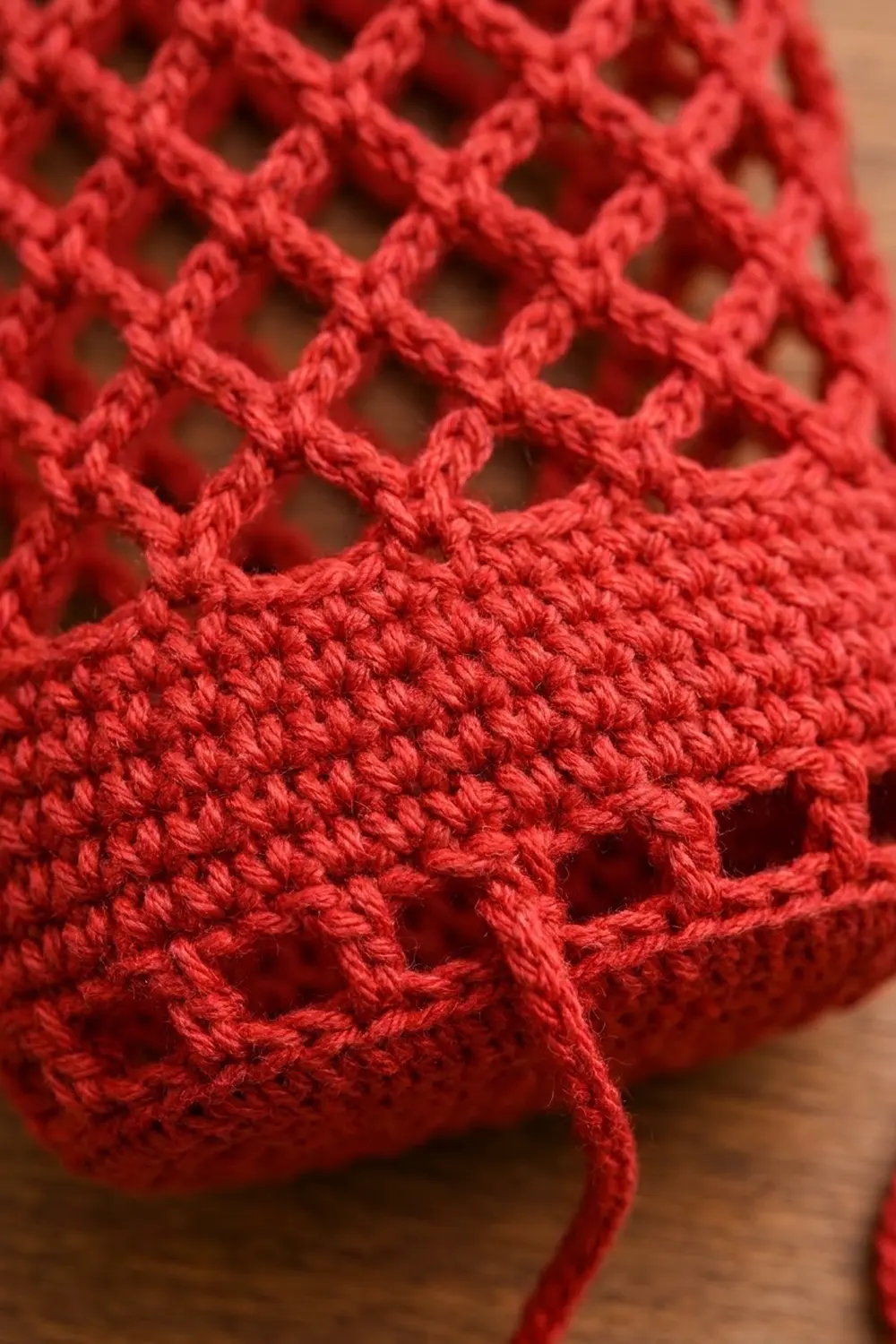
The Lattice Keeper is a hanging bag holder that turns a messy pile of grocery bags into something tidy. It’s a tall tube with a solid band at the top and bottom and an open diamond lattice in between. Stuff bags in through the top and pull them out one at a time through the gathered bottom.
The sample shown is made twice, once in bright red and once in royal blue. Each holder uses one color only, so it’s an easy project for using up a single skein. The lattice lets you see what’s inside and keeps the holder light, while the solid bands give it shape at both ends.
This pattern uses US crochet terms. The finished holder measures 5 in (12.7 cm) wide when flat (10 in / 25.4 cm around) and 15 in (38.1 cm) tall, not counting the hanging loop.
Construction overview: You work the body as one seamless tube from the bottom up: first a solid band with an eyelet round, then a chain-loop mesh, then a solid top band. The hanging strap and the drawstring cord are made separately. The strap is sewn inside the top rim and the cord is threaded through the eyelets.
Finished Size and Construction
- Finished size: 5 in (12.7 cm) wide flat × 15 in (38.1 cm) tall
- Circumference: 10 in (25.4 cm)
- Skill level: Easy
- Terminology: US crochet terms
- Yarn weight: #4 worsted
- Hook: 5.0 mm (H-8)
- Number of pieces: 1 body tube + 1 strap + 1 drawstring cord
- Layout: Single tube worked in joined rounds
- Piece size: 40 stitches around; 5 in (12.7 cm) flat width
- Size before border (top band): 5 × 13 in (12.7 × 33.0 cm)
- Border depth (top band): 2 in (5.1 cm)
Materials
Yarn: Use a worsted-weight (#4) acrylic or cotton. Acrylic is light and springs back well. Cotton is firmer and holds the lattice open nicely, but it’s heavier. Avoid very fuzzy yarns, since they blur the diamond pattern.
- Red (sample 1): 75 g / about 140 m per holder
- Blue (sample 2): 75 g / about 140 m per holder
You only need one color per holder. These quantities include a margin of about 15% to cover gauge differences and a test swatch.
Tools:
- 5.0 mm (H-8) crochet hook
- Stitch marker
- Tapestry needle
- Scissors
- Measuring tape
- Rustproof pins and a spray bottle for blocking
Abbreviations (US Terms)
- ch: chain
- sl st: slip stitch
- sc: single crochet
- dc: double crochet
- sk: skip
- sp: space
- st(s): stitch(es)
- rnd(s): round(s)
Special stitch: chain loop (ch-5 loop). Chain 5, then anchor with an sc in the next stitch or loop as stated. In every mesh round, each new loop is anchored at the center of a loop from the round below. Doing this round after round builds the diamond lattice.
Gauge and Checkpoints
Gauge: 16 sc and 18 rnds = 4 in (10.2 cm) in sc worked in the round.
Mesh gauge: 4 mesh rnds = 2 in (5.1 cm) when lightly stretched lengthwise.
Test the piece first: Work Rnds 1–8 (the bottom band), then stop and measure. This band is your gauge swatch.
Checkpoints:
- After Rnd 8: Circumference is 10 in (25.4 cm), flat width is 5 in (12.7 cm), and band height is 2 in (5.1 cm).
- After Rnd 30: Total height is 13 in (33.0 cm) when lightly stretched.
- After Rnd 39: Total height is 15 in (38.1 cm) and flat width is 5 in (12.7 cm) at the top band.
If your band is too big (more than 5 in / 12.7 cm flat), go down a hook size and start again. If it’s too small, go up a hook size. Change hook size instead of the stitch count, because the mesh repeat needs exactly 40 stitches.
Body: Bottom Band
Join every round with a sl st to the first st. The ch-1 at the start of a round doesn’t count as a stitch.
Rnd 1: Ch 40. Join with a sl st to the first ch to form a ring, making sure the chain isn’t twisted. Ch 1, sc in each ch around, sl st to the first sc. (40 sc)
Rnd 2 (eyelet round): Ch 4 (counts as dc + ch 1), sk next st, dc in next st, ch 1, sk next st; repeat from * 19 times, then sl st to the 3rd ch of the beginning ch-4. (20 dc + 20 ch-1 sps = 40 sts)
This round makes the 20 square eyelets for the drawstring.
Rnd 3 (conversion round): Ch 1, sc in the same st, sc in the next ch-1 sp, sc in next dc, sc in next ch-1 sp; repeat from * around, sl st to the first sc. (20 sc into dc + 20 sc into ch-1 sps = 40 sc)
Rnds 4–8: Ch 1, sc in each st around, sl st to the first sc. (40 sc)
Checkpoint: The band is 5 in (12.7 cm) wide flat and 2 in (5.1 cm) tall. The eyelets sit about 0.25 in (0.6 cm) above the bottom edge.
Body: Diamond Mesh
Rnd 9 (mesh setup): Ch 1, sc in the first st, ch 5, sk 3 sts, sc in next st, ch 5, sk 3 sts; repeat from * 9 times, then sl st to the first sc. (10 ch-5 loops)
Each repeat uses 4 band stitches: 10 repeats × 4 = 40 stitches, so the loops fit the band exactly.
Rnd 10: Sl st in each of the first 3 ch of the next loop (this moves you to the center of the loop). Ch 1, sc in the same loop, ch 5, sc in next ch-5 loop; repeat from * 8 times, then ch 5, sl st to the first sc. (10 ch-5 loops)
Rnds 11–30: Repeat Rnd 10. (10 ch-5 loops in each rnd)
Including the setup round, you’ve now worked 22 mesh rounds. At 4 mesh rounds per 2 in (5.1 cm), the mesh is 11 in (27.9 cm) tall.
Tips for an even lattice:
- Keep each ch-5 the same length. Uneven chains make crooked diamonds.
- Always anchor the sc around the center of the loop below, not into a chain stitch. This keeps the diamonds centered.
- The beginning sl sts shift the round start slightly each time. This is expected and doesn’t show in the finished lattice.
Checkpoint: Total height is 13 in (33.0 cm) when you hold the tube up and let it hang. The relaxed mesh may lie a little wider than the band, about 5 to 5.5 in (12.7 to 14.0 cm) flat. The top band will pull it back in.
Border: Top Band
The top band is the border of the tube. It closes the mesh into a firm rim that holds its shape when the holder is full.
Border gauge: Same as the body, 16 sc and 18 rnds = 4 in (10.2 cm).
Rnd 31 (conversion round): Ch 1, sc in the same sc, 3 sc in the next ch-5 loop, sc in next sc, 3 sc in next ch-5 loop; repeat from * 8 times, then sl st to the first sc. (10 sc into the anchor sc + 30 sc into the loops = 40 sc)
Rnds 32–39: Ch 1, sc in each st around, sl st to the first sc. (40 sc)
Fasten off and weave in the end.
Per-side count: When the tube is flattened, the top band has 20 sc on the front and 20 sc on the back. There are no corner stitches to add, because the tube is seamless and the fold lines fall between stitches. 20 + 20 = 40.
Why the math works: The bottom band has 40 sts. The mesh uses those 40 sts as 10 loops of 4 sts each. Rnd 31 turns each loop back into 4 sts (1 sc in the anchor + 3 sc in the loop), giving 10 × 4 = 40. Top and bottom match exactly, so both bands measure 5 in (12.7 cm) flat. With 9 rounds at 18 rnds per 4 in (10.2 cm), the band is 2 in (5.1 cm) deep.
Checkpoint: Total height is 15 in (38.1 cm). The top band is 5 in (12.7 cm) flat and should lie straight, without flaring or pulling in.
Hanging Strap
Row 1: Ch 41, sc in the 2nd ch from the hook and in each ch across. Turn. (40 sc)
Row 2: Ch 1, sl st in the back loop of each st across. (40 sl sts)
Fasten off and leave a 12 in (30.5 cm) tail. The strap should be about 10 in (25.4 cm) long. The slip-stitch row makes it thick and firm, like a cord.
To attach: Fold the strap in half to make a loop. Position the two ends inside the back of the top band, 1 in (2.5 cm) apart and centered, with each end overlapping the band by 1.5 in (3.8 cm). Use the tail to sew each end firmly through Rnds 32–39, going through only the inside layer so the stitching doesn’t show on the front. The finished loop rises about 3.5 in (8.9 cm) above the rim.
Drawstring Cord
Row 1: Ch 121, sl st in the back bump of the 2nd ch from the hook and in each ch across. (120 sl sts)
Fasten off. The cord should measure about 26 in (66.0 cm).
To finish the cord: Tie an overhand knot about 0.5 in (1.3 cm) from each end and trim the tails close to the knots. These knots give the small bead-like ends shown in the photo.
To thread: Starting at the center front, weave the cord in and out through the 20 eyelets of Rnd 2, so both ends come out at the front, side by side. Pull the cord to gather the bottom into an opening about 1.5 in (3.8 cm) across, then tie a bow. If you can’t pull bags out easily, loosen the bow.
Final Blocking
- Lightly spray the body with water until it’s damp but not soaked. If you’re using acrylic, you can steam it instead, holding the iron above the fabric without touching it.
- Lay the tube flat on a blocking mat with the strap fold at the center back.
- Pin the top and bottom bands to 5 in (12.7 cm) wide.
- Pin the total height to 15 in (38.1 cm), easing the mesh so the diamonds look even.
- Run your fingers along each diamond column to straighten any loops that lean.
- Let it dry completely before you remove the pins.
- Do not block the drawstring. Just smooth it by hand.
Final Quality-Control Checklist
- Rnd 1 ring is not twisted.
- Each band round has 40 sts, and the eyelet round has 20 dc + 20 ch-1 sps.
- Each mesh round has 10 ch-5 loops.
- Rnd 31 has 40 sc (10 + 30).
- Both bands are 5 in (12.7 cm) wide flat.
- Total height is 15 in (38.1 cm).
- The strap is sewn securely through the inside layer only.
- The drawstring passes through all 20 eyelets and both ends come out at the front.
- All ends are woven in securely.
Troubleshooting
The diamonds are lopsided. You’re anchoring into a chain stitch instead of around the loop center. Work the sc around the whole loop.
The mesh spirals. Check that every round has exactly 10 loops and that you sl st 3 ch at the start, not 2 or 4.
The top band flares. Your Rnd 31 tension is loose. Redo it with a firmer tension, or use one hook size smaller for Rnds 31–39.
The top band pulls in. Make sure you worked exactly 3 sc in every loop. Too few stitches makes the band cinch.
Bags fall out on their own. Tighten the bow, or tie a double knot before the bow.
The strap stretches under weight. Sew through more band rounds, or work a second sl st row along the other edge of the strap.
Care
Hand wash in cool water, press out the water gently, and lay flat to dry. Acrylic holders can go in a mesh laundry bag on a gentle cycle and be reshaped while still damp.

Final Notes
Each measurement builds on the one before it. Get the bottom band to 40 sts and 5 in (12.7 cm) flat first. The mesh turns those 40 sts into 10 loops, and 22 mesh rounds bring the height to 13 in (33.0 cm). The top band turns the 10 loops back into 40 sts and adds 2 in (5.1 cm), for a finished holder 5 × 15 in (12.7 × 38.1 cm). Add the 10 in (25.4 cm) strap and the 26 in (66.0 cm) drawstring, and your Lattice Keeper is ready to hang. Make one in each color for different rooms, or match it to your kitchen.
Happy crocheting!