

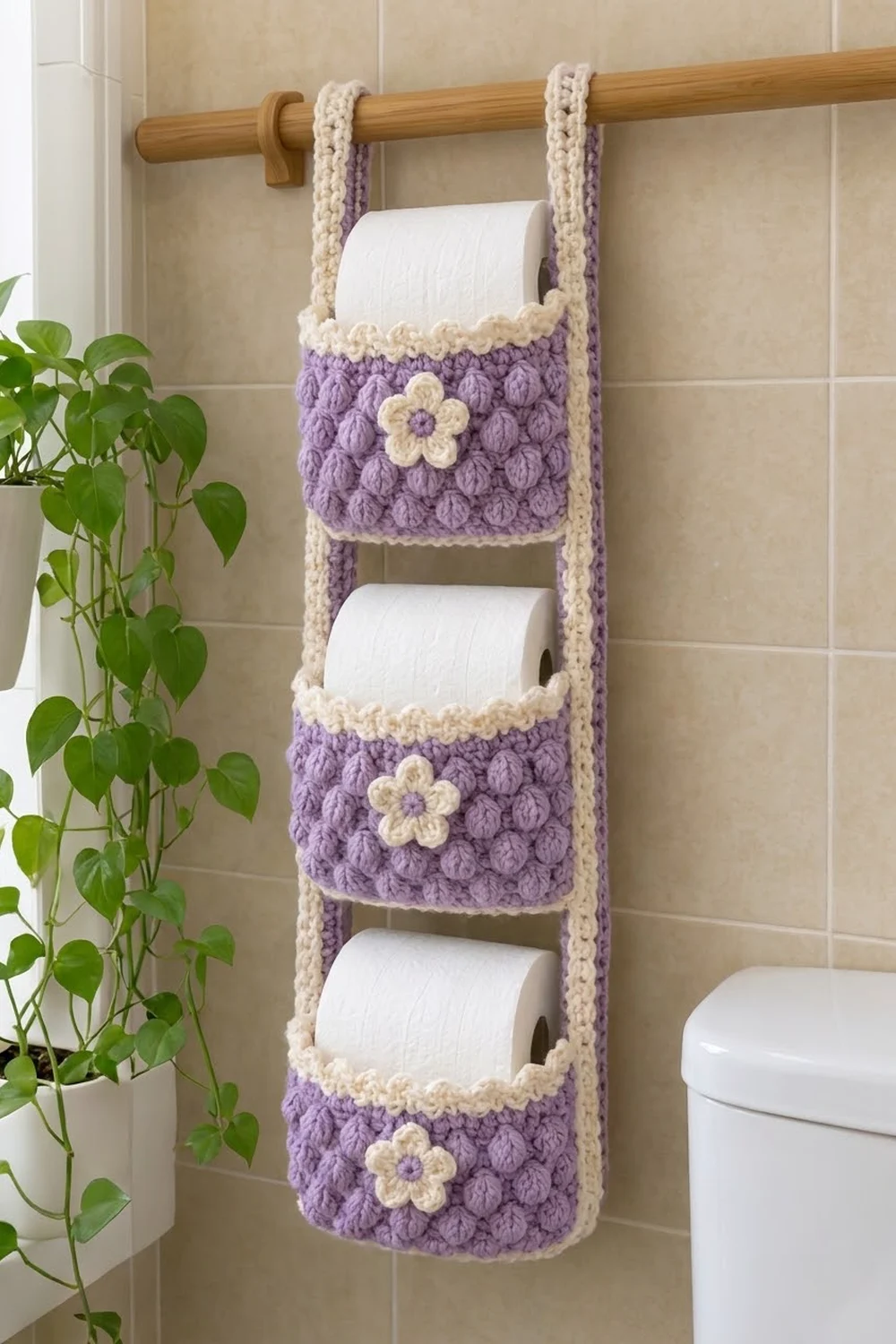
This hanging toilet paper holder keeps three spare rolls in sight and within reach. Three soft lavender pockets hang one above the other on two cream straps, and the whole thing loops over a towel rod or wooden dowel.
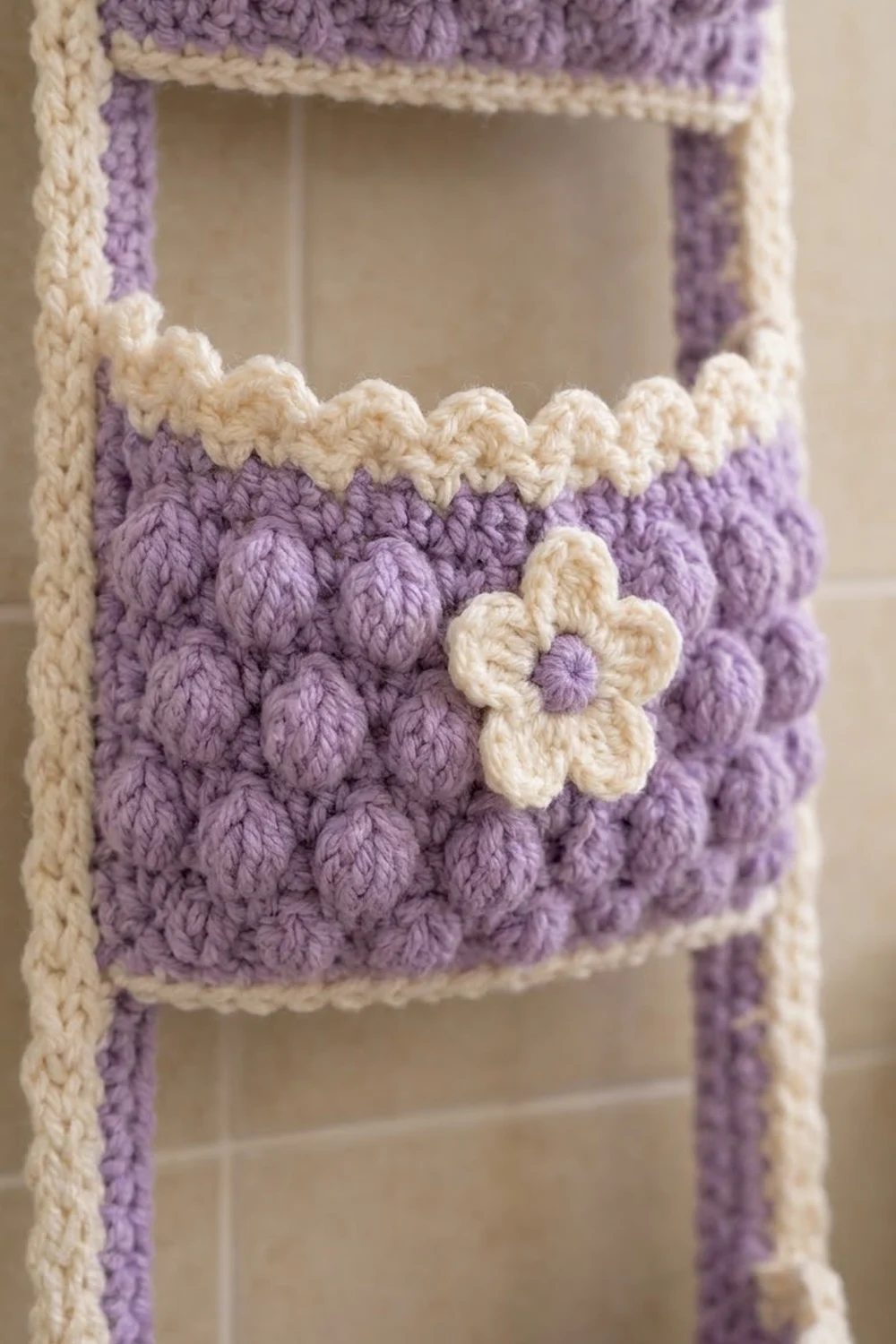
Each pocket is covered in rows of offset bobbles, which gives it a padded, quilted look. A cream ridge outlines the base, a cream band with small scallops trims the top, and a cream flower with a lavender center sits on each pocket front. The style is cottage-sweet but neat, and it looks good on a small bathroom wall.
The pattern uses US crochet terms. The finished holder is about 6 in (15.2 cm) wide and 32.5 in (82.6 cm) tall. Each pocket measures 6 in (15.2 cm) wide, 5 in (12.7 cm) deep and 4.5 in (11.4 cm) tall.
Construction is simple. Each pocket starts as a flat rectangular base. A back-loop round turns the walls upward, and the walls are worked in joined, turned rounds with bobbles on the wrong-side rounds. The straps are worked lengthwise in single crochet. The flowers are sewn on, the straps are whipstitched to the back corners of the pockets, and the top of each strap is folded into a hanging loop.
Finished Size and Construction
- Finished size: 6 in (15.2 cm) wide x 32.5 in (82.6 cm) tall, hanging
- Skill level: Intermediate (bobbles, working in rounds, seaming)
- Terminology: US crochet terms
- Yarn weight: Worsted (#4)
- Hook: 5.0 mm (H-8)
- Number of pieces: 8 (3 pockets, 2 straps, 3 flowers)
- Layout: 3 pockets stacked vertically, 1 column, on 2 parallel straps
- Pocket size: 6 in (15.2 cm) wide x 5 in (12.7 cm) deep x 4.5 in (11.4 cm) tall
- Pocket height before top trim: 3.75 in (9.5 cm)
- Top trim depth: 0.75 in (1.9 cm): one cream round plus the scallops
- Strap size: 35 in (88.9 cm) x 1 in (2.5 cm) before folding
Materials
Use a smooth worsted-weight cotton or cotton blend. Cotton holds the basket shape and shows each bobble clearly. Acrylic also works, but the pockets will be softer and may sag a little. The amounts below assume about 200 m (219 yd) per 100 g.
- Lavender: 180 g, about 360 m (394 yd), for the bases, bobble walls and flower centers
- Cream: 100 g, about 200 m (219 yd), for the edge rounds, scallops, straps and flower petals
Tools:
- 5.0 mm (H-8) crochet hook
- Tapestry needle
- Scissors
- 8 locking stitch markers
- Measuring tape
- Steam iron or spray bottle
- Optional: wooden dowel or rod up to 1.5 in (3.8 cm) across
Both yarn amounts include about a 15% margin for swatching and weaving in ends.
Abbreviations (US Terms)
- ch: chain
- sc: single crochet
- hdc: half double crochet
- dc: double crochet
- sl st: slip stitch
- BLO: back loop only
- st(s): stitch(es)
- sk: skip
- rep: repeat
- RS / WS: right side / wrong side
- yo: yarn over
Special stitch: bobble. Yo, insert the hook in the stitch, yo and pull up a loop, yo and pull through 2 loops; repeat from * to * 3 more times in the same stitch (5 loops on hook). Yo and pull through all 5 loops. A bobble counts as 1 stitch. You always work bobbles on WS rounds, so they push out to the RS, which is the outside of the pocket.
Gauge and Checkpoints
Gauge: 16 sc and 16 rows = 4 in (10.2 cm) in firm single crochet with a 5.0 mm hook. The bobble pattern should match this gauge in both width and height.
Make one complete pocket before you start the others. It is your real gauge swatch.
Checkpoints:
- Base after Row 20: 6 in (15.2 cm) x 5 in (12.7 cm).
- After Round 2: the edge measures 22 in (55.9 cm) around, and the walls turn upward.
- After Round 16: the walls are 3.75 in (9.5 cm) tall, measured from the cream ridge.
- After Round 18: the pocket is 4.5 in (11.4 cm) tall, including the scallops.
- Strap after Row 4: 35 in (88.9 cm) x 1 in (2.5 cm).
If your base is too big, go down to a 4.5 mm hook. If it is too small, go up to a 5.5 mm hook. If only the walls run wide, your bobbles are too loose. Pull each one snug before you close it, and work the sc after it firmly. Check the fit with a real roll. It should lie on its side inside the pocket, with about 0.25 in (0.6 cm) of room at each end.
Pocket (Make 3)
Base
With lavender, ch 25.
Row 1: Sc in the 2nd ch from the hook and in each ch across, turn. (24 sc)
Rows 2–20: Ch 1, sc in each st across, turn. (24 sc)
At the end of Row 20, do not turn. Change to cream in the last yo. The base measures 6 in (15.2 cm) x 5 in (12.7 cm).
Edge and Turning Rounds
Work these two rounds with the bottom of the base facing you. This is the outside of the pocket.
Round 1 (cream): Ch 1. Work 24 sc down the first row-end edge, 1 in each row end. Work 20 sc across the foundation chain, 1 in each remaining loop. Work 24 sc up the second row-end edge. Work 20 sc across the top of Row 20. Join with a sl st to the first sc.
Count: 24 + 20 + 24 + 20 = 88 sc. Wait, that does not match the base shape. The row-end edges are 20 rows long and the chain edges are 24 sts long, so work it this way instead:
Round 1 (cream), corrected order: Ch 1. Work 1 sc in each of the 24 sts of Row 20. Work 1 sc in each of the 20 row ends down the side. Work 1 sc in each of the 24 foundation chains. Work 1 sc in each of the 20 row ends up the other side. Join with a sl st to the first sc.
Count: (24 + 20 + 24 + 20) worked 1 per existing stitch or row end, + 0 added = 88 sc.
Do not add extra corner stitches. The first and last stitch of each side are the corner stitches, so each side count already includes its corners. Keeping the corners tight helps the walls stand straight.
Round 2 (cream): Ch 1. Sc in the BLO of each st around. Join with a sl st to the first sc.
Count: 88 worked 1 per existing stitch + 0 added = 88 sc.
The unused front loops leave a cream ridge around the base, and the walls start to rise. Place markers in the 4 corner stitches. Per side, the count is 24 / 20 / 24 / 20. At the join, change to lavender, ch 1 and turn.
Bobble Walls
From here on, turn at the end of every round. Odd rounds are WS bobble rounds. Even rounds are RS plain rounds. Move the corner markers up as you go.
Round 3 (WS): Sc in the next st, bobble in the next st; rep from * around. Join, ch 1, turn. (44 sc + 44 bobbles = 88 sts)
Round 4 (RS): Sc in each st around. Join, ch 1, turn. (88 sc)
Round 5 (WS): Bobble in the next st, sc in the next st; rep from * around. Join, ch 1, turn. (44 bobbles + 44 sc = 88 sts)
Round 6 (RS): Sc in each st around. Join, ch 1, turn. (88 sc)
Rounds 7–16: Repeat Rounds 3–6 twice more, then Rounds 3–4 once more. (88 sts each round)
That gives you 7 bobble rounds. Rounds 5, 9 and 13 follow Round 5. Rounds 3, 7, 11 and 15 follow Round 3. Each new bobble row sits between the bobbles of the row below, which creates the offset pattern.
Each bobble round has 12 bobbles on each wide side and 10 on each narrow side. At the end of Round 16, change to cream, ch 1 and turn. The walls now measure 3.75 in (9.5 cm).
The cream top trim (Rounds 17–18) is in the Border section below. Finish it before you go on to the straps.
Strap (Make 2)
With cream, ch 141.
Row 1: Sc in the 2nd ch from the hook and in each ch across, turn. (140 sc)
Rows 2–4: Ch 1, sc in each st across, turn. (140 sc)
Fasten off and leave a 24 in (61.0 cm) tail for sewing. The strap measures 35 in (88.9 cm) x 1 in (2.5 cm). Long chains tend to stretch, so lay the strap flat to measure it, and don’t hang it.
Flower (Make 3)
Round 1 (lavender): Make a magic ring. Ch 1 and work 10 sc in the ring. Pull the ring closed and join with a sl st to the first sc. (10 sc) Fasten off.
Round 2 (cream): Join cream with a sl st in any sc. In the next sc, work (hdc, 2 dc, hdc). Sl st in the next sc. Rep from * 4 more times. Make the last sl st in the joining stitch. (5 petals)
Each petal uses one stitch and each sl st uses the next one, so the 5 repeats use all 10 stitches exactly. The flower measures about 1.75 in (4.4 cm) across. Leave a 10 in (25.4 cm) cream tail.
Make All Pieces
Before you assemble, check that you have all of these:
- Pockets: 3, in lavender with cream Rounds 1, 2, 17 and 18
- Straps: 2, in cream
- Flowers: 3, with lavender centers and cream petals
The layout, seen from the front with the loop at the top:
   [loop]                  [loop]
  | strap |               | strap |
  |       |               |       |
  |    [ Pocket 3 (top) ]    |
  |       |               |       |
  |    [ Pocket 2 (middle) ] |
  |       |               |       |
  |    [ Pocket 1 (bottom) ] |
The diagram is 1 column of 3 pockets. The straps run behind the back corners of every pocket.
Joining
Flowers first. Center one flower on the 24-stitch front of each pocket, between Rounds 8 and 11. Use the cream tail to sew around the center ring, then tack down the tip of each petal.
Mark the straps. Count stitches along one long edge of each strap, starting at the bottom end. Mark stitches 1, 39, 77 and 120. Strap stitches run 4 per inch, so this works out as:
- Bottom pocket: strap sts 1–16, 0–4 in (0–10.2 cm)
- Middle pocket: strap sts 39–54, 9.5–13.5 in (24.1–34.3 cm)
- Top pocket: strap sts 77–92, 19–23 in (48.3–58.4 cm)
- Loop fold point: after st 120, at 30 in (76.2 cm)
Stitch-to-stitch logic. The back corner of each pocket has 16 rounds between the cream ridge and the scallops: Rounds 2–17. That is 16 rounds at 4 rounds per inch, or 4 in (10.2 cm). The matching strap section has 16 stitches at 4 per inch, also 4 in (10.2 cm). Sew 1 strap stitch to 1 pocket round, with no easing and no skipped stitches.
Seam. Lay the strap on the 24-stitch back panel, with its outer long edge flush with the back corner marker. Whipstitch the outer edge to the corner column. Then whipstitch the inner edge to the 4th column in from that corner. Repeat on the other corner with the second strap. The space between the two straps is 16 stitches, or 4 in (10.2 cm).
Tension. Pull each whipstitch snug enough to close the gap, but not so tight that it puckers. The seam should lie as flat as the strap.
Loop. Fold the top 20 stitches (sts 121–140), which is 5 in (12.7 cm), to the back so stitch 140 meets stitch 120. Whipstitch across all 4 rows. You now have a loop 2.5 in (6.4 cm) tall.
Size check. The bases should be 9.5 in (24.1 cm) apart. The holder should measure 32.5 in (82.6 cm) from the top of the loop to the bottom edge. Both straps must match exactly.
Border
The border on each pocket is its cream top trim.
Border gauge: One scallop uses 4 stitches, which is 1 in (2.5 cm). Each scallop rises about 0.5 in (1.3 cm).
Round 17 (WS, cream): Sc in each st around. Join, ch 1, turn.
Count: 88 worked 1 per existing stitch + 0 added = 88 sc. Per side: 24 / 20 / 24 / 20.
Round 18 (RS, cream): Start at a corner marker. Sl st in the next st, sk 1 st, 5 hdc in the next st, sk 1 st; rep from * around. Join to the first sl st and fasten off.
Count: 88 sts used, made up of 22 sl sts + 22 shells of 5 hdc each (110 hdc).
Scallops per side:
- Front: 6 (24 sts ÷ 4)
- Side: 5 (20 sts ÷ 4)
- Back: 6 (24 sts ÷ 4)
- Side: 5 (20 sts ÷ 4)
Why the math works: Both side counts divide evenly by 4, and each side starts on its own corner stitch. So every side ends on a full scallop, and no shell wraps around a corner. That is why the base is 24 x 20 stitches: 6 + 5 + 6 + 5 = 22 scallops, using all 88 stitches.
Final Blocking
- Weave in all ends along the seams, away from the bobbles.
- Slide a roll into each pocket, or pack it with a folded washcloth, so it holds a box shape.
- Steam each pocket lightly, or mist it, and keep the iron 1 in (2.5 cm) above the fabric. Never press the bobbles flat.
- Pinch the 4 corners straight while the fabric is damp.
- Pin the straps flat at their marked lengths and let them dry.
- Lay the holder flat until it is completely dry, then hang it.
Final Quality-Control Checklist
- Each pocket is 6 in (15.2 cm) x 5 in (12.7 cm) x 4.5 in (11.4 cm).
- Every bobble round has 44 bobbles, offset from the round below.
- Every pocket has 22 scallops (6 / 5 / 6 / 5).
- The cream ridge runs unbroken around each base.
- The flowers are centered on the fronts and all petal tips are tacked down.
- The pocket bases are 9.5 in (24.1 cm) apart on both straps.
- Both loops are 2.5 in (6.4 cm) tall and sit level.
- The full length is 32.5 in (82.6 cm).
Troubleshooting
- Walls flare outward: The corners have too many stitches, or the bobbles are loose. Recount for 88 stitches and tighten your bobbles.
- Bobbles show on the inside: You worked them on a RS round. Bobbles belong on odd (WS) rounds only.
- Bobbles stack instead of offsetting: You repeated the same opening twice. Alternate between “sc, bobble” and “bobble, sc.”
- Scallops don’t fit the sides: Your count is not 88, or you didn’t start at a corner stitch.
- Pockets tilt forward: Sew the inner edge of each strap as well as the outer edge.
- Straps are different lengths: Re-measure them flat and adjust the loop fold point by 1–2 stitches.
Care
Hand wash in cool water, then reshape and dry flat with the pockets packed. Don’t tumble dry, because it crushes the bobbles and stretches the straps.
Final Notes
Each measurement leads to the next. Gauge of 16 stitches and 16 rows per 4 in (10.2 cm) gives a 24 x 20 stitch base of 6 in (15.2 cm) by 5 in (12.7 cm). That base gives an 88-stitch wall, 22 in (55.9 cm) around. The wall rises 3.75 in (9.5 cm) to Round 16, and the trim brings it to 4.5 in (11.4 cm). The trim gives 22 even scallops, the 16-round back corners match 16 strap stitches, and the 140-stitch straps finish at 32.5 in (82.6 cm). If you check each step as you go, the finished holder will hang straight and level.
Happy crocheting!