

This wall hanging brings a soft spring garden indoors. Six beaded strands drop from a rope-wrapped dowel. Each one carries little crochet bells with scalloped rims, five-petal flowers, four-leaf clovers, glossy pearls and a lavender tassel at the tip.
The palette is gentle. Lavender is used for the bells, flowers, hanging tabs and tassels, and cream for the flower centers. The clovers come in two greens, light sage and a deeper olive. Cream pearls tie everything together and catch the window light.
The pattern uses US crochet terms. The finished hanging measures 16 in (40.6 cm) wide and about 20.5 in (52.1 cm) tall, from the top of the dowel to the tip of the longest tassel.
Construction is simple. You crochet every motif separately:
– the bells top-down in the round
– the flowers and clovers as flat motifs
– short tabs that wrap around the dowel
Then you string the motifs and pearls onto cotton cord and tie each strand to its tab.
Finished Size and Construction
- Finished size: 16 in (40.6 cm) wide x about 20.5 in (52.1 cm) tall
- Skill level: Easy (advanced beginner)
- Terminology: US crochet terms
- Yarn weight: DK / light (3) cotton
- Hook: 3.5 mm (E-4)
- Number of pieces: 27 crocheted pieces (12 bells, 3 flowers, 6 clovers, 6 tabs), plus 6 tassels
- Layout: 6 strands spaced 2.5 in (6.4 cm) apart, alternating Strand A (long) and Strand B (short)
- Piece sizes: bell 2.9 in (7.4 cm) tall; flower 2.3 in (5.8 cm) across; clover 2.5 in (6.4 cm) across; tab 0.8 in (2.0 cm) x 3.6 in (9.1 cm)
- Bell size before rim: 2.4 in (6.1 cm) wide when flattened
- Rim (border) depth: about 0.5 in (1.3 cm)
Materials
Choose a smooth mercerized or combed DK cotton. Cotton gives crisp stitch definition, holds the bell shape and doesn’t fuzz around the pearls.
- Lavender: 100 g (about 230 m) for bells, flowers, tabs and tassels
- Cream: 5 g (about 12 m) for flower centers
- Light sage green: 15 g (about 35 m) for 3 clovers
- Olive green: 15 g (about 35 m) for 3 clovers
Tools and extras:
- 3.5 mm (E-4) crochet hook
- Tapestry needle and scissors
- About 110 cream pearl beads, 8 mm, with holes that fit your cord
- 1 mm cream cotton or nylon cord: 3 lengths of 30 in (76.2 cm) and 3 lengths of 26 in (66.0 cm)
- Wooden dowel, 16 in (40.6 cm) long and 0.75 in (1.9 cm) thick
- Jute twine for wrapping the dowel, plus 24 in (61.0 cm) more for the hanger
- Cardboard strip 2.5 in (6.4 cm) tall for the tassels
- Stitch marker, ruler and fabric glue (optional)
All quantities include a margin of about 15% to cover gauge swatches and small differences in tension.
Abbreviations (US Terms)
- MR – magic ring
- ch – chain
- sl st – slip stitch
- sc – single crochet
- hdc – half double crochet
- dc – double crochet
- tr – treble crochet
- inc – 2 sc in the same stitch
- sk – skip
- st(s) – stitch(es)
- rnd(s) – round(s)
Special stitch – Scallop: sk 1 st, 5 dc in next st, sk 1 st. Each scallop uses 3 base stitches. The sl st between scallops uses a fourth.
Gauge and Checkpoints
Gauge: 5 sc and 5.5 rnds = 1 in (2.5 cm), worked in continuous sc rounds with a 3.5 mm hook.
Make one bell, one flower and one clover before you start the full set. If they measure correctly, these test pieces become part of the hanging.
Checkpoints:
- Bell Rnd 3: flat disk about 1.1 in (2.8 cm) across
- Bell Rnd 13: 2.4 in (6.1 cm) wide when flattened
- Finished bell: 2.9 in (7.4 cm) tall
- Flower Rnd 2: 1.3 in (3.3 cm) across
- Clover Rnd 3: 2.1 in (5.3 cm) across
If your pieces are too big, go down to a 3.25 mm hook. If they are too small, go up to a 3.75 mm hook. Bells should be firm enough to hold their shape. If the fabric is floppy, go down a hook size even if the width is close.
Bell (Make 12, Lavender)
Bells are worked top-down in continuous rounds. Do not join; move your stitch marker up each round.
Rnd 1: MR, 6 sc in ring. (6)
Rnd 2: Inc in each st around. (12)
Rnd 3: [Sc in next st, inc] 6 times. (18)
Rnd 4: Sc in each st around. (18)
Rnd 5: [Sc in next 2 sts, inc] 6 times. (24)
Rnds 6–11: Sc in each st around. (24)
Rnd 12: [Sc in next 3 sts, inc] 6 times. (30)
Rnd 13: Sc in each st around. (30)
Check that the bell measures 2.4 in (6.1 cm) wide when flattened. The increases in Rnd 12 start the gentle flare above the rim. Continue to the rim in the Border section below.
Pull the magic ring snug, but leave a small opening just large enough for the cord to pass through. Do this before you weave in the top tail.
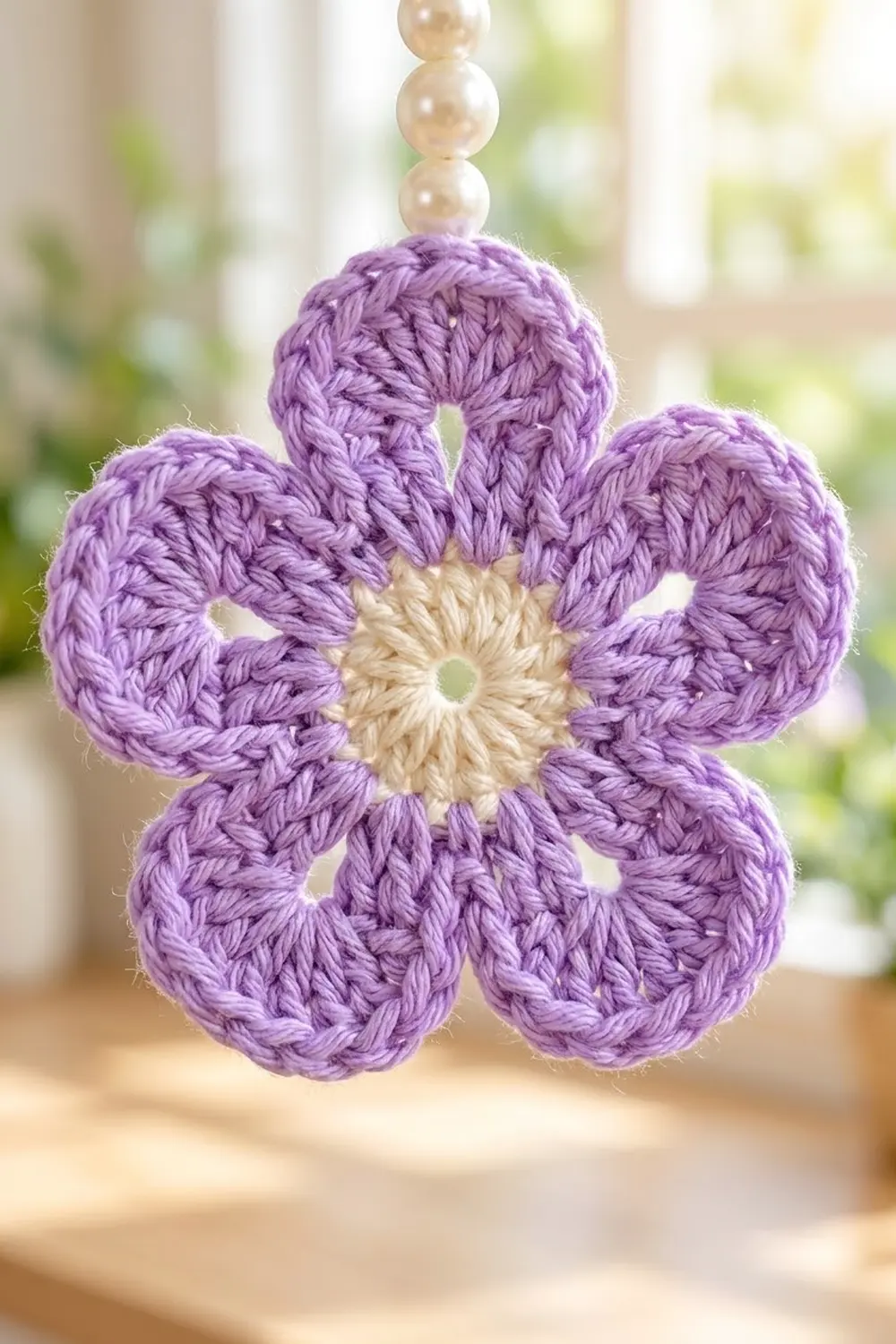
Flower (Make 3, Cream and Lavender)
Rnd 1 (cream): MR, 10 sc in ring, sl st to first sc to join. (10) Fasten off.
Rnd 2 (lavender): Join with sc in any st, sc in same st, 2 sc in each remaining st, sl st to first sc. (20)
Rnd 3 (lavender): Sl st in next st, (hdc, 3 dc) in next st, (3 dc, hdc) in next st, sl st in next st; repeat from * 4 more times. (5 petals of 10 sts each = 50 sts)
Sl st to the first sl st and fasten off. Each petal uses 4 base stitches, and 5 x 4 = 20, so the petals land evenly on Rnd 2. The two sl sts between petals form the clear V-shaped gaps.
Clover (Make 3 Light Sage, 3 Olive)
Rnd 1: MR, 8 sc in ring, sl st to first sc. (8)
Rnd 2: Ch 1, 2 sc in each st around, sl st to first sc. (16)
Rnd 3: Sl st in next st, (dc, 2 tr) in next st, (2 tr, dc) in next st, sl st in next st; repeat from * 3 more times. (4 leaves of 8 sts each = 32 sts)
Rnd 4 (edging): Work each leaf in this order:
1. Sl st in the sl st.
2. Sc in the dc.
3. 2 sc in the next tr.
4. Sc in the next tr.
5. Sl st into the space between the two tr groups, pulling it snug.
6. Sc in the next tr.
7. 2 sc in the next tr.
8. Sc in the dc.
9. Sl st in the sl st.
Repeat for all 4 leaves. (11 sts per leaf = 44 sts)
Rnd 4 count: 32 stitches worked once each + 8 extra sc (2 per leaf) + 4 notch sl sts (1 per leaf) = 44. The notch sl st pulls in the center of each leaf to give it a rounded heart shape. Fasten off and weave in ends.
Hanging Tab (Make 6, Lavender)
Row 1: Ch 5, sc in 2nd ch from hook and in each ch across, turn. (4)
Rows 2–20: Ch 1, sc in each st across, turn. (4)
The tab measures 0.8 in (2.0 cm) x 3.6 in (9.1 cm). Leave a 10 in (25.4 cm) tail for sewing.
Tassel (Make 6, Lavender)
- Wrap lavender yarn 20 times around the 2.5 in (6.4 cm) card.
- Tie the top loops together with a 6 in (15.2 cm) strand and slide the bundle off the card.
- Wrap a second strand around the bundle 0.4 in (1.0 cm) below the top and tie it off.
- Cut the bottom loops and trim the tassel to 2.5 in (6.4 cm).
Make All Pieces
Totals by color:
- Lavender: 12 bells, 3 flower petal rounds, 6 tabs, 6 tassels
- Cream: 3 flower centers
- Light sage: 3 clovers
- Olive: 3 clovers
Strand sequences, from top to bottom:
- Strand A (make 3): 6 pearls, flower, 4 pearls, light sage clover, 4 pearls, bell, 4 pearls, bell, 2 pearls, tassel
- Strand B (make 3): 4 pearls, bell, 4 pearls, olive clover, 4 pearls, bell, 2 pearls, tassel
Layout across the dowel (pearls not shown):
Strand:   1       2       3       4       5       6
Type:     A       B       A       B       A       B
          flower  bell    flower  bell    flower  bell
          sage    olive   sage    olive   sage    olive
          bell    bell    bell    bell    bell    bell
          bell    tassel  bell    tassel  bell    tassel
          tassel          tassel          tassel
Pearl count: Strand A uses 20 pearls and Strand B uses 14. Three of each is 60 + 42 = 102 pearls, so 110 leaves a few spares.
Joining
Tabs to dowel:
1. Wrap the dowel with jute twine.
2. Fold each tab around the dowel so Row 1 meets Row 20.
3. Whipstitch the 4 stitches of Row 1 to the 4 stitches of Row 20, one stitch to one stitch. This keeps the seam flat and the loop snug.
4. Space the tab centers 2.5 in (6.4 cm) apart. This leaves 1.75 in (4.4 cm) of bare dowel at each end.
Cord to tab: Thread the cord through the seamed bottom edge of the tab and tie a tight double knot.
Stringing: Work down each strand in sequence.
- Pearls: Slide on the stated number, keeping them snug.
- Flowers and clovers: On the back of the motif, pass the cord under 2 sts of Rnd 2 at the top, then under 2 sts at the bottom. The cord stays hidden behind the motif.
- Bells: Thread the cord down through the magic ring opening. Tie an overhand knot just inside the bell so the bell rests on it. Let the cord run through the hollow bell, then add the next pearls below the rim.
- Tassel: Tie the cord to the tassel’s top tie with a double knot and add a dot of glue.
Keep the tension even. Pearls should touch without bunching, and no cord should show between beads.
Size checkpoint: Measure each strand from the bottom of the dowel.
– Strand A: 19.5 in (49.5 cm) in total. That is pearls 6.4 in (16.3 cm), flower 2.3 in (5.8 cm), clover 2.5 in (6.4 cm), two bells at 2.9 in (7.4 cm) each and tassel 2.5 in (6.4 cm).
– Strand B: 15.3 in (38.9 cm) in total.
– Whole hanging: The 1 in (2.5 cm) wrapped dowel plus the longest strand gives 20.5 in (52.1 cm).
Border: Scalloped Bell Rim
The rim is the only border in this design, and it gives each bell its ruffled edge. Work it straight on from Rnd 13 of every bell.
Border gauge: one scallop (4 base sts) covers 0.8 in (2.0 cm) of Rnd 14.
Rnd 14 (flare): [Sc in next 4 sts, inc] 6 times. (36)
Count: 30 stitches worked once each + 6 extra sc = 36.
Rnd 15 (scallops): Sl st in next st, sk 1 st, 5 dc in next st, sk 1 st; repeat from * 8 more times. Sl st to first sl st. (9 scallops; 9 x 6 = 54 sts)
Fasten off and weave in ends.
Why the math works: Each scallop repeat uses exactly 4 base stitches. Rnd 14 has 36 stitches, and 36 / 4 = 9, so the ninth scallop ends exactly where the round began. That is why Rnd 14 adds 6 stitches: 30 stitches would leave a partial repeat. The extra width also lets the 5 dc fan outward. The rim measures about 2.6 in (6.6 cm) across when the bell hangs.
Final Blocking
- Lightly mist each bell with water.
- Stuff the bell with a rolled washcloth or a small ball of plastic wrap to hold the shape.
- Pull each scallop down and outward with your fingers so all 9 flare evenly.
- Pin the flowers and clovers flat on a foam board: flowers at 2.3 in (5.8 cm) across, clovers at 2.5 in (6.4 cm).
- Pinch each clover leaf notch and smooth each petal gap.
- Let everything dry completely, for at least 6 hours.
- Remove the stuffing and pins, then assemble the strands.
Final Quality-Control Checklist
- 12 bells, each 2.9 in (7.4 cm) tall with 9 even scallops
- 3 flowers with 5 matching petals and a clean cream center
- 6 clovers with 4 heart-shaped leaves each
- 6 tabs seamed snugly around the dowel, 2.5 in (6.4 cm) apart
- Strand A at 19.5 in (49.5 cm), Strand B at 15.3 in (38.9 cm)
- Strands alternate A, B, A, B, A, B
- All knots tight and all ends hidden
- Hanging cord tied securely at both ends of the dowel
Troubleshooting
Bell flares too early: Your tension may be loose. Go down a hook size, or add one more plain round after Rnd 11.
Scallops ruffle and twist: Rnd 14 may have extra stitches. Make sure it has 36 before you start the scallops.
Last scallop doesn’t fit: Rnd 14 doesn’t have 36 stitches. Fix Rnd 14 rather than forcing the last scallop in.
Petals uneven: Check that Rnd 2 has exactly 20 stitches.
Clover leaves look like 8 separate petals: You skipped the notch sl st in Rnd 4, or you didn’t pull it snug.
Motifs flip on the strand: Thread the cord under stitches at both the top and the bottom of the motif, not just at one point.
Strands hang crooked: Re-tie the knots so each strand hangs straight down from the center of its tab.
Care
Dust gently with a soft brush or a hair dryer on the cool setting. If you need to clean the hanging, spot clean with cool water and mild soap, then reshape the bells and let them air dry.

Final Notes
The measurement chain is short and easy to check:
– Gauge: 5 sc and 5.5 rnds per 1 in (2.5 cm) gives a bell 2.4 in (6.1 cm) wide at Rnd 13.
– Bells: Rnd 14’s 36 stitches hold exactly 9 scallops, and the finished bell is 2.9 in (7.4 cm) tall.
– Other motifs: Flowers measure 2.3 in (5.8 cm) and clovers 2.5 in (6.4 cm).
– Strands: These sizes make Strand A 19.5 in (49.5 cm) and Strand B 15.3 in (38.9 cm).
– Whole hanging: On the 16 in (40.6 cm) dowel, it finishes at about 20.5 in (52.1 cm) tall.
Check your test pieces and keep your stitch counts accurate, and the strands will hang straight and even.
Happy crocheting!