

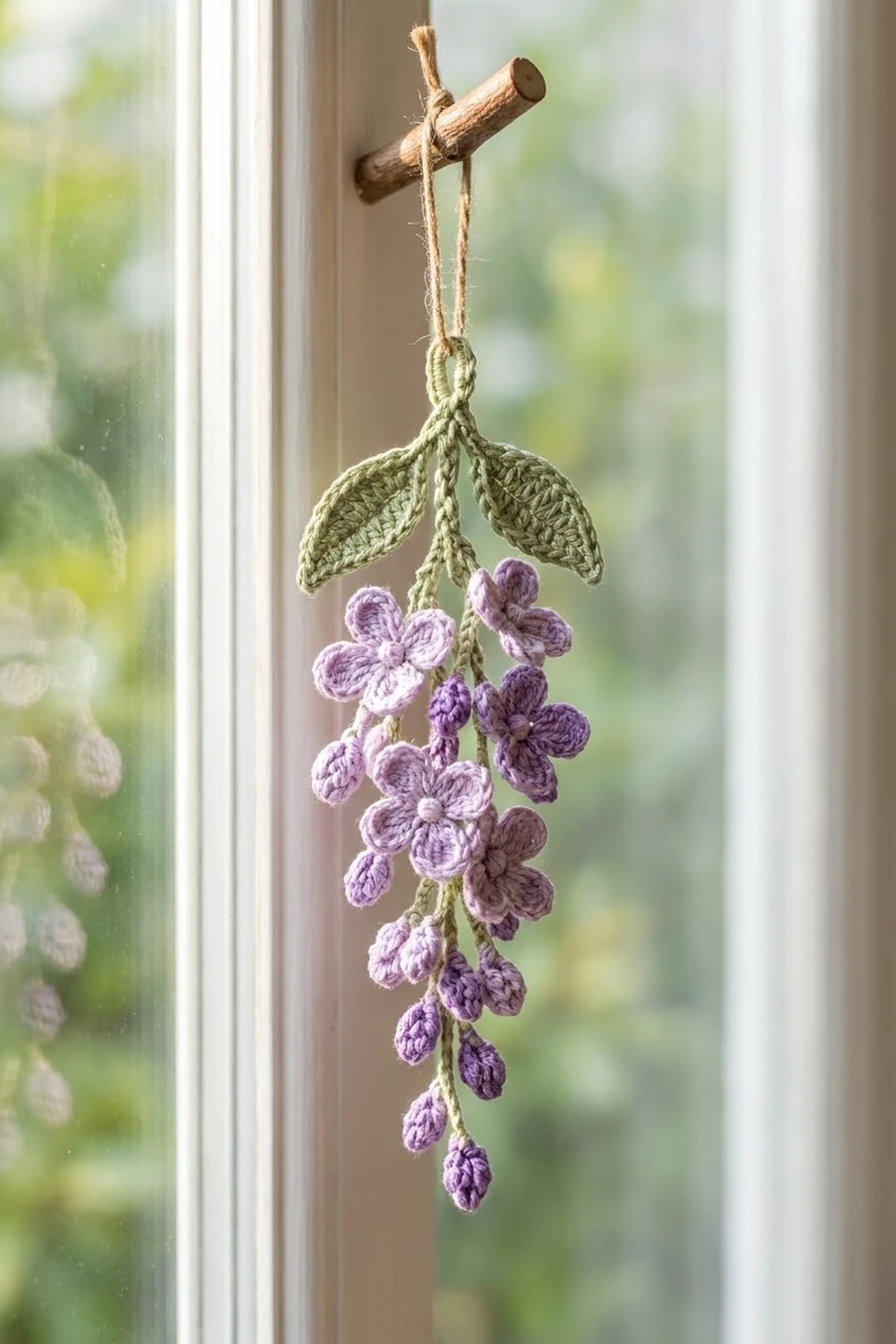
The Lilac Cascade is a single hanging wisteria cluster shaped like a long, narrow teardrop. A sage green stem with a small hanging loop carries two pointed leaves at the top. Below the leaves, five-petal lilac flowers get smaller as they go down. They turn into closed lavender buds and finish in one bud drop at the tip.
The design uses three colors. Sage Green is for the stem and leaves, Light Lilac for the open flowers, and a slightly deeper Lavender for the buds. Each flower has a small raised center, and each leaf has a slip-stitch vein down the middle. The look is soft and botanical, so it works as a curtain accent, a garland drop, or a gift tag.
This pattern uses US crochet terms. The finished cluster is about 3 in (7.6 cm) wide across the leaves and 7 in (17.8 cm) long, measured from the top of the hanging loop to the tip of the last bud.
The cluster is made as one continuous piece. First you chain the loop, upper stem, and leaves from the top down. Then you chain the cluster stem, switch to Lavender at the bottom, and slip stitch back up the stem. On the way up you make buds and flowers on short side stalks. To finish, you add a single crochet (sc) border to each leaf and French knot flower centers.
Finished Size and Construction
- Finished size: 3 in (7.6 cm) wide x 7 in (17.8 cm) long
- Skill level: Intermediate
- Terminology: US crochet terms
- Yarn weight: #2 fine (sport) mercerized cotton
- Hook: 2.75 mm (US C-2)
- Number of pieces: 1, worked continuously with color changes
- Layout: one vertical drop, with the leaves at the top and the cluster below
- Piece size: 3 in (7.6 cm) x 7 in (17.8 cm)
- Size before border: 2.75 in (7.0 cm) x 7 in (17.8 cm)
- Border depth: about 0.125 in (0.3 cm), worked around the leaves only
Materials
Choose a smooth mercerized cotton in #2 fine weight. Cotton keeps the petal points and bud shapes crisp, and it won’t stretch when the cluster hangs. Avoid fuzzy yarns, because they blur the small petals.
- Sage Green: 5 g (16 m) for the loop, stems, leaves, and leaf border
- Light Lilac: 6 g (19 m) for the 10 flowers and the French knot centers
- Lavender: 3 g (9 m) for the 7 buds
These quantities include a margin of about 25 percent for your test pieces and yarn tails.
Tools:
- 2.75 mm (US C-2) crochet hook
- Tapestry needle
- Small scissors
- Rustproof pins and a foam blocking board
- Spray bottle with water
- Ruler marked in inches and cm
Abbreviations (US Terms)
- ch: chain
- sl st: slip stitch
- sc: single crochet
- hdc: half double crochet
- dc: double crochet
- st(s): stitch(es)
- sp: space
- yo: yarn over
- S1, S2, …: cluster stem chains, counted from the bottom tip upward
Special stitches:
- 4-dc bobble: Work [yo, insert hook in st, yo and pull up a loop, yo and pull through 2 loops] 4 times in the same st. Yo and pull through all 5 loops on the hook.
- Bud Drop (BD): Ch 5, work a 4-dc bobble in the 3rd ch from hook, then sl st in each of the next 2 ch. This makes a closed teardrop bud on a 2-ch stalk.
- Small Flower (SF): Ch 7, sl st in the 4th ch from hook to form a 4-ch ring. In the ring, work [ch 1, 2 hdc, ch 1, sl st] 5 times. Sl st in each of the next 3 ch to return to the stem. Count: 5 petals, 10 hdc.
- Large Flower (LF): Ch 9, sl st in the 5th ch from hook to form a 5-ch ring. In the ring, work [ch 2, 2 dc, ch 2, sl st] 5 times. Sl st in each of the next 4 ch to return to the stem. Count: 5 petals, 10 dc.
Gauge and Checkpoints
Gauge is 7 ch = 1 in (2.5 cm) and 6 sc = 1 in (2.5 cm) with a 2.75 mm hook.
Test first: make a 14-ch length with one Large Flower worked at its end. Then use these checkpoints as you go:
- 14 ch = 2 in (5.1 cm)
- Large Flower = 0.75 in (1.9 cm) across
- Small Flower = 0.6 in (1.5 cm) across
- Bud Drop = 0.3 in (0.8 cm) wide x 0.4 in (1.0 cm) long
- Leaf before border = 1.5 in (3.8 cm) x 0.6 in (1.5 cm)
- Leaf after border = 1.6 in (4.1 cm) x 0.85 in (2.2 cm)
- Cluster stem (35 ch) = 5 in (12.7 cm)
If your pieces are too big, go down to a 2.5 mm hook. If they’re too small or the petals cup, go up to a 3 mm hook. If only your chain length is off, adjust your chain tension and keep the same hook.
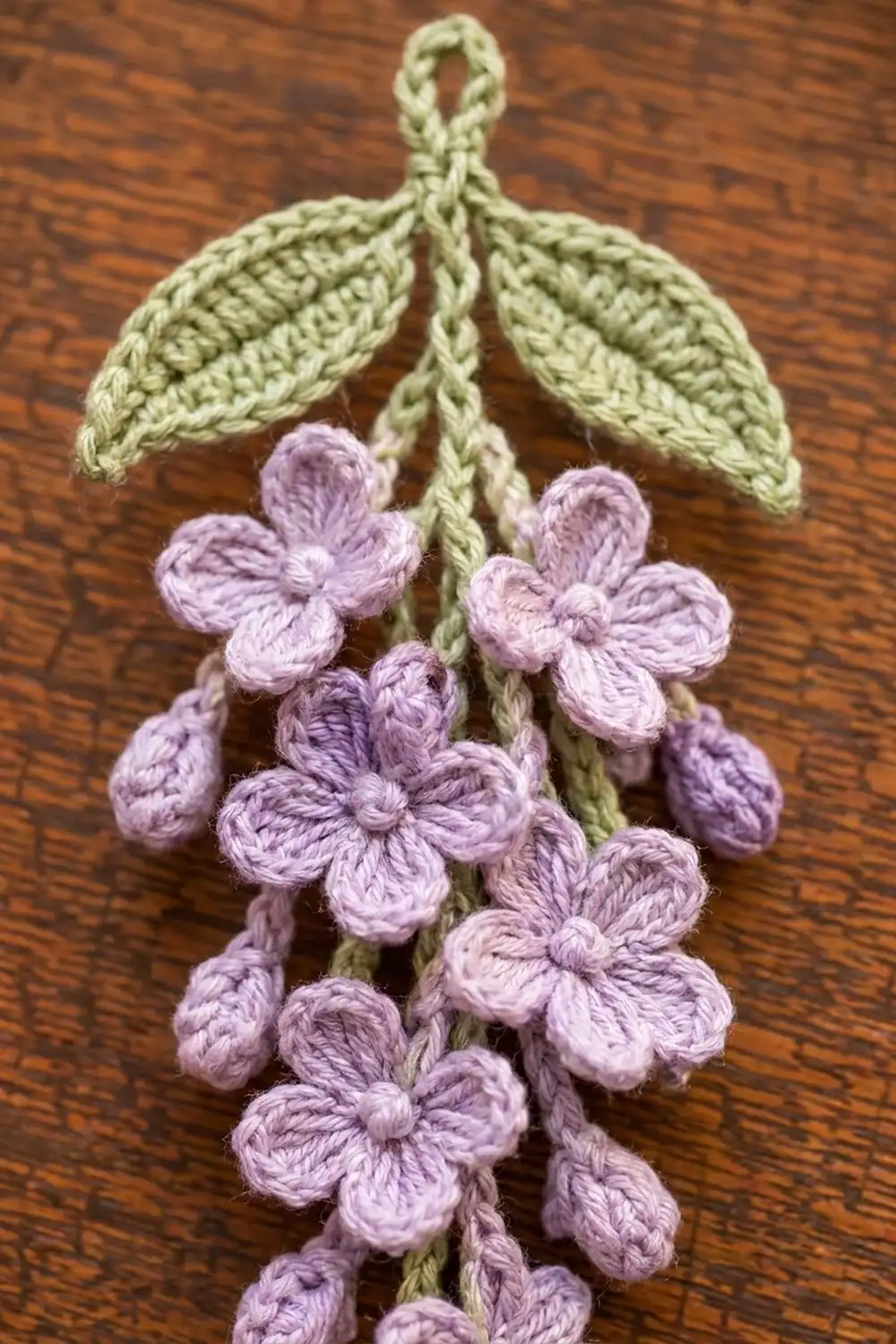
Part 1: Hanging Loop, Upper Stem, and Leaves (Sage Green)
Step 1, hanging loop: With Sage Green, ch 12, then sl st in the first ch to form a ring. (12 ch)
Step 2, upper stem: Ch 6. (6 ch) The last ch of this step is the leaf junction. Both leaves start from it.
Checkpoint: the loop is about 0.75 in (1.9 cm) tall and the upper stem is about 0.9 in (2.3 cm) long.
Step 3, Leaf 1: Ch 11. In this step, the leaf chains are labeled A1 (next to the stem) through A11 (the tip ch, at the hook).
- Side 1: Sc in the 2nd ch from hook (A10), hdc in A9, dc in each of A8 through A4, hdc in A3, sc in A2, sl st in A1. (10 sts)
- Side 2: Rotate the leaf and work along the opposite side of the foundation ch. Sl st in A1, sc in A2, hdc in A3, dc in each of A4 through A8, hdc in A9, sc in A10. (10 sts)
- Tip: Ch 2, sl st in A11. (20 sts + 1 ch-2 tip)
- Vein: Hold the yarn behind the leaf. Surface sl st along the center line of the foundation ch from the tip back to the base. (10 surface sl sts) Then sl st in the leaf junction ch.
The vein brings you back to the stem and gives the leaf its raised center line.
Step 4, Leaf 2: Work this leaf exactly like Leaf 1, starting from the same leaf junction ch. The two leaves should point out to opposite sides.
Checkpoint: each leaf measures 1.5 in (3.8 cm) x 0.6 in (1.5 cm).
Step 5, cluster stem: Ch 35, changing to Lavender on the final yo. Cut Sage Green, leaving a 4 in (10.2 cm) tail. From here on, S1 is the last ch you made, and S35 sits just below the leaf junction.
Checkpoint: the stem hangs 5 in (12.7 cm) long.
Part 2: Buds and Flowers (Lavender, then Light Lilac)
Work every stem sl st into the back bump of the chain. This keeps the green chain visible on the front, so the stem reads as green between the blossoms. As you make each stalk, lay it to the opposite side from the one before.
Step 6, tip bud (Lavender): Work 1 BD from S1. This bud hangs straight down as the final drop. (1 bud)
Step 7, bud section (Lavender):
- Sl st in S2, then work a BD.
- Sl st in the next stem ch, sl st in the next stem ch, BD. Repeat from * 4 more times. This places buds at S4, S6, S8, S10, and S12.
- Bud stalks: 6. Total buds, including the tip bud: 7.
Step 8, color change: Sl st in S13, changing to Light Lilac on the final pull-through. Cut Lavender, leaving a 4 in (10.2 cm) tail.
Step 9, small flowers (Light Lilac):
- Sl st in S14, then work an SF.
- Sl st in the next stem ch, sl st in the next stem ch, SF. Repeat from * 3 more times. This places flowers at S16, S18, S20, and S22.
- Small flowers: 5 (25 petals, 50 hdc total).
Step 10, spacing: Sl st in S23 and S24. (2 sl sts)
Step 11, large flowers (Light Lilac):
- Sl st in S25, then work an LF.
- Sl st in the next stem ch, sl st in the next stem ch, LF. Repeat from * 3 more times. This places flowers at S27, S29, S31, and S33.
- Large flowers: 5 (25 petals, 50 dc total).
Step 12, finish the stem: Sl st in S34, S35, and the leaf junction ch. Fasten off, leaving an 8 in (20.3 cm) tail.
Stem count check: S2 through S35 each get 1 sl st, for 34 stem sl sts. The cluster has 16 side stalks (6 BD, 5 SF, 5 LF) plus the tip bud, for 17 blossoms in total.
Checkpoint: the cluster is about 2.25 in (5.7 cm) wide at the large flowers, and the overall length is 7 in (17.8 cm). If the stem has shrunk below 4.75 in (12.1 cm), your sl sts are too tight.
Step 13, flower centers: Thread a 12 in (30.5 cm) length of Light Lilac onto the tapestry needle. Work one French knot (2 wraps) in the ring center of each of the 10 flowers. Carry the yarn across the back between flowers. The knots form the raised, bead-like flower centers.
Border: Leaf Edging (Sage Green)
The border goes around the two leaves only. It sharpens their outline.
Border gauge: 6 sc = 1 in (2.5 cm), the same as the main gauge.
Edging round (work on each leaf): Join Sage Green with a sl st in the base sl st of Side 2 (A1). Then work:
- Side 2: Sc in each of the next 9 sts, A2 through A10. (9 sc)
- Tip: (Sc, ch 2, sc) in the ch-2 tip sp. (2 sc + ch-2)
- Side 1: Sc in each of the 9 sts from A10 back to A2. (9 sc)
- Sl st in the base sl st of Side 1 (A1). Fasten off.
Count per leaf: 9 + 2 + 9 = 20 sc, plus the ch-2 tip.
Why the math works: Each leaf side has 10 sts. The base sl st is a joining point and doesn’t get a border stitch, which leaves 9 sts per side. One sc in each of those keeps the edge flat, with no ruffling or cupping. The only increase is at the tip, where (sc, ch 2, sc) turns the point. The border adds about 0.125 in (0.3 cm) all around. Each leaf grows from 1.5 in x 0.6 in (3.8 x 1.5 cm) to 1.6 in x 0.85 in (4.1 x 2.2 cm). The span across both leaves grows from 2.75 in (7.0 cm) to 3 in (7.6 cm).
Final Blocking
- Weave in all tails. Hide the Lavender and Light Lilac tails in the stem sl sts and the Sage Green tails along the leaf veins.
- Mist the cluster until it’s evenly damp but not dripping.
- Lay it face up and pin through the hanging loop.
- Pin the stem straight so it measures 5 in (12.7 cm) from the leaf junction to S1.
- Pin each leaf tip about 30 degrees below horizontal, so the span across the leaves is 3 in (7.6 cm).
- Open each flower and pin its 5 petal points. Large Flowers should measure 0.75 in (1.9 cm) and Small Flowers 0.6 in (1.5 cm).
- Arrange the stalks so they alternate sides. The cluster should taper from 2.25 in (5.7 cm) at the top to the single tip bud.
- Let it dry completely before you unpin it.
Final Quality-Control Checklist
- The hanging loop is closed and about 0.75 in (1.9 cm) tall.
- Both leaves match in size, show a center vein, and have sharp tips.
- Each leaf border has 20 sc plus a ch-2 tip.
- There are 7 Lavender buds, one hanging straight down from S1.
- There are 5 Small and 5 Large Flowers, each with 5 petals and a French knot center.
- The green stem shows on the front between the blossoms.
- The finished size is 3 in (7.6 cm) x 7 in (17.8 cm).
- No tails show on the front.
Troubleshooting
The stem curls or twists: Your sl sts are tighter than your chain. Work them more loosely, or use a hook one size larger for Part 2 only. Steam-block the stem straight.
The petals cup: The ring is too small. Check that you made a 5-ch ring for the Large Flowers and a 4-ch ring for the Small Flowers.
The buds look flat: Keep all 4 dc the same height before you close the bobble, then push the bud outward from behind.
The leaf edges ruffle: You worked too many sc along a side. Each side should have exactly 9 sc.
The cluster is too long: Your chain is too loose. Check that 14 ch = 2 in (5.1 cm).
The flowers bunch on one side: Alternate the stalks as you work them, then correct their placement during blocking.
Care
Hand wash in cool water with a mild soap and press the water out in a towel. Reshape the cluster and dry it flat. Don’t wring it or tumble dry it.
Final Notes
The measurements build on each other in this order:
- 14 ch = 2 in (5.1 cm), and a Large Flower is 0.75 in (1.9 cm) across.
- Each leaf is 1.5 in (3.8 cm) long, and the stem is 5 in (12.7 cm).
- After the border, each leaf is 1.6 in (4.1 cm) long.
- The finished cluster is 3 in (7.6 cm) x 7 in (17.8 cm).
If every checkpoint matches, your Lilac Cascade will hang straight and taper neatly from the leaves to the last bud.
Happy crocheting!