

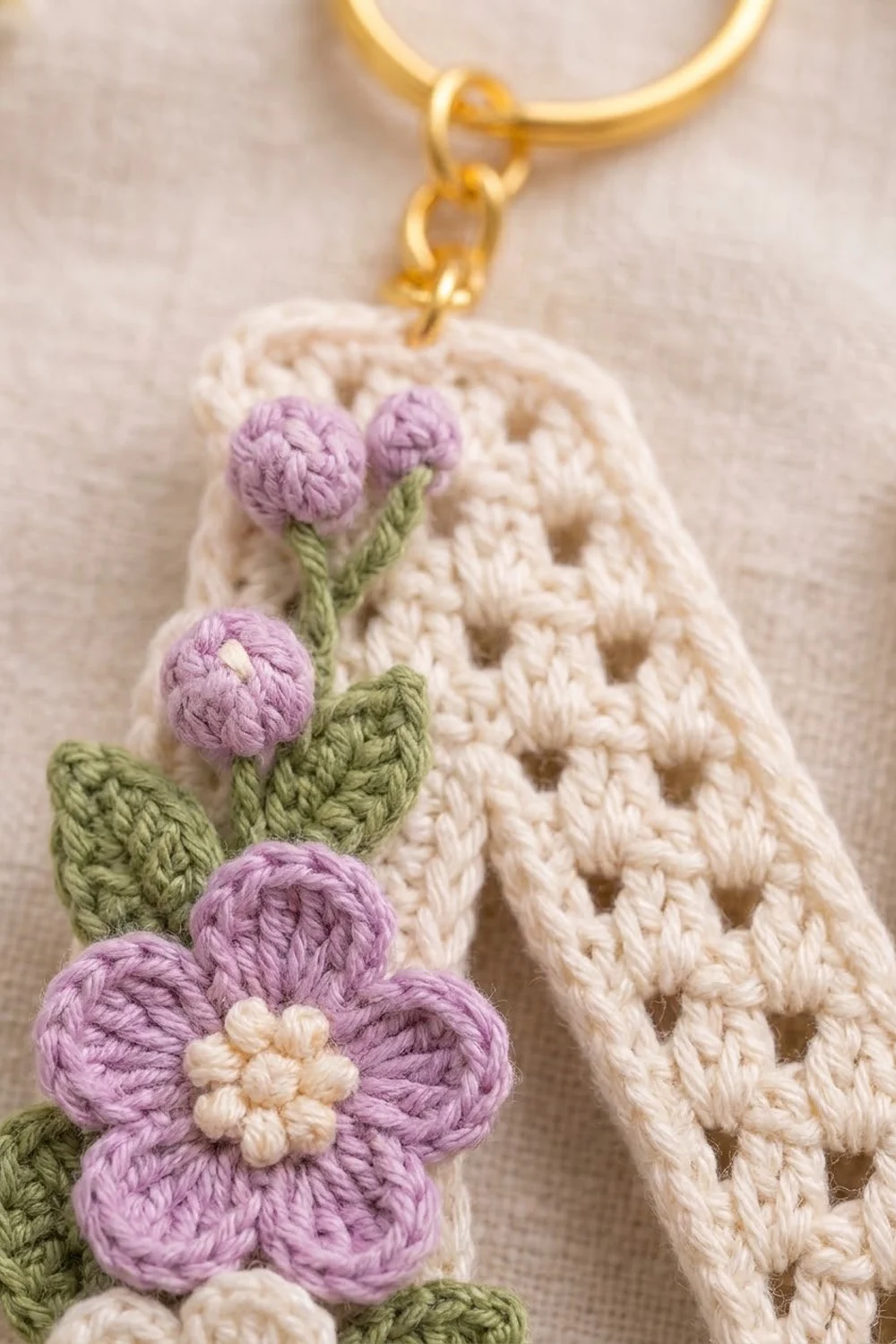
This letter N keychain is a crisp cream openwork letter with a small cascade of lilac and white flowers down its left leg. The body is made of alternating single crochet rows and V-stitch rows, so small eyelets run in neat columns through every stroke.
The colors are soft and springlike. The letter is cream. Lilac is used for two flowers and three bobble buds, and the third flower is white with a golden yellow center. The leaves are sage green. A gold split ring on a short chain turns it into a keychain or bag charm.
The pattern uses US crochet terms. The finished letter is about 4.1 in (10.4 cm) tall and 3.5 in (8.9 cm) wide, not counting the hardware.
The N is worked sideways in one piece, in rows from the left edge to the right edge. The diagonal is made of short rows that step down the letter, and then the right leg grows back to full height. A two-round border pulls the outline together, and the flowers and leaves are sewn on last.
Finished Size and Construction
- Finished size: about 4.1 in (10.4 cm) tall x 3.5 in (8.9 cm) wide
- Skill level: Intermediate
- Terminology: US crochet terms
- Yarn weight: Sport (#2) cotton
- Hook: 2.75 mm (C-2)
- Number of pieces: 1 letter body, plus 3 flowers, 3 buds and 5 leaves sewn on
- Layout: a single letter N, with rows running vertically
- Stroke width: 1 in (2.5 cm) per leg before the border, 1.4 in (3.6 cm) after
- Size before border: about 3.7 in (9.4 cm) tall x 3.1 in (7.9 cm) wide
- Border depth: about 0.2 in (0.5 cm) on every edge
Materials
Use a smooth mercerized cotton in sport weight, about 165 yd (150 m) per 50 g. Cotton keeps the eyelets open and the edges sharp, and it stands up to daily handling on a key ring.
- Cream (letter body, flower centers, knots): 8 g, about 24 m
- Lilac (2 flowers, 3 buds): 4 g, about 12 m
- Sage green (5 leaves): 2 g, about 6 m
- White (1 flower): 1 g, about 3 m
- Golden yellow (1 flower center): 1 g, about 3 m
All quantities include a margin of about 20 percent for swatching and sewing tails.
Tools:
- 2.75 mm (C-2) crochet hook
- Tapestry needle and a sharp embroidery needle
- Blocking mat, rustproof pins, spray bottle
- 1 gold split key ring, 1 in (2.5 cm) across
- Gold chain, about 1.2 in (3.0 cm) long, plus 2 gold jump rings, 6 mm
- Small pliers
Abbreviations (US Terms)
- ch: chain
- sl st: slip stitch
- sc: single crochet
- hdc: half double crochet
- dc: double crochet
- sc2tog: single crochet 2 together
- MR: magic ring
- sp: space
- st(s): stitch(es)
- tch: turning chain
- pos: stitch position along the letter height, from 1 (bottom) to 22 (top)
V-st (V-stitch): (dc, ch 1, dc) in the same stitch.
Popcorn: Work 5 dc in the same stitch and drop the loop from the hook. Insert the hook from front to back in the first dc, pick up the dropped loop and pull it through.
French knot: Bring the needle up, wrap the yarn twice around it, then insert it next to where it came up and pull through.
Gauge and Checkpoints
Gauge: 6 sc = 1 in (2.5 cm) along a row, and 7 sc rows = 1 in (2.5 cm). One V-st row is as wide as two sc rows.
The left leg (Rows 1 to 5) is your test piece. Work it and measure before you go on:
- Row 1: 22 sc = 3.7 in (9.4 cm)
- After Row 5: the leg is 3.7 in (9.4 cm) tall x 1 in (2.5 cm) wide
- After Row 10: the piece is 2.1 in (5.3 cm) wide across the bottom
- After Row 15: 3.7 in (9.4 cm) tall x 3.1 in (7.9 cm) wide
- After the border: 4.1 in (10.4 cm) tall x 3.5 in (8.9 cm) wide
If your leg is taller than 3.7 in (9.4 cm), switch to a 2.5 mm hook. If it is shorter, switch to a 3.0 mm hook. Blocking can fix small differences in width but not in height, so match the 22-stitch height first.
Letter Body
The rows run up and down the letter. Odd rows are sc rows, worked from top to bottom. Even rows are V-st rows, worked from bottom to top.
Left Leg
Foundation: With cream, ch 23. The last chain you make is the top of the letter.
Row 1 (sc, top to bottom): Sc in 2nd ch from hook and in each ch across. (22 sc, pos 22 to 1)
Row 2 (V-st, bottom to top): Ch 3 (counts as dc throughout), turn. *Sk next sc, V-st in next sc; rep from * 9 more times, dc in last sc. (10 V-sts + 2 dc, covering 22 sts)
Row 3 (sc): Ch 1, turn. Sc in first dc, *sc in next V-st ch-1 sp, sc in next sp between sts; rep from * 9 more times, sc in top of tch. (22 sc)
Rows 4 and 5: Repeat Rows 2 and 3. (22 sc; Row 5 ends at pos 1)
Check: the leg should be 3.7 in (9.4 cm) x 1 in (2.5 cm), with two columns of eyelets.
Diagonal
Every diagonal row is 12 sts tall. At each V-st row the diagonal moves down 5 sts: you leave 5 sts unworked at the top and add 5 extension chains at the bottom.
Row 6 (V-st, pos 11 to 22): Turn. Sl st in each of first 11 sc. Ch 3 (counts as dc at pos 11), *sk next sc, V-st in next sc; rep from * 4 more times, dc in last sc. (5 V-sts + 2 dc, covering 12 sts)
Row 7 (sc, pos 22 to 11): Ch 1, turn. Sc in first dc, *sc in next V-st sp, sc in next sp; rep from * 4 more times, sc in top of tch. (12 sc)
Row 8 (V-st, pos 6 to 17): Ch 8, turn. The 3 chains nearest the hook count as the first dc, at pos 6.
– V-st in 6th ch from hook (pos 8), sk next ch, V-st in next ch (pos 10).
– Sk first sc of Row 7, V-st in next sc, [sk next sc, V-st in next sc] twice, dc in next sc (pos 17).
– Leave the last 5 sc of Row 7 unworked. (5 V-sts + 2 dc, covering 12 sts)
Row 9 (sc, pos 17 to 6): Repeat Row 7. (12 sc)
Row 10 (V-st, pos 1 to 12): Repeat Row 8. The V-sts land at pos 3, 5, 7, 9 and 11, and the last dc is at pos 12. Leave the last 5 sc of Row 9 unworked. (5 V-sts + 2 dc, covering 12 sts) Do not turn. Ch 11 for the top extension.
Check: the piece is 2.1 in (5.3 cm) wide across the bottom. You now have two triangular gaps: one next to the left leg that opens at the bottom, and one beside Row 10 that opens at the top.
Right Leg
Row 11 (sc, pos 22 to 1): Turn. Sc in 2nd ch from hook and in the next 9 ch (10 sc, pos 22 to 13). Sc in last dc of Row 10, *sc in next V-st sp, sc in next sp; rep from * 4 more times, sc in top of tch. (10 + 12 = 22 sc)
Rows 12 to 15: Repeat Rows 2 and 3 twice. (22 sc) Do not fasten off.
Check: the piece is 3.7 in (9.4 cm) x 3.1 in (7.9 cm). The right leg matches the left leg: 1 in (2.5 cm) wide with two columns of eyelets.
Flowers, Buds and Leaves
Large lilac flower (make 1), 1.25 in (3.2 cm):
– R1 (cream): MR, 10 sc in ring, sl st to first sc. (10 sc) Fasten off.
– R2 (lilac): Join with sl st in any sc. *(Hdc, 3 dc, hdc) in next sc, sl st in next sc; rep from * 4 more times, working the last sl st in the joining st. (5 petals, 25 petal sts + 5 sl st)
– With cream, work 5 French knots in a ring on the center.
White flower (make 1), 1 in (2.5 cm):
– R1 (yellow): MR, 5 sc in ring, sl st to first sc. (5 sc) Fasten off.
– R2 (white): Join in any sc. In each sc: (sl st, ch 2, 3 dc, ch 2, sl st). (5 petals)
Small lilac flower (make 1), 0.9 in (2.3 cm):
– R1 (cream): MR, 5 sc in ring, sl st to first sc. (5 sc) Fasten off.
– R2 (lilac): Join in any sc. In each sc: (sl st, ch 2, 2 dc, ch 2, sl st). (5 petals)
– With cream, work 3 French knots on the center.
Bobble buds (make 3), 0.3 in (0.8 cm): With lilac, ch 2, popcorn in 2nd ch from hook, ch 1. Fasten off, leaving a 6 in (15.2 cm) tail.
Leaves (make 5), 0.8 in (2.0 cm): With sage, ch 6. Sc in 2nd ch from hook, hdc in next ch, dc in next 2 ch, (hdc, ch 2, hdc) in last ch for the tip. Working along the other side of the chain: dc in next 2 ch, hdc in next ch, sc in last ch, sl st to first sc. (10 sts + ch-2 tip) Fasten off, leaving a tail.
Border
Border gauge: Along stitch edges, work 1 sc per stitch, which is 6 sc per 1 in (2.5 cm). Along row ends, work 1 sc per sc row and 2 sc per V-st row. That gives 3 sc per 0.43 in (1.1 cm), or 7 sc per 1 in (2.5 cm), the same as the row gauge.
Each corner is 3 sc in one stitch. The side counts below do not include these corner groups.
Round 1 (sc): Ch 1, turn.
- Bottom-right corner: 3 sc in first sc of Row 15.
- Right side: sc in next 20 sc, pos 2 to 21. (20)
- Top-right corner: 3 sc in last sc, pos 22.
- Top-right serif: work along the row ends of Rows 14, 13 and 12: 2 + 1 + 2. (5)
- Corner: 3 sc in top end of Row 11.
- Top gap wall: sc in the free loops of the Row 10 extension chain, pos 21 to 14. (8)
- Upper diagonal:
- Sc2tog over the free loop at pos 13 and the top end of Row 10, then sc in the Row 10 end.
- Sc in the 5 unworked sc of Row 9, pos 13 to 17.
- 1 sc in the Row 9 end, then 2 sc in the Row 8 end.
- Sc in the unworked sc of Row 7 at pos 18 to 21.
- (2 + 5 + 3 + 4 = 14)
- Corner: 3 sc in Row 7 at pos 22.
- Top-left serif: work along the row ends of Rows 7 to 2: 1 + 2 + 1 + 2 + 1 + 2. (9)
- Top-left corner: 3 sc in the free loop of the foundation ch at pos 22.
- Left side: sc in the free loops, pos 21 to 2. (20)
- Bottom-left corner: 3 sc in the foundation ch at pos 1.
- Bottom-left serif: work along the row ends of Rows 2, 3 and 4: 2 + 1 + 2. (5)
- Corner: 3 sc in the last sc of Row 5, at pos 1.
- Bottom gap wall: sc in the Row 5 sts at pos 2 to 9, working through the sl sts. (8)
- Lower diagonal:
- Sc2tog over pos 10 and the bottom end of Row 6, then sc in the Row 6 end.
- 1 sc in the Row 7 end.
- Sc in the free loops of the Row 8 extension, pos 10 to 6.
- 2 sc in the Row 8 end, then 1 sc in the Row 9 end.
- Sc in the free loops of the Row 10 extension, pos 5 to 2.
- (2 + 1 + 5 + 3 + 4 = 15)
- Corner: 3 sc in the free loop at pos 1 of Row 10.
- Bottom-right serif: work along the row ends of Rows 10 to 14: 2 + 1 + 2 + 1 + 2. (8)
Sl st to first sc. Total: 8 corners x 3 = 24 sc, plus sides 20 + 5 + 8 + 14 + 9 + 20 + 5 + 8 + 15 + 8 = 112 sc, for 136 sc.
Round 2 (sl st rim): Ch 1. Sl st in each sc around, working (sl st, ch 1, sl st) in the center sc of each 3-sc corner. (144 sl st + 8 ch-1 sps) Fasten off.
Why the math works:
– Every straight edge gets one border stitch per unit of fabric, so it lies flat. On each long side, the 22 sts become 20 sc plus the 2 corner centers.
– The 3-sc corner groups add the extra length an outside corner needs.
– Each sc2tog takes away one stitch where the outline turns inward, so the gap points stay sharp.
– On the diagonal, one sc per chain, stitch or row-end unit fills in the stair steps and gives a straight slope.
– Round 2 adds about 0.06 in (0.2 cm) of depth, and its ch-1 points give the serif corners their slight flare.
Final Blocking
- Weave in all ends on the letter. Keep the flower and leaf tails for sewing.
- Pin the letter right side up to 4.1 in (10.4 cm) x 3.5 in (8.9 cm).
- Pin the 8 serif corners first, then the 2 gap points, then pin the diagonal edges straight.
- Check that both legs are 1.4 in (3.6 cm) wide and parallel.
- Mist the letter until damp and let it dry completely. Pin the flowers and leaves flat next to it, petals open, and let them dry too.
- Sew on the appliqués:
- Center the large flower on the left leg, 1.4 in (3.6 cm) above the bottom edge.
- Place the white flower over the bottom-left corner and the small lilac flower just to its right.
- Stack the 3 buds above the large flower, with the top bud 0.4 in (1.0 cm) below the top serif.
- Tuck the 5 leaves around the buds and flowers, letting some overhang the left edge.
- Put a jump ring through the border at the center of the top-left serif. Add the chain, then the second jump ring and the split ring.
Final Quality-Control Checklist
- The letter measures 4.1 in (10.4 cm) x 3.5 in (8.9 cm)
- Each leg shows two straight columns of eyelets
- Border Round 1 has 136 sc, and Round 2 has 8 corner points
- Both triangular gaps are open, with crisp points
- No sewing stitches show on the front
- Both jump rings are fully closed
Troubleshooting
- Diagonal looks stair-stepped: Check that every extension chain got one border sc per chain, then block along a straight edge.
- Gap points look rounded: Use sc2tog at both inner points, not two separate sc.
- Border ruffles: You are adding too many sc on row ends. Use 1 per sc row and 2 per V-st row.
- Border cups: Make sure every corner has its 3-sc group.
- Eyelets close up: Your V-sts are too tight. Loosen your tension or go up a hook size.
- Petals curl: Pin the flowers flat while damp and let them dry fully.
Care
Hand wash in cool water, press the water out in a towel and dry flat. Remove the metal hardware before washing.

Final Notes
Here is the full measurement chain. 22 sts make the 3.7 in (9.4 cm) height. Five rows make each 1 in (2.5 cm) leg, and fifteen rows make the 3.1 in (7.9 cm) wide body. The 136-stitch border and the slip-stitch rim bring the letter to 4.1 in (10.4 cm) x 3.5 in (8.9 cm). If your left leg matches its checkpoint, the rest of the letter will too.
Happy crocheting!