

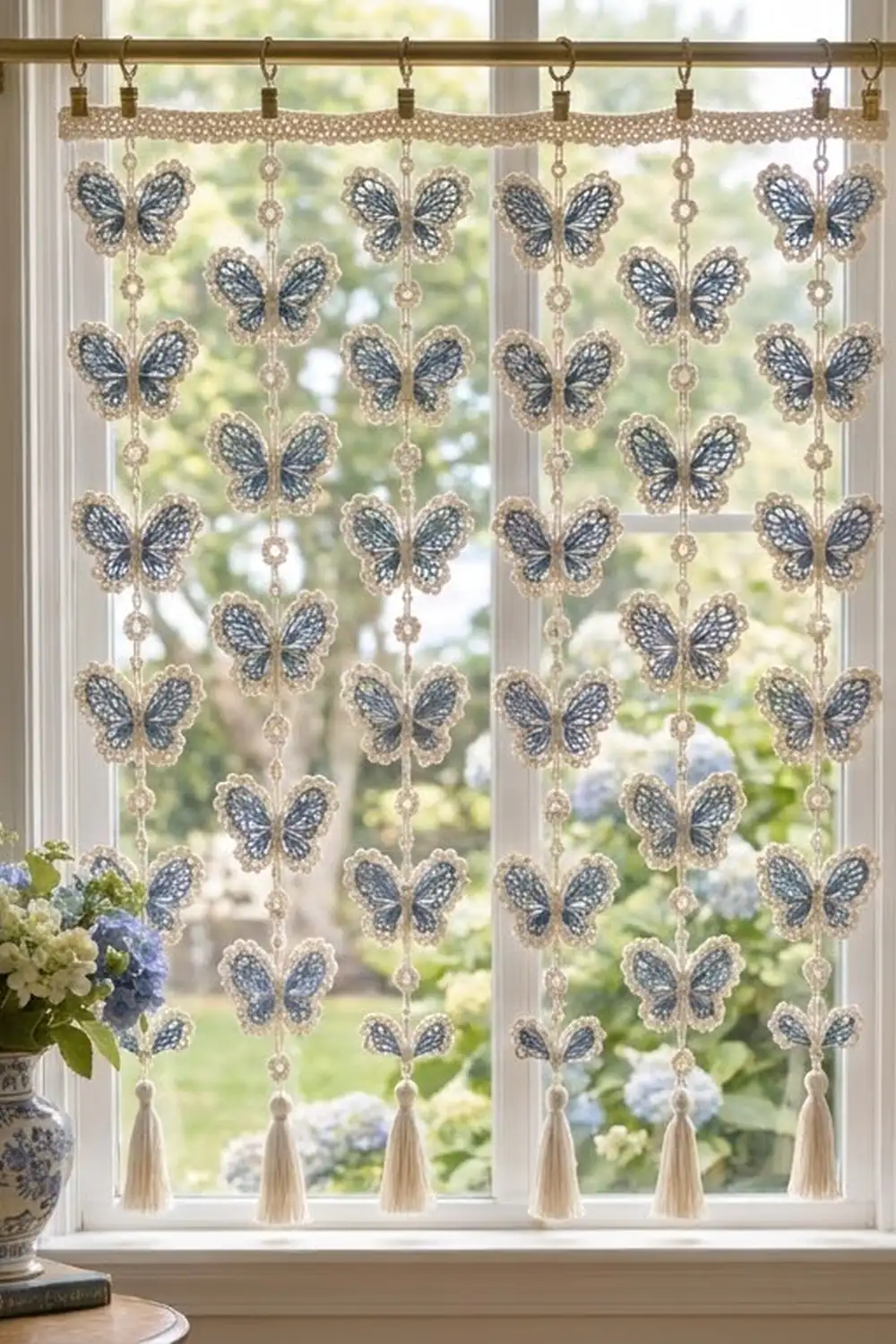
This window curtain is made of lacy butterflies hanging in vertical strands. Each butterfly has four blue wings with radiating spokes like veins, a cream scalloped edging, and a raised cream body. Small cream picot rings sit between the butterflies, and each strand ends in a cream tassel. All the strands hang from a solid cream header band that clips onto a curtain rod.
The palette is just two colors, cornflower blue and cream, which gives it a soft cottage look. Light comes through the open wing spokes and the gaps between strands, so the curtain stays airy.
This pattern uses US crochet terms. The finished curtain is 36 in (91.4 cm) wide and 36 in (91.4 cm) long, measured from the top of the header to the tassel tips.
First you make the wings, bodies, and rings as separate small pieces and put the butterflies together. Then you chain each strand from top to bottom, linking in rings and butterflies as you go. Last, you work the header band and join all 8 strands in its final row.
Finished Size and Construction
- Finished size: 36 in x 36 in (91.4 cm x 91.4 cm), tassels included
- Skill level: Intermediate
- Terminology: US crochet terms
- Yarn weight: Size 3 cotton crochet thread (Lace to Super Fine, CYC 0–1)
- Hook: 2.25 mm (US B-1)
- Number of pieces: 56 butterflies (5 small parts each), 64 rings, 8 tassels, 1 header band
- Layout: 8 strands, 7 butterflies per strand
- Butterfly size: 3.5 in (8.9 cm) wide x 2.75 in (7.0 cm) tall
- Strand spacing: 4.5 in (11.4 cm) center to center
- Size before header: 8 strands, each 34.5 in (87.6 cm) long
- Header depth: 1.5 in (3.8 cm)
Materials
Choose a firm, mercerized cotton thread. It holds the open spokes in place, blocks crisply, and stretches very little when it hangs. With soft, fuzzy cotton, the strands will get longer over time.
- Color A, cornflower blue: about 130 g / 430 m
- Color B, cream: about 220 g / 725 m
These amounts assume your thread has about 330 m per 100 g. Check your label and recalculate if yours is different. Quantities include a margin of about 15%.
Tools:
- 2.25 mm (US B-1) crochet hook
- Tapestry needle and scissors
- Stiff card, 3.25 in (8.3 cm) tall, for tassels
- Rust-proof pins and blocking mats
- Measuring tape
- 9 curtain clip rings and a rod at least 40 in (101.6 cm) long
Abbreviations (US Terms)
- ch – chain
- sl st – slip stitch
- sc – single crochet
- dc – double crochet
- tr – treble crochet
- sk – skip
- sp(s) – space(s)
- st(s) – stitch(es)
- rep – repeat
Picot: (sc, ch 3, sc) in the same stitch.
Shell: 5 dc in the same stitch.
Gauge and Checkpoints
Make one complete butterfly before anything else. It works as your gauge swatch.
- Chain gauge: 8 ch = 1 in (2.5 cm), relaxed
- Header gauge: 24 sc = 4 in (10.2 cm); 4 sc rows + 3 dc rows = 1.5 in (3.8 cm)
Checkpoints:
- Upper wing, after Row 6: 1.6 in (4.1 cm) from ring center to picot tip
- Lower wing, after Row 5: 1.15 in (2.9 cm) from ring center to picot tip
- Body, after Rnd 2: 1.5 in (3.8 cm) long, not counting the loops
- Assembled butterfly: 3.5 in (8.9 cm) x 2.75 in (7.0 cm)
- Ring: 0.75 in (1.9 cm) across, picot tip to picot tip
If your butterfly is too big, go down to a 2.0 mm hook. If it is too small, go up to a 2.5 mm hook. Small errors add up: an extra 0.25 in (0.6 cm) per butterfly makes each strand 1.75 in (4.4 cm) longer.
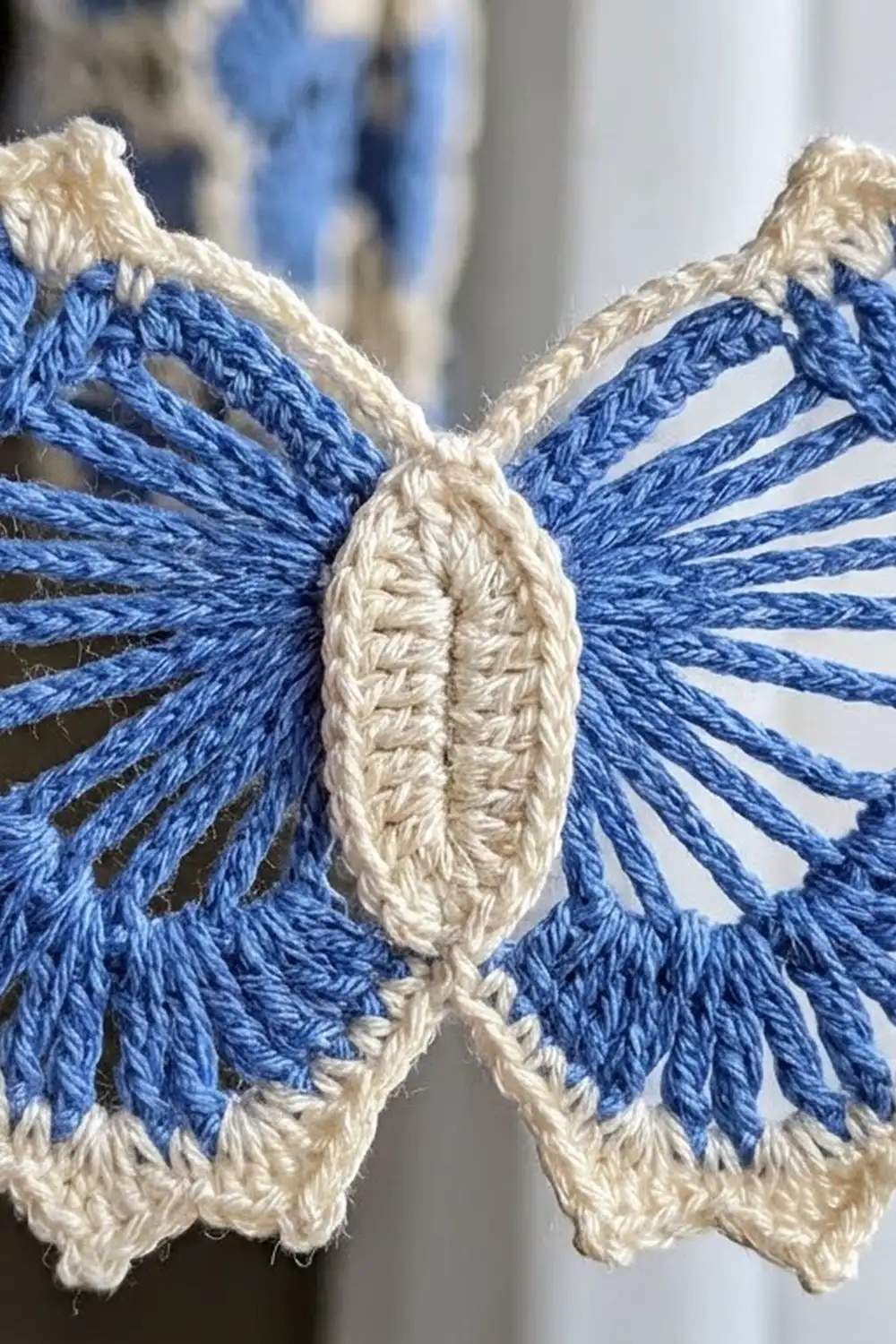
Upper Wing (Make 2 per Butterfly)
With Color A, ch 4, sl st in first ch to form a ring.
Row 1: Ch 3 (counts as dc), 6 dc in ring, turn. (7 dc, forming a half circle)
Row 2: Ch 5 (counts as dc + ch 2), sk first dc, dc in next dc, ch 2; rep from * 4 more times, dc in top of turning ch, turn. (7 dc, 6 ch-2 sps)*
Row 3: Ch 7 (counts as tr + ch 3), tr in next dc, ch 3; rep from * 4 more times, tr in 3rd ch of turning ch, turn. (7 tr, 6 ch-3 sps)*
The tr stitches become the long wing veins.
Row 4: Ch 1, sc in first tr, 5 sc in next ch-3 sp, sc in next tr; rep from * 5 more times, working the last sc in 4th ch of turning ch. (1 + 6 x 6 = 37 sc)* Fasten off Color A.
Row 5: Join Color B with sl st in first sc. Ch 1, sc in same sc, sk 2 sc, shell in next sc, sk 2 sc, sc in next sc; rep from * 5 more times, turn. (6 shells, 7 sc; covers all 37 sc)*
Row 6: Ch 1, sc in first sc, sc in next 2 dc, picot in next dc, sc in next 2 dc, sc in next sc; rep from * 5 more times. Fasten off, leaving a 6 in (15.2 cm) tail. (37 sts worked 1-per-stitch + 6 extra sc = 43 sc, plus 6 ch-3 picots)*
The shells make the outer scallops, and the picots add the small bumps.
Lower Wing (Make 2 per Butterfly)
With Color A, ch 4, sl st in first ch to form a ring.
Rows 1–2: Work as Upper Wing Rows 1–2. (7 dc, 6 ch-2 sps)
Row 3: Ch 1, sc in first dc, 3 sc in next ch-2 sp, sc in next dc; rep from * 5 more times, working the last sc in 3rd ch of turning ch. (1 + 6 x 4 = 25 sc)* Fasten off Color A.
Row 4: Join Color B with sl st in first sc. Ch 1, sc in same sc, sk 1 sc, shell in next sc, sk 1 sc, sc in next sc; rep from * 5 more times, turn. (6 shells, 7 sc; covers all 25 sc)*
Row 5: Work as Upper Wing Row 6. Fasten off, leaving a 6 in (15.2 cm) tail. (25 sts worked 1-per-stitch + 6 extra sc = 31 sc, plus 6 picots)
Because it has no tr row, the lower wing comes out smaller than the upper wing.
Body (Make 1 per Butterfly)
With Color B, ch 13.
Rnd 1: 2 sc in 2nd ch from hook, sc in next 10 ch, 3 sc in last ch. Working along the other side of the foundation chain, sc in next 10 ch, sc in same ch as first 2 sc. Sl st in first sc to join. (26 sc)
Rnd 2: Ch 1, (sc, ch 3, sc) in first sc for the tail loop, sc in next 12 sc, (sc, ch 3, sc) in next sc for the head loop, sc in next 12 sc. Sl st in first sc to join. Fasten off, leaving a 10 in (25.4 cm) tail. (26 sts worked 1-per-stitch + 2 extra sc = 28 sc, plus 2 ch-3 loops)
The body is 1.5 in (3.8 cm) long and about 0.4 in (1.0 cm) wide. It sits on top of the wings, so it looks raised.
Butterfly Assembly
- Lay both upper wings right side up with their starting rings touching, fanning up and out.
- Place both lower wings below them, with their starting rings at the same center point. Fan them down and out, tucked slightly under the upper wings.
- Use the wing tails to sew the four starting rings together.
- Center the body on top with the head loop up. Use the body tail to sew it down along both long sides.
- Weave in all ends on the back.
Checkpoint: 3.5 in (8.9 cm) x 2.75 in (7.0 cm). The head loop sits about 0.5 in (1.3 cm) below the top of the upper wings. The tail loop sits about 0.5 in (1.3 cm) above the bottom of the lower wings.
Ring (Make 64)
With Color B, ch 6, sl st in first ch to form a ring.
Rnd 1: Ch 1, 12 sc in ring. Sl st in first sc to join. (12 sc)
Rnd 2: Ch 3, sk next sc, sl st in next sc; rep from * 5 more times, putting the last sl st in the joining st. (6 ch-3 picot loops)*
Fasten off. The ring is 0.75 in (1.9 cm) across. Picot loops 1 and 4 sit opposite each other; use them as the top and bottom.
Tassel (Make 8)
Wrap Color B 40 times around the 3.25 in (8.3 cm) card. Tie a strand tightly under the top loops, then cut the bottom loops. Wrap another strand around the tassel 0.5 in (1.3 cm) below the top and tie it. Trim to 3 in (7.6 cm).
Make All Pieces
- Upper wings: 112 (Color A, Color B edging)
- Lower wings: 112 (Color A, Color B edging)
- Bodies: 56 (Color B)
- Rings: 64 (Color B), 8 per strand
- Tassels: 8 (Color B)
Layout (B = butterfly, o = ring, T = tassel; each column is one strand):
[====== HEADER BAND, 216 sts ======]
  o  o  o  o  o  o  o  o
  B  B  B  B  B  B  B  B
  o  o  o  o  o  o  o  o
  B  B  B  B  B  B  B  B
  o  o  o  o  o  o  o  o
  B  B  B  B  B  B  B  B
  o  o  o  o  o  o  o  o
  B  B  B  B  B  B  B  B
  o  o  o  o  o  o  o  o
  B  B  B  B  B  B  B  B
  o  o  o  o  o  o  o  o
  B  B  B  B  B  B  B  B
  o  o  o  o  o  o  o  o
  B  B  B  B  B  B  B  B
  o  o  o  o  o  o  o  o
  T  T  T  T  T  T  T  T
Joining: Building the Strands
Each strand is one continuous Color B chain. It runs behind every ring and every butterfly body, so it carries the weight and stays out of sight.
Strand (make 8): With Color B, ch 4, sl st in first ch to form the top loop.
- Ch 16. Sl st in the top picot of a ring. Ch 5 behind the ring, then sl st in its bottom picot.
- Ch 6, sl st in the head loop of a butterfly. Ch 13 behind the body, then sl st in the tail loop. Ch 6, sl st in the top picot of the next ring, ch 5 behind the ring, then sl st in its bottom picot. Rep from * 6 more times. (7 butterflies, 8 rings total)*
- Ch 6, sl st in the top loop of a tassel. Fasten off.
Stitch logic: Each sl st goes through only one loop, so every piece hangs straight and faces forward. The ch 5 and ch 13 behind the pieces match the distance between their loops, so the pieces lie flat.
Tension: Keep chains relaxed and even. Tight chains make the strand shorter and twist the butterflies.
Strand length checkpoint:
- Ch 16 drop: 2 in (5.1 cm)
- First ring: 0.75 in (1.9 cm)
- One butterfly unit (ch 6 + butterfly loop-to-loop + ch 6 + ring): 0.75 + 1.75 + 0.75 + 0.75 = 4 in (10.2 cm); x 7 = 28 in (71.1 cm)
- Ch 6 to tassel: 0.75 in (1.9 cm)
- Tassel: 3 in (7.6 cm)
Total: 2 + 0.75 + 28 + 0.75 + 3 = 34.5 in (87.6 cm). All 8 strands should be within 0.25 in (0.6 cm) of each other.
Border: Header Band
The header band is this curtain’s border. You work it in rows, starting with the top edge, and join the strands in the last row.
Border gauge: 24 sc = 4 in (10.2 cm), so 6 sc = 1 in (2.5 cm).
Starting count: 8 strands x 27 sts per strand section = 216 sts. Each section is 4.5 in (11.4 cm), so 216 sts = 36 in (91.4 cm). No extra stitches are added between sections.
With Color B, ch 217.
Row 1: Sc in 2nd ch from hook and in each ch across, turn. (216 sc)
Row 2: Ch 3 (counts as dc), dc in next st and in each st across, turn. (216 dc)
Row 3: Ch 1, sc in each st across, turn. (216 sc)
Rows 4–6: Rep Rows 2–3 once, then work Row 2 once more. (216 sts in each row)
Row 7 (joining row): Ch 1, sc in first 13 sts. Insert hook in next st and through the top loop of a strand, sc to join, sc in next 26 sts; rep from * 6 more times. Join the 8th strand in the next st, then sc in last 13 sts. (216 sc, 8 strands joined)*
The strands join at sts 14, 41, 68, 95, 122, 149, 176, and 203. Fasten off. Clip the 9 rings along the top edge, evenly spaced 4.5 in (11.4 cm) apart.
Why the math works: Each strand sits in the middle stitch of its own 27-st section, with 13 sts on each side. Neighboring strands are 27 sts, or 4.5 in (11.4 cm), apart. The outer strands sit 2.25 in (5.7 cm) from each edge, exactly half the spacing. A 3.5 in (8.9 cm) butterfly in a 4.5 in (11.4 cm) section leaves a 1 in (2.5 cm) gap between neighboring wings.
The header is 4 sc rows + 3 dc rows = 1.5 in (3.8 cm) deep. Total length: 1.5 + 34.5 = 36 in (91.4 cm).
Final Blocking
- Soak the curtain in cool water for 10 minutes.
- Roll it in a towel to press out the water; do not wring.
- Pin the header flat to 36 in (91.4 cm) x 1.5 in (3.8 cm).
- Straighten each strand below the header. Pin each butterfly to 3.5 in (8.9 cm) x 2.75 in (7.0 cm), opening every scallop and spoke space.
- Pin each ring into a circle with all 6 picots open.
- Comb the tassels straight.
- Let everything dry completely, at least 24 hours, before unpinning.
Final Quality-Control Checklist
- Header is 36 in (91.4 cm) wide and 1.5 in (3.8 cm) deep.
- Strands are joined at sts 14, 41, 68, 95, 122, 149, 176, and 203.
- Every strand has 8 rings, 7 butterflies, and 1 tassel.
- Every strand is 34.5 in (87.6 cm) long below the header.
- Every butterfly faces forward with the head loop up.
- Each wing has 6 shells and 6 picots.
- No ends show on the front.
Troubleshooting
Wings cup: The Row 3 tr spokes are too tight. Loosen the ch-3 spaces or use a larger hook for that row.
Wings ruffle: The shells are too loose. Work the shell row with a smaller hook.
Butterflies twist: The ch 13 behind the body is too short or too long. Adjust it until it lies flat.
Strands differ in length: Recount the chains in each segment. Fix any strand that is off by more than 0.25 in (0.6 cm).
Header narrows: Count 216 sts in every row. Missed turning chains are the usual cause.
Care
Hand wash in cool water with mild soap, roll in a towel to press out water, and re-block flat. Do not tumble dry or hang the curtain while wet, because the strands will stretch.
Final Notes
One butterfly is 3.5 in (8.9 cm) x 2.75 in (7.0 cm). One butterfly unit is 4 in (10.2 cm). Seven units plus the top drop, first ring, last chain, and tassel make a 34.5 in (87.6 cm) strand. Each strand gets a 27-st header section of 4.5 in (11.4 cm), and 8 sections make 216 sts and 36 in (91.4 cm). Add the 1.5 in (3.8 cm) header and the curtain is 36 in (91.4 cm) long. Check your first butterfly and first strand, and the rest will follow.
Happy crocheting!