

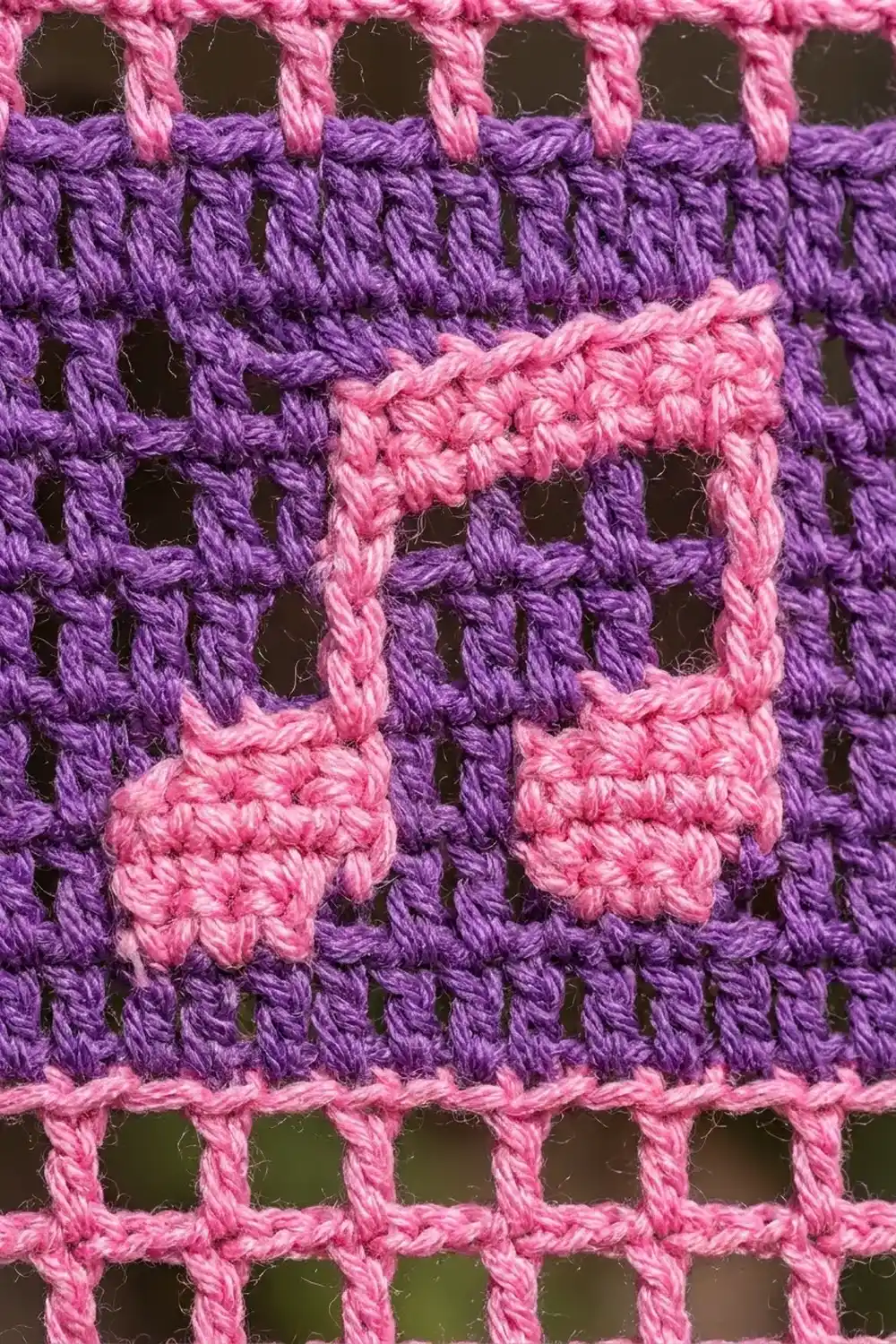
Melody Lines is a one-piece curtain panel that mixes bold colorwork with light, airy filet mesh. Deep purple bands carry a row of bright pink beamed eighth notes. Between them, pink open-mesh stripes let daylight through like the spaces between musical phrases.
The palette is just two colors, purple and pink, so the look is playful but still graphic and clean. The note bands are worked in solid double crochet tapestry colorwork, and the mesh bands are worked in classic filet grid. This pattern uses US crochet terms throughout.
The finished panel measures 37.2 in (94.5 cm) wide by 37.8 in (96.0 cm) long, including the border. That size suits a standard window or a doorway half-curtain.
You work the panel flat from the bottom up in rows of 181 stitches. It has five note bands and four mesh bands, and you finish it with two rounds of purple single crochet. There is no joining, because it’s all one piece.
Finished Size and Construction
- Finished size: 37.2 in × 37.8 in (94.5 cm × 96.0 cm)
- Skill level: Intermediate (tapestry color changes, filet mesh)
- Terminology: US
- Yarn weight: DK (#3), cotton or cotton blend
- Hook: 4.0 mm (G-6)
- Number of pieces: 1
- Layout: 5 purple note bands alternating with 4 pink mesh bands, starting and ending with a note band
- Panel size before border: 36.2 in × 36.8 in (91.9 cm × 93.5 cm)
- Note band: 12 rows, 4.8 in (12.2 cm) tall
- Mesh band: 8 rows, 3.2 in (8.1 cm) tall
- Border depth: 0.5 in (1.3 cm), 2 rounds of sc
Materials
Yarn: Choose a smooth mercerized or matte DK cotton. Cotton holds its shape on a hanging curtain and shows the mesh squares crisply. Avoid fuzzy yarns, because they blur both the note outlines and the mesh windows. The amounts below assume about 110 m per 50 g ball.
- Purple (Color P): 550 g, about 1,210 m
- Pink (Color K): 400 g, about 880 m
These quantities include a safety margin of roughly 15 percent for swatching, carried strands, and dye-lot security. Buy all balls of each color from the same lot.
Tools:
– 4.0 mm (G-6) crochet hook
– Tapestry needle
– Scissors
– Stitch markers (at least 6)
– Tape measure
– Blocking mats or a large towel-covered surface, plus rust-proof pins
– Spray bottle
Abbreviations (US Terms)
- ch: chain
- sl st: slip stitch
- sc: single crochet
- dc: double crochet
- sk: skip
- sp: space
- st(s): stitch(es)
- RS / WS: right side / wrong side
- P / K: work the stated number of dc in Purple / Pink
Tapestry color change: Work the last dc before the new color until 2 loops remain on the hook. Yarn over with the new color and pull it through. Carry the unused color along the tops of the stitches and work over it so it hides inside the dc.
Mesh cell: ch 1, sk 1 st, dc in next st. Each mesh row is 1 dc plus 90 cells, which comes to 181 sts when you count each ch-1 as a stitch.
Gauge and Checkpoints
Gauge: 20 dc and 10 rows = 4 in (10.2 cm). In mesh, 10 cells and 10 rows = 4 in (10.2 cm). Each solid dc row and each mesh row is 0.4 in (1.0 cm) tall. In sc for the border, 20 sc = 4 in (10.2 cm), and each sc round is about 0.25 in (0.6 cm) deep.
Test swatch first. Make one motif repeat:
1. Ch 39, then dc in the 4th ch from the hook and in each ch across (37 sts).
2. Work band rows 2–12 below, using the run counts for one repeat plus the single edge stitch.
3. Work the 8 mesh rows, which gives 18 cells.
Block the swatch. It should measure 7.4 in (18.8 cm) wide and 8 in (20.3 cm) tall.
If the swatch is too big, go down 0.5 mm. If it’s too small, go up 0.5 mm. If only the height is off, adjust your dc height: pull the first loop up a little less or more. Don’t change the row counts.
Checkpoints on the panel (lightly stretched flat):
– Row 1: 36.2 in (91.9 cm) wide
– End of Note Band 1 (Row 12): 4.8 in (12.2 cm) tall
– End of Row 20: 8 in (20.3 cm)
– End of Row 40: 16 in (40.6 cm)
– End of Row 60: 24 in (61.0 cm)
– End of Row 80: 32 in (81.3 cm)
– End of Row 92: 36.8 in (93.5 cm)
The Panel
The panel is worked in 92 rows. Every row has 181 sts. Odd rows are RS rows and even rows are WS rows.
Each 20-row repeat is 12 note-band rows followed by 8 mesh rows. Because the repeat has an even number of rows, band row 1 always falls on a RS row.
Stitch layout: Count stitch positions from the right edge as you look at the RS. Positions 1–180 are 5 motif repeats of 36 sts each. Position 181 is a purple edge stitch. The motif sits in the same stitch columns in every band, so the notes line up vertically.
On motif rows, the ch-3 turning chain counts as the first purple dc. On RS rows, the first P run includes it. On WS rows, it is the “P1” at the start.
Note Band (12 rows, Purple with Pink)
Band Row 1 (RS), solid:
– Band 1 only: With Purple, ch 183. Dc in the 4th ch from the hook and in each ch across. That gives 180 dc plus the skipped ch-3, for 181 sts.
– Bands 2–5: With Purple, ch 3 (counts as dc). Dc in each ch-1 sp and each dc across, working the last dc in the 3rd ch of the turning ch-4. That is 1 + (90 × 2) = 181 sts.
Turn.
On the first tapestry row, join Pink by working over its tail. Carry it through Band Rows 2–11.
Band Row 2 (WS), Motif Row 1: P1, *P8, K4, P10, K4, P10; rep from * 5 times total. (181 sts)
Band Row 3 (RS), Motif Row 2: *P8, K8, P6, K8, P6; rep from * 5 times total, P1. (181 sts)
Band Row 4 (WS), Motif Row 3: P1, *P6, K8, P6, K8, P8; rep from * 5 times total. (181 sts)
Band Row 5 (RS), Motif Row 4: *P8, K6, P8, K6, P8; rep from * 5 times total, P1. (181 sts)
Band Row 6 (WS), Motif Row 5: P1, *P12, K2, P12, K2, P8; rep from * 5 times total. (181 sts)
Band Row 7 (RS), Motif Row 6: *P8, K2, P12, K2, P12; rep from * 5 times total, P1. (181 sts)
Band Row 8 (WS), Motif Row 7: Repeat Band Row 6.
Band Row 9 (RS), Motif Row 8: Repeat Band Row 7.
Band Row 10 (WS), Motif Row 9: P1, *P12, K16, P8; rep from * 5 times total. (181 sts)
Band Row 11 (RS), Motif Row 10: *P8, K16, P12; rep from * 5 times total, P1. (181 sts)
Drop Pink at the edge. Don’t cut it.
Band Row 12 (WS), solid: With Purple, ch 3 (counts as dc), dc in each st across. (181 sts)
Check: Every motif run list adds up to 36, and 5 × 36 + 1 = 181. Rows 2–4 build two note heads and Rows 5–8 form the two stems. Rows 9–10 form the beam, which spans 16 sts and joins both stems. Each note pair is 4.4 in (11.2 cm) wide and 4 in (10.2 cm) tall, and the full repeat is 7.2 in (18.3 cm).
Mesh Band (8 rows, Pink)
Carry Purple loosely up the side edge. Catch it under the turning chain every 2 rows. The border will hide it.
Mesh Row 1 (RS): With Pink, ch 4 (counts as dc + ch 1), sk next st, dc in next st. *Ch 1, sk 1, dc in next st; rep from * across. That makes 90 cells, or 91 dc + 90 ch-1 = 181 sts.
Mesh Rows 2–8: Ch 4 (counts as dc + ch 1), dc in next dc. *Ch 1, dc in next dc; rep from * across, working the last dc in the 3rd ch of the turning ch-4. (181 sts)
The mesh posts sit on the odd stitch positions in every row, so the squares stack straight up.
Panel Sequence
- Rows 1–12: Note Band 1
- Rows 13–20: Mesh Band 1
- Rows 21–32: Note Band 2
- Rows 33–40: Mesh Band 2
- Rows 41–52: Note Band 3
- Rows 53–60: Mesh Band 3
- Rows 61–72: Note Band 4
- Rows 73–80: Mesh Band 4
- Rows 81–92: Note Band 5
After Row 92, cut Pink, leaving a 6 in (15.2 cm) tail. Keep Purple attached.
Size before border: 36.2 in × 36.8 in (91.9 cm × 93.5 cm). The width is 181 sts ÷ 5 = 36.2 in, and the height is 92 rows × 0.4 in = 36.8 in.
Border
Work the border in Purple at the sc gauge of 20 sc = 4 in (10.2 cm). The goal is a border that matches the panel’s width and length exactly, so the edges lie flat without waving or pulling in.
Corner setup: Each corner is a group of 3 sc worked into one stitch. The center sc of the group is the corner stitch. The side counts below are the sc between the corner groups.
Round 1 (RS): Ch 1, turn so the RS is facing.
– Top edge: 3 sc in the first st, sc in each of the next 179 sts, 3 sc in the last st.
– Left side: Work 184 sc evenly across the row ends, 2 sc per row.
– Bottom edge: Working into the bottoms of the foundation stitches, 3 sc in the first st, sc in each of the next 179 sts, 3 sc in the last st.
– Right side: Work 184 sc across the row ends.
Sl st to the first sc. The round has 179 + 179 + 184 + 184 + (4 × 3) = 738 sts.
Round 2: Ch 1. Sc in each sc around, working 3 sc in each corner center sc. Sl st to the first sc.
– Top and bottom: 181 sc between corners each.
– Sides: 186 sc between corners each.
– Total: 181 + 181 + 186 + 186 + 12 = 746 sts, which is 738 + 8.
Fasten off.
Why the math works:
– Top and bottom take 1 sc per existing stitch, and 5 sc per inch matches 5 dc per inch.
– On the sides, each row is 0.4 in tall, so 2 sc per row gives 5 sc per inch, the same as the sc gauge.
– Each round adds 2 sc per corner and nothing else.
– Two rounds add 0.5 in (1.3 cm) to every edge. The finished panel is 36.2 + 1.0 = 37.2 in (94.5 cm) wide and 36.8 + 1.0 = 37.8 in (96.0 cm) long.
Final Blocking
- Weave in all ends inside same-color stitches. In mesh areas, weave along the dc posts.
- Soak the panel in cool water for 15 minutes. Press out the water without wringing.
- Roll it in a towel to remove excess moisture.
- Lay it flat and pin it to 37.2 in × 37.8 in (94.5 cm × 96.0 cm). Pin the corners first, then pin each edge every 2 in (5.1 cm).
- Square the mesh bands so each cell is about 0.4 in (1.0 cm) square. Run a long ruler along each band to keep it level.
- Let it dry completely before unpinning.
Final Quality-Control Checklist
- Every row has 181 sts, and the mesh rows have 90 cells.
- All 25 note pairs (5 per band) face the same way and line up vertically.
- The beams connect both stems, and the note heads sit to the left of the stems.
- No pink shows through the purple background. Re-tension any spots where it does.
- The mesh posts stack straight with no slanted or merged cells.
- Border Round 2 counts 181 / 186 / 181 / 186 with 3-sc corners.
- The blocked size is 37.2 in × 37.8 in (94.5 cm × 96.0 cm), within ±0.25 in (0.6 cm).
- Both side edges are straight, and the carried yarn is hidden under the border.
Troubleshooting
- The panel is narrowing: You’re missing the last st, which is the top of the turning chain. Mark it on every row.
- Notes drift sideways: A run count is off. Recount each 36-st repeat against the run list before moving on.
- The carried yarn peeks through: Hold the carried strand on top of the stitches and slightly to the back. Tighten your yarn-overs a little.
- The fabric puckers in note bands: The carried strand is too tight. Stretch the row gently every few stitches.
- The mesh looks taller than the solid bands: Use ch 3 plus ch 1 consistently, and don’t loosen your mesh dc.
- The border ruffles: You have too many sc, or your sc is loose. Go down a hook size for the border only.
- The border cups: You have too few sc. Recount the side rows. There should be 92 rows, which means 184 sc.
Care
Hand wash cool or machine wash on a gentle cold cycle in a mesh bag, then dry flat. Re-block lightly after washing to keep the mesh squares square.

Final Notes
The measurement chain is simple:
– A gauge of 20 dc = 4 in gives a 181-st row that is 36.2 in (91.9 cm) wide.
– Rows of 0.4 in build 12-row note bands of 4.8 in (12.2 cm) and 8-row mesh bands of 3.2 in (8.1 cm).
– 92 rows give 36.8 in (93.5 cm).
– A 0.5 in (1.3 cm) border brings the panel to 37.2 in × 37.8 in (94.5 cm × 96.0 cm).
If your swatch matches, the panel will too. Check your counts at each band, keep your carried yarn relaxed, and let the notes do the singing.
Happy crocheting!