

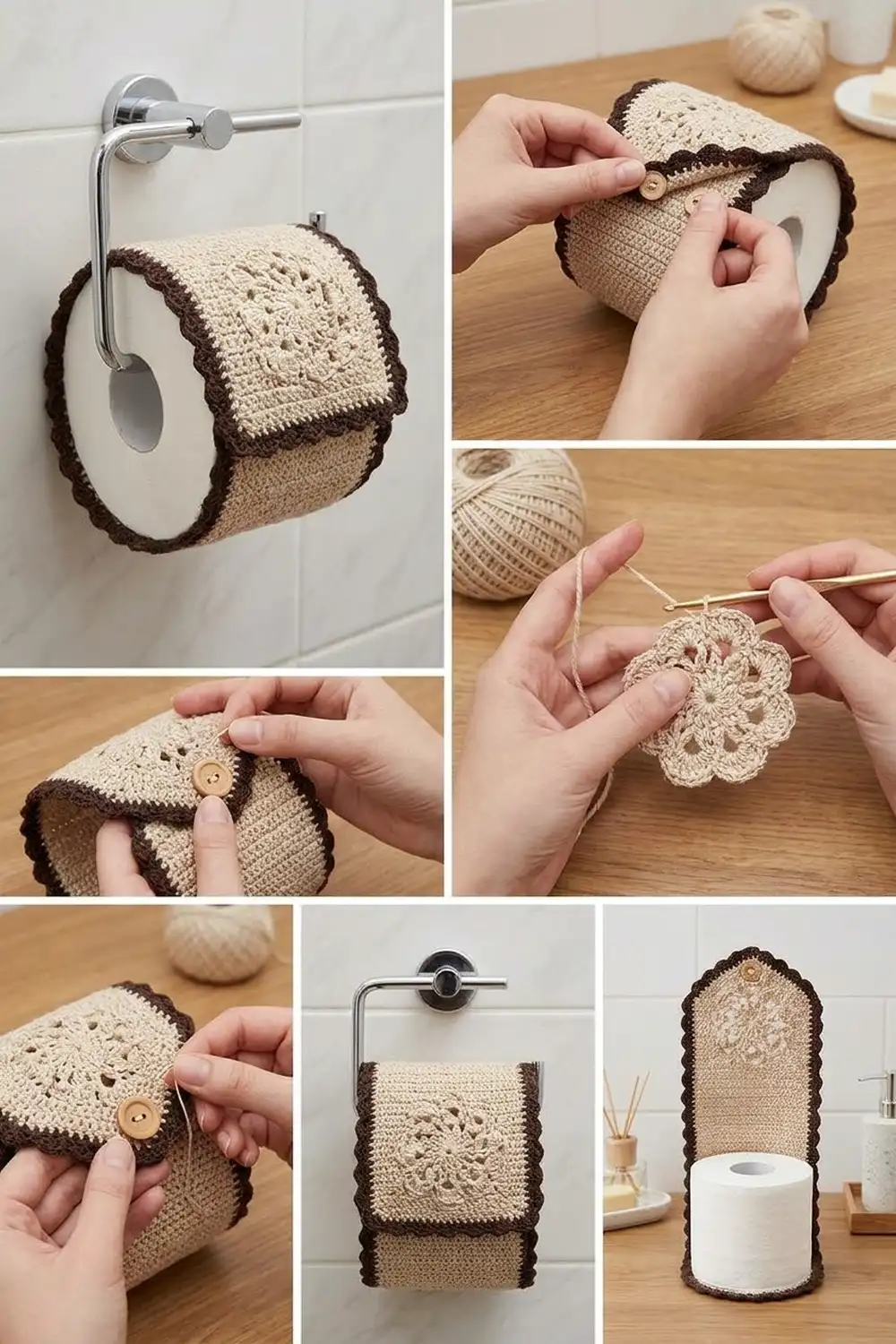
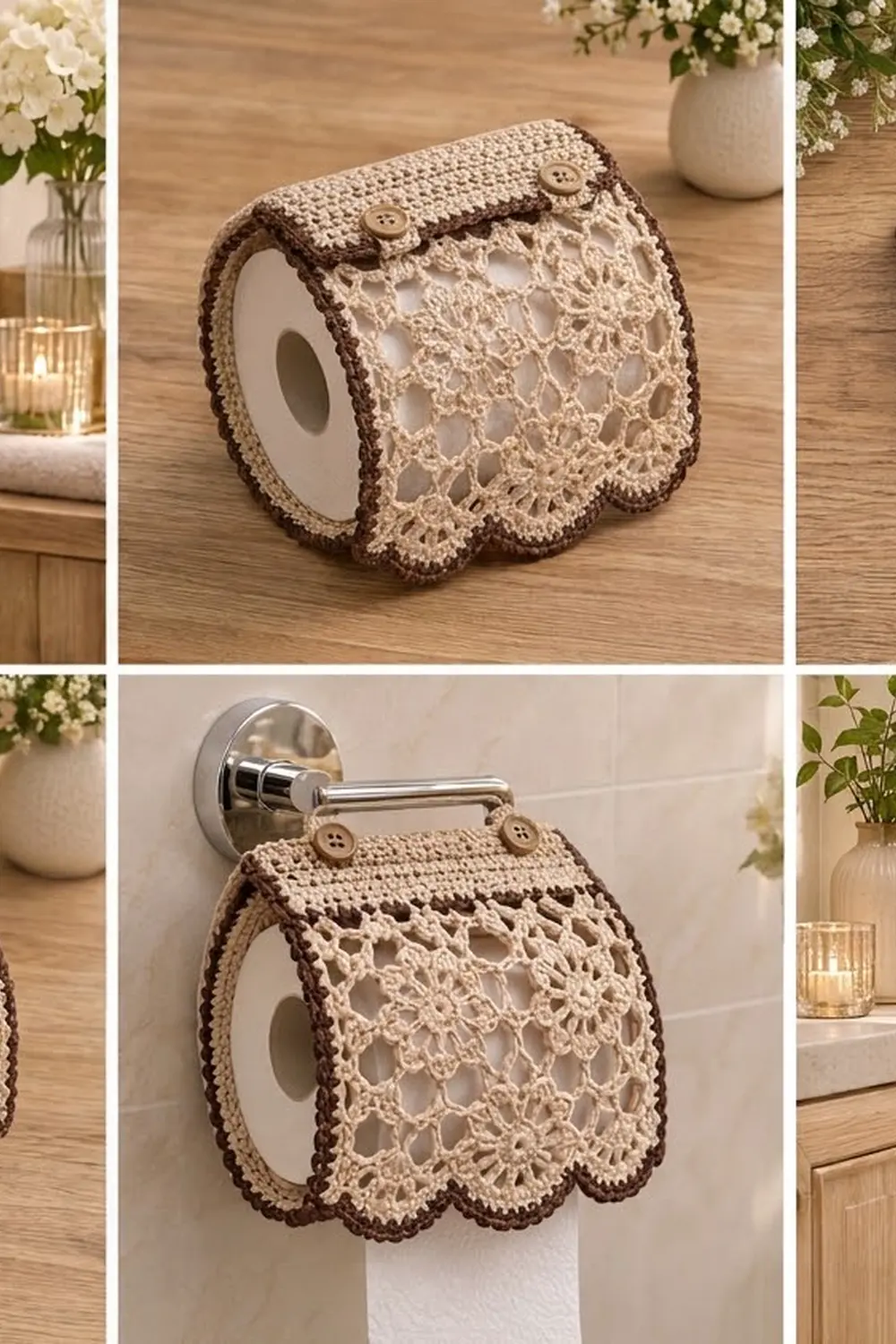
This cover hangs over your toilet paper holder like a small lace awning. Nine eight-petal flower motifs make the lacy front. A solid band buttons around the holder bar, and two shaped side pieces hug the ends of the roll. Deep scallops finish the bottom edge.
There are two colors. Warm beige is used for the lace, the band and the side pieces. Dark chocolate brown is used for a thin outline that sharpens the scallops and frames the cover against pale tile, which gives it a farmhouse, vintage look.
The pattern uses US crochet terms. Laid flat with the side pieces folded out, the finished body is about 5.5 in (14.0 cm) wide and 9 1/8 in (23.2 cm) long. It fits a standard roll about 4 in (10.2 cm) wide and 4.5 in (11.4 cm) in diameter.
Construction overview: make 9 square motifs and join them into a 3 x 3 panel. Work the band in rows off the top edge of the panel. Then add a beige scallop row and a brown edging round. Make 2 tapered side pieces, edge them in brown and sew them on. Add the buttons last.
Finished Size and Construction
- Finished body size: 5.5 in x 9 1/8 in (14.0 cm x 23.2 cm), laid flat
- Skill level: Intermediate
- Terminology: US
- Yarn weight: Fingering (#1) cotton
- Hook: 2.5 mm (US B/1 or C/2, depending on brand)
- Number of pieces: 11 (9 motifs + 2 side pieces). The band is worked directly onto the joined panel.
- Layout: 3 motifs across x 3 motifs down
- Motif size: 1.75 in (4.4 cm) square, 15 sts per side
- Size before border: 5.25 in x 8.25 in (13.3 cm x 21.0 cm), which is the lace panel plus the band
- Border depth: 0.75 in (1.9 cm) at the scallops and 1/8 in (0.3 cm) on all other edges
- Side pieces: 5.25 in (13.3 cm) long at the seam edge, about 3 in (7.6 cm) at the inner edge, and 1.25 in (3.2 cm) deep
Materials
Choose a smooth mercerized cotton in fingering weight. Cotton holds the lace shape, stands up to bathroom humidity and washes well. Avoid fuzzy yarns, because they blur the flower centers.
- Beige (main color): 50 g, about 170 m
- Dark brown (contrast): 10 g, about 34 m
Both quantities include a margin of about 15% for your swatch and for weaving in ends.
Tools:
– 2.5 mm crochet hook
– 2 wooden buttons, 0.5 in (1.3 cm)
– Tapestry needle
– Sewing needle and beige thread
– Stitch markers
– Blocking mat, rustproof pins and a spray bottle
– Measuring tape
Abbreviations (US Terms)
- ch – chain
- sl st – slip stitch
- sc – single crochet
- hdc – half double crochet
- dc – double crochet
- sc2tog – (insert hook in next st, yarn over, pull up a loop) twice, yarn over, pull through all 3 loops
- sp(s) – space(s)
- st(s) – stitch(es)
- RS – right side
- rep – repeat
Special stitch – shell: (dc, [ch 1, dc] 6 times) all in the same stitch. That is 7 dc and 6 ch-1 sps.
Gauge and Checkpoints
Make one complete motif before you start the rest.
- Motif gauge: one finished motif = 1.75 in (4.4 cm) square.
- Solid gauge: 17 sc or 17 hdc = 2 in (5.1 cm). For row height, 9 sc rows = 1 in (2.5 cm) and 6 hdc rows = 1 in (2.5 cm).
Motif checkpoints:
– After Round 1: 0.75 in (1.9 cm)
– After Round 2: 1.125 in (2.9 cm)
– After Round 3: 1.5 in (3.8 cm)
– After Round 4: 1.75 in (4.4 cm)
If your motif is too big: go down to a 2.25 mm hook. Just 1/8 in (0.3 cm) of extra width per motif adds 3/8 in (1.0 cm) across the panel.
If your motif is too small: go up to a 2.75 mm hook. Don’t add rounds, because that changes every stitch count that follows.
Flower Motif (Make 9)
Use beige throughout.
Round 1: Ch 4, sl st to the first ch to form a ring. Ch 3 (counts as dc), 15 dc in the ring, sl st to the top of ch-3. (16 dc)
Round 2: Ch 3 (counts as dc), dc in next st, ch 3, dc in each of next 2 sts, ch 3; rep from * 6 more times, sl st to the top of ch-3. (16 dc in 8 pairs, 8 ch-3 sps)*
The 8 dc pairs form the petals, and the ch-3 sps open the lace.
Round 3: Sl st in the next dc and into the ch-3 sp. Ch 3 (counts as dc), (2 dc, ch 2, 3 dc) in the same sp for the first corner, ch 1, 3 dc in the next sp, ch 1. (3 dc, ch 2, 3 dc) in the next sp, ch 1, 3 dc in the next sp, ch 1; rep from * 2 more times, sl st to the top of ch-3. (36 dc; 4 ch-2 corner sps, 8 ch-1 sps)*
Round 4: Ch 1. Sc in each dc and each ch-1 sp around, with 3 sc in each ch-2 corner sp. Sl st to the first sc. (56 sc)
Count check: each side has 11 sc between the corner groups (3 dc + 1 sp + 3 dc + 1 sp + 3 dc). That gives 4 x 11 + 4 x 3 = 56. Counted from one corner center st to the next, each side has 15 sts, including both corner center sts. All the math that follows uses this 15.
Fasten off. On 6 motifs, leave a 12 in (30.5 cm) tail for joining.
Make All Pieces
- Beige flower motifs: 9
- Beige side pieces: 2 (see below)
Layout grid (RS facing, band at the top):
[A] [A] [A]   <- Row 1: band worked off this edge
[A] [A] [A]   <- Row 2
[A] [A] [A]   <- Row 3: scallops worked off this edge
Joining the Motifs
Method: whipstitch through the outer loops with beige.
- Place 2 motifs RS up and side by side.
- Start at a corner center st and go through the outer loop on both motifs.
- Work 1 stitch per matching pair, 15 sts to 15 sts, and end at the opposite corner center st.
- Join the 3 motifs in each row first, then join the rows to each other.
- Where 4 corners meet, take one extra pass through all 4 corner sts.
Tension: pull snug enough to close the seam, but don’t let it pucker. A tight seam shortens the panel and throws the scallops out of line.
Size checkpoint: the panel measures 5.25 in x 5.25 in (13.3 cm x 13.3 cm). Each outer side has 3 x 15 = 45 sts.
Band
Join beige with RS facing at the top right corner center st.
Row 1: Ch 2 (does not count as a st), hdc in each of the 45 sts across the top edge, turn. (45 hdc)
Rows 2–15: Ch 2, hdc in each st across, turn. (45 hdc)
Checkpoint: the band is now 2.5 in (6.4 cm) long and still 5.25 in (13.3 cm) wide.
Row 16 (buttonholes): Ch 2, hdc in next 9 sts, ch 4, skip 4 sts, hdc in next 19 sts, ch 4, skip 4 sts, hdc in last 9 sts, turn. (9 + 4 ch + 19 + 4 ch + 9 = 45 sts)
Row 17: Ch 2, hdc in each hdc and 4 hdc in each ch-4 sp, turn. (45 hdc)
Row 18: Ch 2, hdc in each st across. (45 hdc) Fasten off.
The band measures 3 in (7.6 cm), and the body measures 5.25 in x 8.25 in (13.3 cm x 21.0 cm).
Side Pieces (Make 2)
Use beige. Each piece tapers so its inner edge circles the end of the roll without ruffling.
Foundation: Ch 46.
Row 1: Sc in the 2nd ch from the hook and in each ch across, turn. (45 sc)
Row 2: Ch 1, sc in next 4, sc2tog, sc in next 8; rep from * 2 more times, sc2tog, sc in last 9, turn. (41 sc)*
Rows 3, 5, 7 and 9: Ch 1, sc in each st across, turn. (each keeps the count of the row before it)
Row 4: Ch 1, sc in next 4, sc2tog, sc in next 7; rep from * 2 more times, sc2tog, sc in last 8, turn. (37 sc)*
Row 6: Ch 1, sc in next 4, sc2tog, sc in next 6; rep from * 2 more times, sc2tog, sc in last 7, turn. (33 sc)*
Row 8: Ch 1, sc in next 4, sc2tog, sc in next 5; rep from * 2 more times, sc2tog, sc in last 6, turn. (29 sc)*
Row 10: Ch 1, sc in next 4, sc2tog, sc in next 4; rep from * 2 more times, sc2tog, sc in last 5, turn. (25 sc)*
Row 11: Ch 1, sc in each st across. (25 sc) Fasten off.
Checkpoint: each piece is 5.25 in (13.3 cm) along the foundation edge, about 3 in (7.6 cm) along Row 11, and about 1.25 in (3.2 cm) deep.
Border
Border gauge: 17 sc = 2 in (5.1 cm). If the brown edge draws in, go up 0.25 mm.
Scallop Row (beige, bottom edge only)
With RS facing, join beige at the bottom right corner center st.
*Sc in the corner st, skip 6 sts, shell in the 8th st, skip 6 sts, sc in the 15th st (the next corner st); rep from * across the other 2 motifs. Fasten off.
Each repeat uses 1 + 6 + 1 + 6 + 1 = 15 sts, so 3 scallops fill the 45-st edge exactly.
Body Edging Round (brown)
With RS facing, join brown in the first sc of the scallop row. Ch 1 and work:
- Bottom: sc in each sc, dc and ch-1 sp. That is 15 per scallop (1 + 7 + 6 + 1), so 45 sc.
- Left lace side: sc in each of the 45 motif edge sts, starting with the corner st under the last scallop sc. 45 sc.
- Left band side: 3 sc for every 2 row ends across 18 rows. 27 sc.
- Top: 3 sc in the first st of Row 18, sc in the next 43, 3 sc in the last st. 49 sc (45 worked 1 per st + 4 extra at the corners).
- Right band side: 27 sc.
- Right lace side: 45 sc.
Sl st to the first sc. Total: 45 + 45 + 27 + 49 + 27 + 45 = 238 sc. Fasten off.
Side Piece Edging (brown, on each piece)
Join brown at the end of Row 1. Ch 1, sc in the ends of Rows 1–10, 3 sc in the first st of Row 11, sc in the next 23, 3 sc in the last st, sc in the ends of Rows 10–1. Total: (10 + 25 + 10 = 45 worked 1 per st) + 4 extra = 49 sc. Fasten off. Leave the foundation edge unedged so it can be sewn on.
Why the Math Works
Each lace side is 3 motifs x 15 sts = 45 sts, with nothing added at the seams. Each side piece foundation is also 45 sts, so the side seam is exactly 1:1. The band is worked into the same 45 top-edge sts, so it matches the panel width. The scallop repeat is 15 sts, the same as one motif side, so every scallop sits centered under a flower column.
Assembly
- With RS out, place the foundation edge of a side piece against the brown sts of one lace side, with the narrow edge pointing inward.
- Whipstitch with beige, 45 foundation loops to 45 brown sts. Repeat on the other side.
- Wrap the band around your holder bar and fold the end forward. Mark where the buttonholes land. By default that is Row 7, sts 11–12 and 34–35.
- Sew on the buttons.
Final Blocking
- Weave in all ends along the seams.
- Pin the body RS up with the side pieces folded out.
- Spray it until evenly damp.
- Pin the lace to 5.25 in x 5.25 in (13.3 cm x 13.3 cm) and the band to 5.25 in x 3 in (13.3 cm x 7.6 cm).
- Pin each scallop tip to the same depth, 0.75 in (1.9 cm).
- Open the flower centers with a pin tip.
- Let it dry completely before you fit it on the roll.
Final Quality-Control Checklist
- 9 motifs, each 1.75 in (4.4 cm) with 56 sts
- Flat seams with no gaps at the 4-corner points
- Band of 45 sts and 18 rows, with even buttonholes
- Scallops centered under the motif columns
- Brown round of 238 sc that lies flat
- Side pieces taper from 45 to 25 sts and are sewn 1:1
- Finished body measures 5.5 in x 9 1/8 in (14.0 cm x 23.2 cm)
Troubleshooting
- Motif cups: loosen the Round 2 chains.
- Motif ruffles: go down 0.25 mm.
- Band is wider than the panel: rework it with a 2.25 mm hook.
- Brown edge waves: work exactly 3 sc per 2 band rows.
- Side piece ruffles at the inner edge: add one more decrease row (25 to 21 sts).
- Buttons slip: tighten the buttonhole, or use a 5/8 in (1.6 cm) button.
Care
Hand wash in cool water with mild soap and roll the cover in a towel to remove water. Lay flat to dry and reshape the scallops while damp.
Final Notes
The measurement chain is short. A 1.75 in (4.4 cm) motif with 15 sts per side makes a 5.25 in (13.3 cm) panel with 45 sts per side. That number 45 carries into the band, the scallops, the brown edging and the side pieces, so every piece meets cleanly. Get the first motif to gauge and the rest of the cover will fit.
Happy crocheting!