

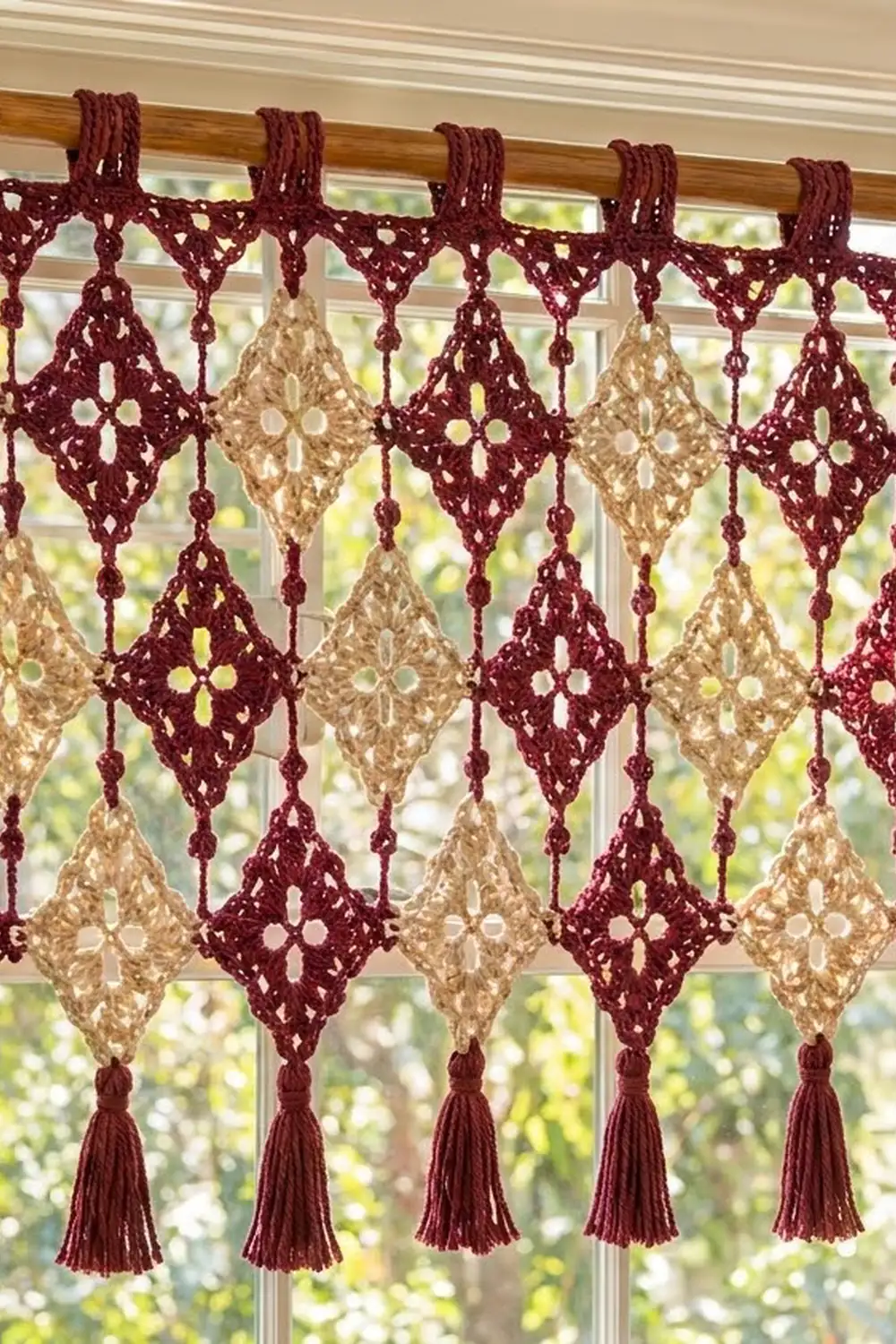
The Mulberry Lattice Valance is a light, open curtain topper. It’s made from small granny motifs turned on point so they read as diamonds. Burgundy and cream diamonds alternate in a checkerboard, hang in vertical strands, and finish with a row of plump burgundy tassels. Sunlight comes through every gap, so the piece glows without blocking the view.
The palette has only two colors, a deep burgundy and a soft cream. Every join, the header band, the rod tabs, and all the tassels are burgundy. This frames the cream diamonds and ties the lattice together. The style is cottage and farmhouse, with a slight boho touch from the tassels.
The pattern uses US crochet terms. The finished valance is 51.3 in (130.3 cm) wide at the side points. It measures 20.1 in (51.1 cm) from the top of the header to the tassel tips, not counting the rod tabs. The header itself is 47.3 in (120.1 cm) wide.
Construction is simple. You make 33 identical diamond motifs and join them point to point into a lattice 11 strands wide and 3 motifs tall. Then you crochet a narrow header with 11 loop tabs across the top points and tie a tassel to the bottom point of each strand.
Finished Size and Construction
- Finished size: 51.3 in (130.3 cm) wide x 20.1 in (51.1 cm) long, plus tabs
- Skill level: Easy-intermediate
- Terminology: US
- Yarn weight: DK (light worsted, #3), cotton or cotton blend
- Hook: 4.0 mm (G-6)
- Number of pieces: 33 motifs (17 burgundy, 16 cream) plus 11 tassels
- Layout: 11 strands wide x 3 motifs tall, set on point
- Motif size: 3.3 in (8.4 cm) per side; 4.67 in (11.9 cm) point to point
- Size before border: 51.3 in (130.3 cm) x 15.3 in (38.9 cm)
- Border depth: the header adds 0.6 in (1.5 cm) above the top points; the tassels add 4.2 in (10.7 cm) below the bottom points
Materials
Choose a smooth cotton DK, either mercerized or matte. Cotton holds the diamond shape well, resists sagging in a sunny window, and keeps the stitches crisp. Avoid fuzzy or very stretchy yarns, because the lattice depends on clean points.
- Burgundy: 200 g, about 460 m (motifs, joins, header, tabs, tassels)
- Cream: 150 g, about 345 m (motifs)
The meter amounts assume a DK cotton of about 115 m per 50 g. All quantities include a margin of about 20 percent for gauge differences and tassel trimming.
Tools:
- 4.0 mm (G-6) crochet hook
- Tapestry needle
- Scissors
- Stiff card 3.5 in (8.9 cm) tall, for tassels
- Rustproof pins and a blocking mat
- Measuring tape
- Spray bottle
Abbreviations (US Terms)
- ch – chain
- sl st – slip stitch
- sc – single crochet
- dc – double crochet
- sp(s) – space(s)
- st(s) – stitch(es)
- rep – repeat
- Corner sp – the ch-3 space at each corner of a motif. When the motif is turned on point, the four corners become the top, bottom, left, and right points.
Special stitch – Granny corner: (3 dc, ch 3, 3 dc) worked into the same corner space.
Gauge and Checkpoints
Header gauge: 18 sc and 20 rows = 4 in (10.2 cm) in sc.
Motif gauge: One finished motif = 3.3 in (8.4 cm) per side, measured from corner sp to corner sp.
Make one motif before anything else and measure it after each round:
- Round 1: 0.75 in (1.9 cm) across
- Round 2: 1.25 in (3.2 cm) across
- Round 3: 1.9 in (4.8 cm) per side
- Round 4: 2.4 in (6.1 cm) per side
- Round 5: 3.0 in (7.6 cm) per side
- Round 6: 3.3 in (8.4 cm) per side, 4.67 in (11.9 cm) point to point
If your motif is larger than 3.4 in (8.6 cm) per side, go down half a hook size. If it’s smaller than 3.2 in (8.1 cm), go up half a size. A difference of 0.1 in (0.3 cm) per side adds up to about 1.6 in (4.1 cm) across the full width, so it’s worth checking.
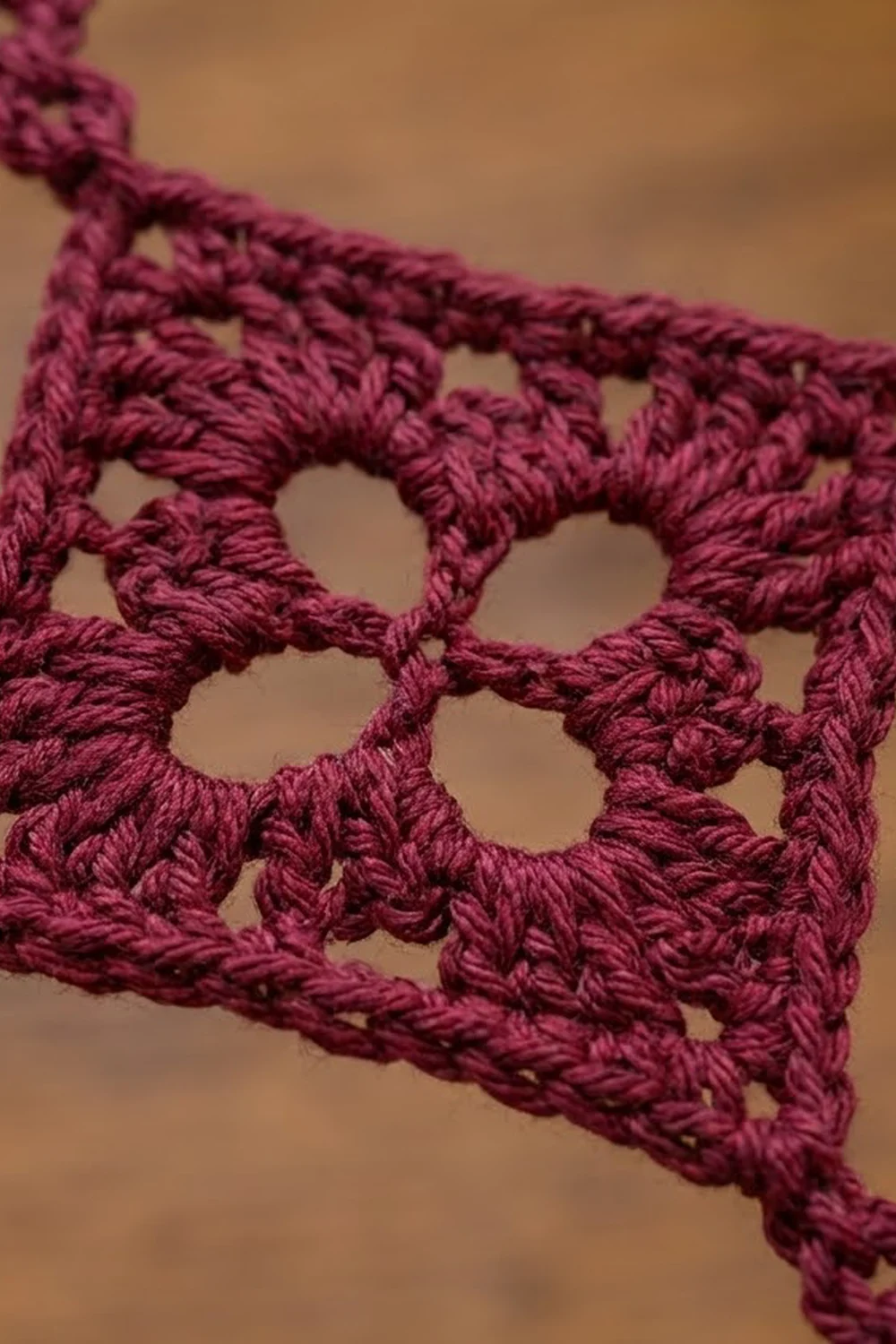
Diamond Motif (Make 33)
Work each motif entirely in one color. Do not turn between rounds.
Round 1: Make a magic ring. Ch 1, work 8 sc in the ring, and join with sl st to the first sc. Pull the ring closed. (8 sc)
Round 2: Ch 1, sc in first sc, ch 5, skip next sc, [sc in next sc, ch 5, skip next sc] 3 times, join with sl st to first sc. (4 sc, 4 ch-5 loops)
These four loops become the four open “petals” at the center. Each loop points toward a future corner, so on the finished diamond the holes point up, down, left, and right.
Round 3: Sl st into first ch-5 loop. Ch 3 (counts as dc), (2 dc, ch 3, 3 dc) in same loop, ch 1, [granny corner in next ch-5 loop, ch 1] 3 times, join with sl st to top of beginning ch-3. (24 dc: 6 dc per side, 4 corner sps, 4 ch-1 sps)
Round 4: Sl st in next 2 dc and into corner sp. Ch 3, (2 dc, ch 3, 3 dc) in same sp, ch 1, 3 dc in next ch-1 sp, ch 1, [granny corner in next corner sp, ch 1, 3 dc in next ch-1 sp, ch 1] 3 times, join to top of beginning ch-3. (36 dc: 9 dc per side)
Round 5: Sl st in next 2 dc and into corner sp. Ch 3, (2 dc, ch 3, 3 dc) in same sp, ch 1, [3 dc in next ch-1 sp, ch 1] twice, granny corner in next corner sp, ch 1, [3 dc in next ch-1 sp, ch 1] twice; rep from * 2 more times, join to top of beginning ch-3. (48 dc: 12 dc per side)*
Round 6 (edging): Sl st in next 2 dc and into corner sp. Ch 1, (sc, ch 3, sc) in same sp, *sc in each of next 12 dc, skipping the ch-1 sps, (sc, ch 3, sc) in next corner sp; rep from * 2 more times, sc in each of last 12 dc, join with sl st to first sc. Fasten off and weave in ends.
(56 sc: 14 sc per side, including that side’s 2 corner sc; 4 corner ch-3 sps)
Check: 4 sides x 14 sc = 56 sc. Each corner holds 2 sc, and each of those belongs to one of the two sides that meet there. No corner stitch is counted twice.
Make All Pieces
- Burgundy motifs: 17
- Cream motifs: 16
- Total: 33
Lay the motifs out on point in 3 rows of 11, using this checkerboard (B = burgundy, C = cream):
Row A (top):    B C B C B C B C B C B
Row B (middle): C B C B C B C B C B C
Row C (bottom): B C B C B C B C B C B
Row A has 6 B and 5 C. Row B has 5 B and 6 C. Row C has 6 B and 5 C. That’s 17 B and 16 C in total. Both outer strands start and end with burgundy, which frames the edges.
Block all the motifs lightly before joining (see Final Blocking) so every point is sharp and every diamond is the same size.
Joining
All joins use burgundy and connect only at the corner sps. The sides of the diamonds stay free, which creates the open diamond-shaped gaps between motifs.
Side joins (left and right points): Hold the right point of one motif against the left point of the next motif in the same row, so the two corner ch-3 sps line up. Insert the hook through both sps, pull up a burgundy loop, and ch 1. Work 3 sc through both sps together and fasten off. This makes a small solid knot, like a bead, where the points meet.
- 10 side joins per row x 3 rows = 30 side joins
Strand links (top and bottom points): Join burgundy with sc in the bottom corner sp of an upper motif, ch 3, sc in the top corner sp of the motif directly below, and fasten off.
- 2 links per strand x 11 strands = 22 links
Each link adds about 0.67 in (1.7 cm) between points.
Stitch-to-stitch logic: Every join connects one corner sp to one corner sp. No stitches along the motif sides are skipped or worked into, so each motif keeps its 14 sc per side.
Tension advice: Keep the 3 sc of each side join snug but not tight. If they pull, the points pucker and the rows tilt. Keep all ch-3 links the same length, because uneven links make the strands hang at different heights.
Size checkpoint: Lay the joined lattice flat.
- Width at the side points: 11 x 4.67 in = 51.3 in (130.3 cm).
- Height from top points to bottom points: (3 x 4.67 in) + (2 x 0.67 in) = 15.3 in (38.9 cm).
Up to 0.5 in (1.3 cm) over or under is fine.
Border: Header, Tabs, and Tassels
The border has three parts: a narrow burgundy header across the 11 top points, 11 loop tabs for the rod, and 11 tassels at the bottom points.
Border gauge: 18 sc = 4 in (10.2 cm), or 4.5 sts per inch.
Header
Row 1: With the lattice right side up, join burgundy in the top corner sp of the first motif on the right. *3 sc in this top corner sp, ch 18; rep from * across. End with 3 sc in the top corner sp of the last motif, with no ch after it. Turn.
(213 sts: 11 points x 3 sc = 33 sc, plus 10 valleys x 18 ch = 180 ch)
Row 2: Ch 1 (does not count as a st), sc in each sc and each ch across. Turn. (213 sc)
Row 3 (tab row): Ch 1, sc in next 3 sc (above a point), ch 24, sl st in the first of those 3 sc to form a loop, sc in next 18 sc; rep from * 9 more times, sc in last 3 sc, ch 24, sl st in first of those 3 sc. Fasten off. (213 sc plus 11 ch-24 loops)*
Row 4 (tab reinforcement): Join burgundy at the base of a loop, work 30 sc into the ch-24 loop, sl st at the base, and fasten off. Repeat for every loop. (30 sc per tab x 11 tabs = 330 sc)
Each finished tab stands about 2.4 in (6.1 cm) above the header and fits a rod up to 1.25 in (3.2 cm) in diameter.
Why the math works:
- The top points sit 4.67 in (11.9 cm) apart.
- One repeat (3 sc + 18 ch) is 21 sts, and 21 sts / 4.5 sts per inch = 4.67 in. Each repeat spans exactly one point-to-point distance.
- The full header is 10 repeats plus the final 3 sc: (10 x 21) + 3 = 213 sts. At gauge, 213 / 4.5 = 47.3 in (120.1 cm).
- That equals 10 x 4.67 in plus the 0.67 in (1.7 cm) width of the last point.
No extra stitches are added at any seam. The 18 ch in each valley is the only bridge between points. The header lies flat because its width matches the span of the points below it.
Tassels (Make 11)
- Wrap burgundy 30 times around the 3.5 in (8.9 cm) card.
- Slide a 10 in (25.4 cm) tie strand under the wraps at the top and knot it tightly.
- Cut the wraps along the bottom edge.
- Wrap a separate strand 6 times around the bundle 0.5 in (1.3 cm) below the top. Knot it and bury the ends inside the tassel.
- Trim the bottom evenly to 3.5 in (8.9 cm).
Attach: Join burgundy with sc in the bottom corner sp of each Row C motif, ch 3, and fasten off. Tie the tassel’s top strands through the end of this ch-3 link and hide the ends inside the tassel head. The link plus the tassel adds 0.67 in + 3.5 in = 4.2 in (10.7 cm).
Final Blocking
- Weave in every remaining end, including the tassel ties.
- Lay the valance face down on a blocking mat or a large surface covered with towels.
- Pin the top points along a straight line 47.3 in (120.1 cm) long, with the header above it.
- Pin each row of side joins along a straight horizontal line.
- Check that the width at the side points is 51.3 in (130.3 cm).
- Pin the bottom points so all 11 strands are the same length: 15.3 in (38.9 cm) from top points to bottom points.
- Mist evenly with water until damp but not soaked.
- Leave the tassels unpinned and comb them straight with your fingers.
- Let the piece dry completely before unpinning, usually 12 to 24 hours.
Final Quality-Control Checklist
- 33 motifs: 17 burgundy and 16 cream, in the checkerboard layout
- Every motif has 56 sc in Round 6, 14 per side including corners
- Every motif measures 3.3 in (8.4 cm) per side
- 30 side joins and 22 strand links, all in burgundy
- Header Rows 1 to 3 each have 213 sts
- 11 tabs, each with 30 sc
- 11 tassels, each 3.5 in (8.9 cm), all trimmed level
- Width 51.3 in (130.3 cm), header 47.3 in (120.1 cm), length 20.1 in (51.1 cm)
- All ends woven in and secure
Troubleshooting
Motifs curl or cup. Your Round 6 tension is too tight. Loosen your sc, or go up half a hook size for that round only.
Motifs ruffle. You may have worked sc into the ch-1 sps in Round 6. Count again: there should be 12 sc between corners.
Points are rounded, not sharp. Make sure each corner gets (sc, ch 3, sc), and pin the points firmly when blocking.
Header is wider than the lattice. Your chains are loose. Rework Row 1 with 17 ch per valley, or use a smaller hook for the chains only.
Header pulls the points together. Your chains are tight. Use 19 ch per valley, or a larger hook for the chains.
Strands hang at different lengths. One or more ch-3 links are uneven. Redo any link that is longer or shorter than the others.
Tassels look thin. Add 5 to 10 more wraps per tassel.
Care
Hand wash in cool water with mild soap, press the water out in a towel, and dry flat, pinning the points back into shape. Cotton may fade in strong sun, so shake out dust often instead of washing frequently.
Final Notes
All the measurements in this valance follow from the motif size:
- Each motif is 3.3 in (8.4 cm) per side, which makes it 4.67 in (11.9 cm) point to point.
- Eleven strands give a width of 51.3 in (130.3 cm).
- Three diamonds and two links give a lattice height of 15.3 in (38.9 cm).
- The 21-st header repeat at 4.5 sts per inch matches the 4.67 in point spacing, so the 213-st header is 47.3 in (120.1 cm) wide.
- Adding the 0.6 in (1.5 cm) header and the 4.2 in (10.7 cm) link and tassel gives 20.1 in (51.1 cm) in total.
Check your first motif carefully, and the rest will follow.
Happy crocheting!