

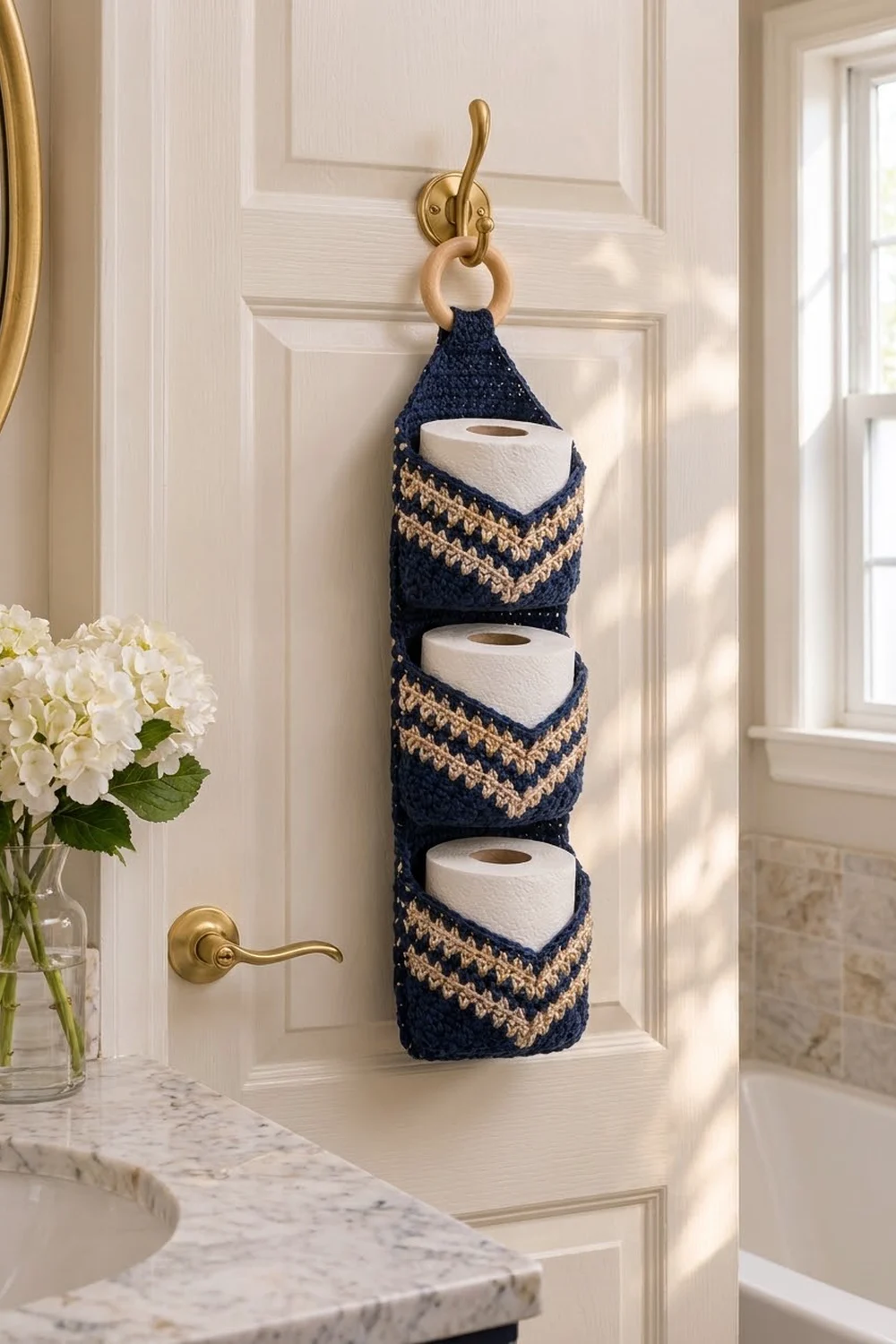
This hanging holder stores three spare rolls on the back of a bathroom door. A long navy panel carries three box-shaped pockets, one above the other. The top of the panel narrows into a strap that loops through a wooden ring.
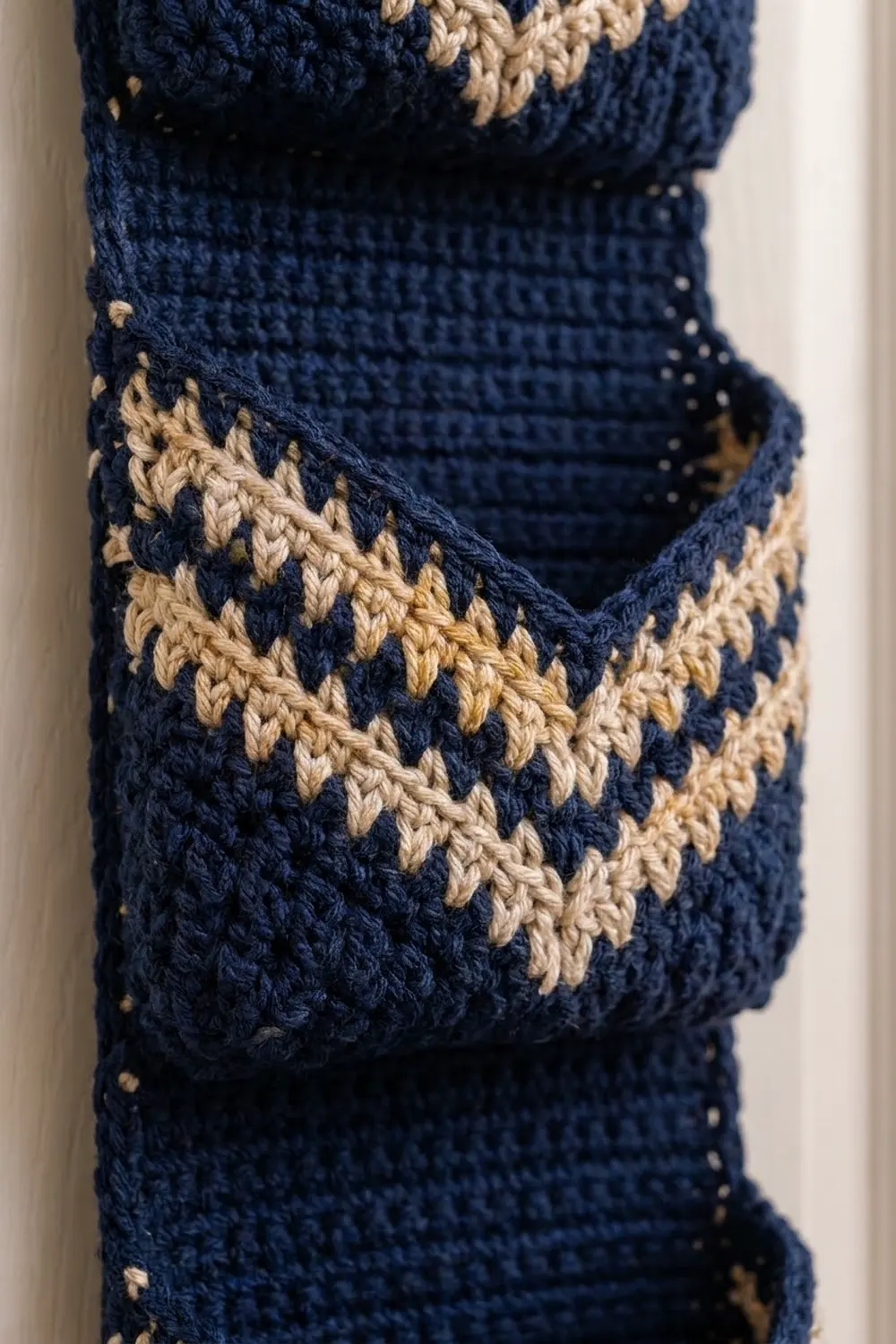
Each pocket has a flat base and two beige chevron stripes across the front. The stripes make the top edge dip into a soft V. The navy and beige colors look calm and classic, and they suit a bathroom with white doors, marble, or brass fittings.
The pattern uses US crochet terms. The finished holder is about 6 in (15.2 cm) wide and about 23.9 in (60.7 cm) long from the bottom edge to the top of the folded strap, not counting the ring. Each pocket is 5.25 in (13.3 cm) wide, 4 in (10.2 cm) deep, and 4 in (10.2 cm) tall at the corners.
You make the panel in rows and the pockets in the round from a flat rectangular base. Then you sew the pockets to the panel, add a two-round border, and fold the strap around the ring.
Finished Size and Construction
- Finished size: about 6 in (15.2 cm) × 23.9 in (60.7 cm) hanging, without the ring
- Skill level: Intermediate
- Terminology: US
- Yarn weight: Worsted (#4), cotton or a cotton blend
- Hook: 5.0 mm (H-8)
- Number of pieces: 4 (1 backing panel, 3 pockets)
- Layout: one column of 3 pockets on one panel
- Panel size before border: 5.25 in (13.3 cm) × 25.1 in (63.8 cm), unfolded
- Pocket size: 5.25 in (13.3 cm) wide × 4 in (10.2 cm) deep × 4 in (10.2 cm) tall at the corners, 3.25 in (8.3 cm) at the center dip
- Border depth: about 0.4 in (1.0 cm) on each edge
Materials
Use a firm worsted cotton. It keeps the pockets upright and holds up to washing. Acrylic also works, but the pockets will be softer and may sag under a full roll.
- Navy (MC): 320 g / about 545 m
- Beige (CC): 50 g / about 85 m
Both amounts include a margin of about 10% for your gauge swatch and small differences in tension.
Tools:
– 5.0 mm (H-8) crochet hook
– Wooden ring, 2.5 in (6.4 cm) across
– 4 locking stitch markers
– Tapestry needle
– Scissors
– Measuring tape
– Rust-proof pins for blocking
Abbreviations (US Terms)
- ch: chain
- sc: single crochet
- sl st: slip stitch
- st(s): stitch(es)
- BLO: back loop only
- sc2tog: single crochet 2 together (a 1-stitch decrease)
- sc3tog: single crochet 3 together (a 2-stitch decrease)
- MC / CC: main color (navy) / contrast color (beige)
Special stitch, sc3tog: Insert the hook in the next stitch, yarn over, and pull up a loop. Repeat in each of the next 2 stitches, so you have 4 loops on the hook. Yarn over and pull through all 4 loops.
Gauge and Checkpoints
Gauge: 16 sc and 18 rows = 4 in (10.2 cm) in single crochet. That is 4 sts and 4.5 rows per inch.
Make one pocket before you start the panel. A pocket is small, and it tests your gauge, the corner fold, and the chevron shaping all at once.
Checkpoints:
– Pocket base after Row 18: 5.25 in × 4 in (13.3 cm × 10.2 cm)
– Pocket walls after Round 8: about 1.8 in (4.6 cm) tall
– Finished pocket: 4 in (10.2 cm) tall at the corners
– Panel after Row 81: 5.25 in × 18 in (13.3 cm × 45.7 cm)
If your pieces are too big, go down 0.5 mm in hook size. If they are too small, go up 0.5 mm. Firm stitches matter here. Loose fabric lets the pockets slump.
Backing Panel
Use MC (navy).
Row 1: Ch 22. Sc in the 2nd ch from the hook and in each ch across. Turn. (21 sc)
Rows 2–81: Ch 1, sc in each st across. Turn. (21 sc)
Checkpoint: 5.25 in × 18 in (13.3 cm × 45.7 cm).
Taper
Row 82: Ch 1, sc2tog, sc 17, sc2tog. Turn. (19 sc)
Row 83: Ch 1, sc in each st across. Turn. (19 sc)
Rows 84–95: Repeat Rows 82–83 six more times. Each decrease row ends with 2 fewer sts than the plain row before it.
| Rows | Stitches |
|---|---|
| 84–85 | 17 |
| 86–87 | 15 |
| 88–89 | 13 |
| 90–91 | 11 |
| 92–93 | 9 |
| 94–95 | 7 |
The taper is 14 rows, or about 3.1 in (7.9 cm).
Strap
Rows 96–113: Ch 1, sc in each st across. Turn. (7 sc)
The strap is 1.75 in (4.4 cm) wide and 4 in (10.2 cm) long. Fasten off and weave in the ends.
Checkpoint: the unfolded panel measures 25.1 in (63.8 cm) from the bottom to the top.
Pocket (Make 3)
Base
Use MC.
Row 1: Ch 22. Sc in the 2nd ch from the hook and in each ch across. Turn. (21 sc)
Rows 2–18: Ch 1, sc in each st across. Turn. (21 sc)
Checkpoint: 5.25 in × 4 in (13.3 cm × 10.2 cm). Do not fasten off.
Walls
Round 1: Ch 1. Rotate the base and work around all four edges:
- 16 sc evenly down the row ends
- 21 sc in the free loops of the foundation chain. This is the front edge. Put a marker in the first and last of these 21 sts.
- 16 sc evenly up the other row ends
- 21 sc across the top of Row 18. This is the back edge.
Join with a sl st to the first sc. (74 sc)
Round 2: Ch 1, sc in the BLO of each st around. Join. (74 sc)
Working in the back loop makes a crisp fold line, so the walls stand up from the base.
Rounds 3–8: Ch 1, sc in each st around. Join. (74 sc)
Checkpoint: the walls are about 1.8 in (4.6 cm) tall.
Chevron Front
Chevron round: Ch 1. Sc in each st up to the first front marker, then work the 21 front sts like this:
- 2 sc in the marked st
- sc 8
- sc3tog
- sc 8
- 2 sc in the last marked st
Sc in each remaining st around and join. (74 sc: the front has 2 + 8 + 1 + 8 + 2 = 21 sts, and the other 53 sts are unchanged)
Marker rule: Move the first marker to the first sc of the left 2-sc pair. Move the second marker to the second sc of the right 2-sc pair. On the next round, the sc3tog will land right on top of the previous one, and the V stays centered.
Work the chevron round 10 times in this color order:
| Rounds | Color |
|---|---|
| 9–10 | MC |
| 11–12 | CC |
| 13–14 | MC |
| 15–16 | CC |
| 17–18 | MC |
Every round has 74 sts.
To change color, finish the last yarn over of the joining sl st with the new color. Carry the unused color loosely up the inside of the back wall.
The extra stitch at each front corner and the 2-stitch decrease at the center tilt the front stitches into a V. The navy wall below the stripes absorbs the change in shape, so the base stays flat.
Round 19 (trim): With MC, sl st in each st around. (74 sl st: 74 worked one in each st + 0 added)
Fasten off, leaving a 40 in (101.6 cm) tail for sewing.
Checkpoint: 4 in (10.2 cm) tall at the corners and 3.25 in (8.3 cm) at the front center. The V dips 0.75 in (1.9 cm).
Make All Pieces
- Backing panel: 1, in MC
- Pockets: 3, in MC with two CC stripes each
Layout (front view, top to bottom):
      [ ring ]
        |  |      strap, 7 sts
       /    \     taper, 14 rows
      |      |    plain panel, about 2.9 in (7.4 cm)
      | P3 |      pocket 3, rows 51-69
      |      |    gap, about 1.5 in (3.8 cm)
      | P2 |      pocket 2, rows 26-44
      |      |    gap, about 1.5 in (3.8 cm)
      | P1 |      pocket 1, rows 1-19
      |______|    bottom border
Joining
Lay the panel flat with the right side up. Place a marker on row 1, row 26, and row 51. The bottom edge of each pocket base lines up with one of these rows.
Stitch-to-stitch logic: The back edge of each pocket base has 21 sts, and each panel row has 21 sts. Sew them one to one, from edge to edge.
- Pin pocket 1 so the back fold line sits along row 1. Whipstitch the 21 front loops left over from Round 2 along the back fold to the 21 sts of row 1.
- The back wall has 18 rounds of sc, and the panel has 18 rows from row 1 to row 19. Sew one round to one row up each back corner.
- Whipstitch the 21 back sts of Round 19 to row 19.
- Repeat steps 1–3 for pocket 2 (rows 26–44) and pocket 3 (rows 51–69).
Tension: Pull each stitch snug but not tight. The panel should lie flat and should not ripple behind the pockets.
Checkpoint: The pocket bottoms are about 5.5 in (14.0 cm) apart, and each gap between pockets is about 1.5 in (3.8 cm).
Border
Border gauge: Sc at 4 sts per inch along stitch edges, and 8 sc per 9 rows along row ends.
The border goes around the panel only. Join MC at the bottom right corner.
Round 1: Ch 1, then work:
- Bottom: 3 sc in the first st, sc 19, 3 sc in the last st (25 sts)
- Right side, going up:
- 72 sc along rows 1–81
- 14 sc along the taper, one per row
- 16 sc along the strap
- Total: 102 sts
- Strap top: 3 sc in the first st, sc 5, 3 sc in the last st (11 sts)
- Left side, going down: 16 + 14 + 72 = 102 sts
Join. (25 + 102 + 11 + 102 = 240 sc)
Round 2: Ch 1. Sc in each st around, with 3 sc in the center sc of each of the 4 corner groups. Join. (240 + 8 = 248 sc)
The new counts per edge are:
| Edge | Stitches |
|---|---|
| Bottom | 29 |
| Each long side | 102 |
| Strap top | 15 |
Fasten off.
Why the math works:
– Long sides: 81 rows ÷ 4.5 rows per inch = 18 in, and 72 sc ÷ 4 sts per inch = 18 in.
– Taper: The taper rises 3.1 in (7.9 cm) and moves in 1.75 in (4.4 cm), so its diagonal edge is about 3.6 in (9.1 cm) long. 14 sc fit that length.
– Strap sides: 18 rows = 4 in, and 16 sc = 4 in.
Because the border matches the edge lengths, the edges neither flare nor pull in.
Attach the ring: Thread the strap through the ring from front to back. Fold the top 2 in (5.1 cm) of the strap to the back of the panel and whipstitch it down.
Final Blocking
- Spray the holder evenly with water until it is damp.
- Lay it face up on a blocking mat.
- Pin the panel to 6 in (15.2 cm) wide with straight sides.
- Pin the bottom edge straight.
- Stuff each pocket with a dry toilet paper roll wrapped in plastic, so the box shape sets.
- Gently pull each front V into a symmetrical point.
- Let it dry completely, about 24 hours.
- Remove the pins and the rolls.
Final Quality-Control Checklist
- [ ] The panel is about 6 in (15.2 cm) wide all the way down.
- [ ] Each pocket has 74 sts and a clear fold at the base.
- [ ] Every V is centered on the front.
- [ ] The beige stripes line up across all three pockets.
- [ ] The pockets are evenly spaced, with gaps of about 1.5 in (3.8 cm).
- [ ] The border lies flat on every edge.
- [ ] The strap is sewn securely behind the ring.
- [ ] All ends are woven in on the back.
Troubleshooting
- The V drifts sideways: You moved a marker to the wrong st. Recheck that the 11th front st is the sc3tog.
- The pockets sag: Your gauge is too loose. Go down a hook size, or line the base with plastic canvas.
- The border ruffles: Work 8 sc per 10 rows on the long sides instead.
- The panel puckers behind a pocket: Undo that seam and resew it one stitch to one stitch.
- A roll won’t fit: Block the pocket over a slightly larger form. Cotton stretches a little when it is damp.
Care
Hand wash in cool water and lay flat to dry. Reshape the pockets while they are damp.
Final Notes
The sizes depend on each other:
- Gauge is 16 sc × 18 rows = 4 in (10.2 cm).
- A 21-stitch base gives pockets 5.25 in (13.3 cm) wide.
- The 74-stitch walls rise 4 in (10.2 cm).
- An 81-row panel is 18 in (45.7 cm) long.
- A 240-stitch border adds about 0.4 in (1.0 cm) on each edge.
- The finished holder is about 6 in × 23.9 in (15.2 cm × 60.7 cm).
If each step measures correctly, the next one will fit. Happy crocheting!