

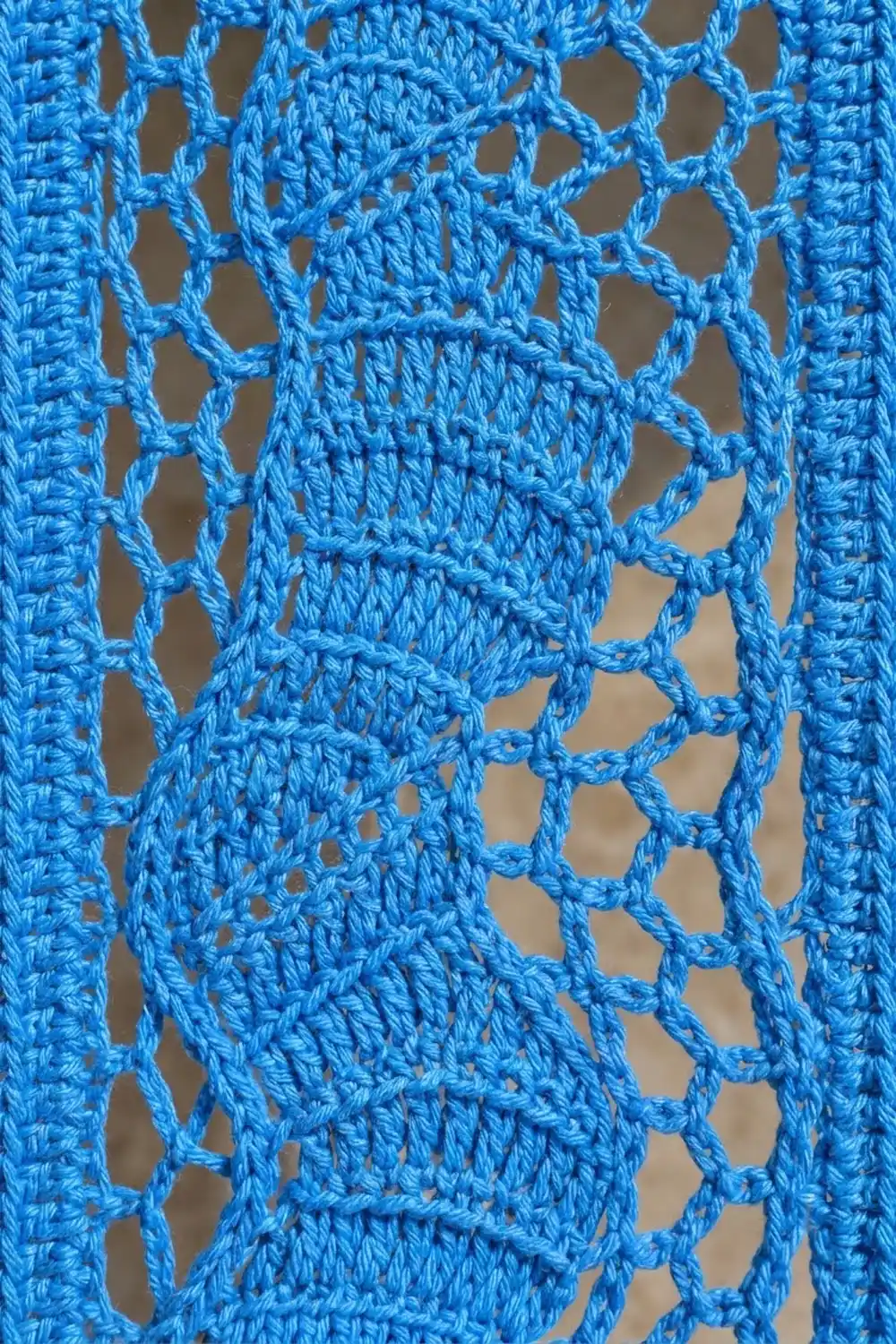
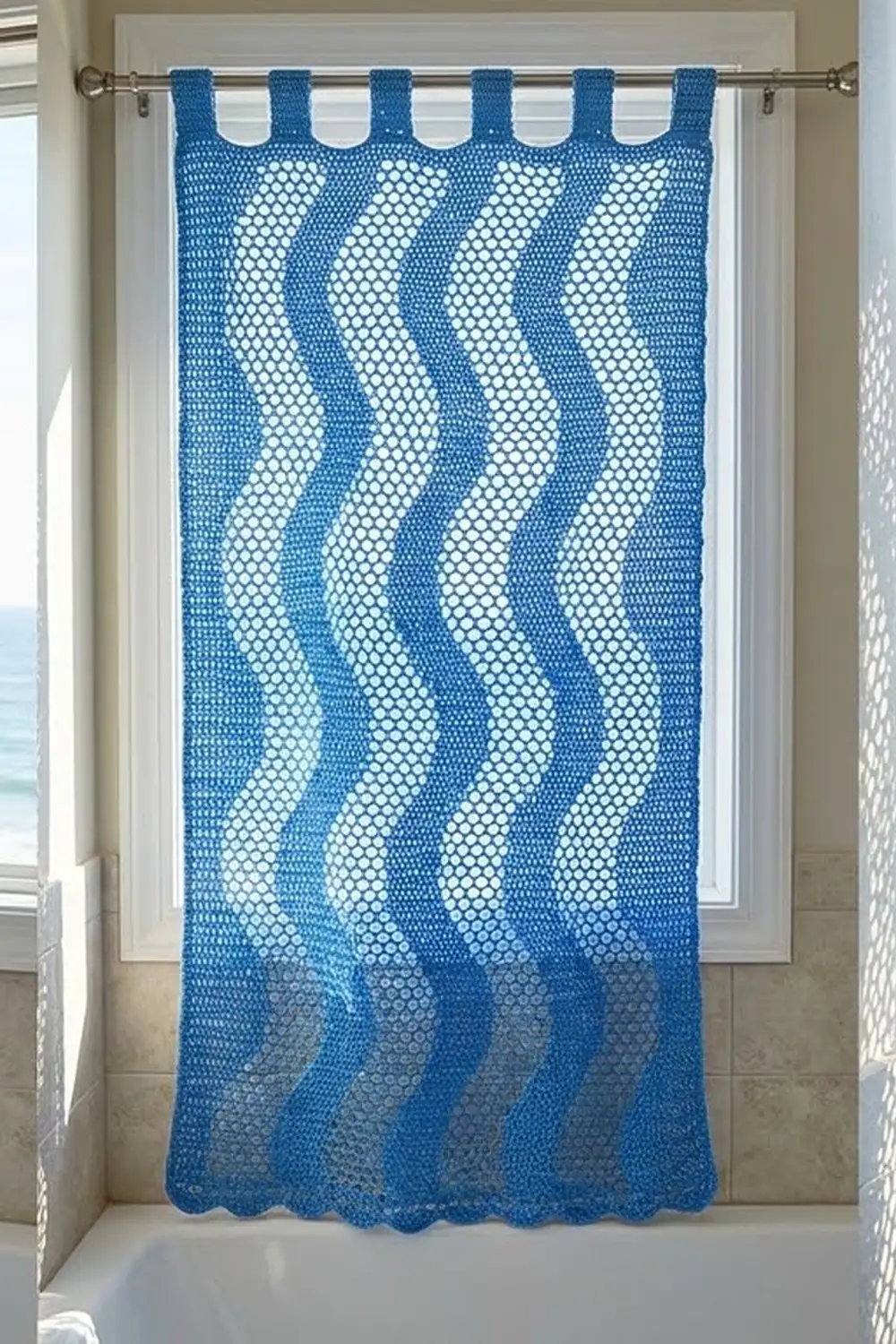
This curtain panel is made of rolling vertical waves. Bands of solid double crochet curve from top to bottom, and an open honeycomb mesh of chain loops sits between them. Light comes through the mesh, while the solid bands give the panel enough body to hang straight.
The sample uses one bright azure blue, which looks like sea water when the panel hangs in a sunny window. A plain top strip with folded tabs and a hem of small shell scallops finish the edges.
The pattern uses US crochet terms. The finished panel measures 34.25 in (87.0 cm) wide and 46.75 in (118.7 cm) from the top of the tabs to the tips of the scallops.
The panel is worked flat in one piece, from the bottom up. Every row is made of “units,” each 3 stitches wide: solid double crochet units and chain-loop mesh units. On a few right-side rows, each solid band moves one unit sideways, and this creates the wave. A single round of single crochet, a scalloped hem and tabs finish the panel.
Finished Size and Construction
- Finished size: 34.25 in (87.0 cm) wide × 46.75 in (118.7 cm) long, including tabs and scallops
- Skill level: Intermediate
- Terminology: US crochet terms
- Yarn weight: DK / light worsted (#3) cotton or cotton blend
- Hook: 4.0 mm (G-6)
- Number of pieces: 1 (the tabs are worked directly onto the panel)
- Layout: 1 rectangular panel with 6 wave columns
- Panel size before border: 33.75 in (85.7 cm) × 44 in (111.8 cm)
- Border depth: 0.25 in (0.6 cm) of single crochet on all sides, plus 0.5 in (1.3 cm) of scallops at the hem
- Tab loops: 11 tabs, each 1.75 in (4.4 cm) tall when folded
Materials
Yarn: Choose a smooth, mercerized or combed cotton in DK / light worsted weight. Cotton holds the wave shape after blocking and survives bathroom humidity. Avoid fuzzy yarns, because they blur the honeycomb mesh.
- Azure blue: 650 g / 1,469 m (1,606 yd), which is 13 balls of 50 g / 113 m
These quantities include a margin of about 10% for the swatch and for blocking differences.
Tools:
– 4.0 mm (G-6) crochet hook
– Tapestry needle
– Stitch markers (about 10)
– Tape measure
– Blocking mats and rust-proof pins
– Spray bottle
Abbreviations (US Terms)
- ch – chain
- sc – single crochet
- dc – double crochet
- sl st – slip stitch
- sk – skip
- st(s) – stitch(es)
- sp – space
- RS / WS – right side / wrong side
- tch – turning chain
Special terms:
- Edge unit (E): At the start of a row: ch 3 (counts as dc), dc in next 2 dc. At the end of a row: dc in next 2 dc, dc in top of tch.
- Dc unit (D): Over a dc unit below, dc in each of the next 3 dc. Over a loop below, work 3 dc in the next ch-5 loop.
- Loop unit (M): Over a loop below, ch 5, sc in the next ch-5 loop. Over a dc unit below, ch 5, sk next 2 dc, sc in the next dc.
- Forward shift (RS rows only): Work the first D of every solid band as an M. Work the M that comes right after every solid band as a D.
- Backward shift (RS rows only): Work the last D of every solid band as an M. Work the M that comes right before every solid band as a D.
Every unit is worked over exactly one unit of the row below, so each row always has 45 units.
Gauge and Checkpoints
Gauge: 16 dc and 8 rows = 4 in (10.2 cm) in plain dc, after blocking. One unit is 3 sts, which is 0.75 in (1.9 cm) wide. Each row is 0.5 in (1.3 cm) tall.
Test swatch: Make one wave column before you start the panel.
– Ch 32 and dc in the 4th ch from the hook: 30 dc, or 10 units.
– Work Rows 1–13 as written below, but with only 1 cell: E, M, D, D, D, D, M, M, M, E.
– Block the swatch. It should measure 7.5 in (19.1 cm) wide × 7 in (17.8 cm) tall.
If your swatch is too big, go down to a 3.75 mm hook. If it is too small, go up to a 4.5 mm hook. Check width first, because the width of every unit sets the size of the whole panel.
Checkpoints:
– Foundation row: 33.75 in (85.7 cm) wide
– After Row 13: 7 in (17.8 cm) tall
– After Row 85: 43 in (109.2 cm) tall
– After Row 87: 44 in (111.8 cm) tall
– After the border: 34.25 in (87.0 cm) × 44.5 in (113.0 cm), not counting scallops or tabs
Panel
The layout: Each row has 45 units: E, then 6 cells of 7 units, then 1 extra M, then E. In the starting position each cell reads M, D, D, D, D, M, M.
- Each solid band is 4 units, or 3 in (7.6 cm) wide.
- The mesh between two bands is always 3 loops, or 2.25 in (5.7 cm).
- Each cell is 5.25 in (13.3 cm) wide.
Foundation Row (WS): Ch 137. Dc in the 4th ch from the hook (the skipped ch count as 1 dc) and in each ch across. Turn. (135 dc = 45 units)
Row 1 (RS, set-up): E. Then work [M, D, D, D, D, M, M] 6 times. Then work M, E. Turn.
Count: 26 dc units (78 dc) and 19 loops = 45 units.
The wave repeat starts here. On WS rows, work every unit over the matching unit below. On shift rows, follow the special definitions above.
Row 2 (WS): E, work each unit as it appears below, E. Turn.
Row 3 (RS): E, Forward shift across, E. Turn. Each band now starts one unit later in the row.
Row 4 (WS): Work as Row 2.
Row 5 (RS): Work as Row 3. The bands are now 2 units from where they started, which is the crest of the wave.
Rows 6–8: Work as Row 2.
Row 9 (RS): E, Backward shift across, E. Turn.
Row 10: Work as Row 2.
Row 11 (RS): Work as Row 9. The bands are back in their starting position.
Rows 12–13: Work as Row 2.
Count after every row from 2 to 13: 78 dc in 26 dc units and 19 loops, for 45 units. Each shift row turns one D into an M and one M into a D in every band, so the total never changes.
One 12-row repeat makes one full S-curve. It is 6 in (15.2 cm) tall and swings 1.5 in (3.8 cm) to the side.
Rows 14–85: Repeat Rows 2–13 six more times, for 7 repeats in total. Row 85 ends with the bands in their starting position.
Because the loop units are anchored with sc, the mesh rows bow slightly on the hook. Blocking evens them out to the same 0.5 in (1.3 cm) row height as the solid rows. This gentle bowing is also what gives the mesh its honeycomb look.
Row 86 (WS, conversion): E. Then dc in each dc and work 3 dc in each ch-5 loop across. End with E. Turn.
Count: 78 dc worked 1 per dc + 57 dc worked into loops (19 loops × 3) = 135 dc.
Row 87 (RS): Ch 3 (counts as dc), dc in each st across. (135 dc) Do not fasten off.
The panel now measures 33.75 in (85.7 cm) × 44 in (111.8 cm), with 88 rows in total.
Border
Border gauge: 4 sc per inch along every edge. That works out to 1 sc per dc across the top and bottom, and 2 sc per dc row end along the sides.
Round 1 (RS): Ch 1. Then work each side as follows:
- Top: sc in each of the 135 sts, ch 2 for the corner.
- Left side: work 2 sc in each of the 88 row ends (176 sc), ch 2.
- Bottom: working into the bases of the foundation dc, sc in each of the 135 sts, ch 2.
- Right side: work 2 sc in each of the 88 row ends (176 sc), ch 2.
Sl st to the first sc and fasten off.
Count: 135 sc on the top, 176 sc on each side, 135 sc on the bottom, and 4 ch-2 corner sps. (622 sc in total) Each side count already includes its corner stitches.
Why the math works: 135 sc at 4 sc per inch is 33.75 in, so the top and bottom match the panel exactly. Each side has 88 rows at 0.5 in each, which is 44 in. Two sc per row end gives 176 sc, and 176 sc at 4 per inch is also 44 in. Because the border matches the panel on all four sides, the edges will not ruffle or pull in.
Scalloped hem (RS, bottom edge only):
- Join yarn in the bottom-left corner ch-2 sp and sc in that sp.
- Sk 1 sc, then work 7 dc in the next sc.
- Work [sk 2 sc, sc in next sc, sk 2 sc, 7 dc in next sc] 22 times.
- Sk 1 sc, sc in the corner ch-2 sp. Fasten off.
Count: 1 + 1 + 1 + (22 × 6) + 1 = 136 positions. That is the 135 bottom sc plus the 1 they share with the first corner sp. The hem has 23 scallops, each about 1.5 in (3.8 cm) wide and 0.5 in (1.3 cm) deep, with 22 sc between them.
Tabs (top edge): Count the 135 sc of the top edge from right to left, starting on the RS. You will make 11 tabs of 5 sts each, with 7 free sts between tabs and 5 free sts at each end: 55 + (10 × 7) + 10 = 135.
- Tab Row 1: Join yarn in st 6. Ch 1, sc in the same st and in the next 4 sts. Turn. (5 sc)
- Tab Rows 2–14: Ch 1, sc in each of the 5 sc. Turn.
- Fasten off, leaving a 12 in (30.5 cm) tail.
Each tab is 1.25 in (3.2 cm) wide and 3.5 in (8.9 cm) long, with 4 sc rows per inch.
Work the remaining tabs in the same way, starting in sts 18, 30, 42, 54, 66, 78, 90, 102, 114 and 126. Each tab starts 12 sts after the last one.
Fold each tab to the WS and whipstitch its last row to the back of the Row 87 dc directly below it. This makes a loop 1.75 in (4.4 cm) tall that fits a rod up to 1 in (2.5 cm) across.
Final Blocking
- Weave in all ends along the solid dc bands, where they will not show.
- Soak the panel in cool water for 15 minutes. Press out the water without wringing, then roll it in a towel.
- Lay it flat with the RS up and pin it to 34.25 in (87.0 cm) × 44.5 in (113.0 cm).
- Pin the waves first. Use one pin at every crest along the solid bands, then smooth the mesh loops until they open into even hexagons.
- Pin each scallop at its tip, and pin each tab flat.
- Let the panel dry completely before you unpin it.
Final Quality-Control Checklist
- [ ] Every row has 45 units: 26 dc units and 19 loops.
- [ ] Each solid band is 4 units wide along its whole length.
- [ ] Every band shows 7 complete S-curves.
- [ ] All the mesh sections between bands are 3 loops wide.
- [ ] Rows 86–87 are solid, with 135 dc each.
- [ ] Border Round 1 has 135 / 176 / 135 / 176 sc.
- [ ] There are 23 even scallops along the hem.
- [ ] There are 11 tabs, evenly spaced, and all sewn at the same depth.
- [ ] The panel measures 34.25 in (87.0 cm) × 44.5 in (113.0 cm) before tabs and scallops.
Troubleshooting
- The bands drift instead of waving. You probably shifted on a WS row or used the same shift too often. Shift only on RS Rows 3, 5, 9 and 11 of each repeat.
- The unit count is wrong. Remember that a loop worked over a dc unit uses all 3 dc: sk 2, then sc in the 3rd.
- The mesh puckers. Your ch-5 loops are too tight. Loosen your chain tension, or work ch 6 throughout.
- The side edges wave or flare. Check that you worked exactly 2 sc per row end in the border.
- The scallops cup. Block them flat, or work 6 dc per scallop instead of 7.
- The tabs are uneven. Count the stitch positions again before joining each tab.
Care
Hand wash or machine wash on a cool, gentle cycle inside a mesh bag. Lay the panel flat and pin out the waves while it is damp so it keeps its shape.
Final Notes
The measurement chain is straightforward. Each unit is 3 sts, which is 0.75 in (1.9 cm). Forty-five units make the 33.75 in (85.7 cm) panel width. Eighty-eight rows at 0.5 in (1.3 cm) each make the 44 in (111.8 cm) length. A border at 4 sc per inch matches every edge exactly, and the scallops and tabs bring the hanging panel to 34.25 in (87.0 cm) × 46.75 in (118.7 cm).
If you check your gauge on the swatch, the full panel will come out to these measurements.
Happy crocheting!