

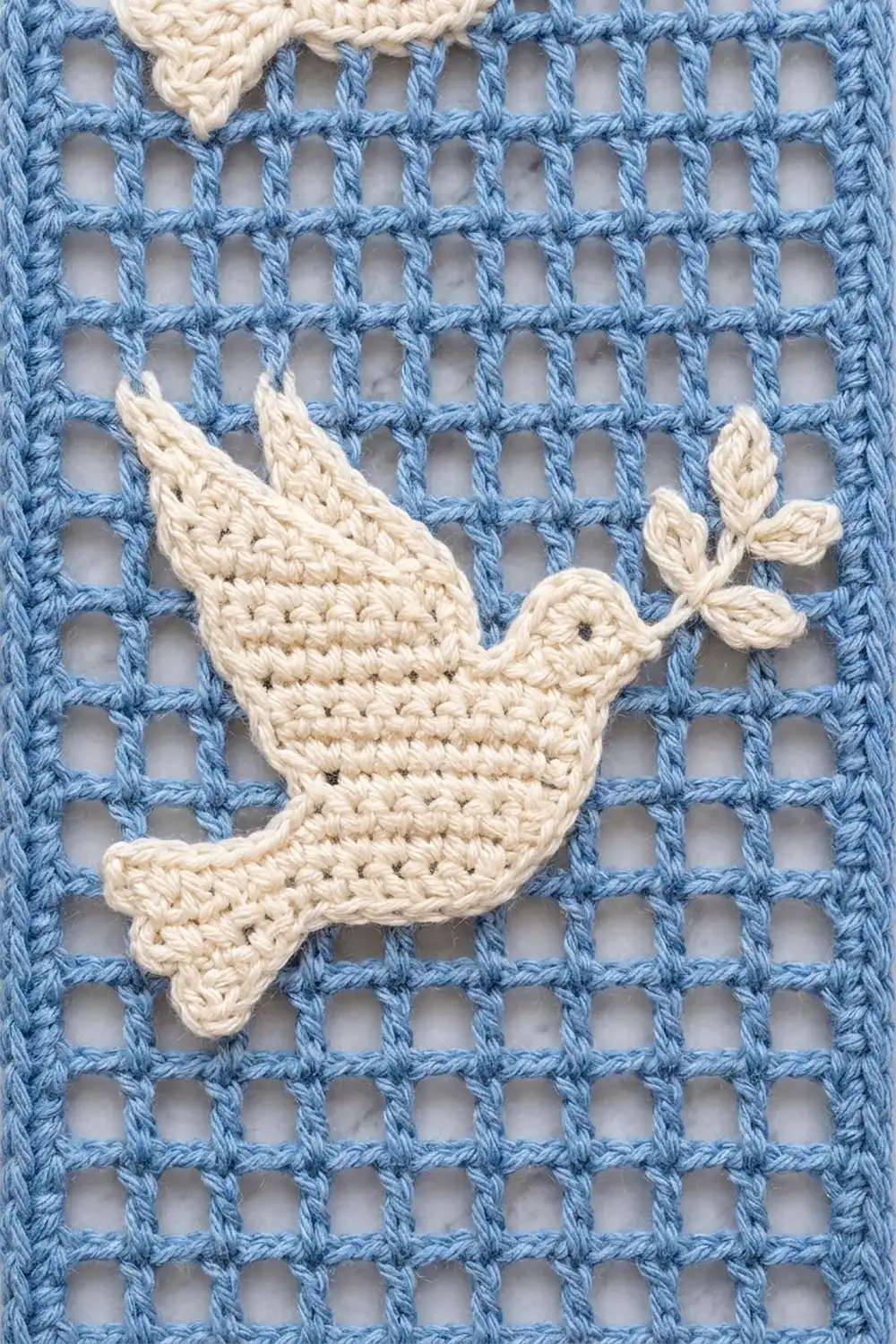
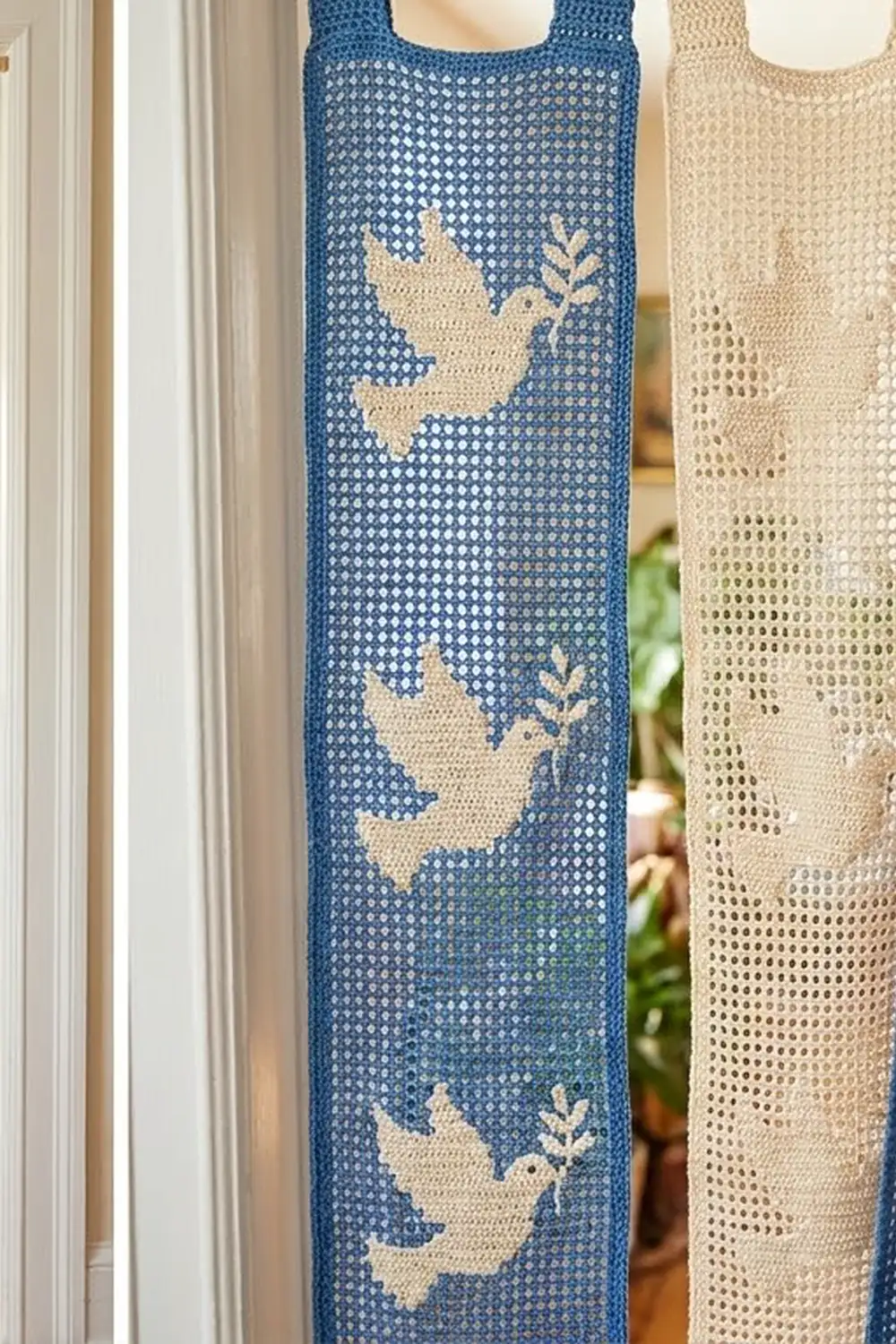
This door curtain is made from seven long filet crochet strips. Each strip has a column of doves flying right, each carrying an olive sprig. Light blue strips with cream doves alternate with cream strips that have cream doves. The curtain lets in light, and you can push it aside with one hand.
The style is classic filet: square open mesh with solid filled blocks that form the dove shapes. A single-crochet and slip-stitch outline gives each strip a clean, firm edge. Two folded tabs at the top slide onto any curtain rod up to 1.25 in (3.2 cm) across.
The pattern uses US crochet terms. Each finished strip measures 7 in (17.8 cm) wide by 74.5 in (189.2 cm) long, not counting the tabs. Seven strips hung edge to edge cover about 49 in (124.5 cm).
Each strip is worked flat in rows from the bottom up, outlined with a two-round border, and finished with two tabs. The strips are never sewn together. They simply hang next to each other on the rod.
Finished Size and Construction
- Strip size (blocked, with border): 7 in x 74.5 in (17.8 cm x 189.2 cm)
- Size before border: 6.5 in x 74 in (16.5 cm x 188.0 cm)
- Border depth: 0.25 in (0.6 cm) on every side
- Skill level: Intermediate (filet mesh, reading a grid, simple color change)
- Terminology: US
- Yarn weight: Sport (2), cotton
- Hook: 3.0 mm
- Number of pieces: 7 separate strips (4 blue, 3 cream)
- Layout: One row of 7 strips hung side by side, not joined
- Curtain width: About 49 in (124.5 cm) with the strips touching
- Doves per strip: 11, each 11 meshes wide x 10 rows tall, or 5.5 in x 5 in (14.0 cm x 12.7 cm)
Materials
Yarn. Use a smooth, mercerized or combed sport-weight cotton, about 150 m per 50 g. Cotton keeps the mesh square and crisp and holds up to handling in a doorway. Avoid fuzzy yarns, which blur the dove shapes.
- Light blue: 250 g (about 750 m). About 52 g per blue strip.
- Cream: 250 g (about 750 m). About 60 g per cream strip plus about 10 g per blue strip for the doves.
Both quantities include a margin of about 15% for gauge swatches and differences in tension.
Tools:
– 3.0 mm crochet hook
– Tapestry needle
– 3 small yarn bobbins (for the cream doves on the blue strips)
– Stitch markers
– Rust-proof pins, a spray bottle, and a long blocking surface
– Tape measure
Abbreviations (US Terms)
- ch – chain
- sl st – slip stitch
- sc – single crochet
- dc – double crochet
- sp – space
- RS / WS – right side / wrong side
Special stitches:
– Open mesh: ch 2, skip the next 2 stitches (or the ch-2 sp), dc in the next dc.
– Filled block: 2 dc in the next ch-2 sp (or 1 dc in each of the next 2 dc), then dc in the next dc.
Every row has 40 stitch positions: 14 dc “posts” plus 13 two-stitch gaps. Each gap is either a ch-2 sp (open) or 2 dc (filled).
Gauge and Checkpoints
Gauge: 10 meshes x 10 rows = 5 in x 5 in (12.7 cm x 12.7 cm) in open mesh. One mesh is a 0.5 in (1.3 cm) square.
Before making all seven strips, make one test strip and stop after Row 17 to measure:
- After Row 1: width 6.5 in (16.5 cm).
- After Row 4: height 2 in (5.1 cm).
- After Row 17 (first dove finished): height 8.5 in (21.6 cm). The dove should measure 5.5 in x 5 in (14.0 cm x 12.7 cm).
- After Row 74: height 37 in (94.0 cm), half the body length.
- After Row 148: 6.5 in x 74 in (16.5 cm x 188.0 cm).
The length is very sensitive to gauge. If each row is just 1/16 in (0.16 cm) too tall, the strip ends up 9.25 in (23.5 cm) too long. If your meshes are too big, go down to a 2.75 mm hook. If they are too small, go up to a 3.25 mm hook. If the meshes are wider than they are tall, wrap the yarn a little more firmly on each dc. Measure again on the new swatch before continuing.
Strip Pattern (Make 7)
All strips use the same stitches. Cream strips are worked entirely in cream. Blue strips use blue for the mesh and cream for every filled block.
Foundation and Lower Edge
Foundation: Ch 42.
Row 1 (RS): Dc in the 4th ch from the hook (the skipped 3 ch count as the first dc). Dc in each remaining ch. Turn. (40 dc)
Row 2: Ch 5 (counts as dc + ch 2). Skip the next 2 dc and dc in the next dc. Ch 2, skip 2 dc, dc in next dc. Repeat from * across, working the last dc into the top of the turning ch. Turn. (13 open meshes: 14 dc + 13 ch-2 sps = 40 positions)
Rows 3–4: Ch 5 (counts as dc + ch 2), dc in the next dc. Ch 2, dc in the next dc. Repeat from * across, working the last dc into the 3rd ch of the turning ch-5. Turn. (13 open meshes)
Odd-numbered rows are RS rows, and even-numbered rows are WS rows.
Dove Repeat (13 Rows, Worked 11 Times)
Each repeat is 10 motif rows (M1–M10) followed by 3 open rows. The grid below shows the dove as it looks from the RS, with the top row first. X = filled block, . = open mesh. Columns 1–13 run left to right.
M10  ....XX.......
M9   ....XXX......
M8   .....XXX.XX..
M7   .....XXXXXXX.
M6   .X..XXXXXX.X.
M5   .XXXXXXXX.X..
M4   ..XXXXXXX....
M3   ...XXXXX.....
M2   ....XXX......
M1   .....X.......
How to read it: Work M1 first and M10 last. On RS (odd-numbered) rows, read the line from right to left. On WS (even-numbered) rows, read it from left to right. Each row still starts with ch 5 for an open edge mesh, since columns 1 and 13 are always open.
Stitch counts per motif row (dc = 14 + 2 x filled blocks):
| Row | Filled | Open | Total dc |
|---|---|---|---|
| M1 | 1 | 12 | 16 |
| M2 | 3 | 10 | 20 |
| M3 | 5 | 8 | 24 |
| M4 | 7 | 6 | 28 |
| M5 | 9 | 4 | 32 |
| M6 | 8 | 5 | 30 |
| M7 | 7 | 6 | 28 |
| M8 | 5 | 8 | 24 |
| M9 | 3 | 10 | 20 |
| M10 | 2 | 11 | 18 |
Every row still adds up to 40 positions.
The single block in column 2 of M5–M6 forms the tail feathers. Columns 10–12 of M5–M8 form the head, beak, and olive sprig. The block stack in columns 5–7 of M8–M10 is the raised wing.
Repeat rows:
– Dove 1: Rows 5–14 = M1–M10. Rows 15–17 = open mesh.
– Doves 2–11: Continue in the same way. Each dove starts 13 rows after the previous one: Dove 2 on Row 18, Dove 3 on Row 31, and so on, up to Dove 11 on Row 135.
– Dove 11 ends on Row 144. Rows 145–147 are open mesh.
Because a repeat is 13 rows (an odd number), doves start on alternating RS and WS rows. Always follow the reading rule for the row you are on.
Color work on blue strips: Wind three small cream bobbins, one each for the tail, body, and sprig. At the start of a filled block, finish the opening dc in blue but close it with cream. Work both dc of the block and its closing dc in cream, laying the blue strand along the top of the row and working over it. Change back to blue on the last yarn-over of the closing dc. Leave bobbins hanging on the WS. Never carry cream across open meshes, because the strand would show through the holes.
Upper Edge
Row 148 (WS): Ch 3 (counts as dc). 2 dc in the next ch-2 sp, dc in the next dc. Repeat from * across. (40 dc)
Do not fasten off.
Checkpoint: 6.5 in x 74 in (16.5 cm x 188.0 cm).
Make All Pieces
- Blue strips: 4 (blue mesh, cream doves)
- Cream strips: 3 (all cream)
Layout seen from the room side, left to right:
| B | C | B | C | B | C | B |
B = blue strip, C = cream strip. Blue strips sit at both outer edges.
Joining (Hanging Without Seams)
The strips are never stitched together. Each one hangs on its own pair of tabs, so the curtain parts anywhere you walk through it.
- Slide the strips onto the rod in the layout order, with all the doves facing the same way.
- Let the long edges just touch. Since every strip is 7 in (17.8 cm) wide, seven strips cover 49 in (124.5 cm).
- For a wider door, leave equal gaps between strips. For a narrower door, overlap the edges slightly.
- Size check: Hung edge to edge, the curtain should be 49 in (124.5 cm) wide. Every strip should end within 0.25 in (0.6 cm) of the others at the bottom.
Border and Tabs
Border gauge: about 6.2 sc per inch (2.5 cm) along every edge.
Rnd 1 (RS): Ch 1 and turn so the RS faces you.
– Top edge: Sc in each of the 40 dc. Ch 1 for the corner.
– Long side: Work 3 sc into each of the 148 row ends, for 444 sc. Ch 1 for the corner.
– Bottom edge: Sc in each of the 40 foundation ch. Ch 1 for the corner.
– Second long side: 444 sc. Ch 1.
– Sl st to the first sc. (968 sc: 40 + 444 + 40 + 444, plus 4 corner ch-1 sps)
Rnd 2: Sl st in each sc around, with 1 sl st in each corner ch-1 sp. Fasten off. (968 sl st over sc, plus 4 corner sl st)
Why the math works: The top edge has 40 sc across 6.5 in, which is 6.15 sc per inch. Each side has 3 sc per 0.5 in row, which is 6 sc per inch. The two edges are almost the same density, so the strip doesn’t flare at the sides or pull in at the ends.
Tabs (make 2 per strip): With the RS facing, join yarn in the 3rd sl st of the top edge.
- Row 1: Sc in the same st and in the next 5 sts. (6 sc)
- Rows 2–20: Ch 1, turn, sc in each sc. (6 sc)
Fasten off, leaving a 12 in (30.5 cm) tail. Make the second tab over sl sts 33–38 of the top edge, so each tab sits 2 stitches in from its end.
Each tab is about 1 in (2.5 cm) wide and 4 in (10.2 cm) long. Fold it to the WS and sew the last row just below the top border. This makes a loop about 2 in (5.1 cm) deep.
Final Blocking
- Weave in all tails along dc posts. On blue strips, weave cream tails into cream blocks only.
- Lay the strip flat on a long blocking surface. You can join foam mats to make one.
- Pin the corners out to 7 in x 74.5 in (17.8 cm x 189.2 cm).
- Pin along both long edges every 4 in (10.2 cm), keeping the edges straight.
- Run a ruler down the center. Every mesh should be a 0.5 in (1.3 cm) square.
- Mist with water until damp, but not soaked.
- Leave to dry completely before unpinning.
Final Quality-Control Checklist
- [ ] Every strip measures 7 in x 74.5 in (17.8 cm x 189.2 cm).
- [ ] Each strip has 11 doves, all facing right on the RS.
- [ ] The tail, wing, and sprig blocks match the grid on every dove.
- [ ] No cream strands are visible across open meshes on the blue strips.
- [ ] The border lies flat with sharp corners.
- [ ] Both tabs are sewn securely and fit the rod.
- [ ] There are 4 blue strips and 3 cream strips, in alternating order.
Troubleshooting
Mesh is rectangular rather than square. If the meshes are too tall, shorten the yarn-over pull-through on each dc. If they are too wide, change ch 2 to a tighter ch 2 or go down a hook size.
Strip is too long or too short. Recheck your row height and compare the strip to the Row 74 checkpoint. Remove or add open rows only in the spacers, never inside a dove.
Dove looks distorted. You probably read a row in the wrong direction. Check that odd-numbered rows were read right to left.
Border ripples. You worked more than 3 sc per row end. Remove the border and work exactly 444 sc per side.
Border cups. You worked fewer than 3 sc in some row ends. Recount.
Tabs twist. Re-sew the tabs with the last row centered directly over the starting stitches.
Care
Hand wash in cool water with a mild detergent and press out the water in a towel. Re-block flat to 7 in x 74.5 in (17.8 cm x 189.2 cm) and let dry fully before hanging.
Final Notes
Each measurement depends on the one before it:
- One mesh is 0.5 in (1.3 cm), so 13 meshes make a 6.5 in (16.5 cm) width.
- 148 rows make a 74 in (188.0 cm) body.
- The 0.25 in (0.6 cm) border brings each strip to 7 in x 74.5 in (17.8 cm x 189.2 cm).
- Seven strips hung edge to edge cover 49 in (124.5 cm).
If your first test dove measures 5.5 in x 5 in (14.0 cm x 12.7 cm), the rest of the curtain will come out at the right size. Happy crocheting!