

This strand curtain turns a plain window into a holiday display. Twelve cream cords hang from a curtain rod. Each one carries a column of chunky striped candy canes that alternate with little green bows. Light passes between the strands, so the room stays bright while still feeling festive.
The colors are classic Christmas ones. Deep cranberry red and warm cream make the peppermint stripes, and sage-olive green is used for the bows. The cords and the matching striped tieback are cream. The motifs are firm and slightly puffy, so they look good from both sides of the window.
This pattern uses US crochet terms. The finished curtain is 36 in (91.4 cm) wide. It hangs 60 in (152.4 cm) below the rod loops, or 63 in (160.0 cm) overall. Each candy cane is 4.5 in (11.4 cm) tall, and each bow is 2.75 in (7.0 cm) wide.
The curtain is made of separate parts:
– candy canes, worked as spiral tubes around a wire core
– flat bows, each made of three parts
– slip-stitch cords with hanging loops built in
You sew the motifs onto the cords at counted stitches, then finish with a tieback that has a border.
Finished Size and Construction
- Finished size: 36 in (91.4 cm) wide × 63 in (160.0 cm) long, including the loops
- Skill level: Easy-intermediate
- Terminology: US terms
- Yarn weight: Worsted (#4)
- Hooks: 3.5 mm (E-4) for the motifs and tieback; 5.0 mm (H-8) for the cords
- Number of pieces: 84 candy canes, 72 bows, 12 cords, 1 tieback
- Layout: 12 strands × 13 motifs each (7 canes, 6 bows)
- Piece size: cane 4.5 in (11.4 cm) × 1.75 in (4.4 cm); bow 2.75 in (7.0 cm) × 2 in (5.1 cm)
- Tieback before border: 18 in (45.7 cm) × 1.6 in (4.1 cm)
- Border depth: 0.375 in (1.0 cm), 2 rounds
- Finished tieback: 18.75 in (47.6 cm) × 2.4 in (6.1 cm)
Materials
Use a smooth worsted yarn in acrylic or a cotton blend. Smooth yarn keeps the stripes crisp and holds the tube shape. Fuzzy yarn blurs the color changes. These amounts assume about 200 m per 100 g.
- Cranberry red: 220 g (440 m), for the canes and tieback stripes
- Cream: 290 g (580 m), for the canes, cords and tieback
- Sage green: 210 g (420 m), for the bows
Each amount includes about 15% extra for swatching, tails and sewing.
Tools:
– 3.5 mm (E-4) and 5.0 mm (H-8) hooks
– 84 white chenille stems, 12 in (30.5 cm) long
– About 60 g polyester fiberfill
– Tapestry needle
– 13 locking stitch markers
– Scissors and a tape measure
– Blocking mat and pins
Abbreviations (US Terms)
- ch – chain
- sl st – slip stitch
- sc – single crochet
- sc2tog – single crochet 2 together
- st(s) – stitch(es)
- rnd(s) – round(s)
- MR – magic ring
Back-bump slip stitch: put the hook under the bump on the back of the chain and finish a sl st. This keeps both edges of the cord neat.
Color change: work the last st in the old color until 2 loops remain on the hook. Finish that st with the new color. Carry the color you are not using loosely inside the tube.
Gauge and Checkpoints
Motif gauge (3.5 mm hook): 10 sc × 11 rows = 2 in (5.1 cm).
Cord gauge (5.0 mm hook): 9 cord sts = 3 in (7.6 cm).
Make one cane and one bow first, and check these sizes:
- Cane tube after Rnd 2: 1.6 in (4.1 cm) around and 0.5 in (1.3 cm) across
- Cane tube before bending: 6 in (15.2 cm) long
- Bent cane: 4.5 in (11.4 cm) × 1.75 in (4.4 cm)
- Bow wings before edging: 2.4 in (6.1 cm) × 1.2 in (3.0 cm)
- First 30 cord sts: 10 in (25.4 cm)
- Tieback before border: 18 in (45.7 cm) long
If your pieces are too big, use a hook 0.5 mm smaller. If they are too small, use a hook 0.5 mm larger. Cord gauge matters most, because every motif position is counted in stitches.
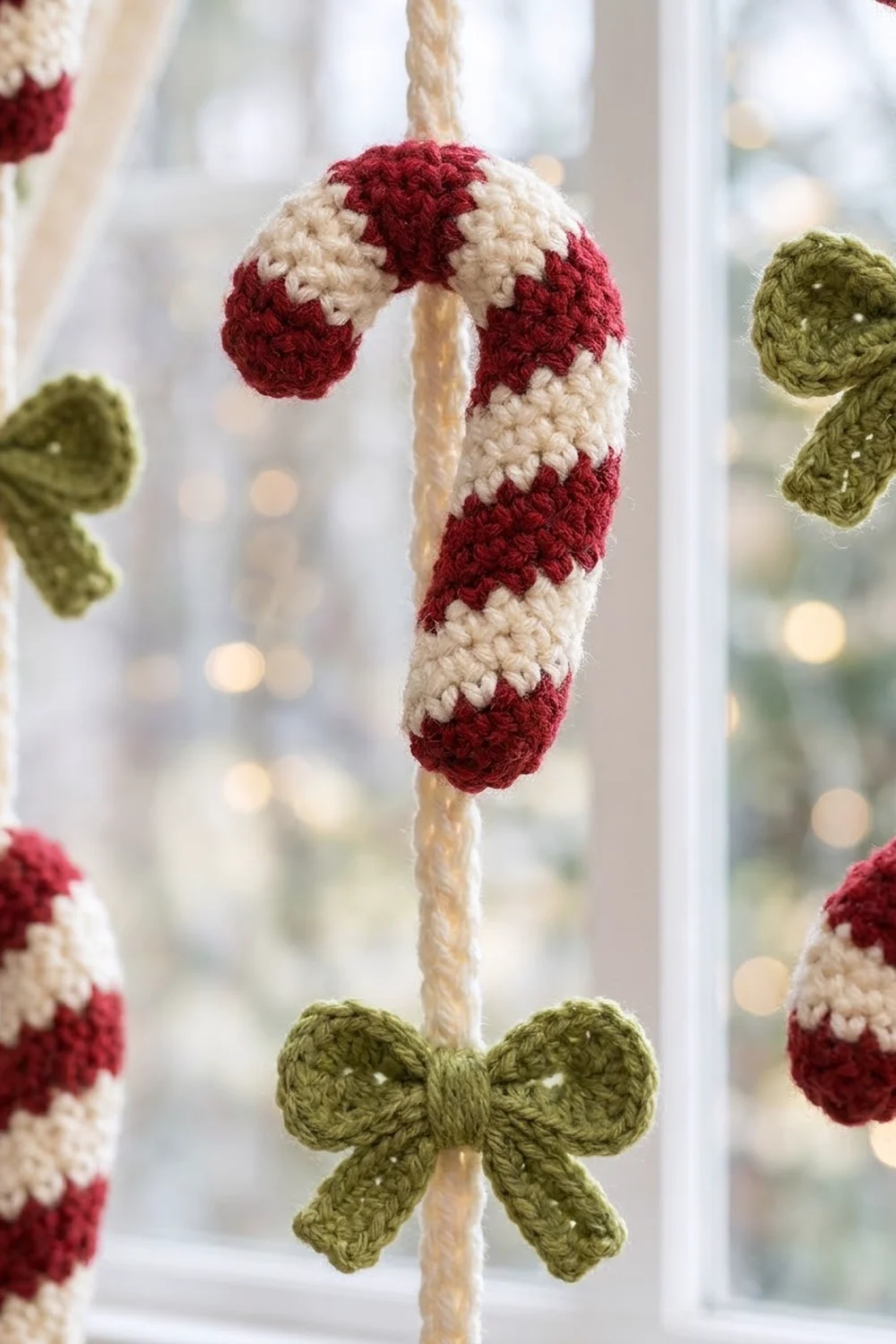
Candy Cane (Make 84)
The cane is a spiral tube of 8 sc. You change color every 2 rounds. Because the rounds spiral, the stripes lean slightly, like a real peppermint. Do not join the rounds. Mark the first st of each round.
Use the 3.5 mm hook and red.
Rnd 1: 6 sc in MR. (6 sts)
Rnd 2: [2 sc in next st, sc in next 2 sts] 2 times. (8 sts)
Rnds 3–32: sc in each st around. (8 sts each round)
Switch colors every 2 rounds:
– Rnds 3–4: cream
– Rnds 5–6: red
– Keep alternating. Rnds 31–32 are cream.
This gives 16 stripes, each 2 rounds deep.
Stuffing: after Rnd 10, fold a chenille stem in half so it is 6 in (15.2 cm) long. Twist it once and push the folded end to the bottom of the tube. Every few rounds, add small wisps of fiberfill around the wire. The tube should be firm, with no gaps between stitches.
Rnd 33 (red): [sc2tog] 4 times. (4 sts)
Fasten off and leave a 6 in (15.2 cm) tail. Weave the tail through the front loops of the 4 sts and pull to close the end. Hide all ends inside the tube.
Shaping:
1. Rnds 1–20 are the straight shank, about 3.6 in (9.1 cm) long.
2. Bend Rnds 21–33, about 2.4 in (6.1 cm), into a half circle with the tip turned down.
3. The crook should measure 1.75 in (4.4 cm) across.
Bow (Make 72)
Each bow has three parts. Work all of them flat in green with the 3.5 mm hook.
Wings
Ch 13.
Row 1: sc in 2nd ch from hook and in each ch across. Turn. (12 sts)
Rows 2–7: ch 1, sc in each st across. Turn. (12 sts each row)
Rnd 8 (edging): ch 1, then work around the rectangle in this order:
– 3 sc in first st, sc in next 10 sts, 3 sc in last st
– sc in each of the 5 middle row ends
– 3 sc in first ch, sc in next 10 ch, 3 sc in last ch
– sc in each of the 5 middle row ends
Join to the first sc.
Count: (12 + 5 + 12 + 5 = 34, worked 1 per st or row end) + (2 extra at each of the 4 corners = 8) = 42 sts.
Fasten off and leave a 12 in (30.5 cm) tail. The wings now measure 2.75 in (7.0 cm) × 1.6 in (4.1 cm).
Tails
Ch 9.
Row 1: sc in 2nd ch from hook and in each ch across. Turn. (8 sts)
Row 2: ch 1, sc in each st across. (8 sts)
Fasten off.
Center Band
Ch 7.
Row 1: sc in 2nd ch from hook and in each ch across. (6 sts)
Fasten off and leave an 8 in (20.3 cm) tail.
Assembly
- Pinch the wings at the center to make two loops. Wrap the long tail 4 times around the pinch.
- Fold the tail strip into a shallow V. Place it behind the wings with both ends pointing down and outward.
- Wrap the center band around both layers. Sew its ends together at the back.
The finished bow is 2.75 in (7.0 cm) wide and 2 in (5.1 cm) tall. Keep the green tail; you will use it to attach the bow to the cord.
Cord (Make 12)
Use the 5.0 mm hook and cream. Ch 181.
Row 1: back-bump sl st in 2nd ch from hook and in each ch across. (180 sts)
Loop: ch 18, then sl st in the last sl st you worked to close a ring. Work 18 sl st over the ring. Fasten off.
The cord hangs 60 in (152.4 cm) below the loop. The loop is 6 in (15.2 cm) around and fits rods up to 1.5 in (3.8 cm) thick.
Count the cord sts from the top. St 1 is just below the loop.
Make All Pieces
- Red and cream: 84 canes (7 per strand × 12 strands)
- Green: 72 bows (6 per strand × 12 strands)
- Cream: 12 cords, plus 1 tieback with red stripes
Layout grid (C = cane, B = bow; the columns are strands 1–12):
Pos  Cord st  Strands 1-12
 1     18     C C C C C C C C C C C C
 2     30     B B B B B B B B B B B B
 3     42     C C C C C C C C C C C C
 4     54     B B B B B B B B B B B B
 5     66     C C C C C C C C C C C C
 6     78     B B B B B B B B B B B B
 7     90     C C C C C C C C C C C C
 8    102     B B B B B B B B B B B B
 9    114     C C C C C C C C C C C C
10    126     B B B B B B B B B B B B
11    138     C C C C C C C C C C C C
12    150     B B B B B B B B B B B B
13    162     C C C C C C C C C C C C
Joining
Method: sew each motif to its cord with a tapestry needle. Placing motifs at the same stitch on every cord makes level rows across the curtain.
Where the motifs go: each motif is centered on cord st 18 + 12 × (position − 1). At 3 sts per inch, the motifs are 4 in (10.2 cm) apart. The first sits 6 in (15.2 cm) below the loop, and the last sits 54 in (137.2 cm) below it. Below the last motif, 18 sts, or 6 in (15.2 cm), of the cord are left plain.
- On each cord, put a marker in each of the 13 position stitches.
- Canes: center each cane on its marker, with the crook opening toward the cord. With cream, tack the back of the shank to the cord at two points: 1 in (2.5 cm) above and 1 in (2.5 cm) below the marker.
- Bows: center the band on the marker. Wrap the green tail 3 times around the band and the cord, then knot it at the back.
- Turn all the crooks the same way.
Tension: sew firmly enough that the motifs don’t spin. Never pull hard enough to pucker the cord, because that shortens the strand and puts the rows out of line.
Size checkpoint: each strand hangs 60 in (152.4 cm). The lowest cane ends about 56.25 in (142.9 cm) below the loop. Space the 12 strands 3 in (7.6 cm) apart on the rod for a total width of 36 in (91.4 cm).
Border: Striped Tieback
Tieback Body
Use the 3.5 mm hook and cream. Ch 91.
Row 1: sc in 2nd ch from hook and in each ch across. Turn. (90 sts)
Rows 2–9: ch 1, sc in each st across. Turn. (90 sts each row)
Work the stripes in this order:
– Row 1: cream
– Rows 2–3: red
– Rows 4–6: cream
– Rows 7–8: red
– Row 9: cream
The body measures 18 in (45.7 cm) × 1.6 in (4.1 cm).
Border
Border gauge: 5 sc per inch along the stitches, and 1 sc per row end on the short sides.
Rnd 1 (cream): ch 1, then work around:
– On each long side: 3 sc in the corner st, sc in the next 88 sts, 3 sc in the corner st.
– On each short side: sc in each of the 7 middle row ends.
Join.
Count: (90 + 7 + 90 + 7 = 194, worked 1 per st or row end) + (2 extra × 4 corners = 8) = 202 sts.
The middle sc of each 3-sc group is the corner st. Counting corners, each long side has 92 sts and each short side has 11 sts. Check: 92 + 92 + 11 + 11 − 4 shared corners = 202.
Rnd 2 (cream): ch 1, sc in each st, working 3 sc in each corner st. Join.
Count: (202, worked 1 per st) + (8 extra) = 210 sts. The long sides now have 94 sts each and the short sides 13 each. Check: 94 + 94 + 13 + 13 − 4 = 210.
Hanging loops: on each short side, join cream in the center (7th) st. Ch 10, sl st in the same st and fasten off.
Why the math works: each corner needs exactly 2 extra sts per round to turn and lie flat. The sides get no other extra stitches, so the edges stay straight and don’t ruffle. The 2 rounds add 0.375 in (1.0 cm) to each edge, for a finished size of 18.75 in (47.6 cm) × 2.4 in (6.1 cm).
Final Blocking
- Lightly mist the bows and the tieback with water. Keep the canes dry, because the wire cores can rust.
- Pin the bows flat with the wings spread evenly.
- Pin the tieback to 18.75 in (47.6 cm) × 2.4 in (6.1 cm), keeping the edges straight.
- Let everything dry completely.
- Hang each strand with a small clip weight on the bottom end for 24 hours. Then check that it measures 60 in (152.4 cm).
- Reshape any crook that has flattened so it is 1.75 in (4.4 cm) wide again.
Final Quality-Control Checklist
- Every cane has 16 even stripes and a closed tip.
- All crooks face the same way.
- No wire or fiberfill shows between stitches.
- The bows are even on both sides, with the tails pointing down.
- The motifs sit at sts 18 through 162 and form level rows.
- Each strand hangs 60 in (152.4 cm) below its loop.
- The tieback has 202 sts after Rnd 1 and 210 after Rnd 2.
- All ends are woven in.
Troubleshooting
- Stripes look jagged: change color on the last yarn over of the st, and keep the carried strand loose.
- Tube has gaps: use a smaller hook or less stuffing.
- Crook won’t keep its shape: twist the doubled stem tighter, or add a second stem.
- Rows don’t line up: recount the cord stitches from the top.
- Cords are different lengths: block all the cords together with equal weights.
- Tieback ruffles: add only 8 sts per round, 2 at each corner.
- Bows tip forward: add one more tack through the top of the band.
Care
Spot clean with a damp cloth and mild soap, then lay flat to dry. Don’t machine wash, because of the wire cores.

Final Notes
Each measurement builds on the one before:
– Gauge makes the 8-st tube 0.5 in (1.3 cm) across.
– 33 rounds make a 6 in (15.2 cm) tube, which bends into a 4.5 in (11.4 cm) cane.
– Each 180-st cord hangs 60 in (152.4 cm), with a motif every 12 sts, or 4 in (10.2 cm).
– 12 strands spaced 3 in (7.6 cm) apart fill 36 in (91.4 cm).
– The border takes the tieback from 18 in (45.7 cm) to 18.75 in (47.6 cm).
Happy crocheting!