

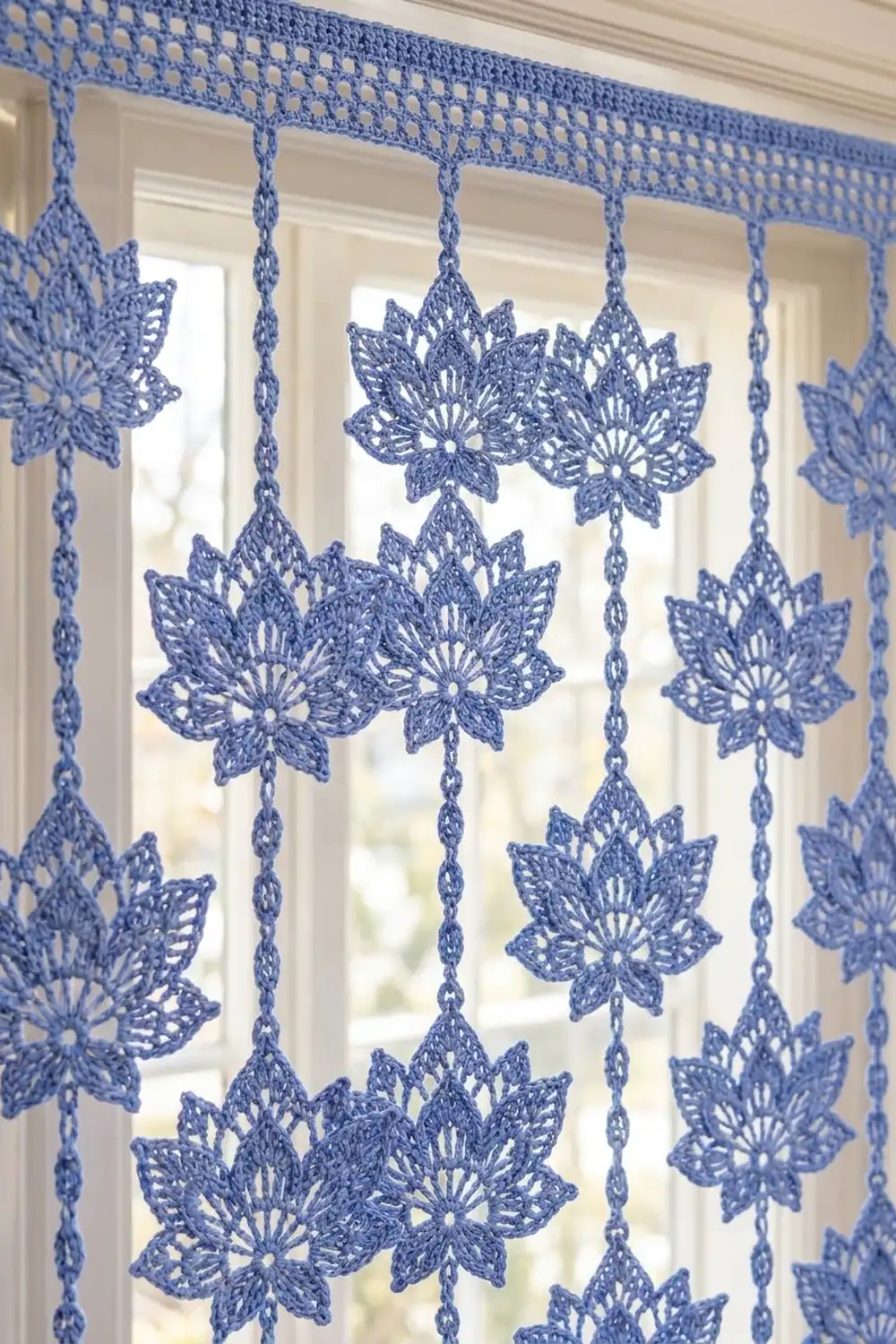
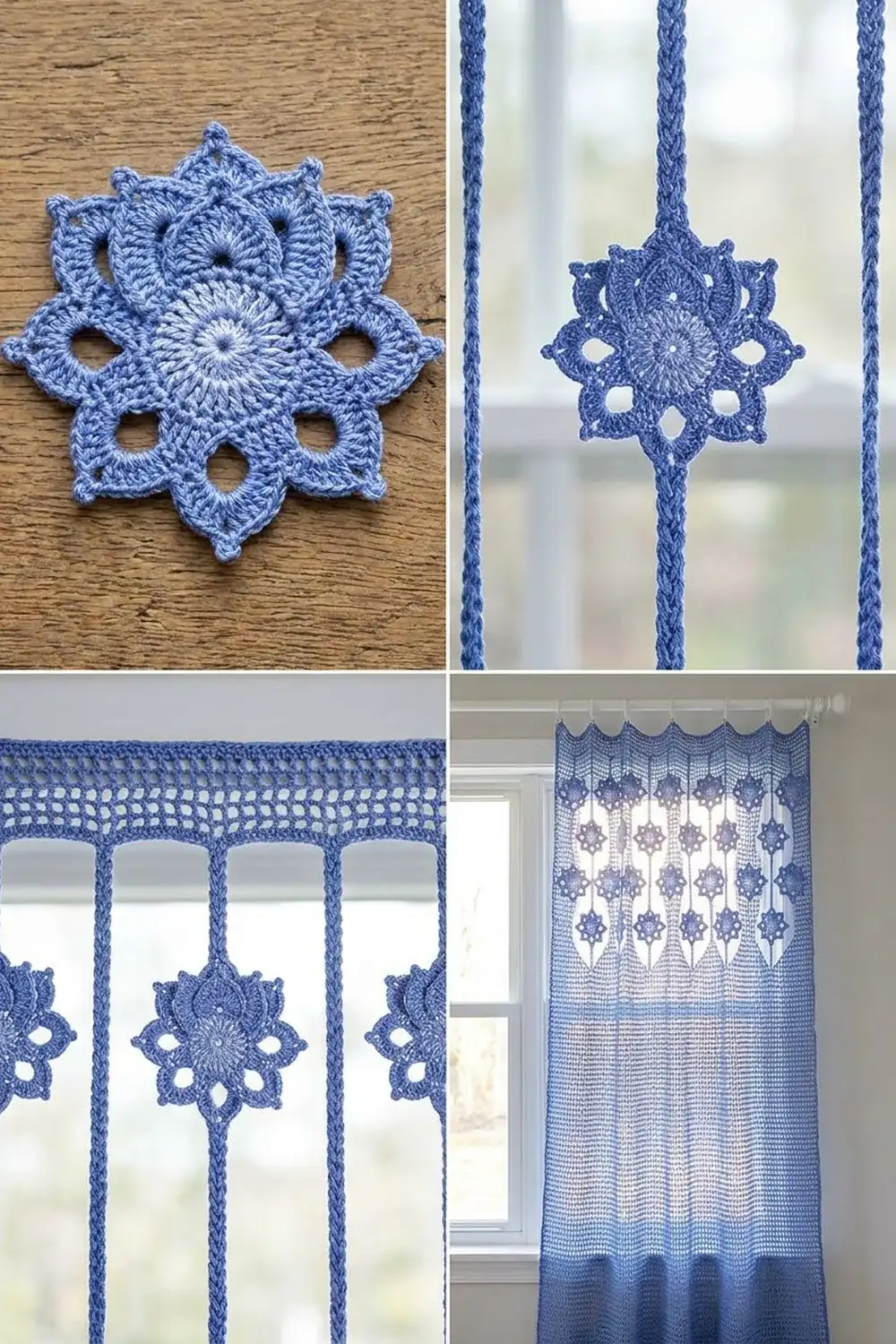
This curtain is made of rows of lace lotus flowers hanging from a narrow mesh band. Each flower has a small open ring at the center, a sunburst of double-crochet spokes, three solid petals stacked in front, and eight lacy, outlined petals behind them that end in sharp picot tips.
Everything is worked in one shade of periwinkle (cornflower) blue mercerized cotton. Light shows through the lace, so the curtain looks soft and wintry in a bright window without blocking the view.
The pattern uses US crochet terms. The finished curtain measures 43.75 in (111.1 cm) wide and 81.5 in (207.0 cm) long, including the top band. Each lotus motif measures 5.5 in (14.0 cm) tip to tip.
You will make 42 identical motifs, crochet a mesh top band, then work 7 sturdy double-chain cords down from the band, catching 6 motifs on each cord. The cords are staggered so the flowers form an offset diamond pattern.
Finished Size and Construction
- Finished size: 43.75 in (111.1 cm) wide x 81.5 in (207.0 cm) long
- Skill level: Intermediate
- Terminology: US crochet terms
- Yarn weight: DK (#3) mercerized cotton
- Hook: 3.5 mm (E-4)
- Number of pieces: 42 lotus motifs + 1 top band + 7 cords
- Layout: 7 cords x 6 motifs, with every other cord offset by half a step
- Motif size: 5.5 in (14.0 cm) tip to tip
- Size before border: 7 cords, each 79.5 in (201.9 cm) long, spaced 6.25 in (15.9 cm) apart
- Border (top band) depth: 2 in (5.1 cm), plus 3 in (7.6 cm) hanging loops
Materials
Choose a smooth, mercerized DK cotton. It shows the petal outlines crisply, holds its shape while hanging, and does not stretch like acrylic.
- Periwinkle blue: 400 g, about 960 m (based on 120 m per 50 g)
- Motifs: 42 x 7 g = 294 g (about 706 m)
- Cords: about 50 g (120 m)
- Top band: about 25 g (60 m)
Quantities include a margin of about 30 g for gauge swatching and weaving in.
Tools:
– 3.5 mm (E-4) crochet hook
– Tapestry needle
– Stitch markers (at least 4)
– Rustproof pins and a blocking board
– Spray bottle
– Measuring tape
– Curtain rod or tension rod, up to 1 in (2.5 cm) in diameter
Abbreviations (US Terms)
- ch – chain
- sl st – slip stitch
- sc – single crochet
- hdc – half double crochet
- dc – double crochet
- tr – treble crochet
- dtr – double treble crochet
- FLO / BLO – front loop only / back loop only
- sk – skip
- sp – space
- st(s) – stitch(es)
- RS – right side
Special stitch – double chain (dch): Ch 2, then sc in 2nd ch from hook (this sc counts as the first dch). For each following dch, insert hook into the left vertical loop of the stitch just made, yo, pull up a loop (2 loops on hook), yo, draw through both loops. This makes a firm, braided-looking cord that stretches much less than a plain chain.
Picot (Rnd 4): Ch 3, sl st in 3rd ch from hook.
Gauge and Checkpoints
Make one complete motif before anything else. It is your gauge swatch and your test of the yarn weight.
- After Rnd 3: 2.5 in (6.4 cm) across
- After Rnd 5: 3.75 in (9.5 cm) across
- After Rnd 7 (blocked): 5.5 in (14.0 cm) tip to tip
- Band gauge: 16 sc = 4 in (10.2 cm); Rows 1–6 = 2 in (5.1 cm)
- Cord gauge: 4 dch = 1 in (2.5 cm)
If your motif is larger than 5.5 in (14.0 cm), go down to a 3.25 mm hook. If it is smaller, go up to a 3.75 mm hook. Check the cord gauge too, because every cord length depends on it.
Lotus Motif (make 42)
Work with the RS facing throughout. Do not turn.
Rnd 1: Make a magic ring. Ch 3 (counts as dc), work 15 dc in the ring. Join with sl st to top of ch-3. Pull the ring closed, leaving a small center hole. (16 dc)
Rnd 2: Ch 5 (counts as dc + ch 2), dc in next dc, ch 2; repeat from * 14 more times. Join with sl st to 3rd ch of ch-5. (16 dc, 16 ch-2 sps) These are the sunburst spokes.
Rnd 3 (conversion): Ch 1, sc in same st, 2 sc in next ch-2 sp, sc in next dc, 2 sc in next ch-2 sp; repeat around. Join to first sc. Fasten off. (16 sc worked 1-per-dc + 32 sc in sps = 48 sc)
The first sc of Rnd 3 is st 1, the bottom center of the motif. Mark it, then count around and mark st 18 and st 32.
Checkpoint: 2.5 in (6.4 cm) across.
Rnd 4 (front petals, top only): Make a standing sc in the FLO of st 18. Working in FLO only, (hdc, dc) in next st, (tr, picot, tr) in next st, (dc, hdc) in next st, sc in next st. Sc in next st, (hdc, dc) in next st, (tr, picot, tr) in next st, (dc, hdc) in next st, sc in next st; repeat from * once more. You end in st 32. Fasten off. (3 petals of 8 sts each: 24 sts + 3 picots)
Each petal uses 5 sts. The tips land on sts 20, 25, and 30, so the center tip sits exactly opposite st 1.
Rnd 5 (petal base, behind): Join yarn with sl st in the BLO of st 1. Working in BLO all the way around, ch 1, sc in st 1, ch 5, sk 2 sts, sc in next st; repeat from * 14 more times. Ch 5, sk 2 sts, join to first sc. (16 sc, 16 ch-5 loops)
Number the Rnd 5 sc from 1 to 16, starting at st 1. Odd-numbered sc are petal centers, and even-numbered sc are dividers. Sc 9 sits on st 25, directly behind the front center petal.
Checkpoint: 3.75 in (9.5 cm) across.
Rnd 6 (outer lace petals): Sl st in each of next 5 ch and in sc 2. Each petal is worked over a loop, a center sc, and the next loop, followed by a sl st in the next divider.
Standard petal: In next ch-5 loop work (sc, hdc, dc, ch 1, dc); in next sc work (tr, ch 3, tr); in next ch-5 loop work (dc, ch 1, dc, hdc, sc); sl st in next divider sc.
Tall petal: In next ch-5 loop work (sc, hdc, dc, ch 1, tr); in next sc work (dtr, ch 3, dtr); in next ch-5 loop work (tr, ch 1, dc, hdc, sc); sl st in next divider sc.
Work standard petals around sc 3 and 5, tall petals around sc 7, 9, and 11, then standard petals around sc 13, 15, and 1. The last sl st lands in sc 2. (8 petals x 10 sts = 80 sts, 16 ch-1 sps, 8 ch-3 tip sps, 8 sl sts)
The three tall petals form the raised crown of the lotus behind the front petals.
Rnd 7 (outline, conversion): Ch 1, sc in same sl st (valley sc). For each petal, sc in each of the 10 sts and 1 sc in each ch-1 sp, working (2 sc, ch 3, 2 sc) in the tip ch-3 sp. Then sc in the next divider sl st. Join to first sc. Fasten off.
(Per petal: 10 sc 1-per-st + 2 sc in ch-1 sps + 4 sc in tip = 16 sc and 1 ch-3 picot. Total: 8 x 16 + 8 valley sc = 136 sc, 8 picots)
Checkpoint: 5.5 in (14.0 cm) tip to tip after blocking. The picot above sc 9 is the top picot, and the picot above sc 1 is the bottom picot.
Weave in ends. Wet-block each motif flat, pinning every picot tip to a point.
Make All Pieces
- Lotus motifs: 42, all periwinkle blue
- Top band: 1, periwinkle blue
- Cords: 7, worked directly from the band
In the layout below, S = cord number, M = motif, and . = bare cord. Each grid row is 6 in (15.2 cm) lower than the one above it.
        S1 S2 S3 S4 S5 S6 S7
ROW 1:  M  .  M  .  M  .  M
ROW 2:  .  M  .  M  .  M  .
ROW 3:  M  .  M  .  M  .  M
ROW 4:  .  M  .  M  .  M  .
ROW 5:  M  .  M  .  M  .  M
ROW 6:  .  M  .  M  .  M  .
ROW 7:  M  .  M  .  M  .  M
ROW 8:  .  M  .  M  .  M  .
ROW 9:  M  .  M  .  M  .  M
ROW 10: .  M  .  M  .  M  .
ROW 11: M  .  M  .  M  .  M
ROW 12: .  M  .  M  .  M  .
The odd cords (S1, S3, S5, S7) and even cords (S2, S4, S6) each carry 6 motifs: 4 x 6 + 3 x 6 = 42.
Top Band (Border)
The band is the curtain’s only border. Make it first, because the cords hang from it.
Border gauge: 16 sc = 4 in (10.2 cm). Each cord gets a 25-st section, 6.25 in (15.9 cm) wide.
Foundation: Ch 176.
Row 1: Sc in 2nd ch from hook and in each ch across. Turn. (175 sc = 7 sections x 25 sc)
Row 2 (mesh): Ch 4 (counts as dc + ch 1), sk next st, dc in next st, ch 1, sk next st, dc in next st; repeat across. Turn. (88 dc + 87 ch-1 sps = 175 sts)
Row 3 (conversion): Ch 1, sc in each dc and each ch-1 sp across. Turn. (88 sc 1-per-dc + 87 sc in sps = 175 sc)
Rows 4–5: Repeat Rows 2–3. (175 sts in each row)
Row 6: Ch 1, sc in each st across. Turn. (175 sc)
Checkpoint: 43.75 in (111.1 cm) x 2 in (5.1 cm).
Row 7 (hanging loops): Ch 1, sc in next 10 sts, ch 12, sk 5 sts, sc in next 10 sts; repeat from * 6 more times. Fasten off. (Per section: 20 sc + 1 ch-12 loop. Total: 140 sc, 7 loops)
Why the math works: 7 sections x 25 sts = 175, an odd number, so the mesh starts and ends on a dc. In Row 7, each section uses 10 + 5 + 10 = 25 sts. The skipped sts 11–15 center each loop over st 13, directly above its cord.
Joining (Cords and Motifs)
The cords hang from the free loops of the foundation chain under Row 1. Attach them at sts 13, 38, 63, 88, 113, 138, and 163 (st 13 of each section).
Cord method: With the RS facing, join yarn with sl st in the foundation loop at the cord point. Begin the dch (ch 2, sc in 2nd ch from hook = 1st dch).
Passing a motif: Hold the motif with the RS facing and the top picot up. Sc into the top picot, work 22 dch behind the motif, then sc into the bottom picot. The 22 dch equal 5.5 in (14.0 cm), the motif’s tip-to-tip height, so the motif hangs flat without stretching or bunching. Continue the dch from that sc.
Odd cords (S1, S3, S5, S7): Dch 16. (Pass a motif, dch 26) 5 times, pass a motif, dch 40. Fasten off.
Even cords (S2, S4, S6): Dch 40. (Pass a motif, dch 26) 5 times, pass a motif, dch 16. Fasten off.
Count per cord: 16 + 5 x (22 + 26) + 22 + 40 = 318 dch for both cord types. At 4 dch per inch, that’s 79.5 in (201.9 cm).
The top drops are 4 in (10.2 cm) and 10 in (25.4 cm). They differ by 6 in (15.2 cm), which is half of the 12 in (30.5 cm) motif-to-motif step. That difference creates the stagger.
Tension: Keep the dch firm and even, because loose cords stretch under the weight of the motifs. Every 50 dch, check that the cord measures 12.5 in (31.8 cm). Tack the hidden cord to the back of Rnd 3 at two points so the motif can’t flip.
Size checkpoint: Hang the band. Each cord should measure 79.5 in (201.9 cm) below the band, for a total length of 81.5 in (207.0 cm).
Final Blocking
- Wet-block every motif before joining.
- After assembly, hang the curtain on its rod.
- Mist the band and cords until damp but not dripping.
- Even out the mesh rows and straighten each cord so the motifs face forward.
- Press curled picot tips flat while damp. Let the curtain dry while hanging, about 24 hours.
Final Quality-Control Checklist
- 42 motifs, each 5.5 in (14.0 cm) tip to tip
- Each motif has 3 front petals, 8 outlined back petals, and 8 picots
- Band is 175 sts and 43.75 in (111.1 cm) wide
- 7 hanging loops, each centered over a cord
- Each cord has 318 dch and measures 79.5 in (201.9 cm)
- Odd cords start with 16 dch; even cords start with 40 dch
- All motifs RS out with top picots up, and all ends woven in
Troubleshooting
Motif cups: The Rnd 5 loops are too tight. Use ch 6 instead of ch 5, or a larger hook for that round.
Petals ruffle: Go down a hook size for Rnds 6–7.
Front petals stand up: Block and pin each picot, or work Rnd 4 with a smaller hook.
Cords are different lengths: Recount the dch between motifs. One extra dch in each of the 5 between-motif segments adds 1.25 in (3.2 cm) to a cord.
Band ripples along the bottom: The foundation chain is too tight. Redo it with a hook one size larger.
Care
Hand wash in cool water with mild soap, roll in a towel, and dry hanging or flat. Mist and reshape the picots as needed.
Final Notes
The whole curtain rests on one chain of measurements. Rnd 3 gives 2.5 in (6.4 cm), Rnd 5 gives 3.75 in (9.5 cm), and Rnd 7 gives a 5.5 in (14.0 cm) lotus. That height sets the 22 hidden dch in each cord, and each cord is 318 dch, or 79.5 in (201.9 cm). Seven cords on 25-st sections make a 175-st band of 43.75 in (111.1 cm). The 2 in (5.1 cm) band brings the total length to 81.5 in (207.0 cm).
Check your first motif and first cord carefully. After that, the rest is steady, repeatable work.
Happy crocheting!