

This pair of café curtains has an airy cream diamond mesh, a winding brown vine and olive leaves. Each panel also has three plump 3D pomegranates. A burgundy scalloped hem runs along the bottom, and cream tab loops at the top slide straight onto a curtain rod.
Each panel has two burgundy pomegranates and one terracotta pomegranate, and each fruit has a small five-point crown. Light comes through the open net, so the stuffed fruit stands out clearly. The look is rustic, warm and a little folk-garden.
The pattern uses US crochet terms. Each finished panel measures 16.5 in (41.9 cm) wide and 33.25 in (84.5 cm) long, from the top edge to the scallop points. With the tabs, the hanging length is 35.25 in (89.5 cm).
How it’s built: each panel is one rectangle of chain-5 mesh. You then add a single-crochet edging round, tab loops and a burgundy scallop hem. The pomegranates, crowns, leaves and vine are made separately and sewn on. The two panels are mirror images and hang side by side without being joined.
Finished Size and Construction
- Finished panel size: 16.5 x 33.25 in (41.9 x 84.5 cm), plus 2 in (5.1 cm) tab loops
- Skill level: Intermediate
- Terminology: US
- Yarn weight: Worsted (#4) cotton
- Hooks: 5 mm (H-8) for the panels, 4 mm (G-6) for the appliqués
- Number of pieces: 2 separate panels, not joined to each other
- Appliqués per panel: 3 pomegranates, 3 crowns, 12 leaves, 1 vine cord, 3 stem cords
- Layout: 2 panels hung side by side, with the appliqué layout mirrored
- Mesh size before border: 16 x 32 in (40.6 x 81.3 cm)
- Border depth: 0.25 in (0.6 cm) on the sides and top; 1 in (2.5 cm) at the bottom
Materials
Use a smooth worsted-weight cotton of about 170 m per 100 g. Cotton keeps the mesh crisp and handles sunlight and washing better than acrylic.
- Cream (mesh, edging, tabs): 450 g / 765 m
- Burgundy (4 pomegranates, 4 crowns, hems): 150 g / 255 m
- Terracotta (2 pomegranates, 2 crowns): 100 g / 170 m
- Olive green (24 leaves): 50 g / 85 m
- Brown (2 vines, 6 stems): 50 g / 85 m
These quantities include a safety margin of about 10–15 percent.
Tools:
– 5 mm (H-8) and 4 mm (G-6) crochet hooks
– Polyester fiberfill, about 60 g
– Tapestry needle
– Stitch markers
– Rust-proof pins and a blocking mat
– Tape measure
– Scissors
Abbreviations (US Terms)
- ch: chain
- sl st: slip stitch
- sc: single crochet
- hdc: half double crochet
- dc: double crochet
- sc2tog: single crochet 2 together
- sk: skip
- MR: magic ring
- st(s): stitch(es)
- Rnd: round
Special stitch, the mesh loop: Ch 5, then sc around the center of the next ch-5 loop. Each mesh loop forms half of a diamond.
Gauge and Checkpoints
Mesh gauge (5 mm hook): 1 mesh loop = 1 in (2.5 cm) wide and 2 rows = 1 in (2.5 cm) tall, measured relaxed.
Edging gauge (5 mm hook): 4 sc = 1 in (2.5 cm).
Appliqué gauge (4 mm hook): 5 sc and 5 rnds = 1 in (2.5 cm).
Before starting a full panel, make a swatch. Ch 26, then work Row 1 and Rows 2–12 below to get 6 loops across. Pin it out gently. It should measure 6 x 6 in (15.2 x 15.2 cm).
Checkpoints:
– After Row 10: 5 in (12.7 cm) tall
– After Row 32: 16 in (40.6 cm) tall
– After Row 64: 16 x 32 in (40.6 x 81.3 cm)
– After the edging round: 16.5 x 32.5 in (41.9 x 82.6 cm)
– One stuffed pomegranate: about 2.25 in (5.7 cm) across
If your piece is too big, go down half a hook size. If it is too small, go up half a hook size. Mesh stretches easily, so lay it flat without pulling before you measure.
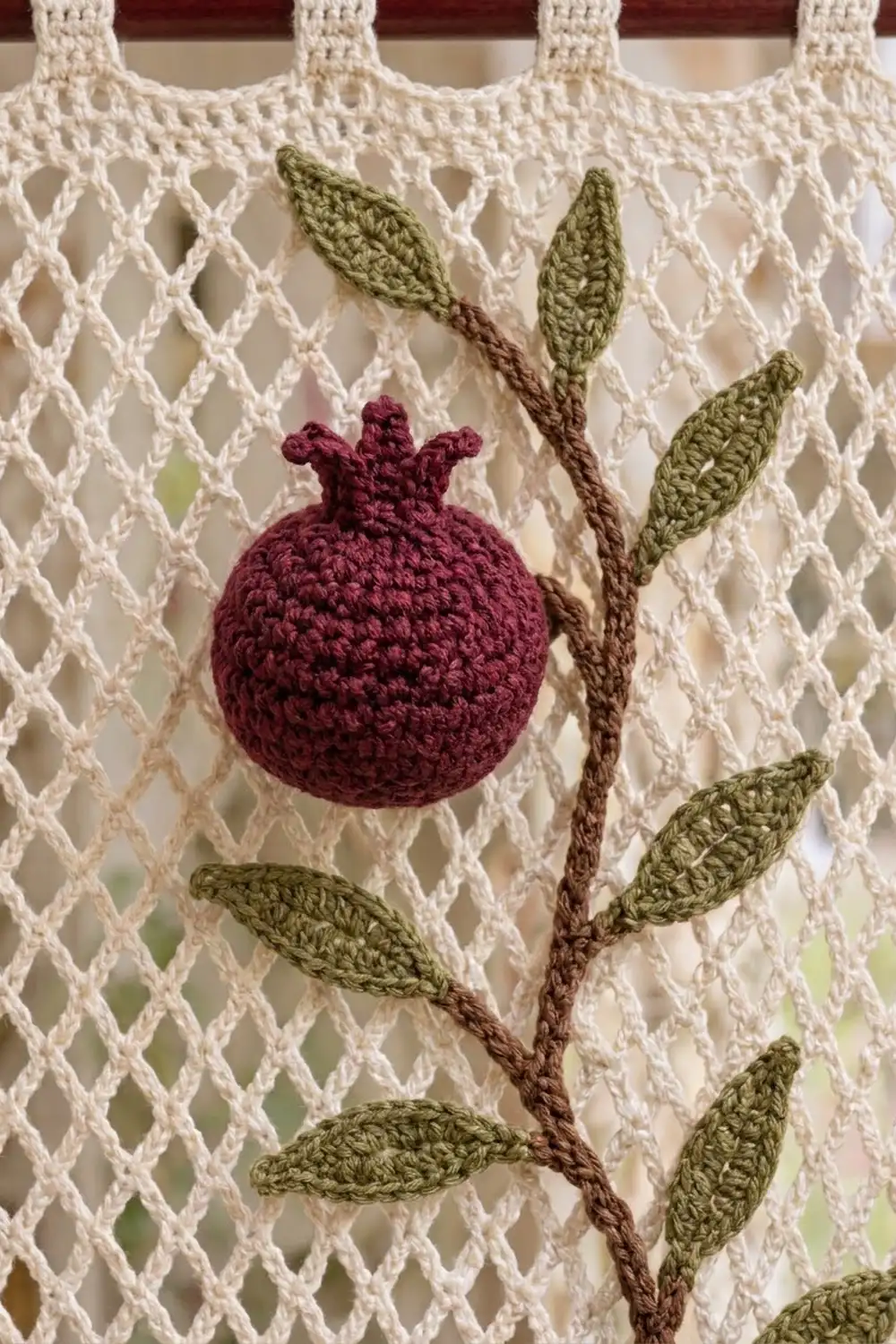
Panel Mesh (make 2)
Use the cream yarn and the 5 mm hook.
Foundation: Ch 66 (a multiple of 4, plus 2).
Row 1: Sc in the 6th ch from hook; the 5 skipped ch form the first loop. Ch 5, sk 3 ch, sc in next ch 15 times. (16 loops)
Row 2: Ch 5, turn, sc in the first ch-5 loop. Ch 5, sc in next ch-5 loop 15 times. (16 loops)
Rows 3–64: Repeat Row 2. (16 loops per row)
Each row’s loops sit halfway between the loops of the row below, which creates the diamond net. Don’t fasten off after Row 64, because the edging round starts from there.
Checkpoint: 16 x 32 in (40.6 x 81.3 cm).
Pomegranate (make 4 burgundy, 2 terracotta)
Use the 4 mm hook. Work in continuous rounds and move a marker up at the start of each round.
- Rnd 1: 6 sc in MR. (6)
- Rnd 2: 2 sc in each st. (12)
- Rnd 3: Sc in next st, 2 sc in next st 6 times. (18)
- Rnd 4: Sc in next 2 sts, 2 sc in next st 6 times. (24)
- Rnd 5: Sc in next 3 sts, 2 sc in next st 6 times. (30)
- Rnd 6: Sc in next 4 sts, 2 sc in next st 6 times. (36)
- Rnds 7–12: Sc in each st. (36)
- Rnd 13: Sc in next 4 sts, sc2tog 6 times. (30)
- Rnd 14: Sc in next 3 sts, sc2tog 6 times. (24)
- Rnd 15: Sc in next 2 sts, sc2tog 6 times. (18)
Stuff firmly. Flatten the back slightly so the fruit sits close to the mesh.
- Rnd 16: Sc in next st, sc2tog 6 times. (12)
- Rnd 17: Sc2tog 6 times. (6)
Fasten off, leaving a 12 in (30.5 cm) tail, and close the hole. The closed end is the top of the fruit.
Checkpoint: The circumference at Rnd 9 is about 7.2 in (18.3 cm). The stuffed fruit is about 2.25 in (5.7 cm) across.
Crown (make 1 to match each pomegranate)
Use the 4 mm hook.
- Rnd 1: 5 sc in MR. (5)
- Rnd 2: 2 sc in each st. (10)
- Rnd 3: Sl st in next st, ch 4, sl st in 2nd ch from hook, sc in next ch, hdc in next ch, sl st in next st 5 times. (5 points)
Fasten off, leaving an 8 in (20.3 cm) tail. Each point uses 2 sts from Rnd 2, so the 5 points use all 10 sts.
Leaf (make 12 per panel, 24 total)
Use olive green and the 4 mm hook.
Ch 9. Starting in the 2nd ch from hook, work: sl st, sc, hdc, dc, dc, hdc, sc. In the last ch, work (sc, ch 2, sc) for the tip. Then work along the other side of the chain: sc, hdc, dc, dc, hdc, sc, sl st. Fasten off, leaving a tail.
The chain down the center forms a visible vein. Each leaf is about 1.75 x 0.75 in (4.4 x 1.9 cm).
Vine and Stems
Use brown and the 4 mm hook.
Vine (1 per panel): Ch 150. Starting in the 2nd ch from hook, sl st in the back bump of each ch across. (149 sl sts) This makes a firm cord about 37.5 in (95.3 cm) long.
Stem (3 per panel): Ch 12. Starting in the 2nd ch from hook, sl st in the back bump of each ch across. (11 sl sts) Each stem is about 3 in (7.6 cm) long.
Make All Pieces
Totals for the pair:
– Cream: 2 mesh panels
– Burgundy: 4 pomegranates, 4 crowns, 2 hems
– Terracotta: 2 pomegranates, 2 crowns
– Olive: 24 leaves
– Brown: 2 vines, 6 stems
Layout grid for the left panel: Heights are measured down from the top of the mesh. Mirror the layout left to right for the right panel.
Height             Left          Center       Right
2 in (5.1 cm)                    vine tip
3 in (7.6 cm)      leaf          vine         leaf
7 in (17.8 cm)                   vine         BURGUNDY fruit
10 in (25.4 cm)    leaf          vine         leaf
13 in (33.0 cm)    leaf          vine         leaf
16 in (40.6 cm)    TERRACOTTA    vine
19 in (48.3 cm)    leaf          vine         leaf
22 in (55.9 cm)    leaf          vine         leaf
25 in (63.5 cm)                  vine         BURGUNDY fruit
28 in (71.1 cm)    leaf          vine         leaf
30 in (76.2 cm)                  vine base
Joining: Attaching the Appliqués
The panels are never joined to each other. Here, “joining” means sewing the appliqués onto each panel.
1. Vine: Pin the vine in a gentle S-curve. It runs from 2 in (5.1 cm) above the bottom of the mesh to 2 in (5.1 cm) below the top. Curl the extra length at the top into a tendril.
2. How to tack it: Wherever the vine crosses a mesh sc or a ch-5 strand, take one small whipstitch around the cord and that strand. That works out to about one tack every 0.5 in (1.3 cm), which matches the 2-rows-per-inch gauge.
3. Stems: Sew each stem from the vine to the top of a pomegranate.
4. Pomegranates and crowns: Sew a crown to the closed top of each fruit. Tack down the center and bend the points upward. Place each fruit using the grid. Tack around its back wherever it touches a strand, about 8 tacks per fruit.
5. Leaves: Tack each leaf at its base to the vine and at its tip to the nearest strand.
Tension: Pull each tack just snug. Too tight puckers the diamonds, and too loose lets the fruit sag forward.
Size checkpoint: The panel should still lie flat at 16 x 32 in (40.6 x 81.3 cm) before the border, or at 16.5 x 32.5 in (41.9 x 82.6 cm) after the edging round.
Border
Border gauge: 4 sc = 1 in (2.5 cm), and 1 sc row = 0.25 in (0.6 cm).
Rnd 1 (cream edging): Continue from the end of Row 64. Ch 1 and work around all four sides:
– Bottom edge: 3 sc in the corner, 4 sc in each of the first 15 loops, then 5 sc in the last loop. (65 sc)
– First side: 3 sc in the corner, then 2 sc in each of the 64 row-ends. (128 sc)
– Top edge: 3 sc in the corner, 4 sc in each of the first 15 foundation spans, then 5 sc in the last span. (65 sc)
– Second side: 3 sc in the corner, then 2 sc in each row-end. (128 sc)
Join with a sl st to the first sc and fasten off.
Total: 65 + 128 + 65 + 128 + (4 corners x 3) = 398 sc. The side counts above do not include the corner groups.
Why the math works: Each loop is 1 in wide and 4 sc measure 1 in, so 4 sc per loop lies flat. The one extra sc fills the half-loop at the edge. Each row is 0.5 in tall and gets 2 sc, which also works out to 4 sc per inch.
Tabs (cream, worked into the 65 top sts):
– Row 1: Join the yarn in the 1st top st. Sc in the same st and in the next 4 sts. (5)
– Rows 2–16: Ch 1, turn, sc in each st. (5)
Fasten off. Skip 5 sts and make the next tab in the following 5 sts. Continue until you have 7 tabs and 6 gaps: (7 x 5) + (6 x 5) = 65 sts. Fold each 4 in (10.2 cm) tab to the back and sew it down to form a 2 in (5.1 cm) loop.
Bottom hem (burgundy, worked into the 65 bottom sts):
– Row A: Join burgundy in the 1st bottom st, ch 1, sc in each st across. (65 sc)
– Row B: Ch 1, turn, sc in the first st. Sk 1, 5 dc in next st, sk 1, sc in next st 16 times. (16 scallops, 17 sc)
Check: 1 + (16 x 4) = 65 sts, which puts one scallop under each mesh loop. Fasten off.
The border adds 0.25 in (0.6 cm) on each side, for a width of 16.5 in (41.9 cm). At the bottom it adds 1 in (2.5 cm): 0.25 in (0.6 cm) of cream, 0.25 in (0.6 cm) of burgundy sc and 0.5 in (1.3 cm) of scallops. That brings the length to 33.25 in (84.5 cm).
Final Blocking
- Weave in each end within its own color.
- Spray the mesh until damp, but not the fruit.
- Pin the panel to 16.5 x 33.25 in (41.9 x 84.5 cm). Pin the corners first, then every 2 in (5.1 cm) along the edges.
- Pin out each scallop point and leaf tip.
- Let it dry completely, which takes 12–24 hours.
- Unpin it and hang both panels to check that they’re the same length.
Final Quality-Control Checklist
- Each mesh row has 16 loops
- Rnd 1 has 398 sc
- Each panel has 7 tabs of equal size
- Each hem has 16 scallops
- The fruit is evenly stuffed with no filling showing
- All crowns point upward
- The panels mirror each other
- Each panel measures 16.5 x 33.25 in (41.9 x 84.5 cm)
Troubleshooting
- The mesh slants: You worked into a chain instead of around the loop. Always work around the whole ch-5 loop.
- The edges ruffle: There are extra sc in the edging. Recount: 65 on the top and bottom, 128 on each side.
- The edges pull in: Go up one hook size for the edging round only.
- The fruit is lumpy: Restuff using small pieces of fiberfill.
- The panel sags under the fruit: Add more tacks and use less stuffing.
- The scallops cup: Block them firmly, or work 4 dc instead of 5 dc.
Care
Hand wash in cool water with mild soap. Lay flat to dry, reshaping the scallops, and don’t wring.

Final Notes
Here’s the measurement chain. One loop is 1 in (2.5 cm) wide and 2 rows are 1 in (2.5 cm) tall, so 16 loops by 64 rows gives a 16 x 32 in (40.6 x 81.3 cm) mesh. The edging round brings it to 16.5 x 32.5 in (41.9 x 82.6 cm). The burgundy hem brings the length to 33.25 in (84.5 cm), and the tabs give a hanging length of 35.25 in (89.5 cm). Check your gauge at each step and both panels will match.
Happy crocheting!