

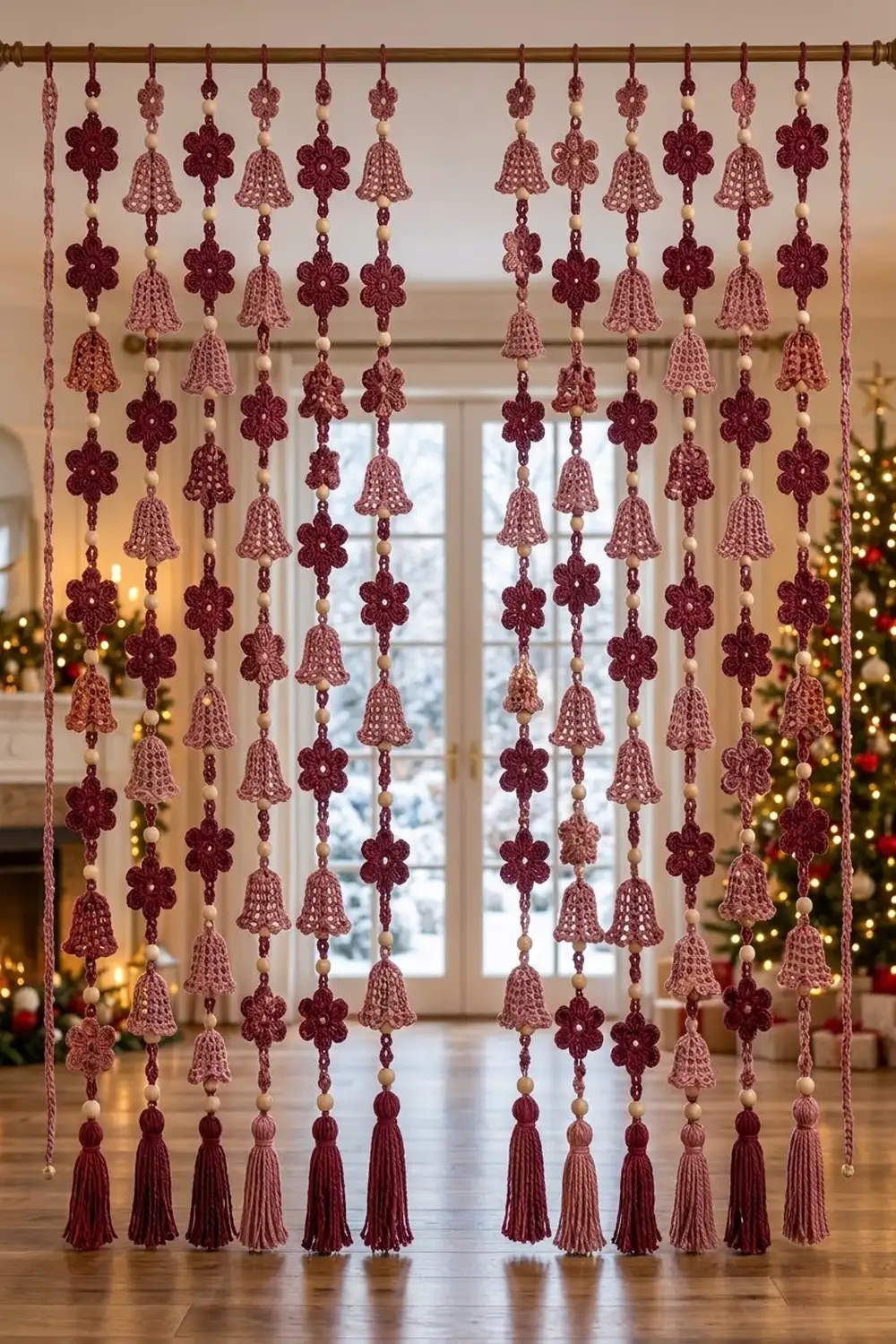
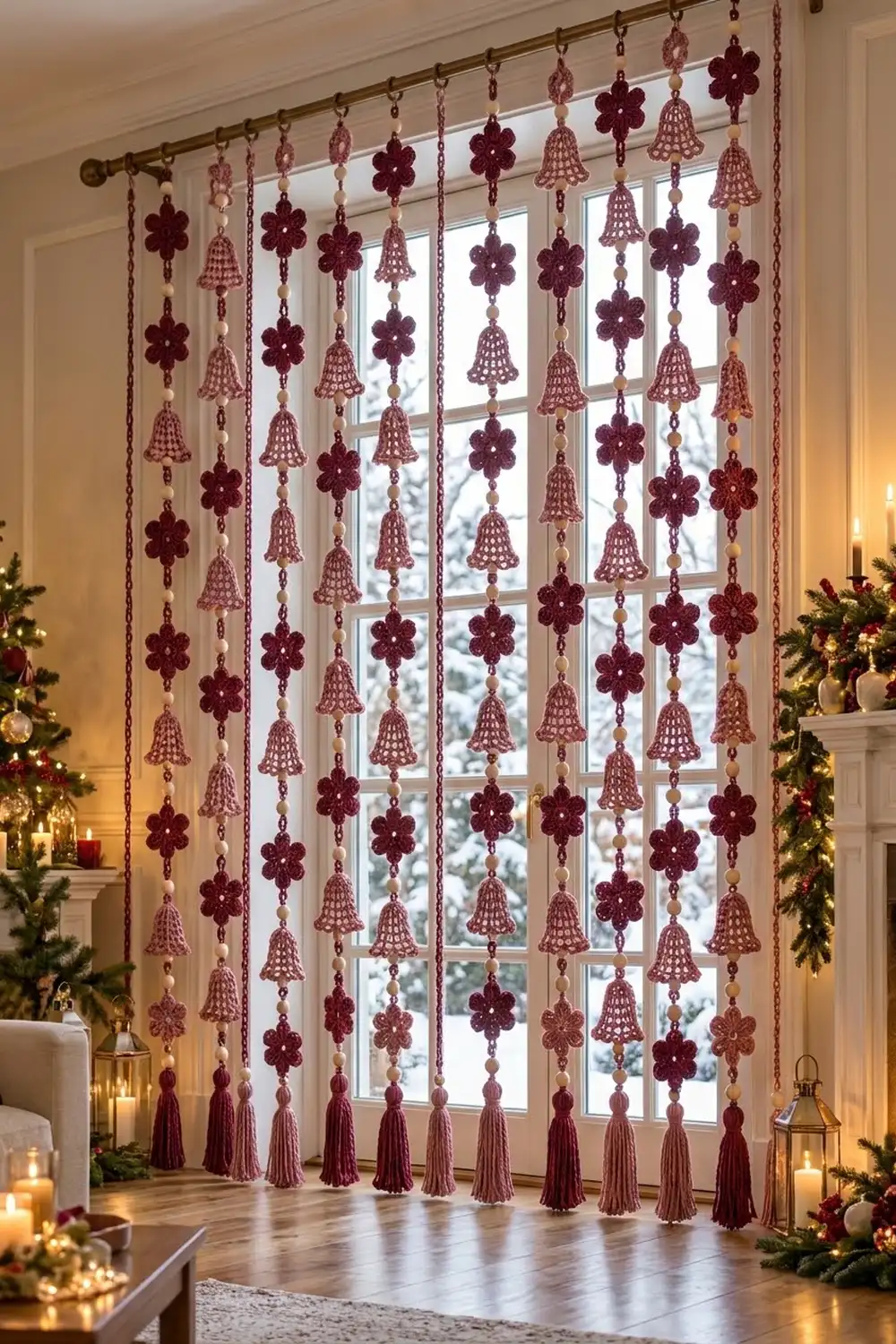
This hanging curtain combines two simple shapes: open filet bells in dusty rose and solid five-petal flowers in deep burgundy. Natural wooden beads and chunky tassels connect them. The colors give it a warm, vintage holiday look that suits a doorway, a window, or a room divider.
Each strand is one burgundy chain cord. Flowers and bells are crocheted separately, then attached as the cord is chained, with a wooden bead between every motif. Neighboring strands are offset, so the flowers and bells form a checkerboard rhythm across the curtain.
The pattern is written in US crochet terms. The finished curtain is about 40.25 in (102.2 cm) wide and 80 in (203.2 cm) long from the rod to the tassel tips.
Construction overview: make 70 flowers and 70 bells, chain 10 beaded cords that join the motifs as you go, then add one tassel to each strand and hang the strands 4 in (10.2 cm) apart.
Finished Size and Construction
- Finished size: 40.25 in (102.2 cm) wide x 80 in (203.2 cm) long
- Skill level: Intermediate (filet shaping, bead stringing)
- Terminology: US
- Yarn weight: Worsted (#4)
- Hook: 4.0 mm (G-6)
- Number of pieces: 70 flowers, 70 bells, 10 cords, 10 tassels
- Layout: 10 strands x 14 motifs each
- Piece size: flower 3 in (7.6 cm) across; bell 4.25 in (10.8 cm) wide x 3.5 in (8.9 cm) tall
- Size before border: 10 strands of 74 in (188.0 cm) each, measured from the rod to the last bead
- Border depth: 6 in (15.2 cm) of tassels along the bottom edge
Materials
Use a smooth worsted-weight cotton or cotton blend. Cotton keeps the filet mesh crisp and the scallops defined, and it doesn’t stretch much when it hangs. The amounts assume roughly 200 m per 100 g.
- Burgundy: 400 g / 800 m (flowers, cords, 5 tassels)
- Dusty rose: 450 g / 900 m (bells, 5 tassels)
- Wooden beads: 146 natural wood beads, 16 mm (0.6 in / 1.5 cm), with a hole of at least 4 mm (140 needed plus 6 spares)
Tools:
– 4.0 mm hook
– Tapestry needle
– A big-eye beading needle or dental-floss threader for stringing beads
– Stitch markers
– Cardboard cut 6 in (15.2 cm) tall for the tassels
– Rust-proof pins, a blocking mat, and a spray bottle
– Scissors and a tape measure
The quantities include a margin of about 15% for gauge differences and swatching.
Abbreviations (US Terms)
- ch chain
- sl st slip stitch
- sc single crochet
- hdc half double crochet
- dc double crochet
- tr treble crochet
- sk skip
- sp space
- st(s) stitch(es)
- rnd round
- rep repeat
- RS / WS right side / wrong side
Special stitches:
– Filet square: one dc plus one ch-1 space, closed by the next dc.
– Increase square: a filet square added beyond the edge of the previous row (method given in Row 2).
– Bead slide (BS): push one pre-strung bead up against the hook, then make the next chain behind it to lock it in place.
Gauge and Checkpoints
- Filet mesh gauge: 5 squares = 2 in (5.1 cm) wide, and 4 rows = 2 in (5.1 cm) tall. One square is 0.4 in (1.0 cm) wide and one row is 0.5 in (1.3 cm) tall.
- Chain gauge: 5 ch = 1 in (2.5 cm).
Make one flower and one bell before anything else, and measure them against these checkpoints:
- Flower after Rnd 4: 3 in (7.6 cm) tip to tip, and 2.5 in (6.4 cm) from a petal tip to the opposite dip.
- Bell after Row 2: 2.4 in (6.1 cm) wide.
- Bell after Row 6: 4 in (10.2 cm) wide and 3 in (7.6 cm) tall.
- Bell after its edging: 4.25 in (10.8 cm) wide x 3.5 in (8.9 cm) tall.
- One strand unit (flower, bead, bell, bead): 10 in (25.4 cm).
If your pieces are too big, go down 0.5 mm in hook size. If they are too small, go up 0.5 mm. If only the chain gauge is off, change hooks for the cords only.
Flower Motif (make 70, burgundy)
Ch 5, sl st in first ch to form a ring.
Rnd 1: Ch 1, 15 sc in ring, sl st in first sc. (15 sc)
Rnd 2: Ch 1, sc in same st, ch 4, sk 2 sts, sc in next st, ch 4, sk 2 sts; rep from * 3 more times, sl st in first sc. (5 sc, 5 ch-4 sps)*
Rnd 3: Sl st in first ch-4 sp. Work (sc, hdc, 2 dc, tr, 2 dc, hdc, sc) in each ch-4 sp around, then sl st in first sc. (5 petals, 9 sts each = 45 sts)
Rnd 4 (outline): Ch 1, then work 1 sc in each st around, with 3 sc in each tr. Sl st in first sc. (11 sc per petal = 55 sc)
Fasten off and weave in the ends. The middle sc of each 3-sc group is that petal’s tip. A dip is the space between the last sc of one petal and the first sc of the next. The ch-5 ring leaves the open center visible in the design.
Bell Motif (make 70, dusty rose)
The bell is worked flat in rows from top to bottom.
Increase row method: Ch 4 (counts as dc + ch-1 now and throughout), dc in the first dc at the base of the ch. *Ch 1, dc in next dc; rep from * across, working the last dc in the 3rd ch of the turning ch. Ch 1, dc in the same ch.
Straight row method: Ch 4, dc in next dc. *Ch 1, dc in next dc; rep from * across, working the last dc in the 3rd ch of the turning ch.
Row 1: Ch 12. Dc in the 6th ch from hook (the skipped chs count as dc, ch-1 and 1 skipped ch). Ch 1, sk next ch, dc in next ch; rep from * 2 more times. Turn. (4 squares; 5 dc + 4 ch = 9 sts; 1.6 in / 4.1 cm wide)*
Row 2: Work the increase row, placing the last two dc in the top of the beginning chain. Turn. (6 squares; 13 sts)
Row 3: Work the straight row. Turn. (6 squares; 13 sts)
Row 4: Work the increase row. Turn. (8 squares; 17 sts; 3.2 in / 8.1 cm wide)
Row 5: Work the straight row. Turn. (8 squares; 17 sts)
Row 6: Work the increase row. Do not fasten off. (10 squares; 11 dc + 10 ch = 21 sts; 4 in / 10.2 cm wide)
The two-square increases give the bell its rounded shoulders, the straight rows give the waist, and the last increase makes the flare.
Rnd 7 (scallop edging):
– Bottom: Ch 1, turn. Sc in first dc. Sk ch-1 sp, 5 dc in next dc, sk ch-1 sp, sc in next dc; rep from * 4 more times. (6 sc + 25 dc = 31 sts, 5 scallops)
– First side: Work 2 sc around each row-end post up the side. (12 sc)
– Top: Working across the underside of the foundation, sc in each of the 5 dc bases and in each of the 4 ch-1 sps. (9 sc)
– Second side: Work 2 sc around each row-end post down the side. (12 sc)
– Sl st in first sc. (64 sts total)*
The shells sit on dc 2, 4, 6, 8 and 10, and the sc sit on the odd-numbered dc. That is why the row needs an odd count: 11 dc = 2 x 5 + 1. The 3rd shell is centered on dc 6, which is the bell’s center column. The 5th of the 9 top sc sits directly above that same column. Fasten off and weave in the ends.
Make All Pieces
Burgundy:
– 70 flowers
– 10 cords
– 5 tassels (strands 1, 3, 5, 7, 9)
Dusty rose:
– 70 bells
– 5 tassels (strands 2, 4, 6, 8, 10)
Strand A (odd strands) starts with a flower. Strand B (even strands) starts with a bell.
STRAND:    1   2   3   4   5   6   7   8   9   10
LEVEL 1:   FL  BE  FL  BE  FL  BE  FL  BE  FL  BE
LEVEL 2:   BE  FL  BE  FL  BE  FL  BE  FL  BE  FL
LEVELS 3-14: repeat Levels 1-2 six more times
TASSEL:    BU  RO  BU  RO  BU  RO  BU  RO  BU  RO
Key: FL = burgundy flower, BE = rose bell, BU = burgundy tassel, RO = rose tassel.
Each strand holds 7 flowers and 7 bells: 10 strands x 7 = 70 of each.
Joining (Beaded Cord)
Method: The cord is one continuous burgundy chain that attaches each motif as you go. String 14 beads onto the burgundy yarn before you start each strand.
Hold every motif with the WS toward you, so the back chain stays hidden behind it.
Header: Ch 20, sl st in first ch to form the rod loop. Ch 10. (4 in / 10.2 cm drop)
Strand A unit (work 7 times):
1. Sl st in the tip sc of a flower’s top petal.
2. Ch 12 behind the flower, then sl st in the dip directly opposite the tip.
3. Ch 4, BS, ch 3.
4. Sl st in the 5th top sc of a bell.
5. Ch 17 behind the center column, then sl st in the 3rd dc of the center shell.
6. Ch 4, BS, ch 3.
Strand B unit: Work the same steps with the bell first and the flower second.
After the 7th unit, fasten off and leave an 8 in (20.3 cm) tail.
Stitch-to-stitch logic:
– The 12-ch flower chain spans the 2.5 in (6.4 cm) from tip to dip.
– The 17-ch bell chain spans the 3.5 in (8.9 cm) from the top center to the center scallop. It lines up with the center dc column, so it disappears behind the mesh.
– Each bead segment (ch 4, bead, ch 3) measures 2 in (5.1 cm). This puts one bead right under every bell, as in the finished piece.
Tension: Chain loosely and evenly. The back chains should lie flat without cupping the motif. A tight chain makes the motif bow forward when it hangs.
Size checkpoint:
– One unit = 2.5 + 2 + 3.5 + 2 = 10 in (25.4 cm).
– Seven units = 70 in (177.8 cm).
– Adding the header gives 74 in (188.0 cm) per strand.
Border (Top Loops and Tassel Fringe)
The curtain has no stitched border around its sides. Its edges are the row of rod loops at the top and the tassel fringe at the bottom.
Border gauge: each tassel is 30 wraps on a 6 in (15.2 cm) card, giving a 6 in (15.2 cm) tassel.
Top edge: 10 rod loops of 20 ch each, centered 4 in (10.2 cm) apart.
Bottom edge: 10 tassels, alternating 5 burgundy and 5 rose.
Side edges: These are open, free-hanging strands with no stitches added.
To make each tassel:
1. Wrap the yarn 30 times around the card.
2. Pass the cord tail under the wraps at the top fold and tie it tightly.
3. Cut the wraps along the bottom of the card.
4. Wrap a 12 in (30.5 cm) length of matching yarn 6 times around the tassel, 0.75 in (1.9 cm) below the top. Knot it and bury the ends inside.
Why the math works:
– 10 strands have 9 gaps x 4 in = 36 in (91.4 cm) between the outer strand centers.
– Half a bell, 2.125 in (5.4 cm), extends past each outer strand: 36 + 4.25 = 40.25 in (102.2 cm) wide.
– The length is 74 + 6 = 80 in (203.2 cm).
– Offset neighbors keep the motifs from overlapping. At each level, half a bell plus half a flower is 2.125 + 1.5 = 3.625 in (9.2 cm), which is less than the 4 in spacing.
Final Blocking
- Lightly mist all flowers and bells.
- Pin the bells right side up to 4.25 in (10.8 cm) wide x 3.5 in (8.9 cm) tall. Pin each scallop out into a round curve.
- Pin the flowers to 3 in (7.6 cm), with each petal tip pinned to a point.
- Let everything dry completely, about 12–24 hours.
- Once the strands are joined, hang them for 24 hours so the cords relax.
- Steam the tassels lightly from a distance and comb them straight.
- Trim all tassels evenly to 6 in (15.2 cm).
Final Quality-Control Checklist
- [ ] 70 flowers at 3 in (7.6 cm), 55 sc each
- [ ] 70 bells at 4.25 x 3.5 in (10.8 x 8.9 cm), 64 edging sts, 5 scallops
- [ ] Every strand has 14 motifs and 14 beads, one bead directly under each bell
- [ ] Back chains are hidden and the motifs hang flat
- [ ] Strands measure 74 in (188.0 cm) before tassels
- [ ] Tassels alternate burgundy and rose, all 6 in (15.2 cm)
- [ ] All ends are woven in and the rod loops are secure
Troubleshooting
- The bell leans or twists: The cord was joined off center. Re-join it at the 5th top sc and the 3rd dc of the center shell.
- Scallops are ruffled: The edging is too loose. Go down one hook size for Rnd 7.
- Mesh squares are uneven: Keep the ch-1s the same size, and check that you skip the ch-sp before each dc.
- Motifs cup forward: The back chain is too short. Add 1–2 ch.
- A bead won’t pass over the yarn: Use a dental-floss threader, or choose beads with a 5 mm hole.
- Strands are different lengths: Measure each finished unit at 10 in (25.4 cm) and adjust the ch-4 before the bead.
Care
Dust the curtain gently or shake it out. If it needs washing, hand-wash it in cool water, then lay it flat and reshape it to dry so the wooden beads aren’t soaked for long.
Final Notes
The measurements build on each other:
– A filet square is 0.4 in (1.0 cm), which makes a 4 in (10.2 cm) bell body and a 4.25 in (10.8 cm) bell after edging.
– A flower is 3 in (7.6 cm).
– Each 10 in (25.4 cm) unit is flower, bead, bell, bead. Seven units plus the header give a 74 in (188.0 cm) strand.
– The 6 in (15.2 cm) tassel brings each strand to 80 in (203.2 cm).
– Ten strands set 4 in (10.2 cm) apart make the 40.25 in (102.2 cm) curtain.
Check each step against these numbers and the curtain will hang straight and even.
Happy crocheting!