

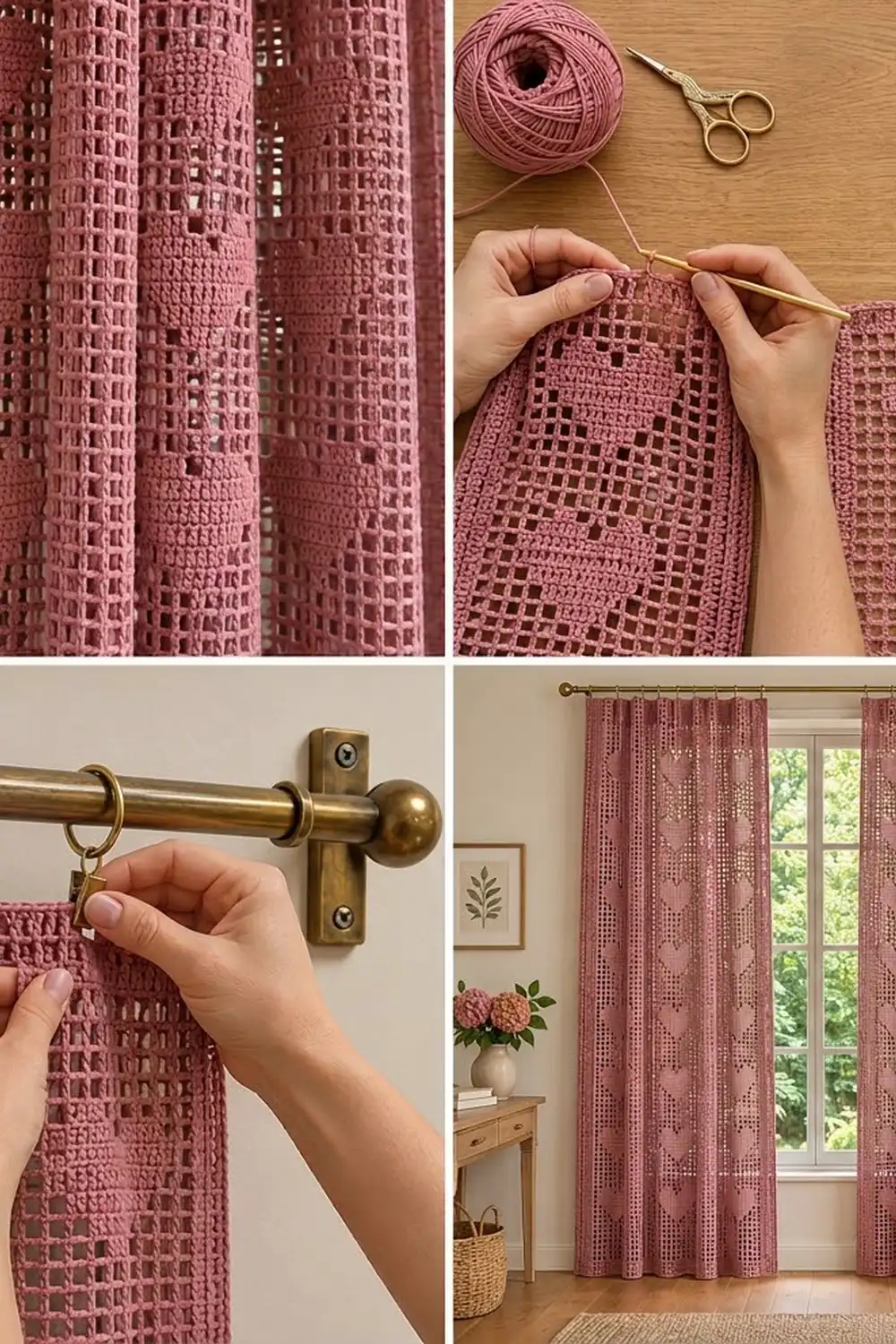
These filet crochet curtain panels let soft light through a grid of open mesh while three columns of solid hearts climb from hem to header. The design uses one dusty rose cotton and looks romantic without being fussy. It suits cottage, farmhouse and modern-vintage rooms equally well.
Each panel is one flat rectangle worked in rows of double crochet blocks and chain spaces. A solid frame two blocks wide runs down both long edges, and a solid bar one block wide separates the heart columns. Two solid rows close the top and bottom. A two-round single crochet border neatens all four edges and gives the clip rings something firm to grip.
This pattern uses US crochet terms. Each finished panel measures 26.2 x 77.0 in (66.5 x 195.6 cm). The pair is two identical, separate panels that hang side by side; they are never joined. With a light gather on the rod, two panels frame a standard window nicely. In daylight the hearts show up as soft silhouettes against the mesh.
Construction in short: chain, work 190 rows of filet from written row sequences, add the border, block, and clip to a rod. There are no charts to follow and no color changes.
Finished Size and Construction
- Finished size (each panel): 26.2 x 77.0 in (66.5 x 195.6 cm)
- Skill level: Easy-intermediate (simple stitches, a long project, careful counting)
- Terminology: US crochet terms
- Yarn weight: DK (#3 light) cotton
- Hook: 3.5 mm (E-4)
- Number of pieces: 2 identical panels
- Layout: One panel on each side of the window, hung separately
- Piece size before border: 25.2 x 76.0 in (64.0 x 193.0 cm)
- Grid: 63 squares wide x 190 rows tall
- Heart motif: 11 squares x 10 rows, 4.4 x 4.0 in (11.2 x 10.2 cm)
- Border depth: 0.5 in (1.3 cm) on every side
Materials
Choose a smooth mercerized or combed cotton in DK weight. Cotton keeps the grid square, sags less than acrylic and washes well. Avoid fuzzy or brushed yarns: they blur the mesh and hide the hearts.
- Dusty rose DK cotton: 1000 g / approx. 2200 m (500 g / approx. 1100 m per panel)
These quantities include a margin of about 10% for your swatch, differences in tension, and the border. Buy all the yarn from one dye lot, because the two panels hang side by side in daylight and any color difference will show.
Tools
- 3.5 mm (E-4) crochet hook, plus one size up and one size down for adjusting gauge
- Tapestry needle
- Scissors
- Stitch markers (at least 10)
- Tape measure
- Rust-proof pins and a large padded surface or blocking mats
- Spray bottle
- 24 curtain clip rings (12 per panel) and a curtain rod
Abbreviations (US Terms)
- ch – chain
- dc – double crochet
- sc – single crochet
- sl st – slip stitch
- sp – space
- st(s) – stitch(es)
- RS – right side
- Rnd – round
Special stitches
- B (block): Dc in each of the next 3 sts. If the square below is a space, work 2 dc in the ch-2 sp and 1 dc in the next dc. Each B uses 3 sts.
- S (space): Ch 2, skip the next 2 sts (or the ch-2 sp), dc in the next dc. Each S uses 3 sts.
Every row begins with ch 3, which counts as the first dc. The 63 squares follow, and each uses 3 sts, so every row has 63 x 3 + 1 = 190 sts.
Gauge and Checkpoints
Gauge: 10 squares and 10 rows = 4 in (10.2 cm) in filet mesh, so one square measures 0.4 x 0.4 in (1.0 x 1.0 cm).
Test first: Ch 48. Dc in the 4th ch from the hook and in each ch across (46 sts, 15 squares). Work 14 more rows, alternating one row of all S with one row of all B. Lightly block. The swatch should measure 6 x 6 in (15.2 x 15.2 cm).
- Too big: Go down a hook size, or tighten the ch-2 in each space.
- Too small: Go up a hook size.
- Width is right but squares are too tall: Pull up the dc loops less and keep the same hook.
Checkpoints while working (measure lightly stretched flat):
- After Row 2: width 25.2 in (64.0 cm)
- After Row 20: length 8.0 in (20.3 cm)
- After Row 104: length 41.6 in (105.7 cm)
- After Row 190: length 76.0 in (193.0 cm)
Blocking can correct a width difference of up to 0.5 in (1.3 cm). If the difference is larger, your tension has changed; compare against your swatch before you continue.

Panel Pattern
Panel Layout Across One Row
Read every row from left to right. The layout is symmetrical, so it reads the same in both directions.
| Section | Squares |
|---|---|
| Side frame | 2 (always B) |
| Heart column 1 with 4 squares of mesh on each side | 19 |
| Center bar | 1 (always B) |
| Heart column 2 with mesh | 19 |
| Center bar | 1 (always B) |
| Heart column 3 with mesh | 19 |
| Side frame | 2 (always B) |
| Total | 63 |
Foundation and Hem
Ch 192.
Row 1 (RS): Dc in the 4th ch from the hook (the skipped ch count as the first dc) and in each ch across. Turn. (190 sts)
Row 2: Ch 3, B 63 times. Turn. (190 sts)
Open Rows
Rows 3–6: Ch 3, B 2 times, S 19 times, B, S 19 times, B, S 19 times, B 2 times. Turn. (190 sts)
These four rows make the mesh gap below the first heart.
Heart Rows
Work the following 10 rows. Each row still has 190 sts.
Heart Row 1: Ch 3, B 2 times, [S 9 times, B, S 9 times, B] 2 times, S 9 times, B, S 9 times, B 2 times. Turn.
Heart Row 2: Ch 3, B 2 times, [S 8 times, B 3 times, S 8 times, B] 2 times, S 8 times, B 3 times, S 8 times, B 2 times. Turn.
Heart Row 3: Ch 3, B 2 times, [S 7 times, B 5 times, S 7 times, B] 2 times, S 7 times, B 5 times, S 7 times, B 2 times. Turn.
Heart Row 4: Ch 3, B 2 times, [S 6 times, B 7 times, S 6 times, B] 2 times, S 6 times, B 7 times, S 6 times, B 2 times. Turn.
Heart Row 5: Ch 3, B 2 times, [S 5 times, B 9 times, S 5 times, B] 2 times, S 5 times, B 9 times, S 5 times, B 2 times. Turn.
Heart Rows 6–8: Ch 3, B 2 times, [S 4 times, B 11 times, S 4 times, B] 2 times, S 4 times, B 11 times, S 4 times, B 2 times. Turn.
Heart Row 9: Ch 3, B 2 times, [S 4 times, B 5 times, S, B 5 times, S 4 times, B] 2 times, S 4 times, B 5 times, S, B 5 times, S 4 times, B 2 times. Turn.
Heart Row 10: Ch 3, B 2 times, [S 5 times, B 3 times, S 3 times, B 3 times, S 5 times, B] 2 times, S 5 times, B 3 times, S 3 times, B 3 times, S 5 times, B 2 times. Turn.
Check: In Heart Row 1, each column section is 9 + 1 + 9 = 19 squares. In Heart Row 10, it is 5 + 3 + 3 + 3 + 5 = 19. Every section totals 19, so every row totals 2 + 19 + 1 + 19 + 1 + 19 + 2 = 63 squares.
Heart Row 1 is the point of the heart and Heart Rows 6–8 are its widest part. Heart Rows 9–10 shape the two rounded lobes with a notch in the center.
The Repeat
Rows 7–188: Work Heart Rows 1–10, then work the Open Row (as Rows 3–6) 4 times. That is one 14-row repeat, 5.6 in (14.2 cm) tall. Work the repeat 13 times in total. Place a marker at the start of each repeat to keep your place.
Rows used: 6 + (13 x 14) = 188.
Top Hem
Rows 189–190: Ch 3, B 63 times. Turn. (190 sts)
Do not fasten off. Go straight on to the border.
The panel now has 13 hearts in each of its 3 columns, 39 hearts in total. There are 4 open rows above the top hearts and 4 below the bottom hearts. The panel measures 25.2 x 76.0 in (64.0 x 193.0 cm).
Make Both Panels
Make 2 panels exactly as written, both in dusty rose (500 g / 1100 m each). Work both panels to the same row count and check them against the same checkpoints so they hang at matching lengths.
Layout as hung:
[ Panel 1 ]   [ window ]   [ Panel 2 ]
 63 x 190                   63 x 190
The panels are not sewn together, so there is no joining step. Each panel hangs from its own 12 clip rings. Space the rings evenly, about 2.4 in (6.1 cm) apart, with one ring at each top corner.
Border
Border gauge: 15 sc = 2 in (5.1 cm), which is 3 sc per filet square in either direction. Because the squares are 0.4 x 0.4 in (1.0 x 1.0 cm), working 3 sc per row-end on the sides matches the 3 sc per square across the top and bottom. The edges stay flat without ruffling or pulling in.
Each side count below is the number of sc on that side only. The ch-2 corner spaces are not counted in the side totals.
Rnd 1 (RS): Ch 1, sc in the first st and in each st across Row 190 (190 sc), ch 2 for the corner. Working down the side, work 3 sc in each row-end down to the foundation (190 rows x 3 = 570 sc), ch 2. Working in the free loops of the foundation chain, sc 190 across the bottom, ch 2. Work 3 sc in each row-end up the second side (570 sc), ch 2. Join with a sl st to the first sc.
Rnd 1 count: 190 + 570 + 190 + 570 = 1520 sc, plus 4 ch-2 corner sps.
Rnd 2: Ch 1, sc in each sc around, working (sc, ch 2, sc) in each ch-2 corner sp. Join with a sl st to the first sc. Fasten off.
Rnd 2 count: 1520 sc worked 1 in each existing sc + 8 sc added at the corners = 1528 sc. Per side, that is 192 sc on the top and bottom and 572 sc on each side, plus 4 ch-2 corner sps.
Why the math works: Each panel is one piece, so each side starts from 1 x that panel’s own edge count: 190 sts across and 190 rows x 3 = 570 down each side. The two rounds add 0.5 in (1.3 cm) to every side. The finished size is 25.2 + 1.0 = 26.2 in (66.5 cm) wide and 76.0 + 1.0 = 77.0 in (195.6 cm) long.
Weave in all ends securely. Run each tail through solid blocks rather than chain spaces, where it would show.
Final Blocking
- Fill a basin with cool water and soak the panel for 15 minutes. Do not wring it.
- Press out the water, then roll the panel in towels to remove more moisture.
- Lay it on a clean, padded surface. The panel is long, so block it in two halves if needed, keeping the damp half supported.
- Pin the corners first, to 26.2 x 77.0 in (66.5 x 195.6 cm).
- Pin along the side frames and center bars every 4 in (10.2 cm), keeping the bars straight.
- Gently square the mesh with your fingers so each space is open and even.
- Let the panel dry completely before unpinning.
- Alternatively, hang the damp panel from its clip rings and let gravity straighten it. Check the length afterward, because cotton can stretch slightly.
Final Quality-Control Checklist
- Each panel measures 26.2 x 77.0 in (66.5 x 195.6 cm).
- The two panels are within 0.5 in (1.3 cm) of each other in length.
- Every row had 190 sts, and the grid shows 63 squares across.
- Each column holds 13 hearts, lined up vertically.
- The side frames are 2 blocks wide and the center bars 1 block wide along the full length.
- Each heart has a point at the bottom and a center notch at the top.
- The border corners lie flat with no cupping.
- All ends are hidden in solid blocks.
Troubleshooting
A heart looks lopsided. You probably miscounted spaces in one section. Count each column section; it must total 19 squares.
The panel narrows or widens. Check that you skip exactly 2 sts in each S and that the last dc of each row goes into the top of the turning ch-3.
Spaces look like tall rectangles. Your dc is taller than your chain is wide. Shorten the dc by pulling up the first loop less, or chain slightly more loosely.
The border ruffles on the sides. Work 2 sc instead of 3 in every third row-end, spreading the change evenly on both sides.
The border pulls in. Make sure you work 3 sc in each row-end, not 2.
The panel droops after hanging. Re-block it and space the clip rings evenly so the weight spreads across the whole top edge.
Care
Hand wash in cool water with a mild detergent, roll in a towel, then dry flat or re-block. Don’t tumble dry, as it can distort the mesh.
Final Notes
The whole design rests on one measurement chain: a 0.4 in (1.0 cm) square made of 3 sts. Sixty-three squares give 190 sts and 25.2 in (64.0 cm) across. 190 rows give 76.0 in (193.0 cm) in length. A 0.5 in (1.3 cm) border then brings each panel to 26.2 x 77.0 in (66.5 x 195.6 cm). Match your swatch, count in 19-square sections, and both panels will hang straight and match each other.
Happy crocheting!