

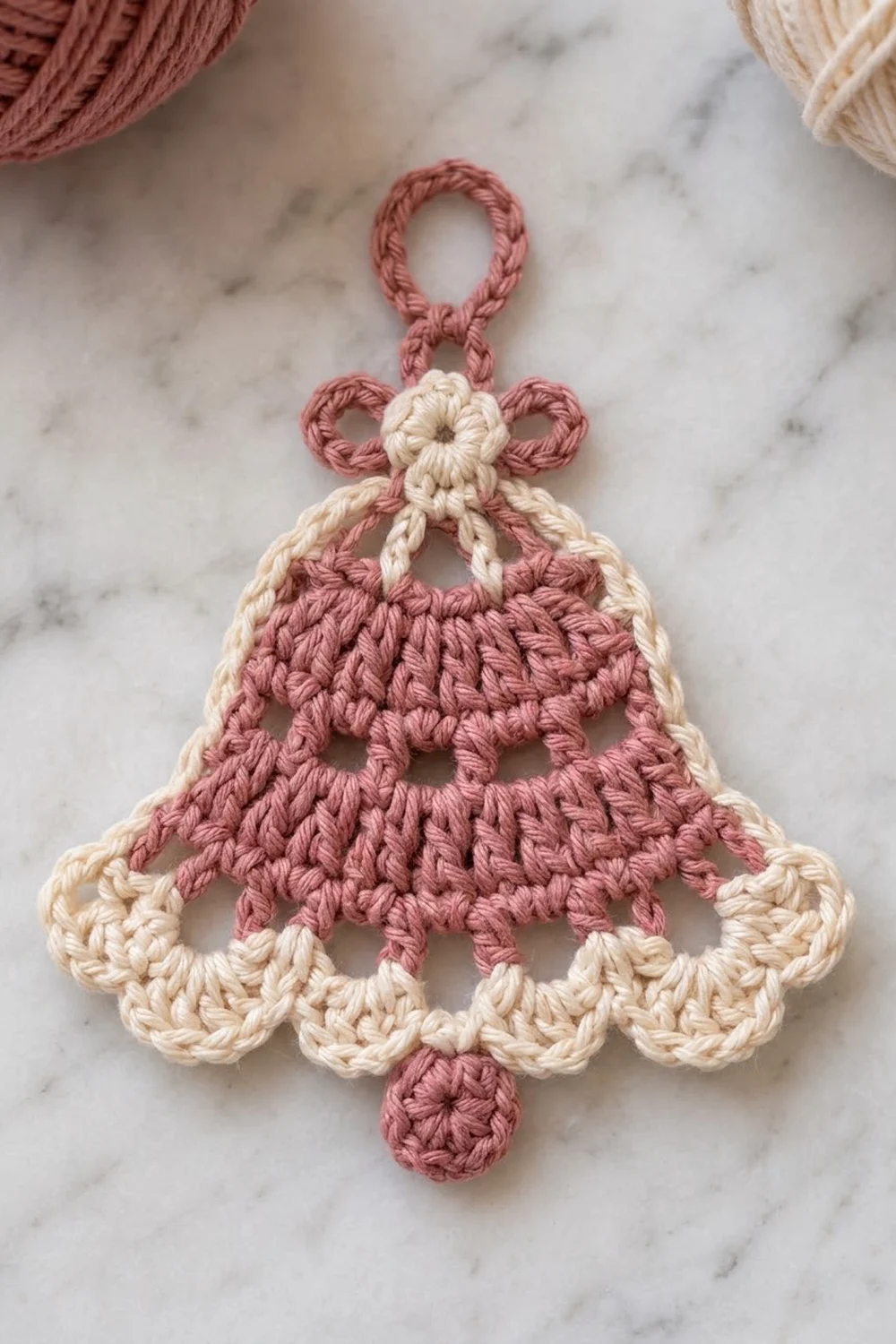
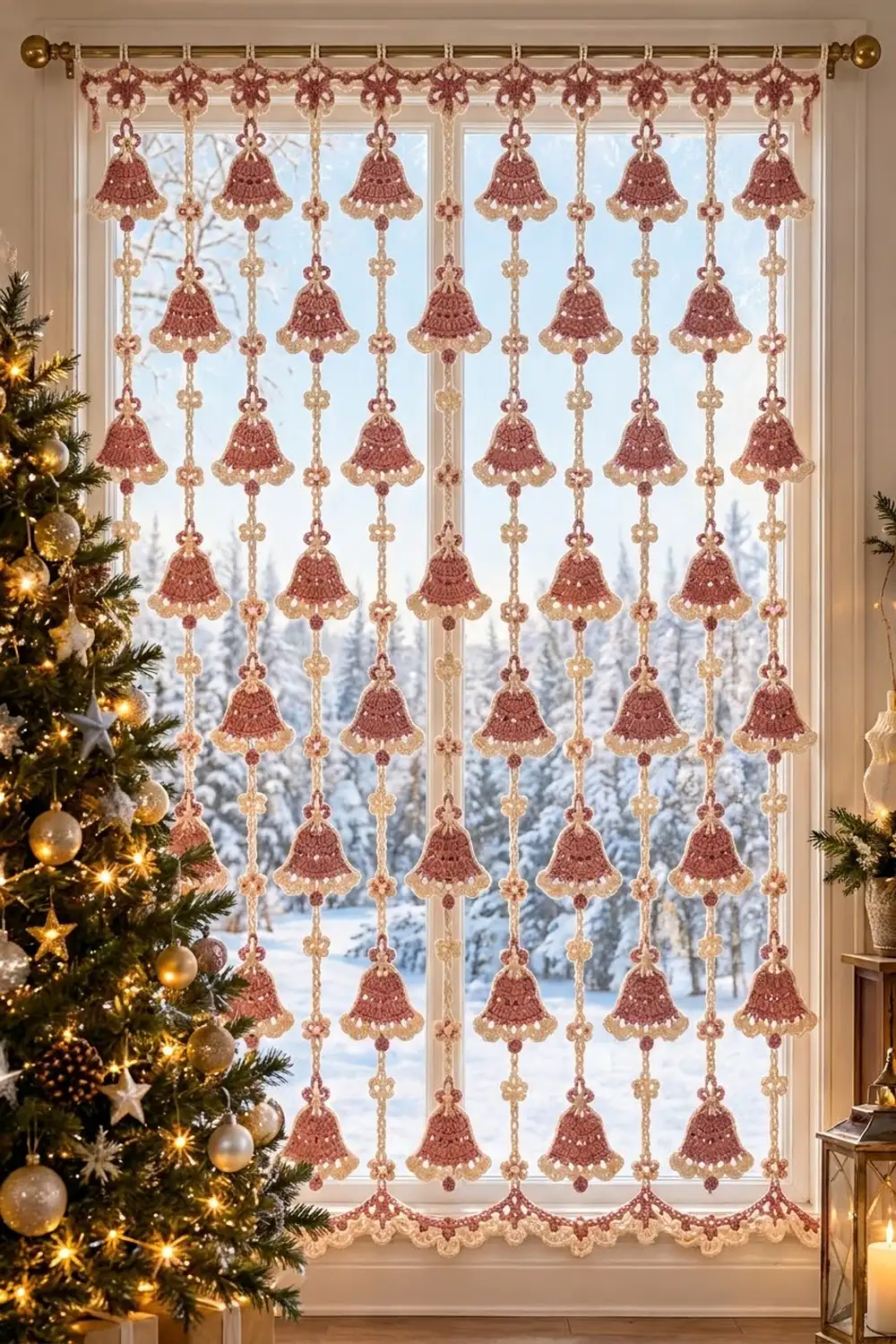
This curtain is a cascade of small dusty rose bells. Each bell has a cream scalloped hem, a round rose clapper, and a cream center with a little rose bow on top. The bells hang from cream chain strands dotted with tiny flowers, and the strands are staggered so the bells fill the window in a soft checkerboard.
Only two colors are used. Dusty rose goes into the bell bodies, bows, loops and clappers. Cream goes into the hems, centers, strands and header. The look is vintage and gentle: perfect for a holiday window, but pretty all year.
All terms are US crochet terms. The finished curtain is 36.2 in (91.9 cm) wide and about 54 in (137.2 cm) long, not counting the rod tabs. Each bell is 5 in (12.7 cm) wide and 3.6 in (9.1 cm) tall.
Each bell is worked flat in rows from the top down. It gets a cream scalloped edging, a top knot and a clapper. You make 45 bells and join them into 9 cream strands as you chain. A cream header band with 9 rod tabs then holds the strand tops together.
Finished Size and Construction
- Finished size: 36.2 in (91.9 cm) wide x about 54 in (137.2 cm) long
- Skill level: Easy-intermediate
- Terminology: US crochet terms
- Yarn weight: DK (#3, light)
- Hook: 4.0 mm (G-6)
- Number of pieces: 45 bells, 9 strands, 1 header band
- Layout: 9 strands of 5 bells each, staggered in 10 tiers
- Piece size: one bell is 5 in (12.7 cm) x 3.6 in (9.1 cm). With its loop and clapper it is 6 in (15.2 cm) long.
- Size before border: 9 strands, each 53 in (134.6 cm) long, spaced 4 in (10.2 cm) apart
- Border depth: header band about 0.75 in (1.9 cm), plus the tabs
Materials
Choose a smooth DK cotton or cotton blend. Cotton keeps the scallops crisp and helps the bells hang flat. Fuzzy yarn will blur the eyelets.
- Dusty rose: 300 g / 720 m (6 balls of 50 g / 120 m)
- Cream: 200 g / 480 m (4 balls of 50 g / 120 m)
Each bell uses about 6 g of rose and 3 g of cream. The strands and header use about 40 g of cream. The quantities above already include a margin of roughly 10 percent.
Tools: 4.0 mm (G-6) hook, tapestry needle, stitch markers, rust-proof pins, blocking mat, measuring tape, spray bottle.
Abbreviations (US Terms)
- ch – chain
- sl st – slip stitch
- sc – single crochet
- dc – double crochet
- sk – skip
- st(s) – stitch(es)
- sp – space
Special stitch – Flower (fl): Ch 4, sl st in 4th ch from hook (first petal). Then [ch 4, sl st in same ch] 3 times. You get 4 petals clustered at one point, about 0.6 in (1.5 cm) across. Continue chaining from the base of the flower.
Gauge and Checkpoints
Gauge: 18 dc and 9 dc rows = 4 in (10.2 cm). Chain gauge: 5 ch = 1 in (2.5 cm).
Make and measure one complete bell before production:
- After Row 1: 9 dc = 2 in (5.1 cm) wide
- After Row 3: 13 dc = 2.9 in (7.4 cm) wide
- After Row 7: 21 dc = 4.7 in (11.9 cm) wide, body 3.1 in (7.9 cm) tall
- After edging: 5 in (12.7 cm) x 3.6 in (9.1 cm)
- Bell unit: 6 in (15.2 cm) from loop top to clapper bottom
If the bell is too big, use a 3.75 mm hook. If it is too small, use a 4.5 mm hook. Don’t change stitch counts, because the scallop repeat needs exactly 21 stitches. Check your chain gauge too, since strand lengths are given in chains.
Bell Pattern (make 45)
Body (dusty rose)
Ch 11.
Row 1: Dc in 4th ch from hook (skipped 3 ch count as dc), dc in each remaining ch. Turn. (9 dc)
Row 2: Ch 3 (counts as dc throughout), dc in same st, dc in next 7 sts, 2 dc in top of turning ch. Turn. (11 dc)
Row 3: Ch 3, dc in same st, dc in next 9 sts, 2 dc in last st. Turn. (13 dc)
Row 4 (eyelet row): Ch 4 (counts as dc + ch 1), sk next st, dc in next st, [ch 1, sk next st, dc in next st] 5 times. Turn. (7 dc + 6 ch-1 sps = 13 sts)
This row does not increase. It creates the band of 6 small openings.
Row 5: Ch 3, dc in same st, [dc in next ch-1 sp, dc in next dc] 5 times, dc in next ch-1 sp, 2 dc in 3rd ch of turning ch. Turn. (15 dc)
Row 6: Ch 3, dc in same st, dc in next 13 sts, 2 dc in last st. Turn. (17 dc)
Row 7 (flare row): Ch 3, dc in same st, 2 dc in next st, dc in next 13 sts, 2 dc in next st, 2 dc in last st. (21 dc)
Row 7 adds 2 sts at each side, which gives the hem its flare. Fasten off rose.
Edging and Scallops (cream)
Row 8: With Row 7 facing you, join cream with sc at the top corner of the left side. Work 13 more sc down the side (2 sc per row-end), for 14 sc. Then work across Row 7:
Sc in first st, sk 1, 5 dc in next st, sk 1, sc in next st; repeat from * 4 more times. (5 scallops: 25 dc + 6 sc = 31 sts)
Then work 14 sc up the right side (2 sc per row-end). Fasten off. (59 sts: 14 + 31 + 14)
The scallops fit because 1 starting sc + (4 sts x 5 repeats) = 21. The middle scallop sits on st 11, the exact center of Row 7.
Top Knot
Rnd 1 (cream): Magic ring, ch 1, 8 sc in ring, sl st to first sc. (8 sc) Fasten off. Number the sc 1 to 8 clockwise, with sc 1 at the top.
Rnd 2 (dusty rose): Join with sl st in sc 1. Ch 12, sl st in same sc (hanging loop). Sl st in sc 2 and sc 3. In sc 3, [ch 5, sl st in same sc] twice (right bow). Sl st in sc 4 through sc 7. In sc 7, [ch 5, sl st in same sc] twice (left bow). Sl st in sc 8 and sc 1. (1 loop + 4 petals)
Loop cover: Work 18 sc into the ch-12 loop, then sl st at its base. Fasten off, leaving a 6 in (15.2 cm) tail. The loop stands about 1 in (2.5 cm) tall.
With the tail, sew sc 5 of the knot to the 5th foundation st, at the top center of the bell, with the loop pointing straight up.
Clapper (dusty rose)
Rnd 1: Magic ring, ch 1, 6 sc in ring, sl st to first sc. (6 sc)
Rnd 2: Ch 1, 2 sc in each st around, sl st to first sc. (12 sc)
The flat disc measures about 0.8 in (2.0 cm). Do not fasten off. Ch 3, then sl st in the 3rd dc of the middle scallop. Fasten off and weave in the ends.
Make All Pieces
- Bells: 45. Each uses about 6 g of dusty rose (body, bow, loop, clapper) and about 3 g of cream (edging, center).
- Strands: 9 in cream. Strands 1, 3, 5, 7 and 9 are Type A. Strands 2, 4, 6 and 8 are Type B.
- Header: 1 in cream.
Block all bells before joining (see Final Blocking).
Layout grid (X = bell, . = chain only):
STRAND:   1  2  3  4  5  6  7  8  9
TIER 1:   X  .  X  .  X  .  X  .  X
TIER 2:   .  X  .  X  .  X  .  X  .
TIERS 3–10: repeat Tiers 1–2 four more times
Type A strands carry bells in the odd tiers and Type B strands in the even tiers: (5 x 5) + (4 x 5) = 45 bells.
Joining
Each strand is a cream chain built from the top down, joining bells as you go. The chain locks into a bell’s hanging loop, and the next segment starts from that bell’s clapper.
Stitch logic: To attach a bell, insert the hook front to back through the top center of its covered loop and sl st. To start the next segment, join cream with sl st in the clapper sc directly opposite its ch-3 stem.
Type A strand:
- Lead: Make a slip knot, leaving an 8 in (20.3 cm) tail. Ch 10, which is 2 in (5.1 cm). Sl st into bell 1’s loop. Fasten off.
- Connector (4 times): Join at the clapper above. Ch 8, fl, ch 8, sl st into the next bell’s loop. Fasten off. Each connector measures about 4 in (10.2 cm), joins included.
- Tail: Join at bell 5’s clapper. Ch 22, fl, fasten off. The tail measures 5 in (12.7 cm).
Length: 2 + (5 x 6) + (4 x 4) + 5 = 53 in (134.6 cm).
Type B strand:
- Lead: Make a slip knot, leaving an 8 in (20.3 cm) tail. Ch 16, fl, ch 16, which is 7 in (17.8 cm). Sl st into bell 1’s loop. Fasten off.
- Connector (4 times): Same as Type A.
- No tail: Finish at bell 5’s clapper.
Length: 7 + (5 x 6) + (4 x 4) = 53 in (134.6 cm).
One bell plus one connector makes a vertical pitch of 10 in (25.4 cm). The Type B lead is 5 in (12.7 cm) longer than the Type A lead, exactly half a pitch, so the tiers stagger evenly.
Tension: Keep your chains even and relaxed. Tight chains shorten the connectors and pull the tiers out of line. Size checkpoint: lay each strand flat. It should measure 53 in (134.6 cm), within 0.5 in (1.3 cm).
Border: Header Band
Border gauge: 18 sc = 4 in (10.2 cm).
With cream, ch 164.
Row 1: Sc in 2nd ch from hook and in each ch across. Turn. (163 sc)
Row 2: Ch 1, sc in each st across. Turn. (163 sc)
Row 3 (tabs): Ch 1, sc in first 9 sts, ch 16, sk next st, sc in next 17 sts; repeat from * 7 more times, ch 16, sk next st, sc in last 9 sts. Fasten off. (9 + (8 x 17) + 9 = 154 sc + 9 tabs, with 9 sts skipped; 154 + 9 = 163)
Attach the strands: Mark the foundation chain at sts 10, 28, 46, 64, 82, 100, 118, 136 and 154. Each mark sits directly below a tab. Use each strand’s 8 in (20.3 cm) top tail to sew it, in order, through the free loop at its marked st. Make 3 passes and weave in.
Why the math works: 9 margin sts + (8 gaps x 18 sts) + 1 last position + 9 margin sts = 163. Positions 18 sts apart sit exactly 4 in (10.2 cm) apart, so the strands span 32 in (81.3 cm), with about 2 in (5.1 cm) of margin at each end. 163 sc at 4.5 sc per in gives 36.2 in (91.9 cm). The band adds 0.75 in (1.9 cm) to the 53 in (134.6 cm) strands, for about 54 in (137.2 cm) total. Each tab is 3.2 in (8.1 cm) around and fits a rod up to 1 in (2.5 cm) thick.
Final Blocking
- Before joining, soak the bells in cool water for 10 minutes. Roll them in a towel to press out the water; do not wring.
- Pin each bell to 5 in (12.7 cm) x 3.6 in (9.1 cm). Pin every scallop tip and open the 6 eyelets.
- Pin the bow petals outward and the loop straight up. Lay the clapper flat.
- Let everything dry completely, about 24 hours.
- After assembly, hang the curtain and mist the strands lightly. Gravity straightens the chains overnight.
- Mist the header and pat it flat to 36.2 in (91.9 cm).
Final Quality-Control Checklist
- 45 bells, each 5 in (12.7 cm) x 3.6 in (9.1 cm)
- 5 scallops and 6 eyelets per bell, clapper centered
- Bow petals symmetrical, loop centered
- 5 Type A and 4 Type B strands, each 53 in (134.6 cm)
- Tiers level across the curtain
- Header 163 sts wide, with each of the 9 tabs directly above a strand
- All ends woven in at least 1 in (2.5 cm)
Troubleshooting
- Hem curls up: The scallops are too tight. Use a 4.5 mm hook for Row 8.
- Bell twists: Join through the exact top center of the loop, and keep the clapper join opposite the stem.
- Tiers drift: Your chain gauge has changed. Re-check 5 ch = 1 in (2.5 cm) and redo the uneven connectors.
- Eyelets close up: Skip a stitch under every ch-1 in Row 4, then open the holes when blocking.
- Header ripples: The foundation chain is too tight. Re-chain it with a 4.5 mm hook.
Care
Hand wash in cool water with mild soap, dry flat, and re-pin the scallops if needed. Store rolled, not folded, so the strands stay untangled.
Final Notes
The measurement chain: 18 dc = 4 in (10.2 cm) gives a 21-st hem of 4.7 in (11.9 cm) and a 5 in (12.7 cm) x 3.6 in (9.1 cm) bell. A 6 in (15.2 cm) bell unit plus a 4 in (10.2 cm) connector makes a 10 in (25.4 cm) pitch. A half-pitch lead offset staggers the tiers, and every strand is 53 in (134.6 cm). Nine strands, 18 sts apart, hang from a 163-st header 36.2 in (91.9 cm) wide, for a curtain about 54 in (137.2 cm) long.
Happy crocheting!