

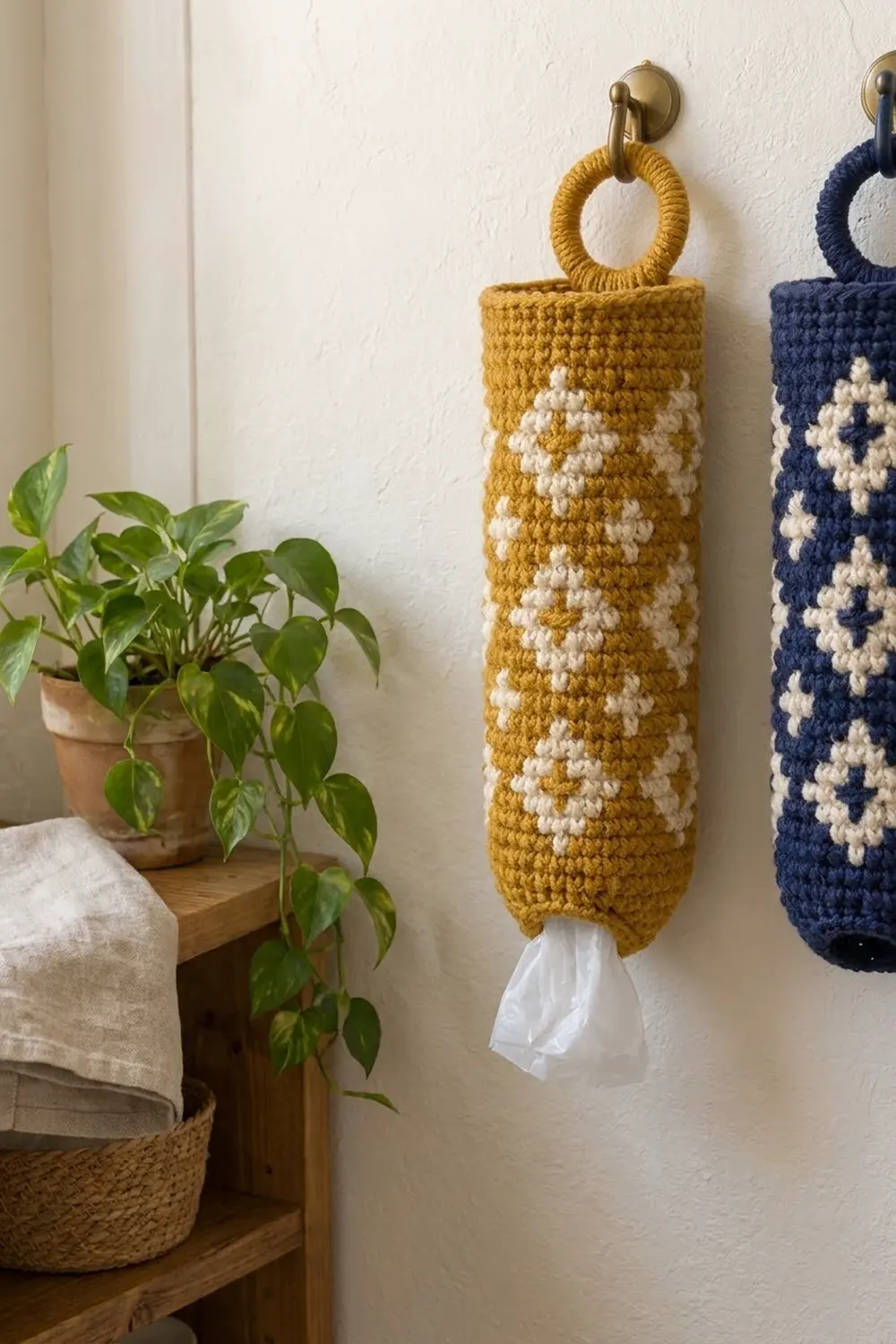
This bag holder is a sturdy tube worked in tapestry crochet. Mustard-gold yarn forms the background, and stacked cream diamonds with small cross accents run all the way around. You push bags in at the wide top and pull them out one at a time through the narrower bottom opening.
The colors are warm mustard and soft cream, and the style is folk-inspired. Because the tapestry stitches are dense, the tube holds its shape on the wall without stiffening. A crochet-covered ring at the back of the rim hangs it on any hook or knob. The pattern uses US crochet terms throughout.
The finished tube measures 5 in (12.7 cm) wide when flat and 13.8 in (35.1 cm) tall. The total hanging height with the ring is about 16.3 in (41.4 cm).
You start at the bottom with a foundation ring and increase to full width in a few rounds. Then you work 50 tapestry rounds in a continuous spiral and finish with plain rounds and a slip-stitch rim. Last, you cover a metal or wooden ring with single crochet and sew it to the inside back of the rim.
Finished Size and Construction
- Finished size: 5 in (12.7 cm) wide flat × 13.8 in (35.1 cm) tall; 16.3 in (41.4 cm) with ring
- Circumference: 10 in (25.4 cm)
- Bottom opening: 7 in (17.8 cm) around, about 2.2 in (5.6 cm) across
- Skill level: Intermediate (tapestry color changes)
- Terminology: US
- Yarn weight: Worsted (#4)
- Hook: 5.0 mm (H-8)
- Number of pieces: 1 tube + 1 covered ring, sewn together
- Layout: Single hanging tube; ring centered on the back
- Piece size before border: 5 in (12.7 cm) flat × 13.8 in (35.1 cm)
- Border depth: one slip-stitch round at each edge, adding less than 1/8 in (0.3 cm)
Materials
Use a smooth worsted-weight yarn in cotton, cotton blend, or acrylic. Cotton gives the crispest diamonds and the stiffest tube. Avoid fuzzy or splitty yarns, because the carried strand must stay hidden.
- Mustard (M): 80 g / 145 m
- Cream (C): 30 g / 55 m
These quantities include a margin of about 15–20% for swatching and tails.
Tools:
- 5.0 mm (H-8) crochet hook
- One metal or wooden ring, 2 in (5.1 cm) inner diameter
- Stitch marker
- Tapestry needle
- Scissors
- Measuring tape
- Rolled towel or a 3 in (7.6 cm) cardboard tube for blocking
Abbreviations (US Terms)
- ch – chain
- sl st – slip stitch
- sc – single crochet
- 2 sc – work 2 sc in the same stitch (increase)
- M / C – mustard / cream
- st(s) – stitch(es)
- Rnd – round
Special technique, tapestry color change: Work the last sc before the color change until 2 loops remain on the hook. Drop the old color, yarn over with the new color, and pull through both loops. Lay the unused color along the tops of the stitches and work over it with every sc, so it stays hidden inside.
Color sequence notation: “M4, C1” means 4 sc in mustard, then 1 sc in cream.
Gauge and Checkpoints
Gauge: 16 sc × 18 rnds = 4 in (10.2 cm) in tapestry sc worked in the round.
The colorwork rounds are your gauge test. Work Rnds 1–17 (the plain base plus the first full motif repeat) before you commit to the whole tube.
Checkpoints:
- After Rnd 5: 40 sts; flat width 5 in (12.7 cm); height about 1.1 in (2.8 cm).
- After Rnd 7: height 1.6 in (4.1 cm).
- Each 10-round motif repeat: 2.2 in (5.6 cm) tall.
- After Rnd 57: height 12.7 in (32.3 cm).
- After Rnd 62: height 13.8 in (35.1 cm).
If the tube is too wide, for example 5.5 in (14.0 cm) flat, go down to a 4.5 mm hook. If it is too narrow or stiff enough to curl, go up to a 5.5 mm hook. Don’t change the stitch count, because the motif needs exactly 40 sts.
Tube
Work in a continuous spiral. Don’t join the rounds. Move the marker up each round so it sits in the first stitch.
Foundation: With M, ch 28 loosely. Join with a sl st to the first ch to form a ring, making sure the chain is not twisted.
Rnd 1: Ch 1, sc in each ch around. Place a marker in the first sc. (28 sts)
Rnd 2: Sc in each st around. (28 sts)
Rnd 3: Sc 6, 2 sc in next st; repeat from * 4 times. (32 sts)*
Rnd 4: Sc 7, 2 sc in next st; repeat from * 4 times. (36 sts)*
Rnd 5: Sc 8, 2 sc in next st; repeat from * 4 times. (40 sts)*
These three increase rounds make the gentle taper at the bottom opening.
Rnds 6–7: Sc in each st around. (40 sts each round)
Join C at the start of Rnd 8. Carry it from now on.
Colorwork Rounds
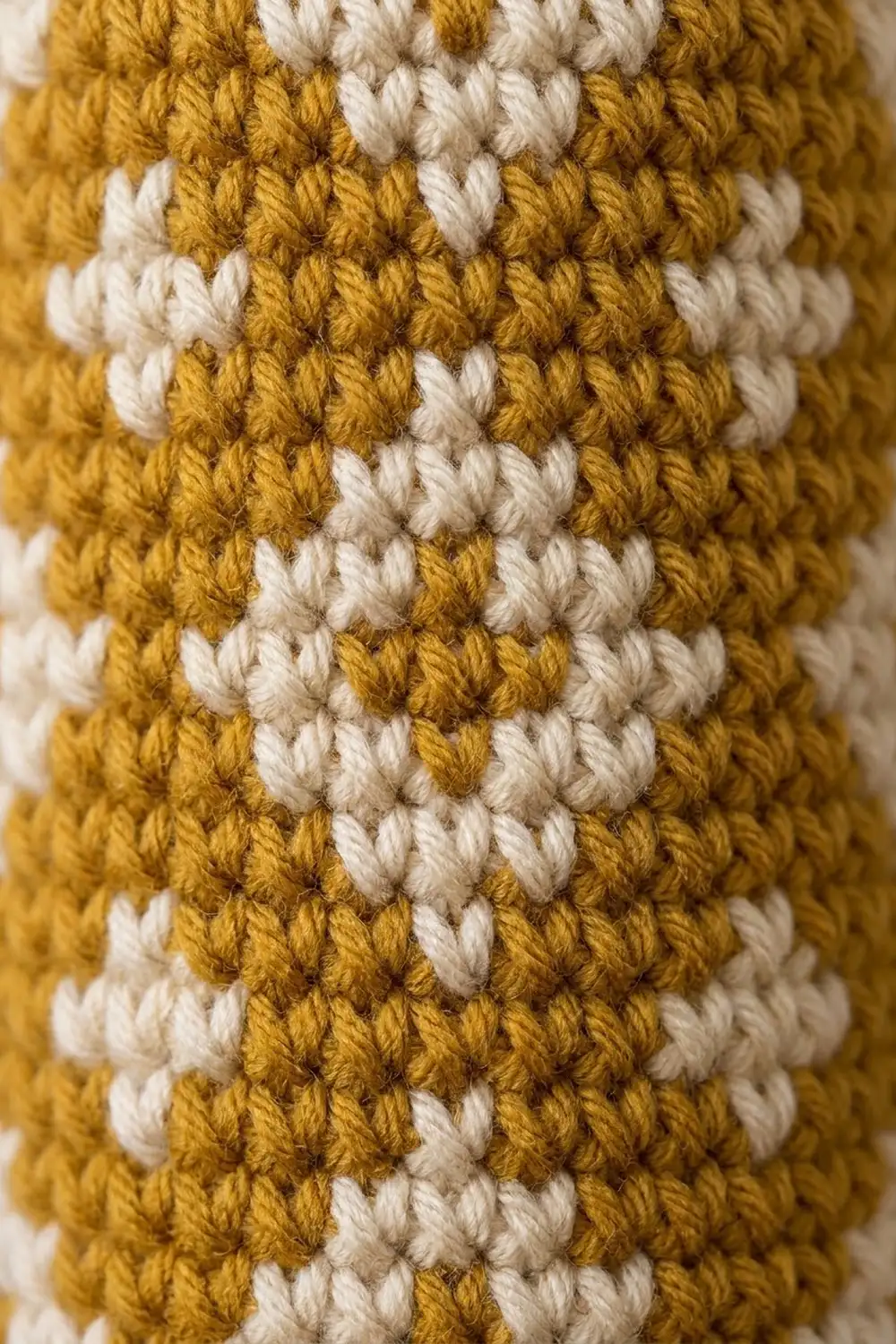
Each motif round is a 10-stitch sequence. Work it 4 times around for 40 sts. The diamonds stack in 4 vertical columns, and the crosses sit on the column boundaries.
- Motif Rnd 1: M4, C1, M5. (40 sts)
- Motif Rnd 2: M3, C1, M1, C1, M4. (40 sts)
- Motif Rnd 3: M2, C1, M3, C1, M3. (40 sts)
- Motif Rnd 4: M1, C1, M2, C1, M2, C1, M2. (40 sts)
- Motif Rnd 5: M2, C1, M3, C1, M3. (40 sts)
- Motif Rnd 6: M3, C1, M1, C1, M4. (40 sts)
- Motif Rnd 7: M4, C1, M5. (40 sts)
- Motif Rnd 8: M9, C1. (40 sts)
- Motif Rnd 9: C1, M7, C2. (40 sts)
- Motif Rnd 10: M9, C1. (40 sts)
In Motif Rnds 1–7, the cream stitches form a hollow diamond 7 sts wide. The cream stitch in the middle of Motif Rnd 4 sits in the mustard center, so it reads as the center dot. The positions 1 and 7 of that diamond-width form the diamond’s widest points.
In Motif Rnds 8–10, the cream stitches build a small plus sign on stitch 10 of each repeat. On Motif Rnd 9, the C2 at the end of one repeat and the C1 at the start of the next are adjacent, so together they form the plus sign’s horizontal bar of 3 stitches.
Rnds 8–57: Work Motif Rnds 1–10 five times. (40 sts each round)
Each stitch count per sequence works out to 10 (for example, 1+1+2+1+2+1+2 = 10 for Motif Rnd 4). Count every sequence on your first repeat.
Fasten off C at the end of Rnd 57, leaving a 4 in (10.2 cm) tail. Carry the tail inside the next 6 sts, then trim it.
Rnds 58–62: With M only, sc in each st around. (40 sts each round)
To smooth the spiral step, sl st into the next st. Don’t fasten off; continue to the top rim in the Border section.
Covered Ring and Attachment
Ring: Join M with a sl st around the 2 in (5.1 cm) ring. Ch 1, then work 48 sc around the ring, packing them tightly so no metal or wood shows. Join with a sl st to the first sc. (48 sts)
Fasten off and leave a 12 in (30.5 cm) tail for sewing. The covered ring measures about 3 in (7.6 cm) across.
If the ring shows gaps, add sc in multiples of 2 until it’s fully covered. Rotate the stitches so the seam faces inward, toward the hole.
Border
The border is two slip-stitch rounds: one at the top rim and one at the bottom opening. Each is worked 1 sl st per existing stitch + 0 extra.
Border gauge: 1 sl st = 1 sc, so each rim is exactly as wide as the round beneath it.
Top rim (Rnd 63): Continuing with M, sl st loosely in each st around. (40 + 0 = 40 sts) That is 20 sts across the front half and 20 sts across the back half when the tube is flattened. Join to the first sl st and fasten off.
Bottom rim: Hold the tube upside down. Join M in any foundation chain loop and sl st in each loop around. (28 + 0 = 28 sts) That is 14 sts on each flattened side. Join and fasten off.
Why the math works: neither rim adds or skips any stitches. So the top stays at 10 in (25.4 cm) around and the bottom opening stays at 7 in (17.8 cm). The slip stitches firm the edges so they don’t stretch as bags are pulled through.
Attaching the ring: Flatten the tube so a diamond column is centered on the front. The back is now the opposite side. Center the covered ring on the back so its lower 0.5 in (1.3 cm) overlaps the inside of the top rim. With the long tail, whipstitch 6 ring stitches to the inside of Rnds 60–63 across 1 in (2.5 cm). Go over the area twice for strength, then weave in the ends. The ring now stands about 2.5 in (6.4 cm) above the rim.
Final Blocking
- Weave in all remaining ends on the inside of the tube.
- Slide a rolled towel or a 3 in (7.6 cm) cardboard tube inside to support the shape.
- Hold a steam iron 1 in (2.5 cm) above the fabric and steam all the way around. Don’t press. If you’re using acrylic, steam very lightly.
- With your fingers, straighten the diamond columns so they run vertically.
- Check that the flat width is 5 in (12.7 cm) and the height is 13.8 in (35.1 cm).
- Let it dry completely with the form still inside.
- Steam the ring lightly so all its stitches face the same way.
Final Quality-Control Checklist
- Every colorwork round has 40 sts and 4 repeats.
- All 20 diamonds (4 columns × 5 rows) are complete and have center dots.
- No cream shows through the mustard areas.
- The tube is 5 in (12.7 cm) flat and 13.8 in (35.1 cm) tall.
- The bottom opening has 28 sts and measures 7 in (17.8 cm) around.
- The top rim is 40 sts with no flare.
- The ring is fully covered, centered on the back, and sewn securely.
- All ends are woven in on the inside.
Troubleshooting
Cream peeks through mustard stitches: Keep the carried strand flat along the stitch tops and tug it gently every few stitches.
The tube is puckering or narrowing: The carried strand is too tight. Spread the stitches out on the hook before you change color.
The diamonds slant to one side: This is normal in a spiral of sc. Hold the hook from above and work through both loops consistently. Blocking with a form inside also helps straighten them.
The motif is off by one stitch: Count back to the last cream stitch. Often a sequence was worked as 11 or 9 sts.
There’s a step at the top rim: The sl st at the end of Rnd 62 smooths it. Work 2 sl sts if the step is still visible.
The ring tilts forward: Sew 2 more stitches lower inside the back so the ring sits upright.
Care
Hand wash in cool water, roll it in a towel, and dry it flat with a form inside to keep its shape. Cotton versions can be steamed back into shape if they relax over time.
Final Notes
The measurement chain follows from one gauge. At 16 sc and 18 rnds = 4 in (10.2 cm), the 28-st opening is 7 in (17.8 cm) around, and 40 sts make a 10 in (25.4 cm) tube that is 5 in (12.7 cm) flat. Each 10-round motif is 2.2 in (5.6 cm) tall, and 62 rounds build 13.8 in (35.1 cm). The slip-stitch rims add width-neutral edges, and the ring brings the hanging height to 16.3 in (41.4 cm). For the navy colorway shown beside the mustard holder, swap navy in for mustard and keep every count the same.
Happy crocheting!