

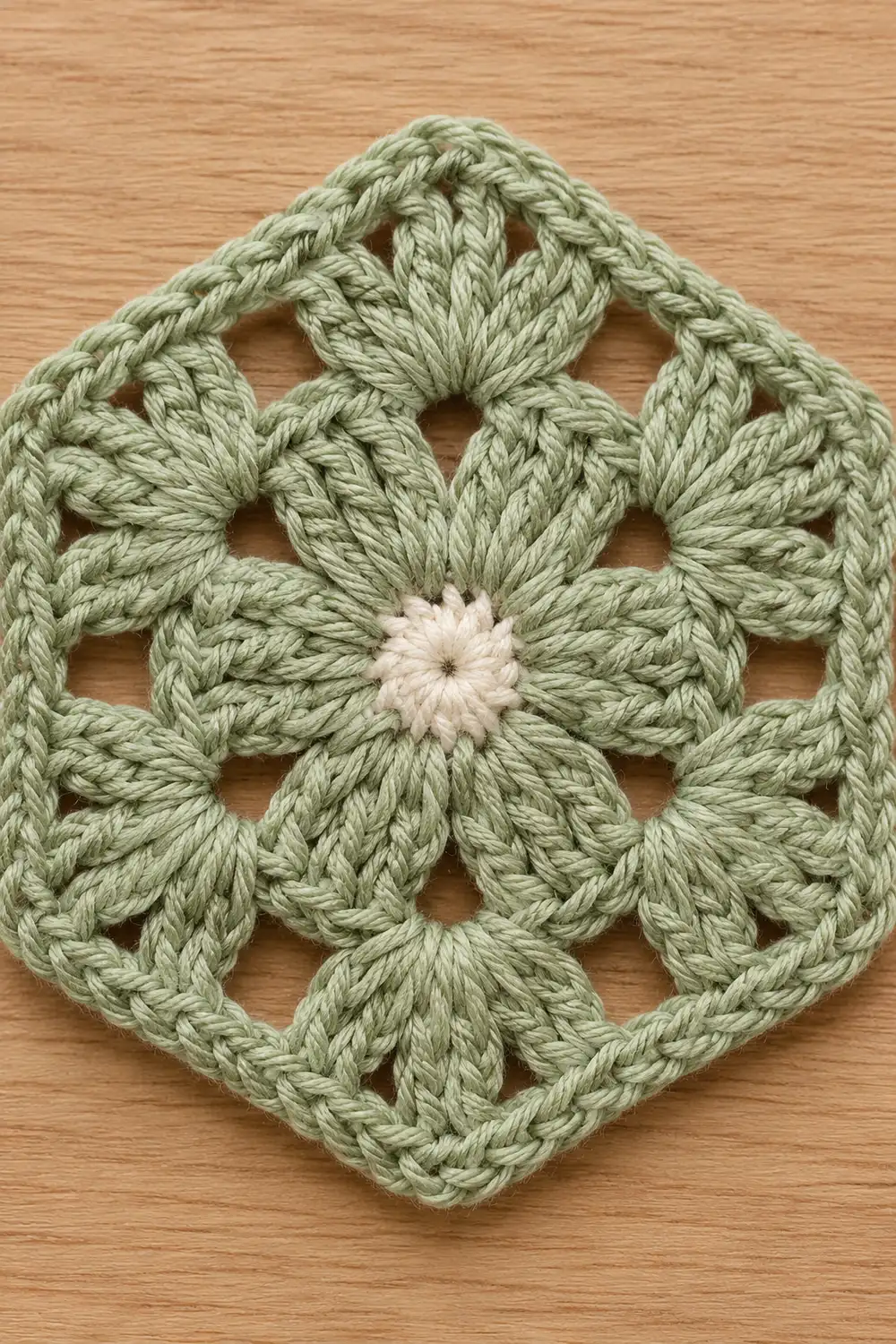
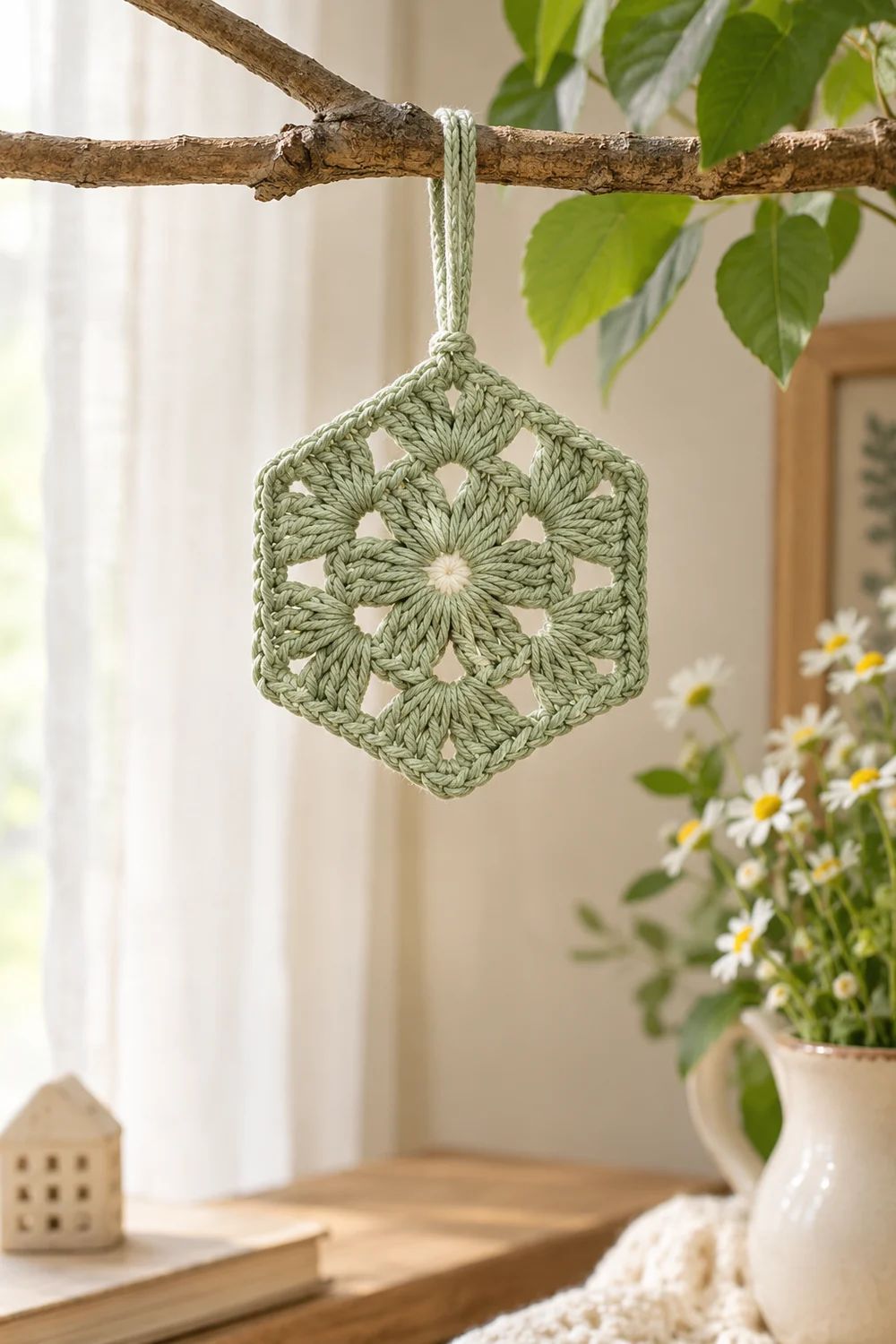
The Sage Bloom Hexagon is a single lacy motif with a calm, botanical look. A small solid center in cream or off-white is surrounded by six petal sections of sage green treble clusters, separated by open chain spaces. A tidy single crochet border follows all six sides and gives the motif crisp edges.
The style is classic granny-inspired lace. The clusters radiate outward like petals and the chain spaces create a soft, airy pattern. The finished piece lies flat with moderate density, so it holds its shape well in the hand.
This pattern uses US crochet terms. The finished hexagon measures 3.75 in (9.5 cm) from point to point and about 3.25 in (8.3 cm) from flat side to flat side.
The motif is worked in the round from the center out. Round 1 is the solid cream center. Rounds 2 and 3 build the sage petals and shape the hexagon. Rounds 4 and 5 form the clean border.
Finished Size and Construction
- Finished size: 3.75 in (9.5 cm) point to point; about 3.25 in (8.3 cm) flat to flat
- Side length: about 1.9 in (4.8 cm)
- Skill level: Easy / advanced beginner
- Terminology: US crochet terms
- Yarn weight: DK (light worsted, weight 3)
- Hook: 3.5 mm (E-4)
- Number of pieces: 1 single hexagon motif
- Layout: Single piece, worked in the round
- Piece size: 3.75 in (9.5 cm) point to point
- Size before border (after Round 3): 3.25 in (8.3 cm) point to point
- Border depth: 0.25 in (0.6 cm) on each side (Rounds 4 and 5)
Materials
Yarn advice: Choose a smooth DK cotton or cotton blend. Cotton shows the cluster texture clearly and blocks to sharp corners. Avoid fuzzy or highly textured yarns, which hide the lace.
- Color A, Cream or off-white (center): 5 g, about 12 m
- Color B, Sage green (petals and border): 10 g, about 23 m
Both quantities include a comfortable margin for a gauge swatch, weaving in ends, and small differences in tension. The motif itself uses less.
Tools:
- 3.5 mm (E-4) crochet hook
- Tapestry needle
- Scissors
- Stitch marker
- Ruler or tape measure
- Blocking mat and rust-proof pins
- Spray bottle with clean water
Abbreviations (US Terms)
- ch – chain
- sl st – slip stitch
- sc – single crochet
- dc – double crochet
- tr – treble crochet
- sk – skip
- sp(s) – space(s)
- st(s) – stitch(es)
- rep – repeat
- cl – 3-treble cluster (see below)
- beg cl – beginning cluster (see below)
Special stitches
3-treble cluster (cl): [Yarn over twice, insert hook in the indicated stitch or space, yarn over and pull up a loop, (yarn over and pull through 2 loops) twice] 3 times in the same stitch or space. Yarn over and pull through all 4 loops on hook.
Beginning cluster (beg cl): Ch 4 (counts as the first treble). Then [yarn over twice, insert hook in the same stitch or space, yarn over and pull up a loop, (yarn over and pull through 2 loops) twice] 2 times. Yarn over and pull through all 3 loops on hook.
Gauge and Checkpoints
Gauge is measured with checkpoints at each stage rather than a flat swatch. Since this is a single small motif, work the motif once as your test piece. If it matches the checkpoints, keep it as your finished piece.
Checkpoints (measured unblocked, lying flat):
- After Round 1: 1.25 in (3.2 cm) across
- After Round 2: 2.25 in (5.7 cm) point to point
- After Round 3: 3.25 in (8.3 cm) point to point
- After Round 5: 3.75 in (9.5 cm) point to point
- Border gauge: about 6 sc = 1 in (2.5 cm)
If your piece is too big: Change to a 3.0 mm hook and start again. A difference of 0.25 in (0.6 cm) or more after Round 3 is worth correcting.
If your piece is too small: Change to a 4.0 mm hook.
If only Round 1 is off: Check that your 18 dc are evenly spaced and the magic ring is pulled fully closed before you change hooks.
Pattern
Round 1 – Solid Center (Color A, Cream)
Make a magic ring.
Ch 3 (counts as first dc), work 17 dc into the ring. Pull the ring closed tightly. Sl st to the top of the beginning ch-3 to join.
Stitch count: 18 dc.
Fasten off Color A, leaving a 6 in (15.2 cm) tail.
Checkpoint: The center measures 1.25 in (3.2 cm) across and lies flat with no hole in the middle.
Round 2 – Petal Base (Color B, Sage)
Join Color B with a sl st in any dc.
Beg cl in the same st, ch 2, cl in the same st, ch 2, sk next 2 dc.
*(Cl, ch 2, cl) in next dc, ch 2, sk next 2 dc; rep from * 4 more times.
Sl st to the top of the beg cl to join.
Stitch count: 12 clusters and 12 ch-2 sps. These are arranged as 6 petal pairs. Each pair has a ch-2 tip space between its two clusters, and a ch-2 space separates neighboring pairs.
Math check: Each repeat uses 3 dc from Round 1 (1 worked, 2 skipped). 6 repeats × 3 = 18 dc, which uses the full round exactly.
Checkpoint: 2.25 in (5.7 cm) point to point. The six petals should be evenly spaced, with clear open gaps between them.
Round 3 – Radiating Clusters and Hexagon Shaping (Color B)
Sl st into the next ch-2 sp. This is the tip space of the first petal.
(Beg cl, ch 3, cl) in the same sp. This forms the first corner.
Ch 1, 3 tr in the next ch-2 sp (between petals), ch 1.
*(Cl, ch 3, cl) in the next ch-2 sp, ch 1, 3 tr in the next ch-2 sp, ch 1; rep from * 4 more times.
Sl st to the top of the beg cl to join.
Stitch count: 30 stitches (12 clusters + 18 tr), 6 ch-3 corner sps, and 12 ch-1 sps. This is the complete count for this round.
Each cluster pair now sits over a Round 2 petal and points to a hexagon corner. The 3-tr groups fill the gaps between petals and straighten the sides.
Checkpoint: 3.25 in (8.3 cm) point to point. Six clear corners should be visible. This is your size before the border.
Border
The border has 2 rounds of plain sc. This gives a smooth, clean edge that follows the six sides.
Border gauge: About 6 sc = 1 in (2.5 cm). For this border, a “side” means all sc between two corner spaces. Corner stitches are counted within that side, and each corner chain space separates two sides, so no stitch is counted twice.
Round 4 – Trim Round (Color B)
This is a conversion round. You work 1 sc into each existing stitch and chain space from Round 3, plus extra sc at the corners.
Sl st into the next ch-3 corner sp.
Ch 1, (sc, ch 2, sc) in the same sp.
Sc in the top of the next cl, sc in the next ch-1 sp, sc in each of the next 3 tr, sc in the next ch-1 sp, sc in the top of the next cl*, (sc, ch 2, sc) in the next ch-3 sp; rep from * 4 more times, then from * to ** once.
Sl st to the first sc to join.
Stitch count per side: 1 corner sc + 7 sc across + 1 corner sc = 9 sc.
Round total: 30 sc worked into existing stitches + 12 sc worked into ch-1 sps + 12 extra corner sc = 54 sc, plus 6 ch-2 corner sps. As a check, 9 sc × 6 sides = 54.
Round 5 – Finishing Round (Color B)
Ch 1, sc in the same st as the join. This is the last sc of side 6.
*(Sc, ch 1, sc) in the next ch-2 corner sp, sc in each of the next 9 sc; rep from * 4 more times.
(Sc, ch 1, sc) in the last ch-2 corner sp, sc in each of the next 8 sc.
Sl st to the first sc to join. You can also use an invisible join for the neatest edge.
Stitch count per side: 9 sc worked 1 per existing sc + 2 corner sc = 11 sc.
Round total: 54 sc worked 1 per existing stitch + 12 corner sc = 66 sc, plus 6 ch-1 corner sps.
Fasten off, leaving a 6 in (15.2 cm) tail.
Checkpoint: 3.75 in (9.5 cm) point to point. Each side measures about 1.9 in (4.8 cm).
Why the Math Works
A flat hexagon in single crochet needs about 6 stitch-widths of growth per round, or about 1 per corner.
In Round 4, each ch-3 corner (about 3 stitch-widths) becomes sc, ch 2, sc (about 4 widths). That is +1 per corner. The ch-1 spaces receive 1 sc each, which keeps the sides flat without adding width.
In Round 5, each ch-2 corner (about 2 widths) becomes sc, ch 1, sc (about 3 widths). That is again +1 per corner.
At 6 sc per inch, 11 sc per side plus the corner chain gives about 1.9 in (4.8 cm) per side. Six sides of 1.9 in (4.8 cm) form a hexagon about 3.75 in (9.5 cm) point to point. This matches the stated finished size.
Final Blocking
- Weave in all ends along stitches of the same color. Weave the cream tail into Round 1 only, so it does not show through the sage lace.
- Lightly mist the motif with water until it is damp but not dripping.
- Lay it right side up on the blocking mat.
- Pin the six corners first, setting each point 3.75 in (9.5 cm) from the opposite point.
- Check flat-to-flat width: about 3.25 in (8.3 cm) on all three axes.
- Add one pin at the middle of each side to straighten it.
- Gently open each ch-2 and ch-3 space with a fingertip so the lace sits evenly.
- Let it dry completely before removing the pins.
Final Quality-Control Checklist
- [ ] Round 1 has 18 dc in cream with no visible center hole
- [ ] Round 2 has 12 clusters forming 6 even petals
- [ ] Round 3 has 12 clusters, 18 tr, and 6 ch-3 corners
- [ ] Round 4 has 54 sc (9 per side)
- [ ] Round 5 has 66 sc (11 per side)
- [ ] Size is 3.75 in (9.5 cm) point to point and about 3.25 in (8.3 cm) flat to flat
- [ ] All six corners are sharp and evenly spaced
- [ ] Motif lies flat with no cupping or ruffling
- [ ] Ends are woven in securely and invisibly
Troubleshooting
Motif cups like a bowl: Your tension is too tight in Rounds 3–5. Loosen up, or go up 0.5 mm in hook size for the border only.
Edges ruffle or wave: You may have added extra sc on the sides. Recount for 9 sc per side in Round 4 and 11 sc per side in Round 5.
Hole in the center: Pull the magic ring tighter before joining Round 1, and secure the tail firmly when weaving in.
Clusters lean or twist: Pull each loop up to full treble height before closing the cluster. Keep cluster tops snug, but not pinched.
Corners look rounded: Make sure each corner chain is the full length (ch 3 in Round 3, ch 2 in Round 4, ch 1 in Round 5). Pin the points firmly when blocking.
Petals are uneven: In Round 2, confirm that you skipped exactly 2 dc between each petal pair.
Cream shows through the sage: Weave the cream tail only within Round 1 stitches, on the wrong side.
Care
Hand wash in cool water with a mild detergent, or machine wash on a gentle cold cycle inside a mesh bag. Reshape and lay flat to dry.
Final Notes
The measurement chain for the Sage Bloom Hexagon is:
- Round 1: 1.25 in (3.2 cm)
- Round 2: 2.25 in (5.7 cm)
- Round 3: 3.25 in (8.3 cm)
- Finished after the 0.25 in (0.6 cm) border: 3.75 in (9.5 cm) point to point
The stitch counts follow the same steady chain: 18 dc, then 12 clusters, then 30 stitches, then 54 sc, then 66 sc. If each checkpoint matches, your finished motif will lie flat with crisp corners.
Optional: If you enjoy this motif, you could later make several and join them for a larger project. The pattern above describes one single hexagon.
Happy crocheting!