

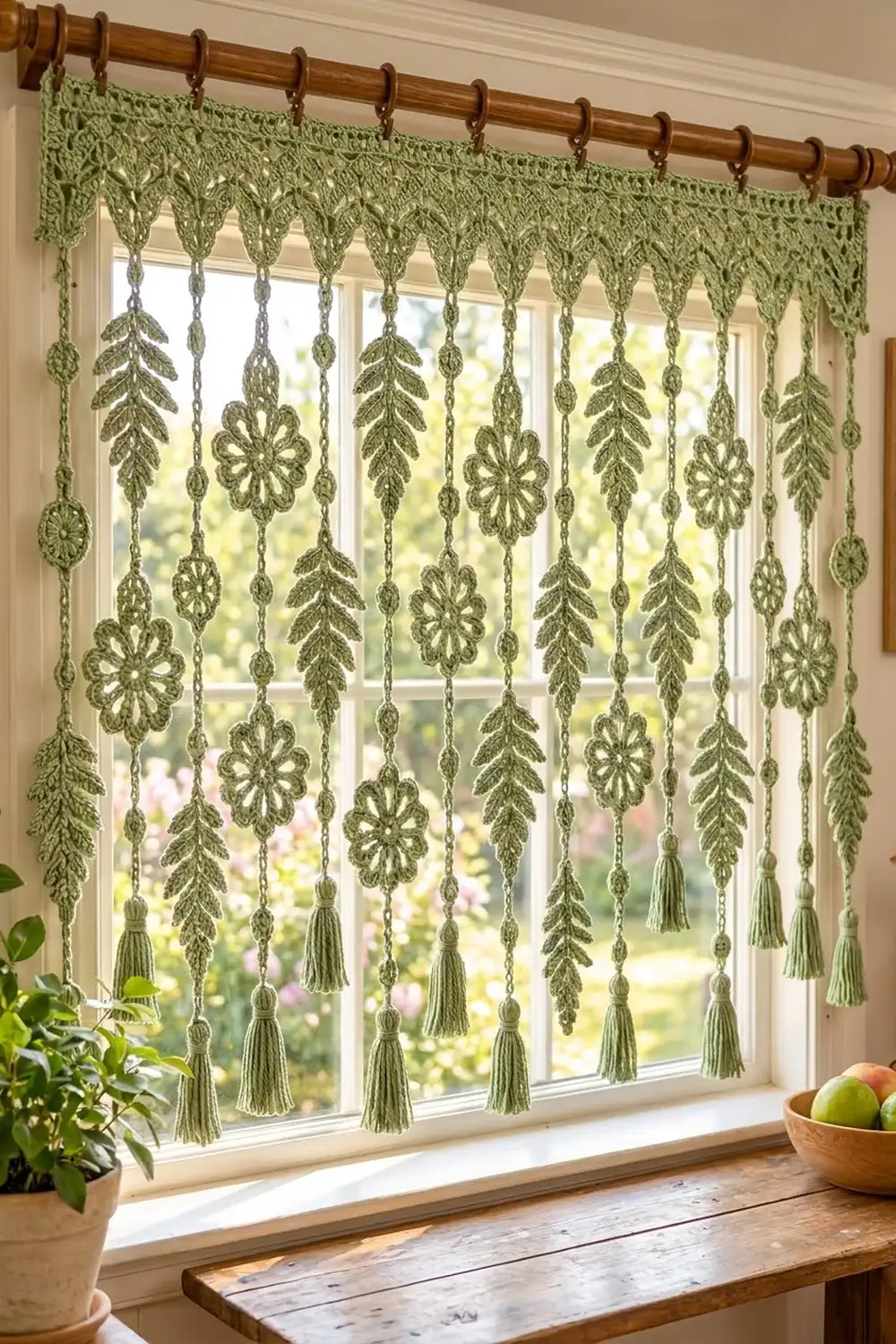
This curtain is a soft sage green panel made from one lacy header band and 23 hanging strands. Fern fronds, eight-petal flowers, small round discs and full tassels hang from it. Light passes through every gap, so the strands cast leaf-shaped shadows across the room.
Everything is worked in one color, a sage green cotton. The style is cottage and botanical. The texture comes from the shapes themselves, not from color changes. All instructions use US crochet terms.
The finished curtain measures 36 in (91.4 cm) wide and 28.5 in (72.4 cm) long from the top edge to the tassel tips. The header band is 6 in (15.2 cm) deep, including its border.
The construction is straightforward. You crochet the header band in rows and then shape 12 triangular points along its lower edge. Next you make all the motifs separately. Finally you build each strand by chaining down from the band and joining motifs as you go, then you tie on the tassels.
Finished Size and Construction
- Finished size: 36 in (91.4 cm) wide × 28.5 in (72.4 cm) long
- Skill level: Intermediate
- Terminology: US crochet terms
- Yarn weight: DK (light worsted, category 3) cotton
- Hook: 4.0 mm (G-6)
- Number of pieces: 1 header band, 12 fern fronds, 12 flowers, 114 discs and 12 tassels, joined into 23 strands
- Layout: 12 main strands hang from the point tips, and 11 disc strands hang from the valleys between the points
- Header band before border: 36 in (91.4 cm) × 5.5 in (14.0 cm)
- Border depth: 0.5 in (1.3 cm) along the top edge, with a single sc outline everywhere else
- Main strand drop: 22.5 in (57.2 cm) below each point tip
Materials
Use a smooth mercerized or matte cotton in DK weight. Cotton keeps the frond and petal shapes crisp and blocks flat. Avoid fuzzy or very stretchy yarns, because the strands are long and would sag.
- Sage Green DK cotton: 300 g, about 660 m (720 yd)
Tools:
- 4.0 mm (G-6) crochet hook
- Tapestry needle
- Scissors
- Stitch markers
- Stiff card, 3 in (7.6 cm) wide, for the tassels
- 13 curtain clip rings and a rod
- Blocking mats, rustproof pins and a spray bottle
The yarn amount includes a margin of about 15% for gauge swatches and tassel trimming.
Abbreviations (US Terms)
- ch: chain
- sl st: slip stitch
- sc: single crochet
- hdc: half double crochet
- dc: double crochet
- dc2tog: double crochet 2 together
- MR: magic ring
- sk: skip
- st(s): stitch(es)
- sp: space
- RS: right side
Leaflet (special stitch): ch 6, sc in 2nd ch from hook, hdc in next ch, dc in next ch, hdc in next ch, sc in next ch. One leaflet is 5 sts long, with a pointed tip and a wide middle.
Gauge and Checkpoints
Gauge: 16 sc and 16 rows = 4 in (10.2 cm). In dc, 16 sts = 4 in (10.2 cm) and 8 rows = 4 in (10.2 cm). Chains measure about 4 ch per 1 in (2.5 cm).
Make one of each motif first and check its size before you make the full set:
- Disc: 1 in (2.5 cm) across
- Flower: 3.5 in (8.9 cm) across
- Fern frond: 5.5 in (14.0 cm) long × 3 in (7.6 cm) wide
Checkpoints for the header band:
- After Row 5: 36 in (91.4 cm) × 2 in (5.1 cm)
- After the points: 5.5 in (14.0 cm) deep, with each point 3 in (7.6 cm) wide at its base
- After the border: 36 in (91.4 cm) × 6 in (15.2 cm)
If your pieces come out too big, go down half a hook size. If they come out too small, go up half a size. A small error repeats across 144 stitches, so check the band width after Row 1 before you continue.
Header Band
Row 1 (RS): Ch 145, sc in 2nd ch from hook and in each ch across, turn. (144 sc)
Row 2: Ch 3 (counts as dc), dc in each st across, turn. (144 dc)
Row 3 (mesh): Ch 4 (counts as dc + ch 1), sk next st, dc in next st, ch 1, sk next st, dc in next st to last st, dc in last st, turn. (73 dc + 71 ch-1 sps)
Row 4: Ch 1, sc in each dc and each ch-1 sp across, turn. (73 + 71 = 144 sc)
Row 5: Ch 3 (counts as dc), dc in each st across. (144 dc) Do not turn. Fasten off.
The band should now measure 36 in (91.4 cm) × 2 in (5.1 cm). Place a marker every 12 sts to divide the band into 12 sections.
Triangular Points
Each point is worked separately over 12 sts of Row 5. In this section, the turning chains do not count as stitches.
With RS facing, join the yarn in the first st of a section.
Row 1: Ch 2, dc in same st and in each of next 11 sts, turn. (12 dc)
Row 2: Ch 2, dc2tog, dc in next 8 sts, dc2tog, turn. (10 dc)
Row 3: Ch 2, dc2tog, dc in next 6 sts, dc2tog, turn. (8 dc)
Row 4: Ch 2, dc2tog, dc in next 4 sts, dc2tog, turn. (6 dc)
Row 5: Ch 2, dc2tog, dc in next 2 sts, dc2tog, turn. (4 dc)
Row 6: Ch 2, dc2tog twice, turn. (2 sts)
Row 7: Ch 2, dc2tog. (1 st) Fasten off.
Repeat in each of the other 11 sections, for 12 points in total. Each point is 3 in (7.6 cm) wide at its base and 3.5 in (8.9 cm) deep. This brings the band to 5.5 in (14.0 cm).
Border
Border gauge: Same as the band, 16 sc = 4 in (10.2 cm). Along the side edges, work 2 sc into the end of each dc row and 1 sc into the end of each sc row.
Round 1: With RS facing, join the yarn in one top corner of the band.
- Top edge: 3 sc in first ch, sc in each of next 142 ch, 3 sc in last ch. (148 sc)
- Short end: Work down the ends of the 5 band rows: 1 + 2 + 2 + 1 + 2 = 8 sc.
- Each point: 14 sc down the first slope (2 per row end × 7 rows), (sc, ch 5, sc) in the tip, then 14 sc up the second slope. (30 sc + 1 tip loop)
- Each valley: Ch 5 between two points, without skipping a st. (11 valley loops)
- Second short end: 8 sc. Join with a sl st to the first sc.
Round 1 totals: 148 + 8 + 8 + (12 × 30) = 524 sc, plus 12 tip loops and 11 valley loops.
Row 2 (top edge only): Ch 1, sc in same st and in each of next 147 sts. (148 sc) Fasten off.
Why the math works: The top edge sits on the 144 foundation chains. The 2 extra sc at each corner (4 extra in total) turn the corners without adding width. Each slope has exactly 7 dc row ends, so 14 sc keeps it flat. The 2 sc at the tip go into the single Row 7 stitch. The 23 loops are the hanging points, and they line up exactly with the 12 tips and 11 valleys.
Motifs
Disc (make 114)
Rnd 1: 6 sc in MR, sl st to first sc. (6 sc)
Rnd 2: Ch 1, 2 sc in each st around, sl st to first sc. (12 sc)
Fasten off and weave in the ends. The disc is 1 in (2.5 cm) across. Call the joining st “st 1” and the stitch directly opposite it “st 7.”
Flower (make 12)
Rnd 1: Ch 6, sl st to form a ring. Ch 1, 16 sc in ring, sl st to first sc. (16 sc)
Rnd 2: Ch 5, sk next st, sc in next st 8 times, working the last sc in the joining st. (8 ch-5 loops)
Rnd 3: In each ch-5 loop work (sc, hdc, 5 dc, hdc, sc), sl st to first sc. (8 petals, 72 sts)
Fasten off. The flower measures 3.5 in (8.9 cm) across and has an open center.
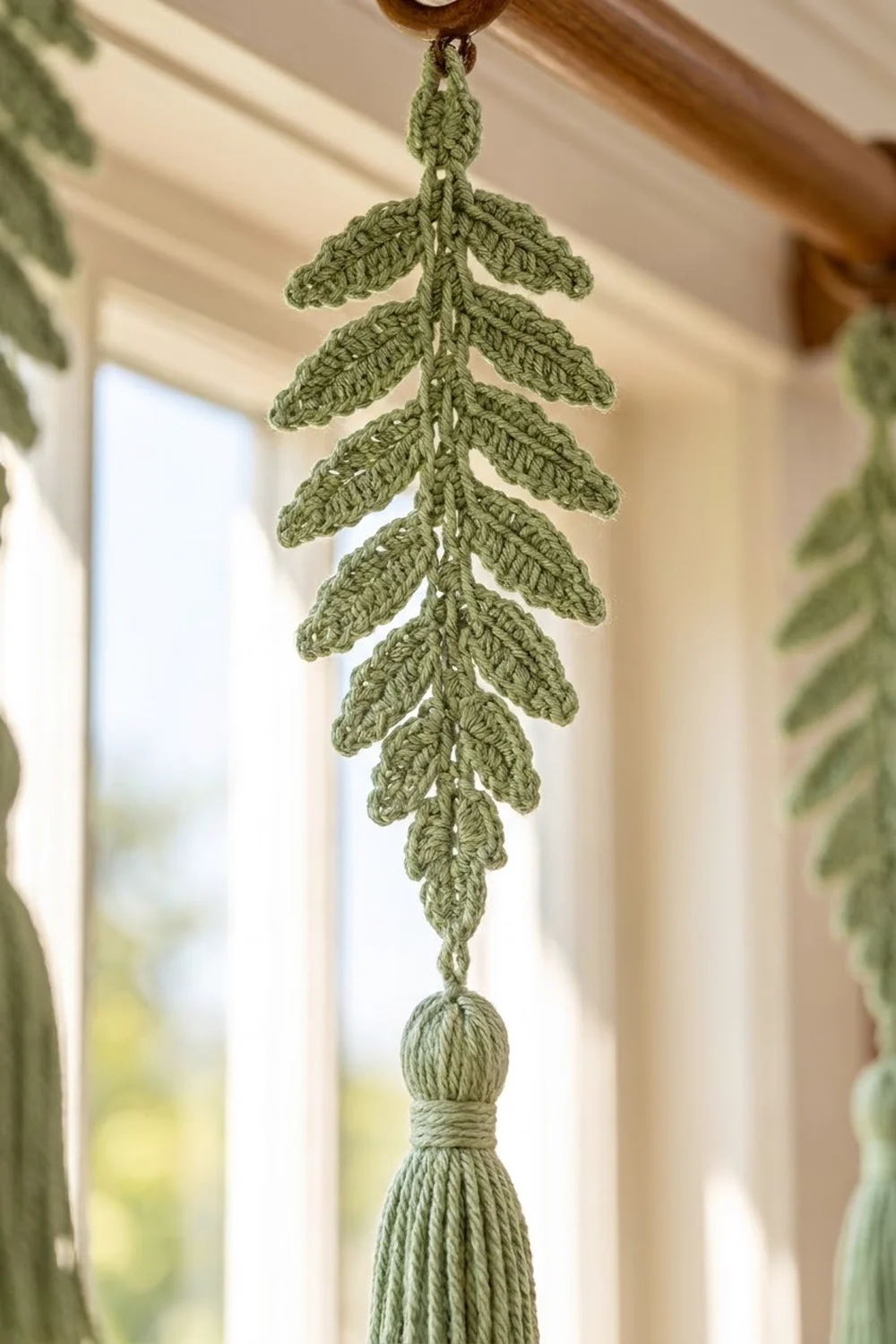
Fern Frond (make 12)
Leave a 6 in (15.2 cm) starting tail. Ch 23.
Tip leaflet: Sc in 2nd ch from hook, hdc in next ch, dc in next ch, hdc in next ch, sc in next ch. (5 sts) The other 17 ch form the spine.
Side 1: Sl st in next 2 ch, leaflet 6 times, sl st in each of last 5 ch (stem). (6 leaflets)
Side 2: Rotate the piece and work in the free loops on the other side of the spine. Sl st in next 5 loops, leaflet, sl st in next 2 loops 6 times. Sl st into the base of the tip leaflet. (6 leaflets)
Fasten off. Each frond has 13 leaflets and measures 5.5 in (14.0 cm) × 3 in (7.6 cm).
Tassel (make 12)
Wrap the yarn 20 times around the 3 in (7.6 cm) card. Tie the top with an 8 in (20.3 cm) strand and leave the ends long. Cut through the loops at the bottom. Wrap the neck 0.5 in (1.3 cm) below the top, then trim the tassel to 3 in (7.6 cm).
Make All Pieces
Quantities, all in Sage Green:
- Strand A (fern), make 6: 2 fronds, 3 discs and 1 tassel each
- Strand B (flower), make 6: 2 flowers, 5 discs and 1 tassel each
- Strand C (disc), make 11: 6 discs each
- Totals: 12 fronds, 12 flowers, 18 + 30 + 66 = 114 discs and 12 tassels
Layout along the lower edge of the band (T = tip loop, V = valley loop):
T1 V1 T2 V2 T3 V3 T4 V4 T5 V5 T6 V6 T7 V7 T8 V8 T9 V9 T10 V10 T11 V11 T12
A  C  B  C  A  C  B  C  A  C  B  C  A  C  B  C  A  C  B   C   A   C   B
Joining
Each strand is one continuous chain that joins the motifs as you go.
Disc join: Sl st in st 1 of the disc, then sl st along the edge in sts 2–7. The yarn now leaves from the bottom of the disc without adding length, and the next chain starts from st 7.
Flower and frond join: Sl st in the top point and fasten off. Rejoin with a sl st at the opposite point to continue. On a flower, the top and bottom points are the center dc of two opposite petals, 4 petals apart. On a frond, join at the stem end on top and rejoin at the tip of the tip leaflet below, so the frond hangs tip-down.
For each strand, join the yarn with a sl st in the loop shown in the layout grid, then work the sequence below (D = disc, F = flower, L = frond):
Strand A: ch 6, D, ch 4, L, ch 4, D, ch 4, L, ch 4, D, fasten off at st 7. Drop: 1.5 + 1 + 1 + 5.5 + 1 + 1 + 1 + 5.5 + 1 + 1 = 19.5 in (49.5 cm).
Strand B: ch 6, D, ch 4, F, ch 4, D, ch 4, F, ch 4, D, ch 4, D, ch 4, D, fasten off at st 7. Drop: 1.5 + 1 + 1 + 3.5 + 1 + 1 + 1 + 3.5 + 1 + 1 + 1 + 1 + 1 + 1 = 19.5 in (49.5 cm).
Strand C: ch 8, D 6 times, then fasten off. Drop: 6 × (2 + 1) = 18 in (45.7 cm).
Tie a tassel to st 7 of the last disc on every A and B strand. This brings each main strand to 22.5 in (57.2 cm).
Tension: Chain at the same tension as your gauge swatch. Tight chains shorten the strands, and loose ones droop. Count the chains rather than measuring them.
Size checkpoint: Lay the curtain flat. Every A and B tassel tip should sit 22.5 in (57.2 cm) below its point tip and 26 in (66.0 cm) below the valleys. The valleys sit 3.5 in (8.9 cm) higher than the tips, so the C strands end 8 in (20.3 cm) above the tassel tips. This staggered hem is intentional.
Final Blocking
- Weave in all remaining ends along the back of the chains or the motif edges.
- Pin the header band flat to 36 in (91.4 cm) × 6 in (15.2 cm).
- Pin the point tips so that all 12 sit level.
- Lay every strand straight down. Pin the motifs flat and spread the leaflets and petals open.
- Mist with water until damp but not soaked.
- Let it dry completely, for at least 24 hours, before unpinning.
Final Quality-Control Checklist
- The header band is 36 in (91.4 cm) wide and 6 in (15.2 cm) deep
- All 12 points are the same size and symmetrical
- Round 1 of the border has 524 sc and 23 loops
- The strand order matches the layout grid
- All A and B strands are 22.5 in (57.2 cm) long, and all C strands are 18 in (45.7 cm)
- The tassels are trimmed to an even 3 in (7.6 cm)
- No loose ends or knots show on the RS
Troubleshooting
- Band too wide or too narrow: Recheck your gauge on Row 1 and change the hook size.
- Points curl inward: The dc2tog stitches are too tight. Loosen your tension or block more firmly.
- Slopes ruffle: There are too many border sc. Keep strictly to 2 sc per dc row end.
- Leaflets twist: Start each leaflet with a fresh ch 6 and anchor it with sl sts into the spine.
- Strands are different lengths: Recount the chain links. One extra ch 4 adds 1 in (2.5 cm).
- Discs cup: Rnd 2 is too tight. Go up half a hook size for the discs only.
Care
Hand wash in cool water with mild soap, then roll the curtain gently in a towel. Lay it flat and reshape the motifs while it dries, and do not tumble dry.
Final Notes
The measurements build step by step. 144 sts make the band 36 in (91.4 cm) wide. The five band rows give 2 in (5.1 cm), the points add 3.5 in (8.9 cm) and the border adds 0.5 in (1.3 cm), for a 6 in (15.2 cm) band. The main strands drop 22.5 in (57.2 cm), for a total length of 28.5 in (72.4 cm). Check each stage as you go, and the finished curtain will hang straight and even.
Happy crocheting!