
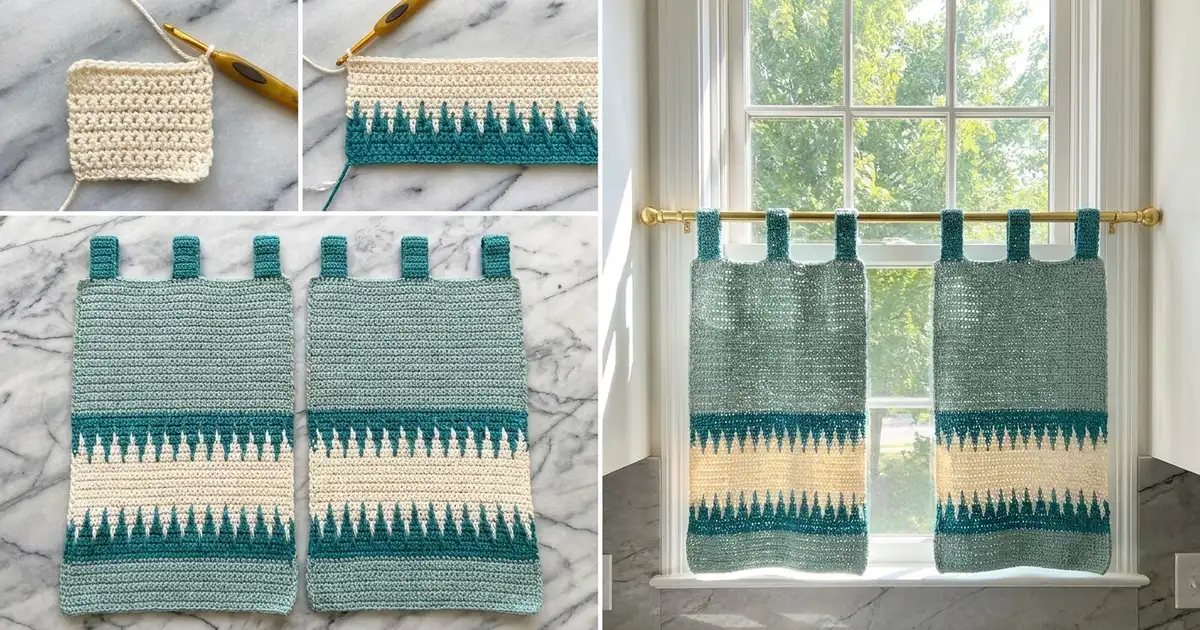
This café curtain pair is made of two matching panels in warm cream single crochet, each crossed by two jagged teal zigzag bands. The zigzags are worked with spike stitches of different lengths, so the bands look like soft, flickering flames rather than flat stripes.
Each panel finishes with a solid teal band at the bottom, a teal band at the top, and three loop tabs that slide straight onto a café rod. The cream and sage-teal palette suits a kitchen window, a bathroom, or a cabinet front.
The pattern uses US crochet terms. Each panel measures 15 in (38.1 cm) wide by 22 in (55.9 cm) long, or 24 in (61.0 cm) including the tabs. The two panels together give 30 in (76.2 cm) of flat width.
Each panel is worked bottom to top in rows of single crochet, with two spike rows per zigzag band. Next, one cream round squares the edges. The teal bottom band is then worked onto the foundation edge and the teal top band onto the top edge, and the tabs are worked straight off the top band. Nothing is sewn except the tab ends.
Finished Size and Construction
- Finished size (one panel): 15 in (38.1 cm) wide x 22 in (55.9 cm) long; 24 in (61.0 cm) including tabs
- Skill level: Intermediate (simple stitches, careful spike counting)
- Terminology: US
- Yarn weight: Worsted (#4)
- Hook: 5.0 mm (H-8)
- Number of pieces: 2 identical panels
- Layout: 2 panels hung side by side, not joined
- Panel body before border: 58 sts x 86 rows = 14.5 in (36.8 cm) x 19.1 in (48.5 cm)
- Size after edging round: 15 in (38.1 cm) x 19.6 in (49.8 cm)
- Border depth: 0.25 in (0.6 cm) at the sides; 1.1 in (2.8 cm) bottom band plus edging; 1.3 in (3.3 cm) top band plus edging
- Tabs: 3 per panel, each 1.5 in (3.8 cm) wide, forming a 2 in (5.1 cm) loop
Materials
Choose a smooth worsted cotton or cotton blend. Cotton holds its shape at a window, shows spike stitches clearly, and takes sun and washing well. Avoid fuzzy yarn, which hides the spike outlines.
- Cream (main color): 300 g, approx. 570 m
- Sage-teal (contrast): 130 g, approx. 245 m
These totals cover both panels and include about a 15% margin for gauge differences and the swatch.
Tools:
– 5.0 mm (H-8) crochet hook
– Tapestry needle
– Stitch markers (at least 6)
– Measuring tape
– Blocking mats and rust-proof pins
– Spray bottle
– Scissors
Abbreviations (US Terms)
- ch – chain
- sc – single crochet
- sl st – slip stitch
- st(s) – stitch(es)
- sp – space
- RS / WS – right side / wrong side
- Sp-n – spike single crochet, n rows deep
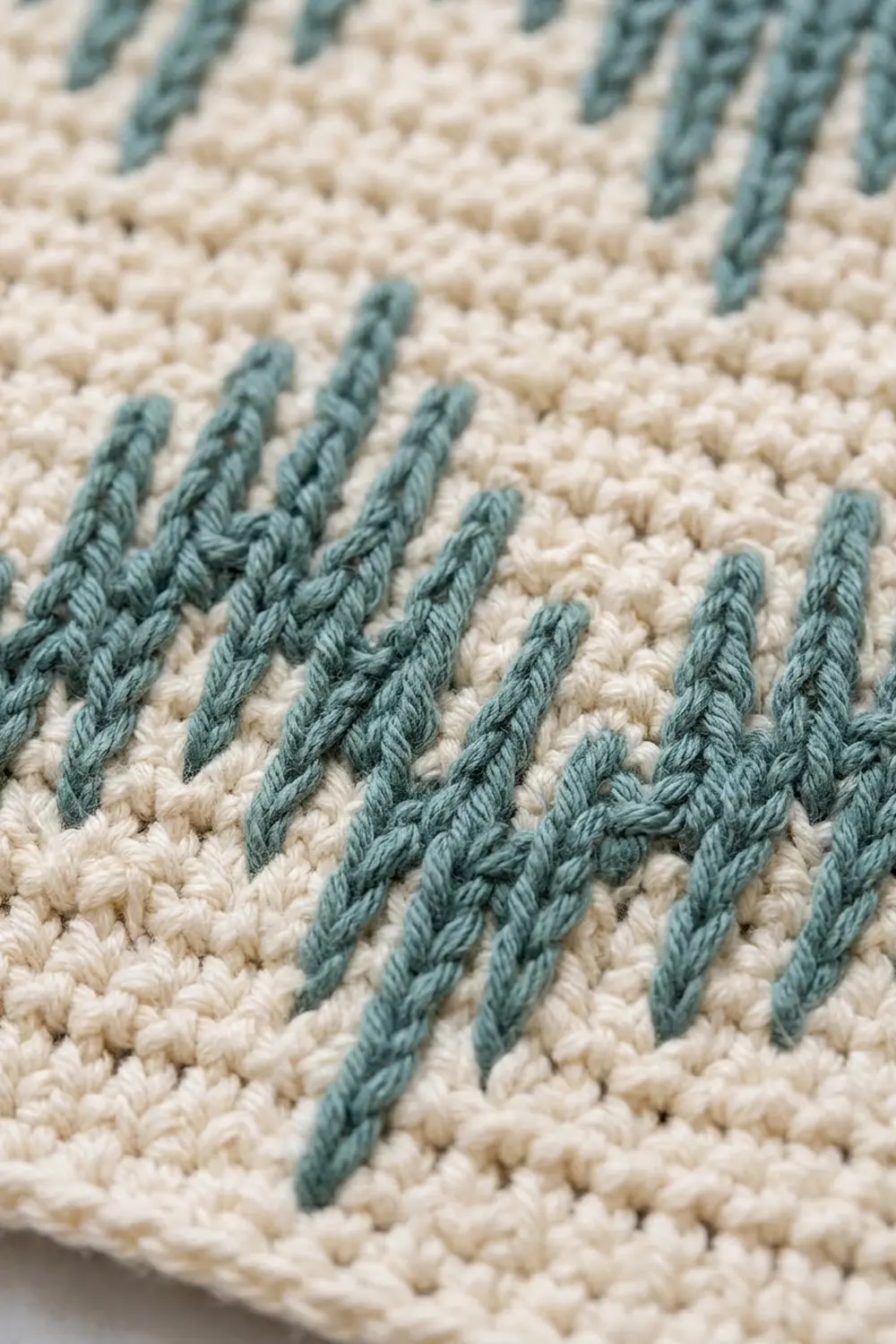
Special stitch – Sp-n (spike single crochet): Find the stitch you would normally work into. Count n rows straight down the same column and insert the hook there. Yarn over and pull up a long loop to the height of the working row, without squeezing the fabric. Yarn over and pull through both loops. Skip the stitch on the previous row that sits behind the spike. Sp-0 is an ordinary sc. Each spike replaces one sc, so the stitch count never changes.
Gauge and Checkpoints
Gauge: 16 sc and 18 rows = 4 in (10.2 cm) in sc, after blocking.
Before you start, make a test swatch: ch 21, then work 20 sc for 18 rows. Block it, then measure it. It should be 5 in (12.7 cm) wide and 4 in (10.2 cm) tall.
- Too big (fewer stitches per inch): go down 0.5 mm.
- Too small (more stitches per inch): go up 0.5 mm.
- Row gauge off but stitch gauge right: keep the hook and add or remove plain cream rows from the top section (rows 48–86) only.
Checkpoints for the first panel:
– After Row 1: 14.5 in (36.8 cm) wide
– After Row 14: 3.1 in (7.9 cm) tall
– After Row 47: 10.4 in (26.4 cm) tall
– After Row 86: 19.1 in (48.5 cm) tall
– After the edging round: 15 in (38.1 cm) x 19.6 in (49.8 cm)
– After both teal bands: 15 in (38.1 cm) x 22 in (55.9 cm)
Panel Body
Work with cream unless stated otherwise. The ch 1 at the start of each row does not count as a stitch. Row 1 is a RS row, so all odd rows are RS rows and every spike row falls on the RS.
To change color, work the last sc of the previous row until 2 loops remain, then pull the new color through. Carry the unused color up the side edge rather than cutting it. The cream edging round will cover the carried strands later.
Foundation: With cream, ch 59.
Row 1 (RS): Sc in 2nd ch from hook and in each ch across, turn. (58 sts)
Rows 2–14: Ch 1, sc in each st across, turn. (58 sts)
Rows 1–14 are 14 rows, about 3.1 in (7.9 cm) tall.
Zigzag Band A
Row 15 (RS, teal spike row): With teal, ch 1, sc in first st. Sp-1, Sp-3, Sp-2, Sp-4, Sp-3, Sp-6, Sp-5, Sp-8, Sp-6, Sp-7, Sp-4, Sp-5, Sp-2, Sp-3; repeat from * 3 more times, sc in last st, turn. (58 sts: 1 sc + 4 repeats of 14 + 1 sc)*
The deepest spike (Sp-8) reaches Row 6, so the teal flames drop well into the cream. The deepest point sits at the 8th stitch of each repeat, which makes the lowest point of each zigzag.
Rows 16–20: With teal, ch 1, sc in each st across, turn. (58 sts)
Row 21 (RS, cream spike row): With cream, ch 1, sc in first st. Sc, Sp-1, sc, Sp-2, Sp-1, Sp-3, Sp-2, Sp-5, Sp-3, Sp-4, Sp-2, Sp-3, sc, Sp-1; repeat from * 3 more times, sc in last st, turn. (58 sts)*
Here the cream spikes cut down into the teal. The deepest cream spike (Sp-5) reaches Row 15. The top edge of the teal therefore also dips at the 8th stitch of each repeat and stays full height at the repeat edges. This gives you four teal peaks and four valleys per panel, with both edges of the band forming the same jagged chevron.
Rows 22–40: With cream, ch 1, sc in each st across, turn. (58 sts)
Zigzag Band B
Row 41 (RS): Work as Row 15 with teal. (58 sts) The Sp-8 spikes reach Row 32, which is still cream.
Rows 42–46: Work as Rows 16–20 with teal. (58 sts)
Row 47 (RS): Work as Row 21 with cream. (58 sts) The Sp-5 spikes reach Row 41.
Check that the panel is 10.4 in (26.4 cm) tall.
Upper Section
Rows 48–86: With cream, ch 1, sc in each st across, turn. (58 sts) Do not fasten off.
The body is now 58 sts x 86 rows, or 14.5 in (36.8 cm) x 19.1 in (48.5 cm).
Make All Pieces
Make 2 identical panels. Per panel, plan on roughly 150 g of cream and 65 g of teal, which fits within the totals listed in Materials.
Text layout on the rod (front view):
| Tab   Tab   Tab | Tab   Tab   Tab |
|   Panel 1      |   Panel 2      |
|   15 in wide   |   15 in wide   |
Work both panels with the same hook, and work all spike rows with the same loop height so the two panels match.
Joining (Tabs Only)
The two panels are not joined to each other. They hang separately, so you can tie one back or slide them apart. The tabs are worked straight off each panel’s top band, so the only sewing is closing each tab loop. That method is explained in the Border section below. Sew with matching teal and keep the stitches snug but not tight, so the loop lies flat and does not pucker the band.
Size checkpoint: Before you sew the tabs, lay both panels side by side. They should match within 0.25 in (0.6 cm) in both width and length.
Border
The border uses the same gauge as the body: 16 sts and 18 rows = 4 in (10.2 cm).
Round 1 (cream edging): Continue from the last st of Row 86. Ch 1 and turn the work so the RS faces you.
- Top edge: sc in each of the 58 sts.
- Corner: ch 1.
- Left side: 86 sc, one in each row end.
- Corner: ch 1.
- Bottom edge: 58 sc, one in each foundation ch.
- Corner: ch 1.
- Right side: 86 sc, one in each row end.
- Corner: ch 1, then sl st to the first sc.
Total: 288 sc + 4 corner ch-1 sps (58 / 86 / 58 / 86). Here the corners are defined as ch-1 spaces, not stitches, so the per-side counts do not include them. Fasten off.
Bottom teal band: With the RS facing, join teal in the bottom-right corner ch-1 sp.
- Row 1: Ch 1, sc in the corner sp, sc in each of 58 sts, sc in the next corner sp, turn. (60 sts)
- Rows 2–5: Ch 1, sc in each st across, turn. (60 sts) Fasten off.
Top teal band: With the RS facing, join teal in the top-right corner ch-1 sp.
- Row 1: Ch 1, sc in the corner sp, sc in each of 58 sts, sc in the next corner sp, turn. (60 sts)
- Rows 2–6: Ch 1, sc in each st across, turn. (60 sts) Do not fasten off.
Tabs (3 per panel): Place markers in sts 1, 28, and 55 of Row 6.
- Tab 1: Ch 1, sc in sts 1–6, turn. (6 sts) Work 17 more rows of 6 sc, for 18 tab rows in total. Fasten off and leave a 12 in (30.5 cm) tail.
- Tab 2: Join teal in st 28 and work 6 sc (sts 28–33). Continue as Tab 1.
- Tab 3: Join teal in st 55 and work 6 sc (sts 55–60). Continue as Tab 1.
Each tab strip is 4 in (10.2 cm) long. Fold it to the WS and whipstitch its last row along the back of the 6 sts it grew from. This makes a 2 in (5.1 cm) loop that fits a rod up to 1 in (2.5 cm) in diameter.
Why the math works: The 58 body sts plus 2 corner sps give 60 band sts, which is 15 in (38.1 cm) at 4 sts per inch. The tabs use 3 x 6 = 18 sts, and the 2 gaps use 2 x 21 = 42 sts, so 18 + 42 = 60. Each gap is 5¼ in (13.3 cm). The height is 86 body rows + 2 edging rows + 5 bottom rows + 6 top rows = 99 rows. At 4.5 rows per inch, that is exactly 22 in (55.9 cm).
Final Blocking
- Weave in all ends inside same-color stitches. Hide the teal tails inside the teal bands.
- Wash gently or soak in lukewarm water for 15 minutes, then press out the water in a towel without wringing.
- Lay the panel RS up on blocking mats.
- Pin the corners first to 15 in (38.1 cm) x 22 in (55.9 cm).
- Pin along each edge every 2 in (5.1 cm), keeping the side edges straight and the bands level.
- Smooth the spike rows by hand so every spike lies flat and straight.
- Let the panel dry completely, then unpin it. Repeat with the second panel to the same size.
Final Quality-Control Checklist
- [ ] Each panel measures 15 in (38.1 cm) x 22 in (55.9 cm), excluding tabs.
- [ ] Every body row has 58 sts and every band row has 60 sts.
- [ ] Each zigzag band shows 4 teal peaks and 4 valleys.
- [ ] No spikes pull or pucker the fabric.
- [ ] Both panels match within 0.25 in (0.6 cm).
- [ ] All 6 tabs are evenly spaced, the same size, and securely sewn.
- [ ] No carried strands show at the side edges.
- [ ] All ends are woven in securely.
Troubleshooting
- Fabric puckers above the spike rows: The spike loops are too short. Pull each loop up to the full row height before finishing the stitch.
- Spikes look loose or loopy: You are pulling the loops up too far. Keep each loop exactly level with the working row.
- Zigzag looks off-center: Check that there is 1 plain sc at each end of every spike row, and that you worked exactly 4 repeats.
- Panel is too wide: Your stitch gauge is too loose. Go down a hook size and start again.
- Panel is too short: Add plain cream rows to Rows 48–86 and keep a note so the second panel matches.
- Side edges wave: You worked more than one sc per row end in Round 1. Undo it and work exactly 86 sc per side.
- Tabs twist: Fold each tab straight back before sewing, and pin it in place first.
Care
Hand wash or machine wash on a gentle cold cycle, then lay flat to dry, re-pinning the panels to size if needed. Avoid hot dryers, which can shrink cotton and distort the spikes.

Final Notes
The measurement chain is short and simple. The 58-stitch body is 14.5 in (36.8 cm) wide, and the cream edging brings it to 60 sts, or 15 in (38.1 cm). Eighty-six body rows give 19.1 in (48.5 cm). The edging and the two teal bands add 13 rows, for 99 rows in all, which is 22 in (55.9 cm). The 2 in (5.1 cm) tab loops bring each panel to 24 in (61.0 cm) on the rod. If your swatch hits gauge, each later checkpoint should hit its number too.
Happy crocheting!