

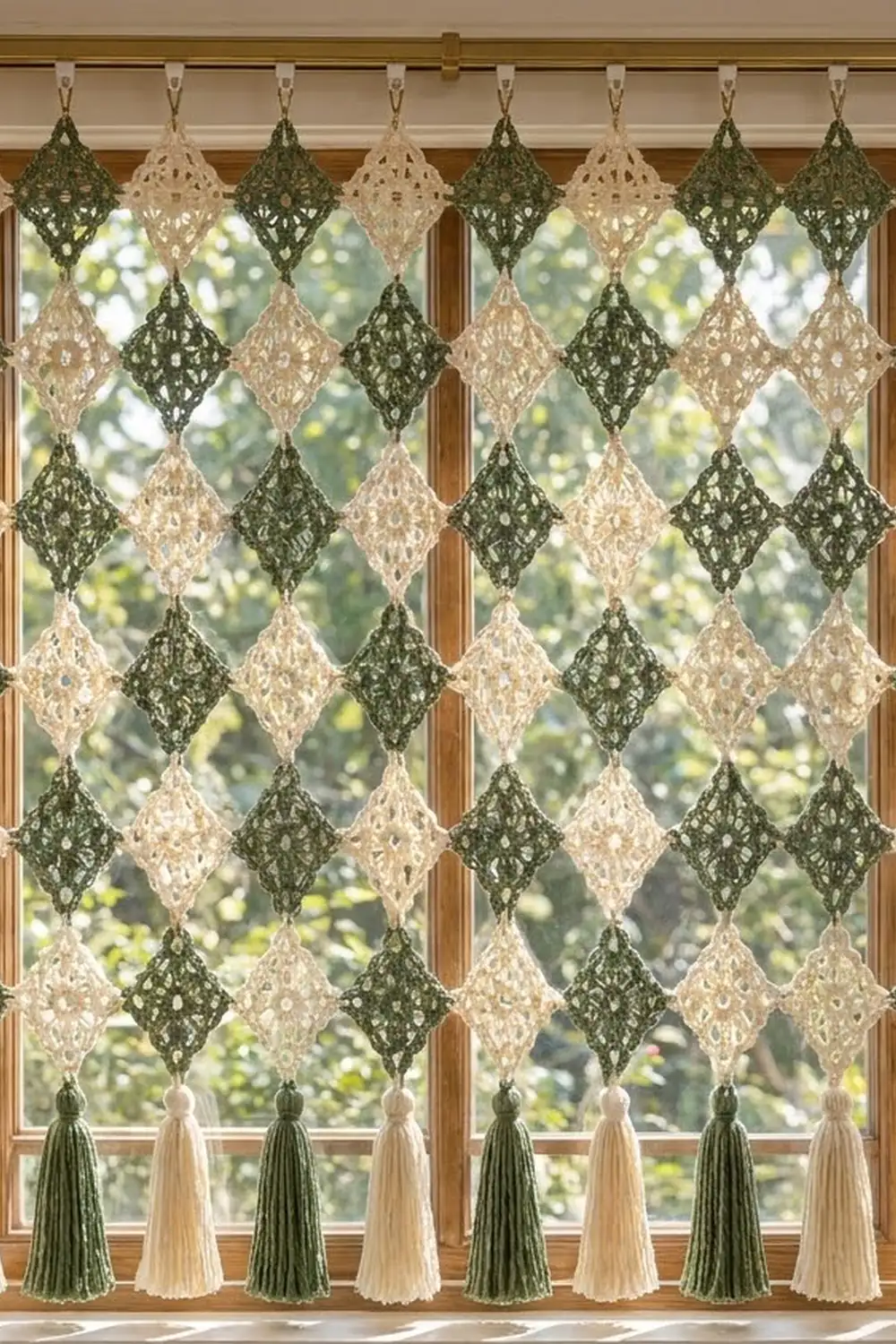
The Sage Lattice Diamond Curtain is a light, airy window hanging made of small lacy diamonds. Each diamond is a square motif turned on point. The diamonds link tip to tip into free-hanging strands, and every strand ends in a full yarn tassel.
The palette is sage green and natural cream. Colors alternate down each strand and from strand to strand, which makes a soft checkerboard lattice that lets light through. The look is cottage-style and a little boho, and it works well in a kitchen window, a doorway, or across a reading nook.
This pattern uses US crochet terms. The finished curtain is about 55 in (139.7 cm) wide and 42.5 in (108.0 cm) long, including the hanging loops and tassels.
Construction is simple and repetitive. Work each diamond in four rounds. The last round is a single-crochet edging, and you use it to join each diamond to the one above it (join-as-you-go). You make 11 strands of 7 diamonds, then add a tassel to the bottom point of each strand.
Finished Size and Construction
- Finished size: about 55 in (139.7 cm) wide x 42.5 in (108.0 cm) long
- Skill level: Easy / advanced beginner
- Terminology: US crochet terms
- Yarn weight: DK / light worsted cotton (CYC 3)
- Hook: 4.0 mm (G-6)
- Number of pieces: 77 diamond motifs + 11 tassels
- Layout: 11 vertical strands x 7 motifs, colors alternating checkerboard style
- Motif size: 3.5 in (8.9 cm) per side; 5 in (12.7 cm) from point to point
- Size before border (after Rnd 3): 3 in (7.6 cm) per side
- Border depth: 1 round of sc, about 0.25 in (0.6 cm)
Materials
Choose a smooth, mercerized or combed cotton in DK / light worsted weight. Cotton holds the diamond points crisply and hangs straight. Acrylic tends to curl and stretch over time.
- Color A, Sage Green: 250 g, about 550 m (39 motifs + 6 tassels)
- Color B, Natural Cream: 250 g, about 550 m (38 motifs + 5 tassels)
These amounts assume cotton at about 110 m per 50 g and include a safety margin of about 15%.
Tools:
- 4.0 mm (G-6) crochet hook
- Tapestry needle
- Scissors
- A stiff card 6.5 in (16.5 cm) tall for winding tassels
- Stitch markers
- Blocking mats and rustproof pins
- Spray bottle
- 11 curtain hooks or rings, plus a rod at least 56 in (142.2 cm) long
Abbreviations (US Terms)
- ch – chain
- sl st – slip stitch
- sc – single crochet
- dc – double crochet
- sp – space
- st(s) – stitch(es)
- rep – repeat
- Rnd – round
Special technique, join-as-you-go corner (JAYG corner): Work this in a corner ch-3 sp in place of the usual (sc, ch 3, sc). Work sc in the corner sp, ch 1, sl st into the bottom-point ch-3 loop of the finished motif above, ch 1, then sc in the same corner sp again. You still work 2 sc at that corner, and the chain-plus-slip-stitch bridge is the same height as a plain ch 3.
Gauge and Checkpoints
Make one complete test motif before you start the curtain. Measure it after each round:
- After Rnd 1: center disc is 1.25 in (3.2 cm) across
- After Rnd 2: petal ring is 2 in (5.1 cm) across
- After Rnd 3: square is 3 in (7.6 cm) per side
- After Rnd 4: square is 3.5 in (8.9 cm) per side and 5 in (12.7 cm) from point to point
Edging gauge: 13 sc = 3.5 in (8.9 cm) along one motif side.
If your motif comes out bigger than 3.5 in (8.9 cm) per side, try a 3.5 mm hook. If it comes out smaller, try a 4.5 mm hook. Even a 0.25 in (0.6 cm) difference per motif adds up to 1.75 in (4.4 cm) over a strand of seven diamonds.
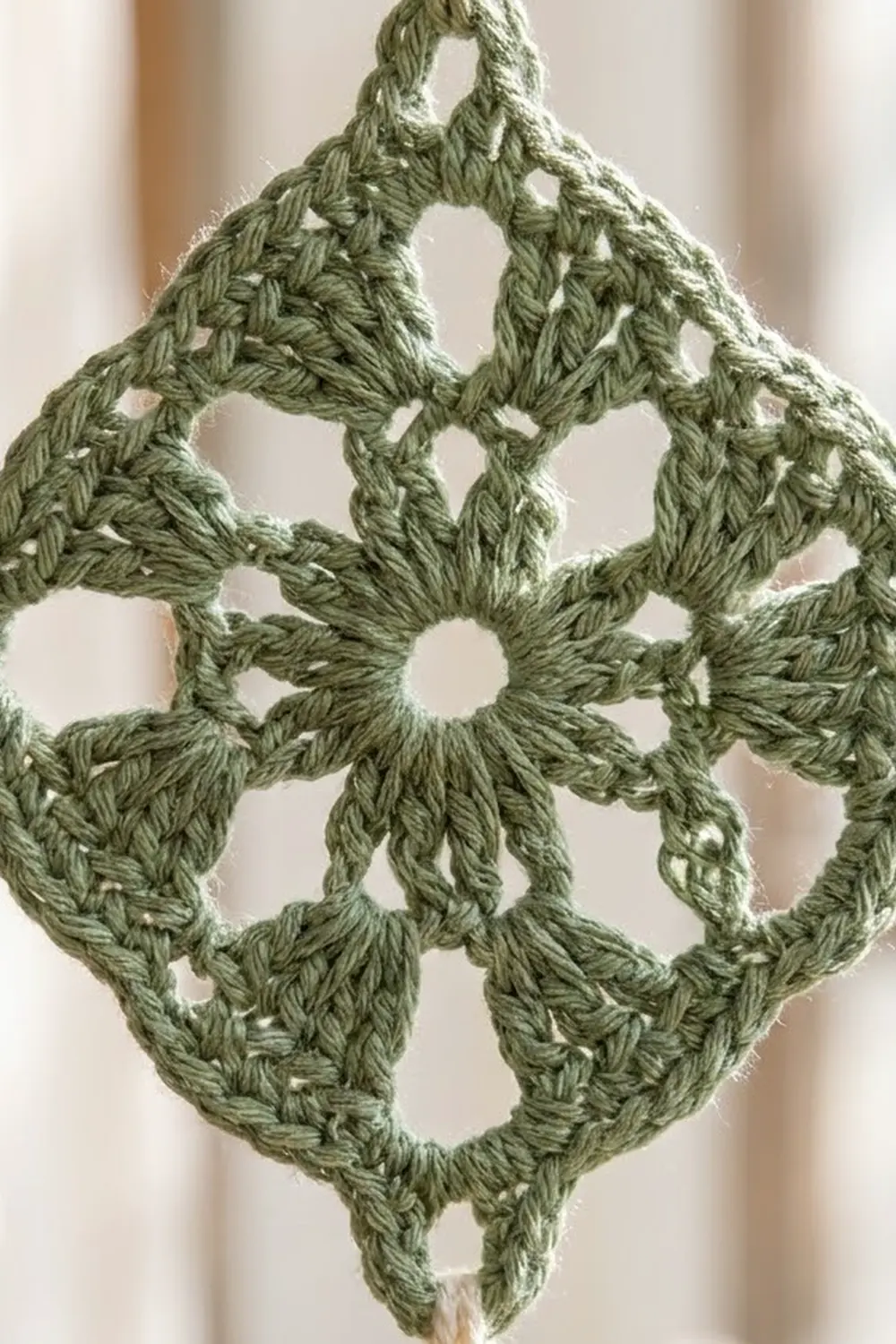
Diamond Motif
Make 77 motifs: 39 in Color A and 38 in Color B. Each motif is worked in one color. Rnds 1–3 are below, and Rnd 4 (the border round) is in the Border section.
Rnd 1: Ch 6 and sl st to the first ch to form a ring. Ch 3 (counts as dc), then work 15 dc in the ring. Sl st to the top of the beginning ch-3. (16 dc)
Rnd 2: Ch 1. Sc in the next st, ch 3, skip the next st. Rep from * 7 more times. Sl st to the first sc. (8 sc, 8 ch-3 sps)
The eight ch-3 loops are the small petals around the center hole. The first sc sits in the same st as the joining sl st.
Rnd 3: Sl st into the first ch-3 sp. Ch 3 (counts as dc). In the same sp, work (2 dc, ch 3, 3 dc) for the first corner. Ch 1, work 3 dc in the next ch-3 sp, ch 1.
In the next ch-3 sp, work (3 dc, ch 3, 3 dc) for a corner. Ch 1, work 3 dc in the next ch-3 sp, ch 1. Rep from * 2 more times. Sl st to the top of the beginning ch-3.
Rnd 3 total: 36 dc, 8 ch-1 sps, 4 corner ch-3 sps. Each side, between corner ch-3 sps, has 9 dc and 2 ch-1 sps, for 11 openings to work into.
Check that each side measures 3 in (7.6 cm). Fasten off only if you are making the first motif of a strand. For every other motif, continue straight into Rnd 4.
Make All Pieces
Totals:
- Color A (Sage Green): 39 motifs, 6 tassels
- Color B (Natural Cream): 38 motifs, 5 tassels
Odd-numbered strands (1, 3, 5, 7, 9, 11) go A-B-A-B-A-B-A from top to bottom, which uses 4 A + 3 B each. Even-numbered strands (2, 4, 6, 8, 10) go B-A-B-A-B-A-B, which uses 3 A + 4 B each.
That gives 6 x 4 + 5 x 3 = 39 A motifs and 6 x 3 + 5 x 4 = 38 B motifs, for 77 total.
Layout grid (Strand 1 on the left, top row first):
Strand:  1  2  3  4  5  6  7  8  9 10 11
Row 1:   A  B  A  B  A  B  A  B  A  B  A
Row 2:   B  A  B  A  B  A  B  A  B  A  B
Row 3:   A  B  A  B  A  B  A  B  A  B  A
Row 4:   B  A  B  A  B  A  B  A  B  A  B
Row 5:   A  B  A  B  A  B  A  B  A  B  A
Row 6:   B  A  B  A  B  A  B  A  B  A  B
Row 7:   A  B  A  B  A  B  A  B  A  B  A
Tassel:  A  B  A  B  A  B  A  B  A  B  A
Each tassel matches the bottom motif of its strand.
Joining
The diamonds are joined only at their points. Each strand is a chain of motifs linked top point to bottom point, and the strands are not joined to each other.
Method: Join-as-you-go during Rnd 4, the border round. The first (top) motif of each strand gets a hanging loop at its top corner. Every motif after that gets a JAYG corner at its top corner, which joins it to the bottom-point ch-3 loop of the motif above.
Stitch-to-stitch logic: The join replaces a ch 3 with ch 1, sl st, ch 1. That is the same chain height, so the motif keeps its shape. Each corner still holds exactly 2 sc, so no stitches are added or lost at any seam, and every side keeps its count of 13 sc.
Tension: Keep the ch-1s on either side of the join slip stitch relaxed but not loose. If they’re too tight, the points pucker and the strand twists. If they’re too loose, the diamonds sag apart and show a gap.
Orientation: Hold the new motif so that its Rnd 4 corner sp lines up directly under the bottom point of the motif above. Keep both right sides facing you. Before you join, use a marker to mark which corner of the finished motif is its bottom point.
Size checkpoint: A finished strand of 7 motifs measures 35 in (88.9 cm) from the top point to the bottom point, not counting the hanging loop or tassel. Every motif adds 5 in (12.7 cm) to the length.
Border (Rnd 4 Edging)
Border gauge: 13 sc = 3.5 in (8.9 cm) per side.
Rnd 4 is a trim round. You work 1 sc into each of the 44 openings from Rnd 3 (36 dc + 8 ch-1 sps), and you add 2 corner sc in each of the 4 corner sps (8 sc). That gives 44 + 8 = 52 sc.
Rnd 4: With the motif’s own color, sl st into the next ch-3 corner sp. Work the first corner according to the motif’s position:
- Top motif of a strand: (sc, ch 12, sc) in this corner sp. The ch 12 makes a hanging loop of about 1.5 in (3.8 cm).
- All other motifs: work a JAYG corner, joining to the bottom point of the motif above.
Then, for each side: sc in each of the next 3 dc, sc in the ch-1 sp, sc in each of the next 3 dc, sc in the ch-1 sp, sc in each of the next 3 dc. That is 11 sc.
Work the next three corners as (sc, ch 3, sc), and work a side of 11 sc after each one. After the fourth side, sl st to the first sc and fasten off. (52 sc, 4 corner loops)
Count per side: 1 corner sc + 11 side sc + 1 corner sc = 13 sc. Each side’s count includes both of its corner sc, so 4 sides x 13 sc = 52 sc, with no corner counted twice.
Why the math works: Each side of Rnd 3 has exactly 11 openings (9 dc + 2 ch-1 sps). Each opening gets one sc, so the edging lies flat without ruffling or cupping. The 2 extra sc per corner, together with the ch-3 loop, turn each corner without pulling. Joining only replaces chains, never sc, so the count of 13 sc per side, and the 3.5 in (8.9 cm) side length, stays the same whether a motif hangs alone or sits in a strand.
Tassels (make 11): Wind yarn 30 times around the 6.5 in (16.5 cm) card. Slide a 12 in (30.5 cm) piece of the same color under the top loops and tie it tightly. Cut the bottom loops.
Wrap a second 12 in (30.5 cm) piece around the bundle 0.75 in (1.9 cm) below the top to form the head, and knot it securely. Bury the wrap ends inside the tassel. Trim the tassel to 6 in (15.2 cm) overall.
Use the top tie ends to knot the tassel firmly into the bottom ch-3 loop of the last motif in its strand.
Final Blocking
- Weave in all ends along the sc edging of the matching color.
- Lay each strand flat on the blocking mats with its points lined up in a straight line.
- Pin all four points of every motif so each side is 3.5 in (8.9 cm) and each diamond is 5 in (12.7 cm) from point to point.
- Mist the strand until it is damp but not soaked.
- Let it dry completely, at least 12 hours.
- Steam the tassels lightly and comb them straight with your fingers. Trim them evenly again if needed.
- Hang the strands from hooks spaced 5 in (12.7 cm) apart so their side points just meet.
Final Quality-Control Checklist
- [ ] 77 motifs made: 39 green and 38 cream
- [ ] Every motif has 52 sc in Rnd 4, with 13 sc per side
- [ ] Every side measures 3.5 in (8.9 cm)
- [ ] Each strand alternates colors correctly, as shown in the layout grid
- [ ] Each strand measures 35 in (88.9 cm) from point to point
- [ ] Every top motif has a ch-12 hanging loop
- [ ] 11 tassels made, each 6 in (15.2 cm) long and matching its bottom motif
- [ ] All ends woven in and invisible from both sides
- [ ] Curtain measures 55 in (139.7 cm) across with all strands hung
Troubleshooting
Motif cups or curls: Rnd 3 is probably too tight. Loosen your tension or go up half a hook size for Rnd 3 only.
Edging ruffles: Check that you worked exactly 11 sc per side, never 2 sc into one dc.
Strand twists: Check that every motif was joined with its right side facing forward. Re-block the strand with all the points pinned in a straight line.
Strands are different lengths: One hook-size change partway through is the usual cause. Measure each strand against the 35 in (88.9 cm) checkpoint, and remake any motif that is off.
Tassel head slips: Tie the head wrap tighter and add a drop of fabric glue inside the knot.
Care
Hand wash in cool water with a mild detergent. Then lay each strand flat and pin its points, and let it dry. Don’t tumble dry, because the tassels will tangle and fray.
Final Notes
Each stage is checked against the one before it. A center disc of 1.25 in (3.2 cm) leads to a square of 3 in (7.6 cm) per side after Rnd 3. The 13-sc edging brings each side to 3.5 in (8.9 cm) and each diamond to 5 in (12.7 cm) from point to point. Seven joined diamonds make a 35 in (88.9 cm) strand. With the hanging loop and tassel, the curtain is 42.5 in (108.0 cm) long, and eleven strands spaced 5 in (12.7 cm) apart make it 55 in (139.7 cm) wide. If your first test motif hits its checkpoints, the whole curtain will too.
Happy crocheting!