

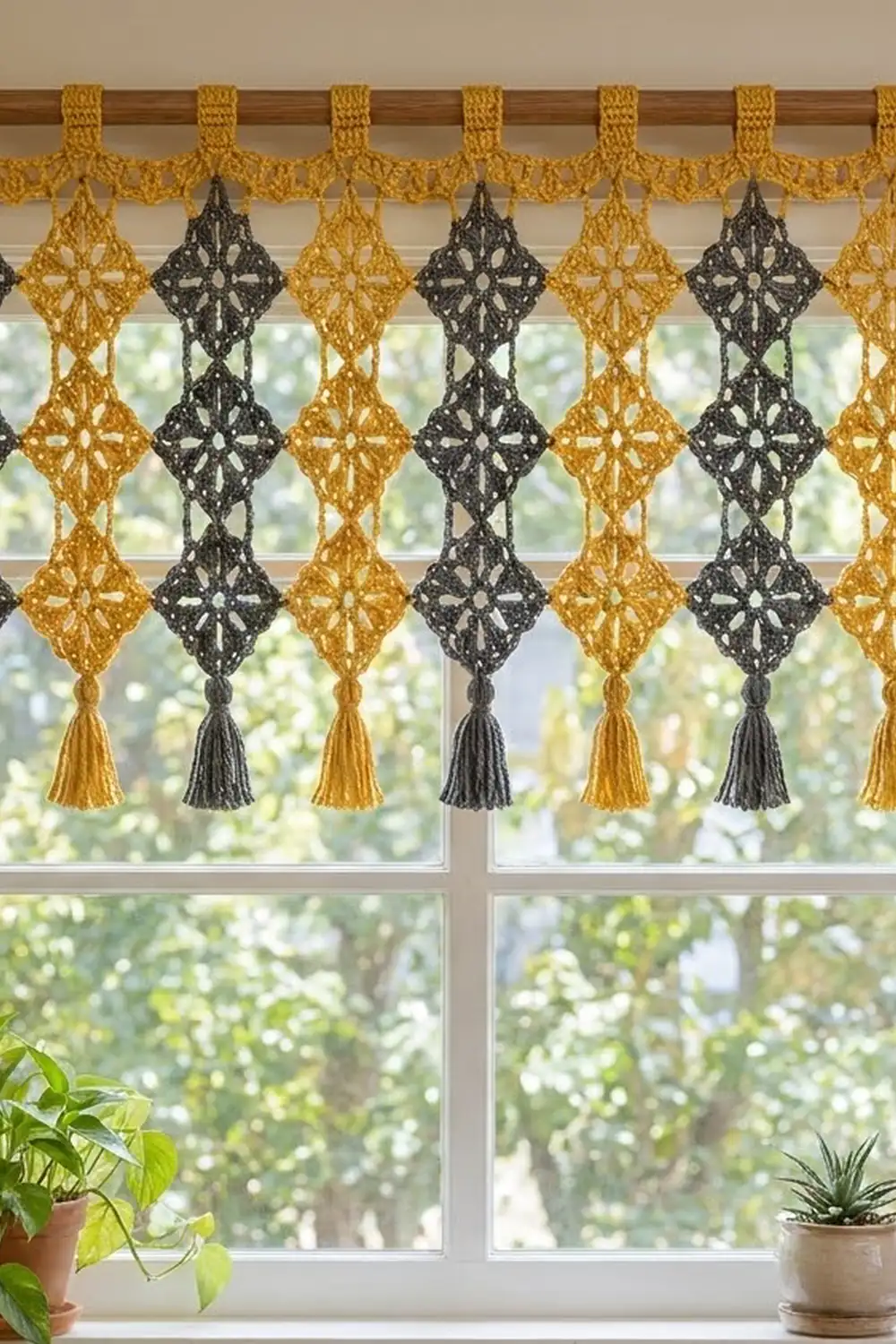
This valance is a row of lacy diamond strands hanging from a simple crocheted header. Each strand has three granny-style motifs turned on point, linked tip to tip, with a full tassel at the bottom. The strands alternate between warm mustard and deep charcoal. That gives the window a bold harlequin look, and plenty of light still comes through the openwork.
Each motif has a small open ring in the center, a ring of eight cluster petals, lacy corner groups, and a crisp single crochet outline. The style is relaxed boho with a little mid-century graphic punch. All instructions use US crochet terms.
The finished valance is about 55 in (139.7 cm) wide. Each strand hangs 16 in (40.6 cm) below the header, plus a 3.5 in (8.9 cm) tassel. Measured from the top of the rod, the total drop is about 22 in (55.9 cm).
Construction is simple. You make 11 strands of 3 motifs each and join the motifs as you go on the last round. Next you add the tassels. Last, you work a mustard header band that picks up the top tip of every strand, then add 11 tabs that loop over the rod.
Finished Size and Construction
- Finished size: about 55 in (139.7 cm) wide x 22 in (55.9 cm) drop from the top of the rod
- Skill level: Easy-Intermediate
- Terminology: US crochet terms
- Yarn weight: worsted (#4)
- Hook: 5 mm (H-8)
- Number of pieces: 33 motifs (18 mustard, 15 charcoal), 11 tassels, and 1 header band with 11 tabs
- Layout: 11 vertical strands of 3 motifs each; strand colors alternate, starting and ending with mustard
- Motif size: 3.5 in (8.9 cm) per side; about 5 in (12.7 cm) tip to tip when turned on point
- Strand length before header: 16 in (40.6 cm), plus the tassel
- Header depth: 3 rows, about 0.7 in (1.8 cm); folded tabs about 1.75 in (4.4 cm) tall
Materials
Choose a smooth worsted cotton or cotton blend. Cotton holds the diamond shape well and won’t stretch much when the strands hang for months.
- Mustard yellow: 250 g, about 500 m (18 motifs, 6 tassels, header and tabs)
- Charcoal gray: 150 g, about 300 m (15 motifs, 5 tassels)
These amounts include a margin of about 15 percent to allow for gauge differences and tassel trimming.
Tools:
- 5 mm (H-8) crochet hook
- Tapestry needle
- Scissors
- Stiff card 4 in (10.2 cm) tall, for tassels
- Stitch markers
- Tape measure
- Blocking mats, rustproof pins, and a spray bottle
- Curtain rod up to 1.25 in (3.2 cm) in diameter
Abbreviations (US Terms)
- ch – chain
- sl st – slip stitch
- sc – single crochet
- dc – double crochet
- sp(s) – space(s)
- st(s) – stitch(es)
- rep – repeat
Special stitch – dc2tog (cluster): [Yarn over, insert hook in next st, yarn over and pull up a loop, yarn over and pull through 2 loops] twice, then yarn over and pull through all 3 loops on hook.
Beginning cluster: Ch 2, then work the second half of a dc2tog into the next st and finish as a normal dc2tog. This counts as the first cluster.
Gauge and Checkpoints
Make one complete motif first and block it before you go on.
Header gauge: 16 sc and 18 rows = 4 in (10.2 cm) in sc rows.
Motif checkpoints:
- After Round 1: about 1.5 in (3.8 cm) across
- After Round 2: about 2.25 in (5.7 cm) across
- After Round 3: about 3 in (7.6 cm) per side
- After Round 4: 3.5 in (8.9 cm) per side, about 5 in (12.7 cm) tip to tip
If your motif is bigger than 3.5 in (8.9 cm), go down half a hook size. If it is smaller, go up half a size. Being off by just 0.25 in (0.6 cm) per motif adds up to 2.75 in (7.0 cm) across 11 strands.

Diamond Motif
Make 18 motifs in mustard and 15 in charcoal. Work the first motif of each strand exactly as written. For motifs 2 and 3 of each strand, use the join from the Joining section when you work Round 4.
Round 1: Make a magic ring. Ch 3 (counts as dc), then work 15 dc in the ring. Pull the ring snug but leave a small open center. Join with sl st to the top of the ch-3. (16 dc)
Round 2: Work the beginning cluster over the first 2 sts, ch 3, [dc2tog over next 2 sts, ch 3] 7 times. Join with sl st to the top of the beginning cluster. (8 clusters, 8 ch-3 sps)
These 8 clusters form the flower petals around the center ring.
Round 3: Sl st into the first ch-3 sp. Ch 3 (counts as dc), then work (2 dc, ch 3, 3 dc) in the same sp for the first corner. Ch 2, sc in next ch-3 sp, ch 2. (3 dc, ch 3, 3 dc) in next ch-3 sp, ch 2, sc in next ch-3 sp, ch 2; rep from * 2 more times. Join with sl st to the top of the beginning ch-3. (24 dc, 4 sc, 8 ch-2 sps, 4 ch-3 corner sps)*
This round squares the motif. The 4 corner groups become the 4 tips of the diamond, and the ch-2 sps make the lacy openings along each side.
Round 4: Sl st in next 2 dc and into the corner ch-3 sp. Ch 1, then work (sc, ch 2, sc) in the same corner sp. *Sc in each of next 3 dc, 2 sc in next ch-2 sp, sc in next sc, 2 sc in next ch-2 sp, sc in each of next 3 dc, (sc, ch 2, sc) in next corner sp; rep from * 2 more times. Sc in each of next 3 dc, 2 sc in next ch-2 sp, sc in next sc, 2 sc in next ch-2 sp, sc in each of next 3 dc. Join with sl st to the first sc. Fasten off and weave in ends.
Count per side: 1 corner sc + 3 + 2 + 1 + 2 + 3 + 1 corner sc = 13 sc per side. This includes the side’s 2 corner sc.
Round 4 total: 4 sides x 13 sc = 52 sc, plus 4 corner ch-2 sps.
The first corner you work in Round 4 is the motif’s top tip. The third corner (directly opposite) is the bottom tip. Put a marker in the bottom-tip ch-2 sp so you can find it easily.
Make All Pieces
- Mustard: 18 motifs (6 strands x 3), 6 tassels
- Charcoal: 15 motifs (5 strands x 3), 5 tassels
Layout grid (M = mustard, C = charcoal, T = tassel):
Header:  ===========================================
Row 1:   M   C   M   C   M   C   M   C   M   C   M
Row 2:   M   C   M   C   M   C   M   C   M   C   M
Row 3:   M   C   M   C   M   C   M   C   M   C   M
Tassel:  T   T   T   T   T   T   T   T   T   T   T
Strands 1, 3, 5, 7, 9 and 11 are mustard. Strands 2, 4, 6, 8 and 10 are charcoal.
Joining
You join each strand tip to tip as you work Round 4 of motifs 2 and 3. The strands aren’t joined to each other at the sides. They hang free and are held in place only by the header, so their side tips sit close together without touching.
Join-as-you-go top corner (motifs 2 and 3): Work Rounds 1–3 as usual. On Round 4, sl st into the corner ch-3 sp and ch 1. Sc in the sp, ch 2, sl st into the bottom-tip ch-2 sp of the motif above, ch 2, then sc in the same corner sp of the current motif. Continue Round 4 as written from the first *.
Stitch logic: The join replaces the plain ch-2 at the top corner with ch 2, sl st, ch 2. No sc are added or removed, so the joined motif still has 13 sc per side and 52 sc in total.
Link size: The two ch-2 lengths make a small open link of about 0.5 in (1.3 cm) between tips. This gap gives the strand its chain-link look.
Tension: Make the link chains the same size as your normal chains. Tight links pull the tips together and make the strand pucker. Loose links make the strand sag and end up longer than its neighbors.
Strand checkpoint: 3 motifs x 5 in (12.7 cm) + 2 links x 0.5 in (1.3 cm) = 16 in (40.6 cm) from top tip to bottom tip. All 11 strands should match to within 0.25 in (0.6 cm).
Tassels
Make 11 tassels, each in the same color as its strand.
- Wrap yarn 30 times around the 4 in (10.2 cm) card.
- Slide an 8 in (20.3 cm) strand under the wraps at the top and tie it tightly.
- Cut the wraps open at the bottom.
- With another 8 in (20.3 cm) strand, wrap the neck tightly 0.5 in (1.3 cm) below the top. Tie it and hide the tails inside the tassel.
- Trim the bottom evenly so the tassel is 3.5 in (8.9 cm) long.
- Use the top tie ends to sew the tassel through the bottom-tip ch-2 sp of motif 3.
Border: Header Band and Hanging Tabs
The header is the valance’s only border.
Header gauge: 16 sc = 4 in (10.2 cm), so 4 sc = 1 in (2.5 cm).
Why the math works: Each strand gives exactly 1 attachment point: its top-tip ch-2 sp. Along the top edge that makes 11 strands x 1 point = 11 sc. No side stitches are picked up, so the motifs add no other stitches to the header.
The strand tips sit 5 in (12.7 cm) apart, center to center, because each motif is 5 in (12.7 cm) wide. At 4 sc per inch, 5 in (12.7 cm) is 20 sts: 1 tip sc + 19 ch. The end motifs reach 2.5 in (6.4 cm) past the first and last tips, so you add 10 ch at each end.
Row 1 (attachment row): With mustard, ch 10. Sc in the top-tip ch-2 sp of strand 1. *Ch 19, sc in the top-tip ch-2 sp of the next strand; rep from * 9 more times. Ch 10.
Count: 10 ch + 11 sc + (10 gaps x 19 ch = 190 ch) + 10 ch = 221 sts.
Check: 221 sts ÷ 4 sts per in = 55.25 in (140.3 cm). This matches 11 motifs x 5 in = 55 in (139.7 cm) within normal blocking tolerance.
Row 2: Ch 1, turn. Sc in each st across, working into the back bumps of the chains and into each sc. (221 sc)
Row 3: Ch 1, turn. Sc in each st across. (221 sc) Fasten off.
Tab placement: Each tab sits directly above a strand tip. Counting from either end of Row 3, the tip sc are stitches 11, 31, 51, 71, 91, 111, 131, 151, 171, 191 and 211. Each tab is 5 sts wide and centered on a tip stitch, so tab 1 uses sts 9–13.
Tab (make 11): Join mustard in the first of the 5 tab sts. Ch 1, then sc in the same st and in the next 4 sts. (5 sc) Work 15 more rows of 5 sc, turning with ch 1 each row, for 16 rows in total, about 3.5 in (8.9 cm). Fasten off and leave a 12 in (30.5 cm) tail. Fold the tab to the back of the header and whipstitch the last row to the back of Row 1, directly behind the tab base. This makes a loop about 1.75 in (4.4 cm) tall that fits a rod up to 1.25 in (3.2 cm) across.
Between the tabs, the weight of the strands pulls the header down slightly, which makes the soft scalloped top edge.
Final Blocking
- Lay the valance flat on blocking mats with the header at the top.
- Pin the header straight to 55 in (139.7 cm) long.
- Pin each strand vertically. Pin every motif at all 4 tips so each side measures 3.5 in (8.9 cm).
- Check that every strand measures 16 in (40.6 cm) from top tip to bottom tip.
- Mist evenly until damp, not soaked. For acrylic, hover steam over it instead.
- Leave it pinned until completely dry, usually 12–24 hours.
- Unpin, then lightly steam and comb the tassels.
Final Quality-Control Checklist
- 33 motifs in total: 18 mustard, 15 charcoal
- Round 4 of every motif has 52 sc and 4 corner ch-2 sps
- Each motif measures 3.5 in (8.9 cm) per side after blocking
- All 22 tip-to-tip links are the same size, about 0.5 in (1.3 cm)
- All 11 strands are 16 in (40.6 cm) long
- Header Rows 1–3 each have 221 sts
- 11 tabs, each 5 sts wide and 16 rows long, centered over a strand tip
- 11 tassels, each 3.5 in (8.9 cm) long and matching its strand color
- All ends woven in securely on the back
Troubleshooting
Motif cups instead of lying flat: The Round 2 chains are too tight. Loosen your ch-3s or go up half a hook size.
Motif ruffles: The Round 3 chains are too loose. Try ch 2 at the corners instead of ch 3, or go down half a hook size.
Corners look rounded: Pin the tips sharply when blocking, and check that each corner has (sc, ch 2, sc) in Round 4.
Strands are different lengths: The links are usually the cause. Redo any link that looks tighter or looser than the others.
Header is wider than the strands: Your chains are looser than your sc. Work Row 1 with a hook half a size smaller.
Tabs are too tight on the rod: Add 2 rows to each tab.
Care
Hand wash in cool water with mild soap. Press the water out in a towel, then dry flat and pin the motifs back into shape. Shake out the tassels and trim them lightly if they fray.
Final Notes
The whole valance follows one chain of measurements. One motif with 13 sc per side is 3.5 in (8.9 cm) square and 5 in (12.7 cm) tip to tip. Three motifs plus two 0.5 in (1.3 cm) links make a 16 in (40.6 cm) strand. Eleven strands set 5 in (12.7 cm) apart need a 221-stitch header that measures about 55 in (139.7 cm).
Happy crocheting!