

This runner is built from simple on-point squares, so each one sits as a diamond. Each motif has a small open center, a sunburst of tall treble spokes, an airy chain lattice, and a firm single-crochet frame finished with a little round ring at every point. When the motifs meet ring to ring, the runner turns into a lacy diamond lattice with open windows between the pieces.
The runner is worked in one color, a soft sage green cotton. It suits a holiday table, but it works just as well year-round. The tassels with ball heads at each end add weight so the ends hang neatly off the table edge.
The pattern uses US crochet terms. The finished runner measures 21 in (53.3 cm) wide by 70 in (177.8 cm) long, measured ring tip to ring tip. With tassels it is 79.5 in (201.9 cm) long.
You’ll crochet 30 identical motifs, joining each one to its neighbors in the last round. Then you’ll add 6 tassels, 3 at each short end. There is no separate border. The motifs’ own frames form the edge.
Finished Size and Construction
- Finished size: 21 in × 70 in (53.3 cm × 177.8 cm); 79.5 in (201.9 cm) long with tassels
- Skill level: Easy intermediate
- Terminology: US
- Yarn weight: Sport (#2) mercerized cotton
- Hook: 3.25 mm (US D/3)
- Number of pieces: 30 motifs, plus 6 tassels
- Layout: 3 motifs wide × 10 motifs long, on point
- Motif size: 4.25 in (10.8 cm) per side; 7 in (17.8 cm) point to point including rings
- Size before border: 21 in × 70 in (53.3 cm × 177.8 cm)
- Border depth: 0 in (0 cm). The edge is the motifs’ Round 5 frame.
Materials
Choose a smooth, mercerized sport-weight cotton or cotton blend. It gives crisp stitch definition, shows the spokes clearly, and blocks well. A fuzzy or very soft yarn will blur the lattice.
- Sage green: 200 g / about 600 m (four 50 g balls, about 150 m each)
- Motifs: about 4 g / 12 m each, so about 120 g / 360 m for all 30
- Tassels and ball heads: about 7 g / 21 m each, so about 42 g / 126 m for all 6
These quantities include a margin of about 20%. Buy all the yarn from one dye lot.
Tools:
– 3.25 mm (US D/3) crochet hook
– Tapestry needle
– Scissors
– A piece of stiff card, 4.5 in (11.4 cm) tall, for the tassels
– A small amount of matching yarn scrap or fiberfill for the ball heads
– Blocking mats, rust-proof pins, and a spray bottle
– Measuring tape
Abbreviations (US Terms)
- ch: chain
- sl st: slip stitch
- sc: single crochet
- hdc: half double crochet
- dc: double crochet
- tr: treble crochet
- sc2tog: single crochet 2 together
- sp(s): space(s)
- st(s): stitch(es)
- RS: right side
Special technique – Ring join (RJ): Remove your hook from the working loop. Insert the hook from front to back through the 6th sc of the neighboring motif’s corner ring. Pick up the dropped loop and pull it through. This links the two rings at their outermost stitch without adding any stitches.
Gauge and Checkpoints
Make one complete motif and block it before you start the rest. Gauge is about 7.3 sc per 1 in (2.5 cm) along the Round 5 edge.
Checkpoints:
– After Round 1: 1.5 in (3.8 cm) across
– After Round 2: 3 in (7.6 cm) across
– After Round 3: 5 in (12.7 cm) from one corner ch-5 tip to the opposite one
– After Round 4: 5.5 in (14.0 cm) corner to corner, not counting the ch-8 loops
– After Round 5: 4.25 in (10.8 cm) per side, 6 in (15.2 cm) across the sc frame from point to point, and 7 in (17.8 cm) point to point including the rings
If your motif is bigger than 7.25 in (18.4 cm) point to point, go down one hook size. If it is smaller than 6.75 in (17.1 cm), go up one hook size. Every 0.25 in (0.6 cm) of difference per motif adds up to 2.5 in (6.4 cm) over the runner’s length.
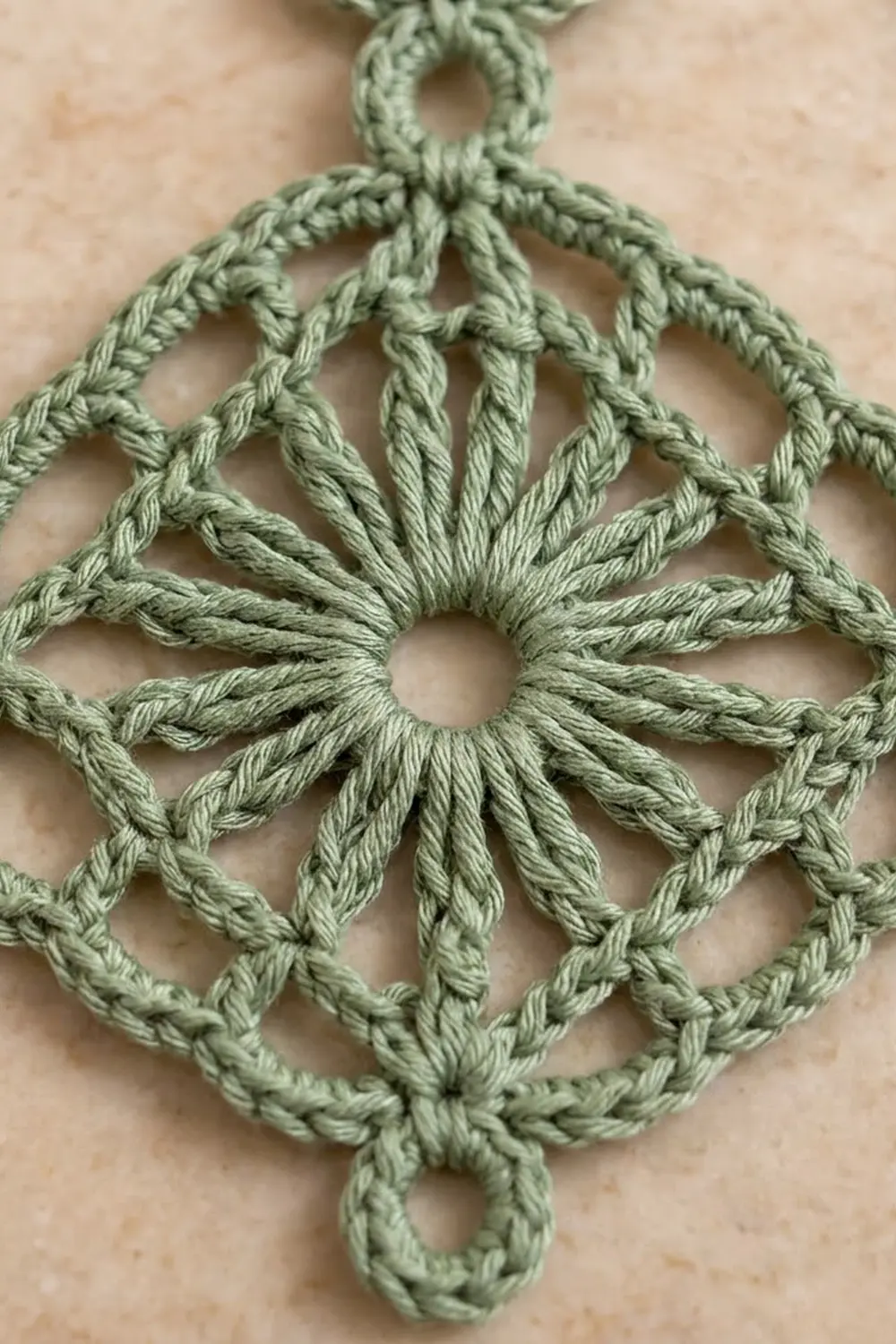
Motif (Make 30)
Ch 8 and sl st to the first ch to form a ring.
Round 1: Ch 3 (counts as dc). Work 23 dc in the ring. Join with a sl st to the top of the ch-3. (24 dc)
The ring stays open, which makes the visible center hole.
Round 2: Ch 5 (counts as tr + ch 1). Tr in next st, ch 1. Repeat from * 22 more times. Join with a sl st to the 4th ch of the beginning ch-5. (24 tr, 24 ch-1 sps)
These are the radiating spokes.
Round 3 (squaring round): Sl st into the first ch-1 sp. Ch 1, sc in the same sp.
Ch 3, hdc in next sp, ch 3, dc in next sp, ch 3, (tr, ch 5, tr) in next sp for the corner, ch 3, dc in next sp, ch 3, hdc in next sp, ch 3, sc in next sp.
Repeat from * 3 times total, ending the last repeat at **. Join with a sl st to the first sc.
Each repeat uses 6 of the 24 ch-1 sps, so 4 repeats use all 24. Stitch heights rise from sc at the middle of each side to tr at each corner, which pulls the circle into a square.
Count: 28 sts (4 sc, 8 hdc, 8 dc, 8 tr), 24 ch-3 sps, and 4 corner ch-5 sps. Each side runs tr, then 6 ch-3 sps, then tr.
Round 4 (lattice + corner loops): Sl st into the next ch-3 sp. Ch 1, sc in the same sp. [Ch 4, sc in next ch-3 sp] 2 times.
Ch 4, (2 sc, ch 8, 2 sc) in corner ch-5 sp, ch 4, sc in next ch-3 sp, [ch 4, sc in next ch-3 sp] 5 times.
Repeat from * 2 more times.
Ch 4, (2 sc, ch 8, 2 sc) in last corner sp, ch 4, sc in next ch-3 sp, [ch 4, sc in next ch-3 sp] 2 times, ch 4. Join with a sl st to the first sc.
Count: 24 sc in ch-3 sps (6 per side), 16 corner sc, 28 ch-4 sps (7 per side), and 4 ch-8 loops.
Check the sc total: 3 at the start + 6 in each of 3 repeats + 3 at the end = 24.
Round 5 (frame + rings): Ch 1, sc in the same sc as the join. [3 sc in next ch-4 sp, sc in next sc] 2 times, 3 sc in next ch-4 sp.
Sc in next 2 sc, 12 sc in ch-8 loop, sc in next 2 sc, 3 sc in next ch-4 sp, [sc in next sc, 3 sc in next ch-4 sp] 6 times.
Repeat from * 2 more times.
Sc in next 2 sc, 12 sc in last ch-8 loop, sc in next 2 sc, 3 sc in next ch-4 sp, [sc in next sc, 3 sc in next ch-4 sp] 3 times. Join with a sl st to the first sc. Fasten off.
Count per side (corner sc to corner sc): 2 + (7 × 3) + 6 + 2 = 31 sc. That count includes the side’s 2 corner sc at each end.
Count per ring: 12 sc.
Round total: (4 × 31) + (4 × 12) = 172 sc.
The 12 sc packed onto each ch-8 loop make the firm round rings at the points. The densely covered ch-4 sps form the solid outer frame.
For the first motif only, work Round 5 as written. For all other motifs, join during Round 5 as described under Joining.
Make All Pieces
- Sage green motifs: 30, worked as 10 rows of 3
- Sage green tassels: 6, worked after joining
Layout grid (each ◇ is one motif; motifs touch at their side points and top/bottom points):
Row 1:   ◇ ◇ ◇   ← tassel end
Row 2:   ◇ ◇ ◇
Row 3:   ◇ ◇ ◇
Row 4:   ◇ ◇ ◇
Row 5:   ◇ ◇ ◇
Row 6:   ◇ ◇ ◇
Row 7:   ◇ ◇ ◇
Row 8:   ◇ ◇ ◇
Row 9:   ◇ ◇ ◇
Row 10:  ◇ ◇ ◇   ← tassel end
Joining
Method: Join as you go in Round 5, using the Ring join (RJ).
When you reach a corner ring that needs to connect to an existing motif, work 6 sc in the ch-8 loop. Then work an RJ into the 6th sc of the neighbor’s ring and finish with 6 sc in the same loop. The ring still has 12 sc. The join only links two existing stitches, so no stitches are added to any side.
Order:
– Row 1: Motif 1 is not joined. Motif 2 joins its left ring to Motif 1’s right ring. Motif 3 joins its left ring to Motif 2’s right ring.
– Rows 2–10: The first motif in each row joins its top ring to the bottom ring of the motif above it. The second and third motifs each join their top ring to the motif above and their left ring to the motif on their left.
That makes 2 side-to-side joins per row × 10 rows = 20 joins, and 3 top-to-bottom joins per column gap × 9 gaps = 27 joins, for 47 joins in total.
Tension: Keep the RJ snug but not tight. A tight join pinches the rings into a figure eight, while a loose one lets the motifs droop apart. After each join, the two rings should touch tip to tip and lie flat.
Size checkpoint: After Row 1, the runner should measure 21 in (53.3 cm) across, calculated as 3 × 7 in (17.8 cm). After Row 3, it should be 21 in (53.3 cm) long. If it measures more than 0.5 in (1.3 cm) off, check your Round 5 tension before continuing.
Border
This design deliberately has no added border rounds. A solid edge would fill in the zigzag points and hide the open diamond silhouette shown in the photo. Each motif’s Round 5 frame works as the edge.
Border gauge: about 7.3 sc per 1 in (2.5 cm), the same as Round 5.
Edge counts:
– Each long edge: Each of the 10 edge motifs shows 2 sides of 31 sc, so 10 × 62 = 620 sc, plus 10 free side rings of 12 sc each.
– Each short end: Each of the 3 end motifs shows 2 sides of 31 sc, so 3 × 62 = 186 sc, plus 3 free point rings where the tassels hang.
Why the math works: Every join is a single RJ into an existing ring stitch, so each side keeps exactly 31 sc no matter where it sits. Each edge count is simply (motifs along that edge) × (exposed sides per motif) × 31, with nothing added at the joins. The width (3 × 7 in = 21 in / 53.3 cm) and the length (10 × 7 in = 70 in / 177.8 cm) work the same way.
Tassels (Make 6)
Ball head: Make a magic ring.
– Round 1: 6 sc in the ring. (6 sc)
– Round 2: 2 sc in each st around. (12 sc)
– Round 3: Sc in each st around. (12 sc)
– Round 4: Sc2tog 6 times. (6 sc)
Stuff the ball lightly with scraps. Leave a 12 in (30.5 cm) tail. The ball should be about 0.75 in (1.9 cm) across.
Tassel: Wrap yarn 25 times around the 4.5 in (11.4 cm) card. Thread a 10 in (25.4 cm) strand under the wraps at the top and tie it tightly. Cut the wraps at the bottom.
Assembly:
1. Use a tapestry needle to pull both tie ends up through the center of the ball. The fold of the tassel sits snugly against the bottom of the ball.
2. Wrap the ball’s tail around the tassel twice, about 0.25 in (0.6 cm) below the ball, and secure it.
3. Use the tie ends to tie the tassel to the free bottom ring of each end motif, so the ball hangs just below the ring.
4. Trim the skirt to 4 in (10.2 cm).
The total drop below each ring is about 4.75 in (12.1 cm).
Final Blocking
- Weave in all ends along the back of the Round 5 frames.
- Lay the runner RS up on blocking mats.
- Pin each motif’s four ring tips first, checking that each ring tip is 7 in (17.8 cm) from the opposite one. The full piece should measure 21 in × 70 in (53.3 cm × 177.8 cm).
- Pin the middle of each long edge side so it stays straight. Don’t stretch the sides into scallops.
- Mist the runner thoroughly until it is damp. Gently open the center rings and straighten the spokes with your fingertips.
- Let it dry completely before unpinning.
- Steam the tassels lightly and comb them straight. Trim again if needed.
Final Quality-Control Checklist
- [ ] All 30 motifs have 24 spokes and 31 sc per side.
- [ ] Every ring has 12 sc, and all 47 joins sit at the 6th sc.
- [ ] The runner is 21 in (53.3 cm) wide and 70 in (177.8 cm) long.
- [ ] The open diamond gaps are even and the motifs are not twisted.
- [ ] All RS faces point up.
- [ ] The 6 tassels are the same length and tied securely to the end rings.
- [ ] No loose ends show on the front.
Troubleshooting
- Round 3 cups or ruffles: Your tr are too tall or the ch-3s too loose. Work the chains a little tighter.
- Round 5 sides curve inward: Your Round 4 ch-4s are too short. Loosen them slightly, or check that you worked 3 sc into every sp.
- Rings look like figure eights: The RJ is too tight. Redo it with more slack.
- Motifs don’t line up in straight columns: You joined the wrong ring. Check each ring position against the grid.
- Corners pull out of square: Count the spaces in Round 3. Each side must have exactly 6 ch-3 sps.
- Tassels flare open: Add a second neck wrap and trim the skirt evenly.
Care
Hand wash in cool water with a mild detergent. Press out the water in a towel and lay the runner flat to dry, reshaping it with pins if needed.

Final Notes
The measurement chain keeps everything predictable:
– Round 1 is 1.5 in (3.8 cm) across, and Round 2 is 3 in (7.6 cm).
– Round 3 squares the motif to 5 in (12.7 cm).
– Round 5 gives 31 sc per side and a 7 in (17.8 cm) point-to-point motif.
– Three motifs across make 21 in (53.3 cm), and ten down make 70 in (177.8 cm).
– With 4.75 in (12.1 cm) of tassel drop at each end, the total length is 79.5 in (201.9 cm).
Check your first motif, keep your joins even, and the lattice will come together neatly.
Happy crocheting!