
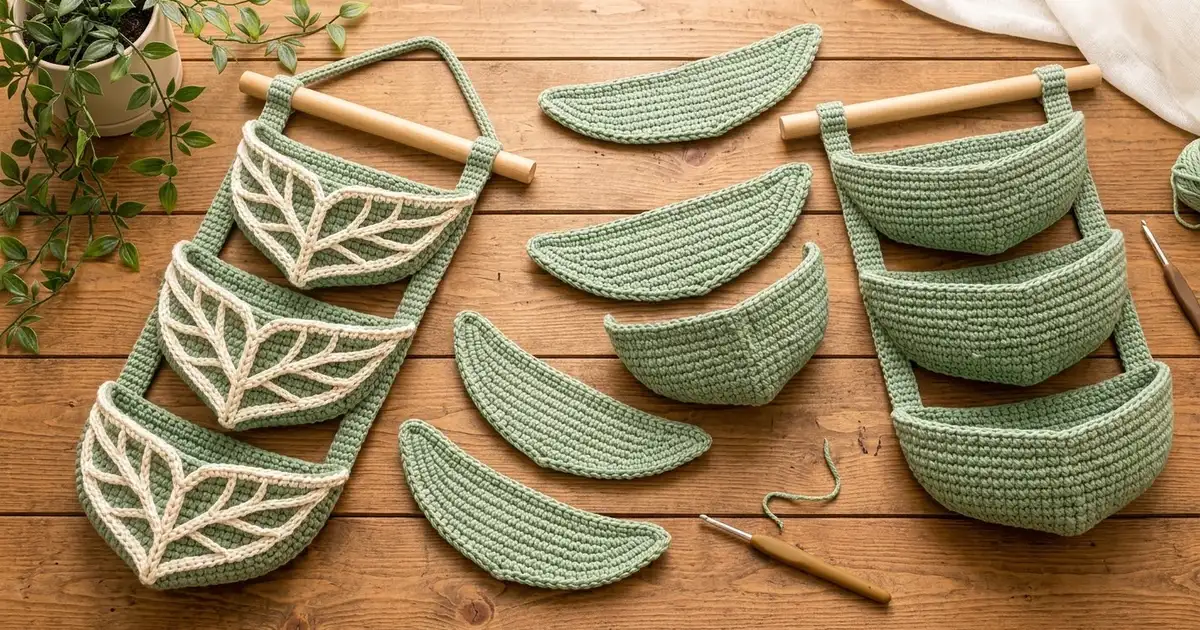
This hanging organizer has three sturdy pockets stacked between two side straps and hung from a wooden dowel. Each pocket is shaped like a leaf, with its tip at the bottom center and raised ivory veins fanning across the front. It holds soaps, sponges, rolled washcloths and small bottles, and the pockets keep their shape even when empty.
The colors are soft sage green and ivory. Sage forms the dense single crochet body. Ivory outlines each leaf, makes the midrib and branching veins, and finishes the rim with a corded edge.
This pattern uses US crochet terms. The finished organizer is 15.0 in (38.1 cm) wide and hangs 22.8 in (57.9 cm) below the dowel. Each pocket is 12.3 in (31.2 cm) wide across the back.
Each pocket starts as a flat, pointed half-leaf base worked in rows. The walls are worked up in rounds, and a back flap is added in rows. Next you add the ivory outline, veins and rim. Then you sew the pockets between two straps worked in rows, loop the straps over the dowel and tie on a crocheted hanging cord.
Finished Size and Construction
- Finished size: 15.0 in (38.1 cm) wide x 22.8 in (57.9 cm) tall below the dowel
- Skill level: Intermediate
- Terminology: US
- Yarn weight: Bulky (#5)
- Hook: 5.5 mm (US I-9)
- Number of pieces: 6 crocheted pieces (3 pockets, 2 straps, 1 hanging cord) plus a dowel
- Layout: 3 pockets stacked in 1 column between 2 straps
- Pocket size: 12.3 in (31.2 cm) wide x 6.8 in (17.3 cm) tall at the back. About 3.5 in (8.9 cm) deep at the center front when filled.
- Pocket before rim: front wall 4.9 in (12.4 cm) tall
- Rim (border) depth: 0.5 in (1.3 cm)
Materials
Choose a firm bulky yarn in cotton or a cotton-acrylic blend. Cotton holds its shape in a damp bathroom and shows stitches clearly, so the veins stand out. Avoid fluffy or very stretchy yarns, because the pockets will sag under weight.
- Sage green (main): 500 g, about 600 m (656 yd)
- Ivory (veins and edges): 100 g, about 120 m (131 yd)
These amounts assume about 120 m per 100 g. They include a margin of roughly 15 percent to cover the gauge swatch and small differences in tension.
Tools:
- 5.5 mm (US I-9) crochet hook
- Wooden dowel, 18 in (45.7 cm) long and 0.75 in (1.9 cm) in diameter
- 4 locking stitch markers
- Tapestry needle
- Scissors and measuring tape
- Rustproof pins for blocking
Abbreviations (US Terms)
- ch – chain
- sc – single crochet
- sl st – slip stitch
- st(s) – stitch(es)
- BLO / FLO – back loop only / front loop only
- sc2tog – single crochet 2 together (decreases 1 st)
- sc3tog – single crochet 3 together (decreases 2 sts)
- inc – 2 sc in the same stitch
- PM – place marker
- rev sc – reverse single crochet (crab stitch)
Reverse sc: Do not turn. Work from left to right (if you are right-handed). Insert the hook in the next stitch to the right, yarn over and pull up a loop, then yarn over and pull through both loops. This makes a twisted, corded edge.
Surface slip stitch: Hold the yarn behind the fabric. Insert the hook from front to back through a gap between stitches and pull up a loop. Then insert the hook in the next gap along your line, pull a loop through the fabric, and pull it through the loop on your hook.
Gauge and Checkpoints
Gauge: 12 sc and 13 rows = 4 in (10.2 cm), in rows or rounds.
Swatch: Ch 16. Sc in the 2nd ch from the hook and in each ch across (15 sc). Work 16 rows. The swatch should be about 5 in (12.7 cm) wide and 4.9 in (12.4 cm) tall. The fabric should feel firm, almost stiff.
Make one full pocket before you start the others, and check these measurements:
- Base Row 1: 11 in (27.9 cm) long
- Base after Row 10: 3.1 in (7.9 cm) from the foundation edge to the tip
- Back after the Edge Round: 12.3 in (31.2 cm) between the back corners
- Wall after Rnd 16: 4.9 in (12.4 cm) tall above the base fold
- Back after Flap Row 22: 6.8 in (17.3 cm) tall above the base fold
If your pocket is too big, go down half a hook size. If it is too small, go up half a size. Don’t change the stitch counts, because the strap rows are matched to the pocket’s 22 rows.
Pocket (Make 3)
Base
Work the base in rows with sage. The foundation edge becomes the straight back, and the shaped edge becomes the leaf tip.
Row 1: Ch 34. Sc in the 2nd ch from the hook and in each ch across. Turn. (33 sts)
Row 2: Ch 1, sc2tog, sc to the last 2 sts, sc2tog. Turn. (31 sts)
Row 3: Repeat Row 2. (29 sts)
Row 4: Repeat Row 2. (27 sts)
Row 5: Repeat Row 2. (25 sts)
Row 6: Repeat Row 2. (23 sts)
Row 7: Ch 1, sc3tog, sc to the last 3 sts, sc3tog. Turn. (19 sts)
Row 8: Repeat Row 7. (15 sts)
Row 9: Repeat Row 7. (11 sts)
Row 10: Repeat Row 7. Do not turn. (7 sts)
The faster decreases in Rows 7–10 make a pointed tip about 2.3 in (5.8 cm) wide.
Edge Round:
- Ch 1. Across Row 10: sc 3, work 3 sc in the next st (the tip center), sc 3. (9 sts)
- Down the side: work 2 sc in each row end of Rows 10–7, then 1 sc in each row end of Rows 6–1. (14 sts)
- Along the foundation chain: 3 sc in the first ch, sc in the next 31 ch, 3 sc in the last ch. (37 sts)
- Up the second side: 1 sc in each row end of Rows 1–6, then 2 sc in each row end of Rows 7–10. (14 sts)
- Join with a sl st to the first sc.
Total: 40 sts worked 1 per existing stitch (7 + 33), plus 28 sts in the row ends, plus 6 extra corner sts = 74 sts.
The 37 sts along the foundation edge are the back section. The other 37 sts (14 + 9 + 14) are the front section. PM in the first and last st of the back section (the outer sts of the two 3-sc corner groups). Move these markers up as you work.
Walls
Work in joined rounds without turning.
Rnd 1: Ch 1, sc BLO in each st around. Join. (74 sts)
The unused front loops form a fold line between the base and the wall. You’ll add the ivory outline here later.
Rnds 2–8: Ch 1, sc in each st around. Join. (74 sts)
Rnd 9 (flare): Ch 1, inc in the first st, sc 7, inc, sc 6, inc, sc 7, sc in each of the 37 back-section sts, sc 7, inc, sc 6. Join. (78 sts: 37 back + 41 front)
The four increases mirror each other around the tip center (the 5th st of the round), so the front bows out evenly.
Rnds 10–16: Ch 1, sc in each st around. Join. (78 sts) Fasten off.
Back Flap
Row 17: Join sage in the first marked st of the back section. Ch 1, sc in the same st and in each st up to and including the second marker. Turn. (37 sts)
Rows 18–22: Ch 1, sc in each st across. Turn. (37 sts) Fasten off.
The marked corner column is now 16 rounds plus 6 rows = 22 rows tall, from the base fold to the top of the flap. The straps will be sewn to these 22 rows.
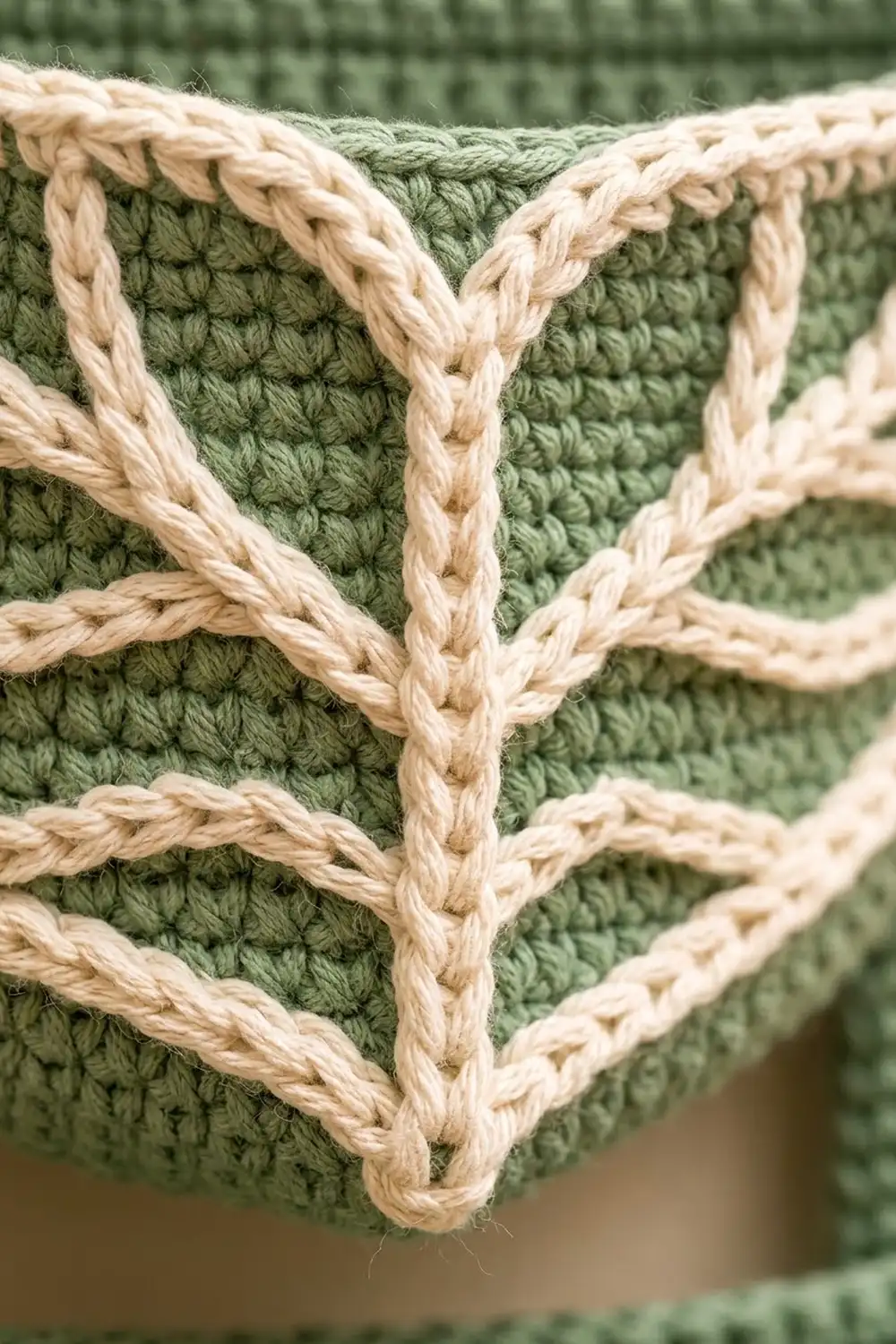
Ivory Leaf Outline
Hold the pocket with the base facing you. Join ivory in the front loop of the front-section st next to one back marker. Sc FLO in each front-section st of the Edge Round, ending next to the other back marker. (37 sts) Fasten off.
This raised ridge outlines the leaf and passes through the tip.
Ivory Veins
Work all the veins in surface slip stitch on the outside of the front wall.
Midrib: Start just above the outline at the tip center. Work 1 surface sl st per round straight up the center column through Rnds 1–16. (16 sl sts) Fasten off at the rim.
Branches (8): Each branch starts next to the midrib. With every sl st it moves up 1 round and out 1 st. Work 5 sl sts per branch.
- Work branches in pairs, one going left and one going right.
- The pairs start at Rnds 2, 5, 8 and 11 and end at Rnds 7, 10, 13 and 16.
- Each branch reaches 1.7 in (4.3 cm) out from the midrib.
Each pocket has 16 + (8 x 5) = 56 vein sl sts.
Keep the yarn behind the fabric relaxed. For bolder veins like the ones shown, work a second line of surface sl st right next to the first.
Straps (Make 2)
Work in rows with sage.
Row 1: Ch 5. Sc in the 2nd ch from the hook and in each ch across. Turn. (4 sts)
Rows 2–88: Ch 1, sc in each st across. Turn. (4 sts) Fasten off.
Each strap is 1.3 in (3.3 cm) wide and 27.1 in (68.8 cm) long. Count the rows from the bottom:
- Rows 1–22: Pocket A (bottom)
- Rows 23–24: gap, 0.6 in (1.5 cm)
- Rows 25–46: Pocket B (middle)
- Rows 47–48: gap
- Rows 49–70: Pocket C (top)
- Rows 71–74: plain section, 1.2 in (3.0 cm)
- Rows 75–82: dowel loop, 2.5 in (6.4 cm)
- Rows 83–88: fold-back
Check: 22 + 2 + 22 + 2 + 22 + 4 + 8 + 6 = 88 rows.
Hanging Cord (Make 1)
Row 1: With sage, ch 73. Sc in the 2nd ch from the hook and in each ch across. Turn. (72 sts)
Row 2: Ch 1, sc in each st across. (72 sts) Fasten off, leaving an 8 in (20.3 cm) tail at each end.
The cord is 24 in (61.0 cm) long.
Make All Pieces
- Sage: 3 pockets, 2 straps, 1 hanging cord
- Ivory: 1 outline, 9 vein lines and 1 rim on each of the 3 pockets
Layout, front view:
       /‾‾‾ cord ‾‾‾\
  ====== dowel ======
  [S]               [S]
  [S]   Pocket C    [S]
  [S]               [S]
  [S]   Pocket B    [S]
  [S]               [S]
  [S]   Pocket A    [S]
S = strap. The tip of each pocket points down at the center.
Joining
Sew with sage and a tapestry needle, using whipstitch or mattress stitch.
Sew the inner edge of the left strap to the left corner column of each pocket, matching one row end to one row end:
- Pocket A: the base fold (Rnd 1) lines up with strap Row 1, and Flap Row 22 lines up with strap Row 22.
- Pocket B: sew to strap Rows 25–46 the same way.
- Pocket C: sew to strap Rows 49–70 the same way.
Repeat on the right side.
Both edges are row ends at the same gauge of 13 rows per 4 in (10.2 cm), so 22 rows meet 22 rows and the seams lie flat without easing. Pull each stitch only until the edges meet. Tight seams pucker the back, and loose seams let the pockets tip forward.
Dowel loop: Wrap Rows 75–82 over the dowel to the back. Lay Rows 83–88 behind Rows 74–69 and sew all around. The loop fits a dowel up to 0.75 in (1.9 cm) thick.
Cord: Tie each end of the cord around the dowel 0.5 in (1.3 cm) from the dowel’s end, outside the straps. Knot it and weave in the tails.
Size checkpoint: 37 back sts (12.3 in / 31.2 cm) + 2 straps at 1.3 in (3.3 cm) each = 15.0 in (38.1 cm) wide. The 74 strap rows below the dowel = 22.8 in (57.9 cm).
Ivory Rim (Border)
Border gauge: 12 sc = 4 in (10.2 cm), the same as the body, using the same hook. If the rim ruffles, switch to a 5.0 mm (US H-8) hook.
Row 1: Join ivory in Rnd 16, in the first front-section st after the second back marker. Ch 1, sc in each of the 41 front-section sts, stopping just before the first back marker. Do not turn. (41 sts)
Row 2: Ch 1, rev sc in each st back across. (41 sts) Fasten off.
Why the math works: After Rnd 9 the front section has exactly 41 sts. One sc and one rev sc in each st add height but no width, so the rim keeps the 13.7 in (34.8 cm) front opening without cupping or ruffling. The outline works 1 sc into each of the 37 front loops left from Wall Rnd 1, so it follows the base edge exactly.
Final Blocking
- Weave in all ends through stitches of the same color, hiding them under the veins where you can.
- Stuff each pocket firmly with a folded hand towel.
- Mist the pockets lightly with water, or hold a steam iron 1 in (2.5 cm) above the fabric without pressing.
- Shape the tip into a crisp point and smooth the front into an even curve.
- Pin the straps flat and straight at 1.3 in (3.3 cm) wide.
- Let everything dry completely before removing the towels.
- Hang the organizer and check that the pockets sit level.
Final Quality-Control Checklist
- Each pocket has 74 sts in Rnds 1–8, 78 sts in Rnds 9–16 and 37 sts in the flap.
- Each pocket is 12.3 in (31.2 cm) wide and 6.8 in (17.3 cm) tall at the back.
- The midrib is centered on the tip and the branches mirror each other.
- Each rim has 41 sts, with no gaps at the markers.
- The strap seams match row for row.
- The dowel loops and cord knots are secure.
Troubleshooting
The base curls up: You’re working the decreases too tightly. Loosen your tension, or block the base flat before you start the walls.
A pocket tips forward: The flap is short or the seams are loose. Check that the corner column has 22 rows, then resew firmly.
The veins pucker: The yarn behind the fabric is too tight. Pull the vein out and work it again with a larger hook.
The rim ruffles: Use a smaller hook for the rim only.
The pockets are different widths: Recount the Edge Round and Rnd 9. A missed corner st shifts the markers.
Care
Spot clean or hand wash in cool water. Reshape the pockets around a towel and dry flat, away from direct heat.
Final Notes
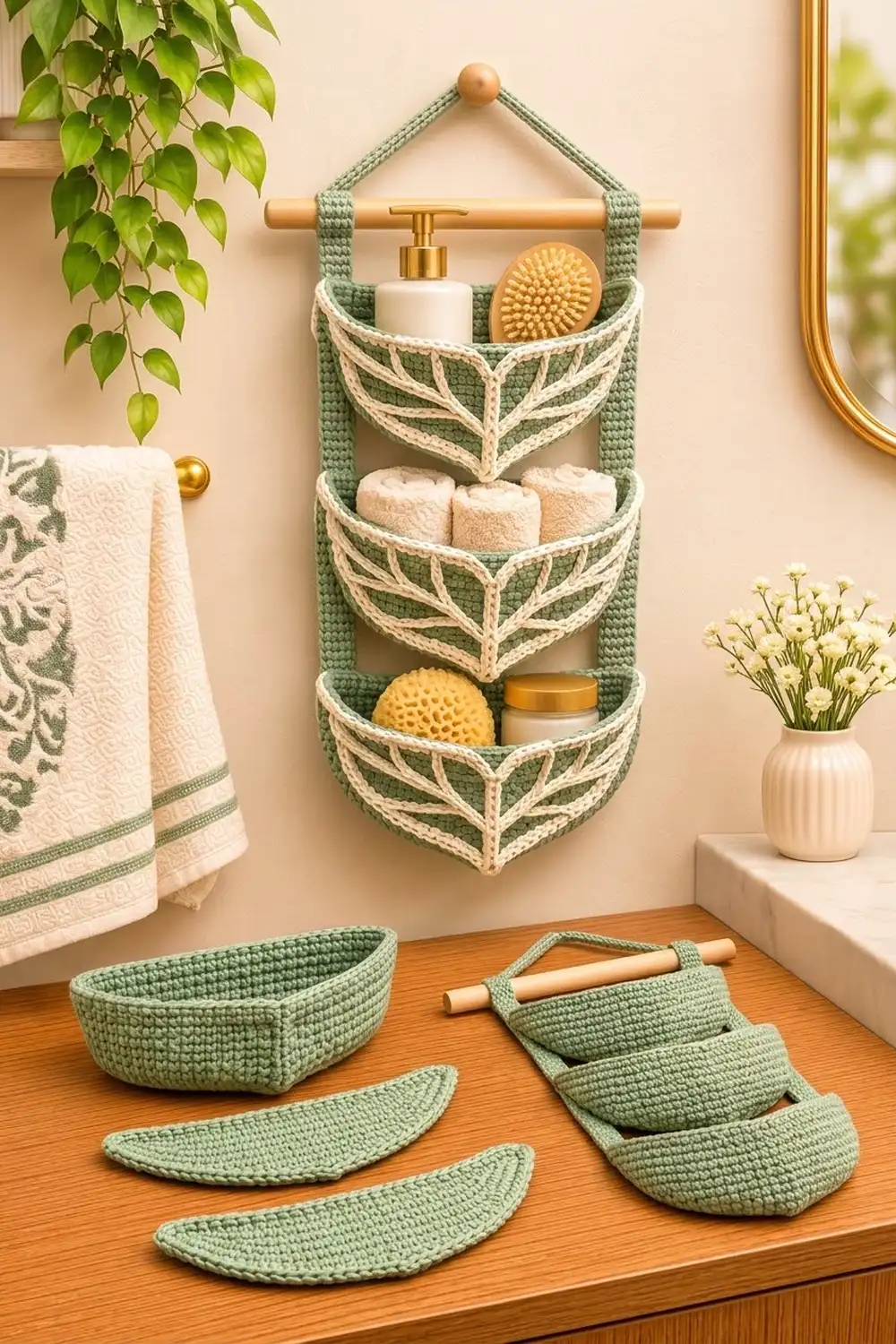
At a gauge of 12 sc and 13 rows per 4 in (10.2 cm), the 33-st base is 11 in (27.9 cm) long. The Edge Round brings it to 74 sts, with a 37-st back that is 12.3 in (31.2 cm) wide. Each pocket’s 22-row corner column matches 22 strap rows. Two straps at 1.3 in (3.3 cm) each give a 15.0 in (38.1 cm) organizer that hangs 22.8 in (57.9 cm) below the dowel. Keep your gauge steady and every piece will line up.
Happy crocheting!