

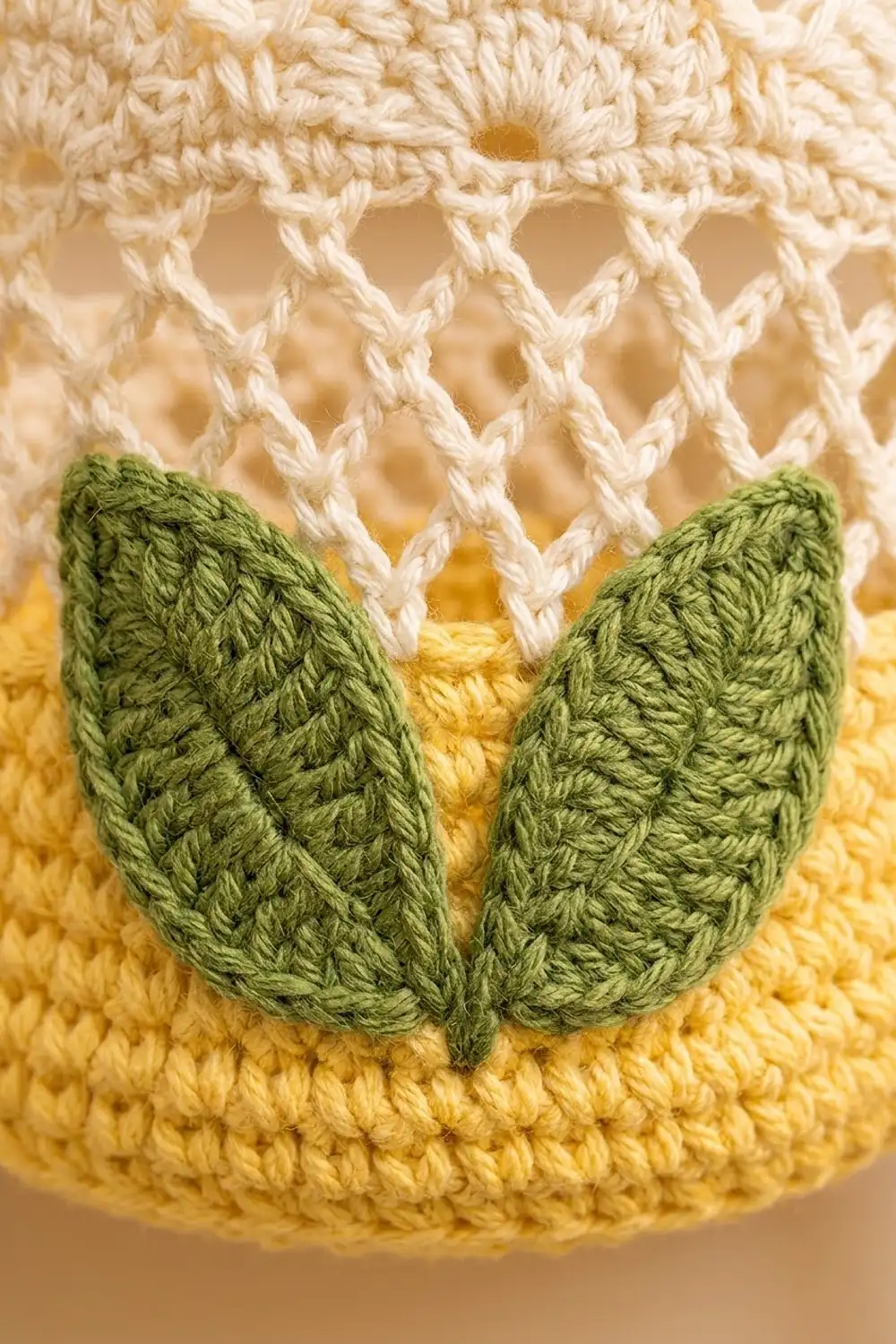
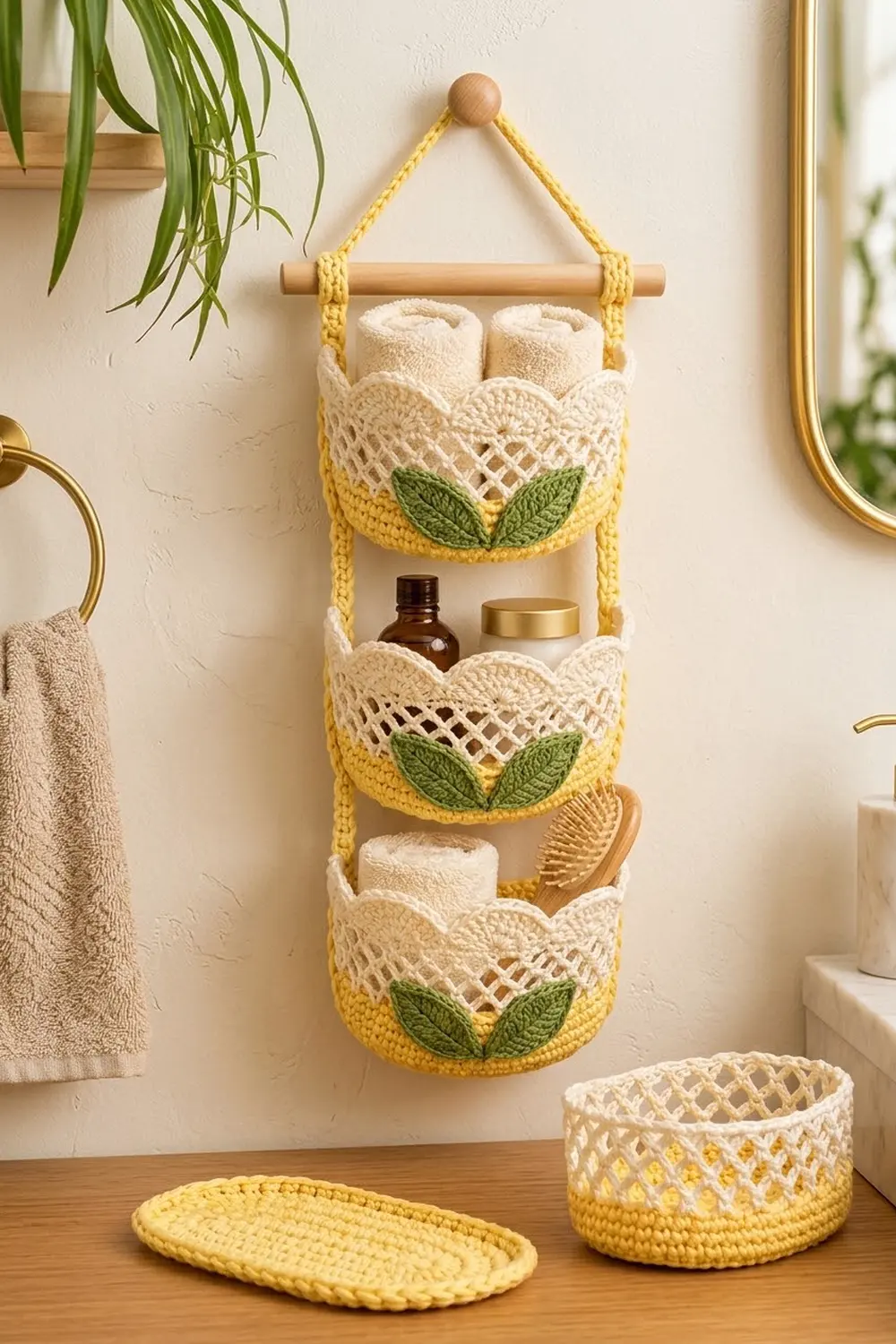
The Tulip Pockets organizer is three oval baskets stacked on a wooden dowel. Each pocket has a solid butter-yellow base, an airy ivory diamond mesh and a scalloped ivory rim that looks like an open tulip. Two moss-green leaves on the front of each pocket complete the flower look.
The colors are soft and warm, so it suits a bathroom, nursery or entryway. Use it for rolled washcloths, small bottles, brushes or hair accessories. The pattern uses US crochet terms throughout.
The finished organizer is about 12″ (30.5 cm) wide at the dowel and hangs 19.25″ (48.9 cm) from the dowel to the bottom of the lowest pocket. Each pocket is about 8″ (20.3 cm) long, 3.25″ (8.3 cm) deep and 5.25″ (13.3 cm) tall at the scallop tips.
Each pocket is worked in the round from the bottom up: an oval base, a yellow wall, ivory mesh, two solid rounds and a scalloped rim. Then you add the leaves, sew the pockets to two yellow straps, slip the straps onto the dowel and tie on a hanging cord.
Finished Size and Construction
- Finished size: 12″ (30.5 cm) wide × 19.25″ (48.9 cm) from the dowel down
- Skill level: Intermediate
- Terminology: US
- Yarn weight: Worsted (#4) cotton
- Hook: 4.5 mm (US 7)
- Number of pieces: 3 pockets, 6 leaves, 2 straps, 1 hanging cord
- Layout: 1 column of 3 pockets, stacked vertically
- Pocket size: 8″ × 3.25″ (20.3 × 8.3 cm) base, 5.25″ (13.3 cm) tall
- Pocket height before the rim: 4.25″ (10.8 cm)
- Rim (border) depth: 1″ (2.5 cm)
Materials
Use 100% cotton or a firm cotton blend. Cotton holds the basket shape and the mesh without sagging, and it can go in the wash. Don’t use acrylic or bulky yarn here, because acrylic is too soft for the walls and bulky yarn closes up the mesh.
- Color A, butter yellow: 85 g / 130 m (bases, walls, straps, cord)
- Color B, ivory: 60 g / 90 m (mesh and rims)
- Color C, moss green: 10 g / 15 m (leaves)
These amounts include a margin of about 25% for your gauge sample and for weaving in ends.
Tools:
– 4.5 mm (US 7) crochet hook
– Wooden dowel, 12″ (30.5 cm) long, 0.625″ (1.6 cm) thick
– Tapestry needle
– 4 locking stitch markers
– Scissors
– Measuring tape
– Rust-proof pins and a blocking mat
Abbreviations (US Terms)
- ch – chain
- sl st – slip stitch
- sc – single crochet
- hdc – half double crochet
- dc – double crochet
- inc – 2 sc in the same stitch
- BLO – back loop only
- sk – skip
- st(s) – stitch(es)
- rnd – round
Special stitch – Shell: 9 dc in the same stitch.
Gauge and Checkpoints
Gauge: 16 sc × 18 rnds = 4″ (10.2 cm) in sc.
Make one complete pocket before you start the others, and measure it at each checkpoint:
- After Rnd 7 (base): 8″ × 3.25″ (20.3 × 8.3 cm), 80 sts around, 20″ (50.8 cm) circumference.
- After Rnd 15: the wall is 1.75″ (4.4 cm) tall.
- After Rnd 19 (mesh): the wall is 3.75″ (9.5 cm) tall.
- After Rnd 21: the wall is 4.25″ (10.8 cm) tall.
- After Rnd 23 (rim): the pocket is 5.25″ (13.3 cm) tall at the scallop tips.
If the base is more than 0.25″ (0.6 cm) too big, go down to a 4.0 mm hook. If it’s too small, go up to a 5.0 mm hook. If the base lies flat but ripples at the ends, your increases are too tight, so work them more loosely and don’t change hooks. If the mesh is taller than shown, chain more firmly; don’t change the loop count.
Pocket (Make 3)
Base
With Color A, ch 22.
Rnd 1: 3 sc in 2nd ch from hook (End A), sc in next 19 ch (Side 1), 3 sc in last ch (End B). Rotate the work and sc in the 19 ch along the opposite side of the chain (Side 2). Sl st to the first sc. (44 sts: 3 + 19 + 3 + 19)
Side 1 will be the front of the pocket. Place a marker in its 10th st.
Rnd 2: Ch 1, inc in each of next 3 sts, sc 19, inc in each of next 3 sts, sc 19, sl st to join. (50 sts: 6 + 19 + 6 + 19)
Rnd 3: Ch 1, (sc 1, inc) 3 times, sc 19, (sc 1, inc) 3 times, sc 19, join. (56 sts: 9 + 19 + 9 + 19)
Rnd 4: Ch 1, (sc 2, inc) 3 times, sc 19, (sc 2, inc) 3 times, sc 19, join. (62 sts: 12 + 19 + 12 + 19)
Rnd 5: Ch 1, (sc 3, inc) 3 times, sc 19, (sc 3, inc) 3 times, sc 19, join. (68 sts: 15 + 19 + 15 + 19)
Rnd 6: Ch 1, (sc 4, inc) 3 times, sc 19, (sc 4, inc) 3 times, sc 19, join. (74 sts: 18 + 19 + 18 + 19)
Rnd 7: Ch 1, (sc 5, inc) 3 times, sc 19, (sc 5, inc) 3 times, sc 19, join. (80 sts: 21 + 19 + 21 + 19)
Checkpoint: 8″ × 3.25″ (20.3 × 8.3 cm). Each round grows by 6 sts, 3 at each end, so the curves stay flat and the straight sides stay at 19.
Yellow Wall
Rnd 8: Ch 1, sc in BLO of each st around, join. (80 sts) This round makes the ridge where the base turns up into the wall.
Rnds 9–14: Ch 1, sc in each st around, join. (80 sts each round)
Move the front marker up into the st above it on Rnd 14. Fasten off Color A.
Ivory Mesh
Rnd 15: Join Color B in any st. Ch 1, sc in each st around, join. (80 sts) Checkpoint: 1.75″ (4.4 cm).
Rnd 16: Ch 1, sc in first st, (ch 5, sk 3 sts, sc in next st) 19 times, ch 5, sk 3 sts, sl st to first sc. (20 ch-5 loops)
Rnd 17: Sl st in each of the first 3 ch so you are at the center of the loop. Ch 1, sc in the same loop, (ch 5, sc in next ch-5 loop) 19 times, ch 5, sl st to first sc. (20 loops)
Rnds 18–19: Repeat Rnd 17. (20 loops each round)
Each round of loops sits halfway between the loops of the round below, which makes the diamond lattice. Checkpoint: 3.75″ (9.5 cm).
Closing Rounds
Rnd 20 (conversion): Ch 1, 4 sc in each ch-5 loop around, join. (80 sts = 20 loops × 4 sc, which matches the 80 sts of Rnd 15 with no extra stitches)
Rnd 21: Ch 1, sc in each st around, join. (80 sts) Checkpoint: 4.25″ (10.8 cm).
Place a marker in the Rnd 21 st directly above the front marker from Rnd 14. Use the straight line of the mesh diamonds to line it up. This marks the front center.
Make All Pieces
Make these pieces in total:
- Pockets: 3 (Color A bases and walls, Color B mesh and rims)
- Leaves: 6 in Color C, 2 per pocket
- Straps: 2 in Color A
- Hanging cord: 1 in Color A
Leaf (Make 6)
With Color C, ch 10.
Rnd 1: Sc in 2nd ch from hook, hdc in next ch, dc in next 4 ch, hdc in next ch, sc in next ch, 3 sc in last ch. Rotate the work and, along the opposite side of the chain, sc in next ch, hdc in next ch, dc in next 4 ch, hdc in next ch, sc in last ch. (19 sts: 8 + 3 + 8)
Tip: Ch 2, sl st in 2nd ch from hook, sl st to the first sc. Fasten off and leave a 12″ (30.5 cm) tail.
Vein: With the tail, work surface sl sts down the center of the leaf from the tip to the base.
Each leaf is about 2.5″ × 1.25″ (6.4 × 3.2 cm).
Strap (Make 2)
With Color A, ch 88.
Row 1: Sc in 2nd ch from hook and in each ch across. (87 sts)
Rows 2–3: Ch 1, turn, sc in each st across. (87 sts)
Each strap is 21.75″ (55.2 cm) long and about 0.625″ (1.6 cm) wide.
Hanging Cord
With Color A, ch 61. Sc in 2nd ch from hook and in each ch across. (60 sts, 15″ / 38.1 cm) Fasten off and leave long tails.
Layout Grid
          /  cord  \
   [====== dowel 12" ======]
   S                       S
   S   [  Pocket 1  ]      S
   S       1" gap          S
   S   [  Pocket 2  ]      S
   S       1" gap          S
   S   [  Pocket 3  ]      S
S = strap, running down the center of each pocket’s End A and End B.
Joining
Method: Sew each strap flat against the pockets with whipstitches through the strap edge and the pocket wall.
Strap map (counting from the top of each strap):
- Sts 1–10: rod loop, 2.5″ (6.4 cm)
- Sts 11–16: gap above Pocket 1, 1.5″ (3.8 cm)
- Sts 17–37: Pocket 1, 5.25″ (13.3 cm)
- Sts 38–41: gap, 1″ (2.5 cm)
- Sts 42–62: Pocket 2
- Sts 63–66: gap
- Sts 67–87: Pocket 3
Check: 10 + 6 + 21 + 4 + 21 + 4 + 21 = 87.
Stitch-to-stitch logic: On each pocket’s 21-stitch section, the lowest 17 strap sts run from the Rnd 8 ridge to Rnd 21, which is 4.25″ (10.8 cm). Whipstitch both long edges of the strap, with one stitch per strap st. In the solid rounds, catch the nearest sc. In the mesh, catch the sc where the loops meet. The top 4 strap sts lie against the end shell. Tack the center dc of that shell to the strap.
Center each strap on End A and End B, directly above the middle st of each end (the 11th of 21 on Rnd 7).
Tension: Pull each whipstitch just snug. If you pull too hard, the mesh puckers. If the stitches are too loose, the pockets tip forward when they’re full.
Rod loop: Fold sts 1–10 over the dowel toward the back and sew st 1 to the back of the strap at st 11.
Leaves: Pin two leaves to the front of each pocket in a V. Their bases meet at the front center just above the Rnd 8 ridge, and the tips angle up and out about 35° over the yellow band and the bottom of the mesh. Sew them on around the edge.
Cord: Tie each end of the cord around the dowel 0.5″ (1.3 cm) outside a strap and weave in the tails.
Size checkpoint: 1.5 + 5.25 + 1 + 5.25 + 1 + 5.25 = 19.25″ (48.9 cm) from the dowel to the bottom of Pocket 3.
Border: Scalloped Tulip Rim
Border gauge: One scallop takes 10 sts and is 2.5″ (6.4 cm) wide and 1″ (2.5 cm) deep.
Each pocket gets its own rim. The pockets aren’t joined edge to edge, so no stitches are added at the seams.
Per-side counts on Rnd 21: End A 21, Side 1 (front) 19, End B 21, Side 2 (back) 19, for 80 in total.
Rnd 22: With Color B, sl st into the front-center marked st. Ch 3 (counts as dc), 8 dc in the same st. Then work (sk 4 sts, sc in next st, sk 4 sts, Shell in next st) 7 times, sk 4 sts, sc in next st, sk 4 sts, and sl st to the top of the beginning ch-3. (8 shells + 8 sc; 72 dc + 8 sc = 80 sts)
Rnd 23 (trim): (Sl st in the sc, sc in each of the 9 dc of the next shell) 8 times. Join and fasten off. (80 sts = 72 sc worked 1 per dc + 8 sl sts worked 1 per sc, with no extra stitches added)
Why the math works: 80 ÷ 10 = 8 repeats with nothing left over. You start at the front center, so the shells land at the front center, the back center, the middle of each end and the four places where the ends meet the sides. From the front, that looks like three full scallops with a half scallop at each side, so it reads as four tulip petals.
Final Blocking
- Weave in all ends and clip them close.
- Spray each pocket until it’s damp but not soaked.
- Stuff each pocket firmly with a rolled towel so the walls stand straight.
- Pin the scallops so each one is 2.5″ (6.4 cm) wide and curves evenly.
- Press the leaves flat with your fingers so the tips point outward.
- Let everything dry completely, which takes about 24 hours.
- Hang the organizer and check that all pockets sit level.
Final Quality-Control Checklist
- [ ] Each base measures 8″ × 3.25″ (20.3 × 8.3 cm) and has 80 sts
- [ ] Each pocket has a clear BLO ridge on Rnd 8
- [ ] Each pocket has 20 mesh loops in every mesh round
- [ ] Each pocket has 8 evenly spaced scallops with one at the front center
- [ ] Each pocket has two leaves forming a centered V
- [ ] There is a 1.5″ (3.8 cm) gap above Pocket 1 and a 1″ (2.5 cm) gap between pockets
- [ ] The total drop is 19.25″ (48.9 cm)
- [ ] The cord is tied the same distance from each strap
Troubleshooting
- Base cups upward: Work the increases more loosely, or add 1 extra inc at each end of the next round. Then return to the written counts.
- Base ruffles: Your stitches are too loose for the increase rate. Go down a hook size for the base only.
- Mesh leans in a spiral: Make sure the sl sts at the start of each round reach the center of the loop.
- Scallops are uneven: Recount the 80 sts on Rnd 21. One missing st puts a whole scallop out of place.
- Pockets tilt forward: Add whipstitches along the strap in the mesh area.
- Pockets hang crooked: Check that the rod loop takes exactly 10 sts on both straps.
Care
Hand wash in cool water and lay flat to dry, with a towel inside each pocket to hold its shape. Take the pockets off the dowel before washing.
Final Notes
Every stage builds on the one before it. The gauge of 16 sc = 4″ (10.2 cm) gives an 80-stitch base that measures 8″ × 3.25″ (20.3 × 8.3 cm). The walls rise to 4.25″ (10.8 cm), and the 1″ (2.5 cm) rim brings each pocket to 5.25″ (13.3 cm). Three pockets on 87-stitch straps hang 19.25″ (48.9 cm) from a 12″ (30.5 cm) dowel. Measure at every checkpoint so that all three pockets match.
Happy crocheting!