
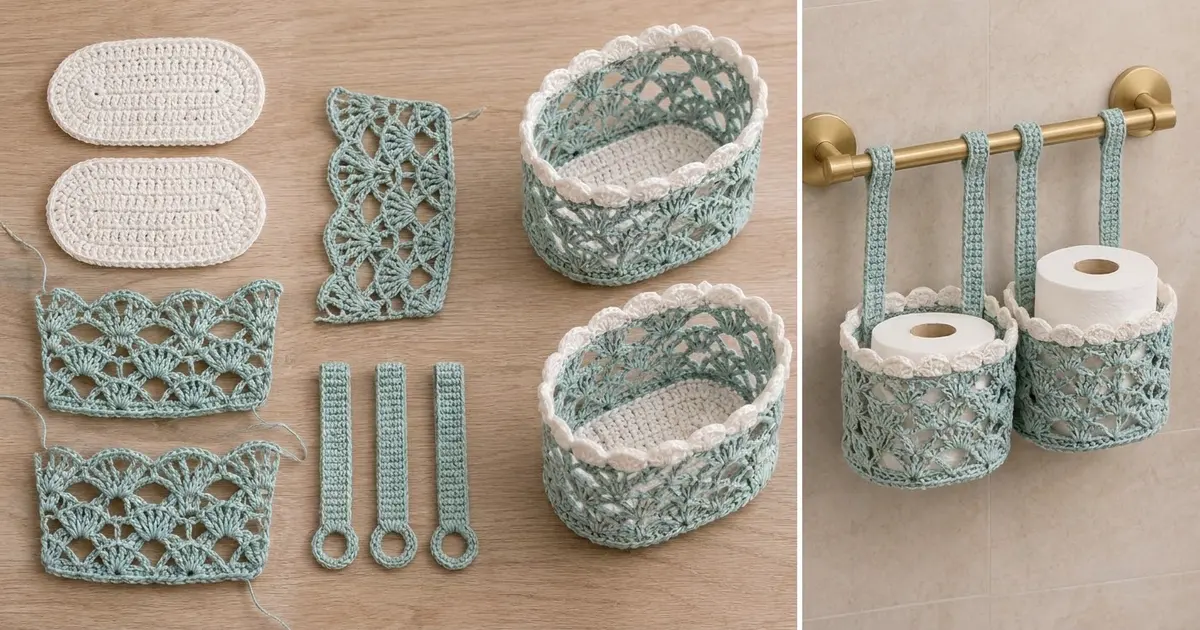
This set has two small oval baskets that hang side by side from a towel bar and hold spare toilet rolls, cotton pads, or small toiletries. Each basket has a solid white base, an open sage-green lace wall made of fans, a scalloped white rim, and two narrow sage straps that end in round rings.
There are only two colors: a soft sage or seafoam green and a clean white. The lace lets light through without looking flimsy, and the white base and rim frame the open wall neatly.
The pattern uses US crochet terms. Each finished basket measures about 7.75 x 4.75 in (19.7 x 12.1 cm) across the base and 5 in (12.7 cm) tall. Each strap is about 8.75 in (22.2 cm) long, including its ring.
Construction is simple and modular. You make a flat oval base in single crochet, then a flat lace panel worked in rows. You seam the panel into a tube, crochet it onto the base, add a two-round scallop rim, and sew on two ring straps. Make everything twice for the set.
Finished Size and Construction
- Finished basket size: 7.75 x 4.75 in (19.7 x 12.1 cm) base, 5 in (12.7 cm) tall
- Skill level: Intermediate
- Terminology: US crochet terms
- Yarn weight: Worsted (#4) cotton
- Hook: 4.5 mm (US 7)
- Number of pieces: 8 (2 bases, 2 lace panels, 4 straps)
- Layout: 2 baskets hung side by side, each on 2 straps
- Base size: 84 stitches around, perimeter 21 in (53.3 cm)
- Wall size before border: 85 stitches x 8 rows, 21.25 x 4.25 in (54.0 x 10.8 cm) flat
- Border depth: 0.75 in (1.9 cm)
Materials
Use a smooth, firm worsted cotton or cotton blend, about 170 m per 100 g. Cotton holds its shape, survives a damp bathroom, and shows the fan pattern clearly. Avoid fluffy or very stretchy yarns, because the baskets will sag.
- Sage green (walls, joining round, straps): 130 g, about 221 m (242 yd)
- White (bases, rim): 80 g, about 136 m (149 yd)
These amounts cover both baskets and all four straps, and they include a margin of roughly 15 to 20 percent for gauge swatches and tension differences.
Tools:
- 4.5 mm (US 7) crochet hook
- Tapestry needle
- 6 to 8 locking stitch markers
- Measuring tape
- Rustproof pins and a blocking mat
- Spray bottle
Abbreviations (US Terms)
- ch – chain
- sl st – slip stitch
- sc – single crochet
- dc – double crochet
- sc2tog – single crochet 2 together
- sp(s) – space(s)
- st(s) – stitch(es)
- RS / WS – right side / wrong side
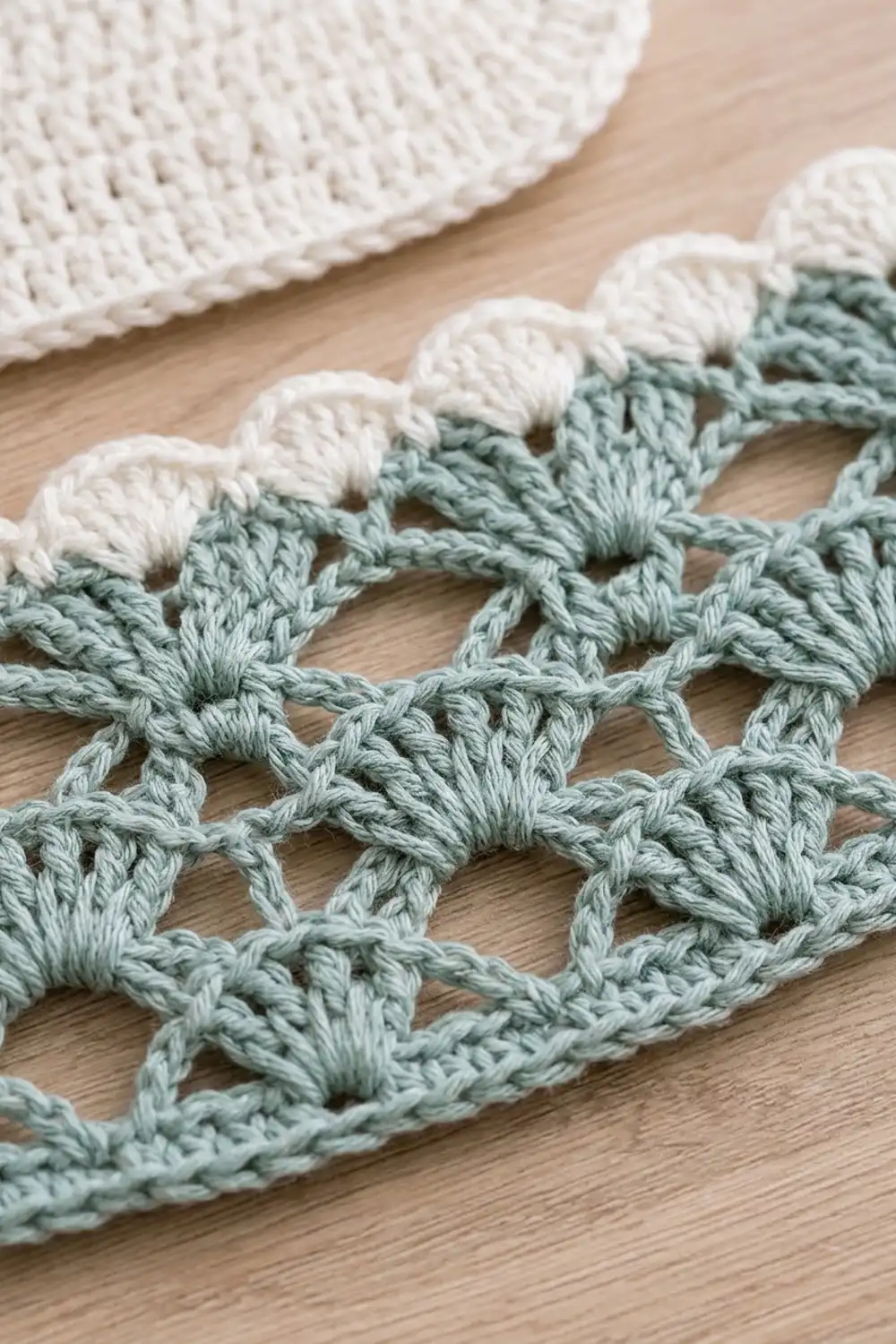
Special stitch – Fan: Work (dc, ch 1) 4 times, then dc, all in the same stitch. This gives 5 dc and 4 ch-1 sps. The 3rd dc is the center dc.
Half fan: (dc, ch 1, dc, ch 1, dc) worked in one stitch. At the start of a row, ch 3 counts as the first dc.
Gauge and Checkpoints
Single crochet gauge: 16 sc and 17 rows/rounds = 4 in (10.2 cm).
Lace gauge: One fan repeat (6 sts) = 1.5 in (3.8 cm). Rows 2–5 together = 2.5 in (6.4 cm).
Make one complete basket before starting the second. That basket is your real gauge test, because the base and the wall have to meet stitch for stitch.
Checkpoints:
- Base after Rnd 5: about 5.5 x 2.5 in (14.0 x 6.4 cm)
- Base after Rnd 10: 7.75 x 4.75 in (19.7 x 12.1 cm), lying flat
- Lace panel after Row 8: 21.25 in (54.0 cm) wide, 4.25 in (10.8 cm) tall
- Strap after Row 30: 7 in (17.8 cm) from the ring to the end, 1.25 in (3.2 cm) wide
If your piece is too big: go down to a 4 mm hook. If it is too small: go up to a 5 mm hook. The base matters most. If the base ripples, go down a hook size. If it cups, go up a hook size.
Base (Make 2, White)
The base is a flat oval with two straight sides of 12 sts each and two curved ends. Every round adds 3 sts at each end, so each round adds 6 sts in total.
Ch 15.
Rnd 1: Sc in 2nd ch from hook, sc in next 12 ch, 3 sc in last ch. Rotate and work along the bottom loops of the chain: sc in next 12 ch, 2 sc in last ch (the same ch that holds the first sc). Join with sl st to first sc. (30 sc)
Each end now has 3 sc and each side has 12 sc. One end’s increases sit at the start of the round and the rest at the end, which keeps the straight sides lined up.
For Rnds 2–10, each round follows this pattern: ch 1, sc in first X sts, 2 sc in next st, sc in next 12 sts, (sc in next X sts, 2 sc in next st) 3 times, sc in next 12 sts, (sc in next X sts, 2 sc in next st) 2 times, join with sl st to first sc. X is 0 in Rnd 2 and goes up by 1 each round.
Rnd 2 (X = 0): 2 sc in first st, sc in next 12, 2 sc in each of next 3, sc in next 12, 2 sc in each of last 2. (36 sc)
Rnd 3 (X = 1): (42 sc)
Rnd 4 (X = 2): (48 sc)
Rnd 5 (X = 3): (54 sc) Check the size here.
Rnd 6 (X = 4): (60 sc)
Rnd 7 (X = 5): (66 sc)
Rnd 8 (X = 6): (72 sc)
Rnd 9 (X = 7): (78 sc)
Rnd 10 (X = 8): (84 sc)
Rnd 10 has 12 sts on each side and 30 sts at each end: 12 + 30 + 12 + 30 = 84. Fasten off and weave in the ends.
Lace Wall Panel (Make 2, Sage)
The panel is worked flat and later seamed into a tube. It uses a multiple of 6 + 1 sts: 85 sts = 14 repeats of 6, plus 1.
Ch 86.
Row 1 (RS): Sc in 2nd ch from hook and in each ch across, turn. (85 sc)
Row 2: Ch 1, sc in first sc, skip 2 sc, Fan in next sc, skip 2 sc, sc in next sc; rep from * 13 more times, turn. (14 fans, 15 sc)*
Row 3: Ch 6 (counts as dc + ch 3), sc in center dc of next fan, ch 3, dc in next sc, ch 3, sc in center dc of next fan; rep from * 12 more times, ch 3, dc in last sc, turn. (15 dc, 14 sc, 28 ch-3 sps)*
Row 4: Ch 3 (counts as dc), (ch 1, dc) twice in first dc (half fan made), sc in next sc, Fan in next dc; rep from * 12 more times, sc in next sc, Half fan in 3rd ch of turning ch-6, turn. (13 fans, 2 half fans, 14 sc)*
The fans in this row sit between the fans of Row 2, so the lace becomes staggered.
Row 5: Ch 1, sc in first dc, ch 3, dc in next sc, ch 3, sc in center dc of next fan; rep from * 12 more times, ch 3, dc in next sc, ch 3, sc in 3rd ch of turning ch-3, turn. (15 sc, 14 dc, 28 ch-3 sps)*
Row 6: Ch 1, sc in first sc, Fan in next dc, sc in next sc; rep from * 13 more times, turn. (14 fans, 15 sc)*
Row 7: Repeat Row 3. (15 dc, 14 sc, 28 ch-3 sps)
Row 8: Ch 1, sc in first dc, 2 sc in next ch-3 sp, sc in next st; rep from * across, ending with sc in 3rd ch of turning ch-6. (85 sc)*
Row 8 is a conversion row. It has 15 dc + 14 sc worked one per stitch = 29, plus 2 sc in each of 28 spaces = 56, for 85 sc in total. This matches Row 1 exactly. Fasten off and leave a 12 in (30.5 cm) tail.
Make All Pieces
- White: 2 bases (84 sc each)
- Sage: 2 lace panels (85 sts wide each) and 4 straps
Straps (Make 4, Sage):
Ch 14 and join with sl st to form a ring.
Rnd 1: Ch 1, 24 sc into the ring, join. (24 sc) The ring measures about 1.75 in (4.4 cm) across, with a hole about 1 in (2.5 cm) wide.
Row 1: Ch 1, sc in same st as join and in next 4 sts, turn. (5 sc)
Rows 2–30: Ch 1, sc in each st, turn. (5 sc) Fasten off and leave a 10 in (25.4 cm) tail.
Layout grid:
[ Strap ]  [ Strap ]      [ Strap ]  [ Strap ]
   |          |              |          |
[ Rim     Basket A  ]     [ Rim     Basket B  ]
[ Lace wall (tube)  ]     [ Lace wall (tube)  ]
[ White oval base   ]     [ White oval base   ]
Joining
1. Seam the panel. Fold the panel with RS together so the two short edges meet. Using the long tail, whipstitch the edges together through matching row ends: 1 stitch per sc row and 2 to 3 stitches per fan or arch row. Turn RS out. You now have a tube 85 sts around.
2. Join the wall to the base. Hold the base and the tube with wrong sides together, the base on the bottom, and the panel’s foundation chain lined up with Rnd 10 of the base. Line up the panel seam with the center of one curved end.
With sage, insert the hook through the free loop of the foundation chain just after the seam and through any base stitch. Sc through both layers. Continue around, working 1 sc through 1 panel loop and 1 base stitch.
The panel has 85 sts and the base has 84. When you reach the seam, insert the hook through the last panel loop, the first panel loop, and the final base stitch, and work them as one sc. That gives 83 + 1 = 84 joining sc. Join with sl st and fasten off.
Tension: Keep the joining round at the same tension as your base rounds. If it is tight, the wall pulls inward. If it is loose, the basket flares.
Size checkpoint: The basket should stand upright with a 21 in (53.3 cm) circumference at the base.
Border
The rim is worked in white into Row 8 of the panel. It uses the single-crochet gauge: 4 sts = 1 in (2.5 cm).
Rnd 1: With the outside facing, draw up a white loop in the last st before the seam, then draw up a loop in the first st after the seam. Yo and pull through all 3 loops (sc2tog made). Sc in each of the remaining 83 sts and join with sl st to the first st. (84 sts: 83 sc + 1 sc2tog)
Like the base join, this decrease turns the panel’s 85 sts into 84.
Rnd 2: Ch 1, sc in first st, skip 2 sts, 5 dc in next st, skip 2 sts, sc in next st; rep from * 12 more times, skip 2 sts, 5 dc in next st, skip 2 sts, join with sl st to first sc. (14 scallops, 14 sc)*
Why the math works: Each scallop repeat uses 6 sts (sc, 2 skipped, dc group, 2 skipped). 14 repeats x 6 = 84, so the rim closes with no partial scallop. The rim matches the base’s 84 sts exactly, so the top and bottom of the wall are the same circumference and the basket stands straight. The 14 scallops also match the 14 fan repeats of the wall. The rim adds 0.75 in (1.9 cm), bringing the basket to 5 in (12.7 cm) tall. Fasten off and weave in the ends.
Attach straps: Place one strap at the center of each curved end, on the inside of the wall. The flat end should overlap the wall by 1.5 in (3.8 cm), just below the rim. Whipstitch all 4 edges of the overlap securely. Repeat on the second basket. Slide the rings onto the towel bar, with 2 rings per basket.
Final Blocking
- Mist each basket with water until it is evenly damp, without soaking it.
- Stuff it with a towel or a box measuring about 7.75 x 4.75 in (19.7 x 12.1 cm).
- Ease the walls upright and open each fan with your fingers.
- Shape each scallop so it curves evenly.
- Lay the straps flat, pin them to 7 in (17.8 cm) plus the ring, and keep the rings round.
- Let everything dry completely, for at least 24 hours.
Final Quality-Control Checklist
- Each base has 84 sts and lies flat.
- Each panel has 14 fan repeats and measures 21.25 in (54.0 cm) flat.
- The panel seam sits at one curved end and has no gaps.
- The joining round has 84 sc with no skipped base stitches.
- The rim has 14 even scallops.
- The straps are 5 sts wide and 30 rows long, with round rings.
- The straps sit 1.5 in (3.8 cm) deep and are sewn on all 4 edges.
- Both baskets hang level and are 5 in (12.7 cm) tall.
Troubleshooting
The base ripples: Go down a hook size, and check that you added exactly 6 sts in each round.
The base cups: Go up a hook size, or check that you made 6 increases in that round.
The fans lean or don’t line up: Check that each fan sits in the center dc of a fan or on a dc, never in a ch-3 space.
Row 8 does not total 85: You probably worked 1 or 3 sc in a space. Count 2 sc in every ch-3 space.
There is an extra stitch left at the base join: You missed the 3-loop join at the seam.
The basket flares at the top: Work Border Rnd 1 more firmly, or use a 4 mm hook for that round only.
The straps stretch under load: Make them firmer with a 4 mm hook, or add a second line of stitches across the sewn overlap.
Care
Hand wash in cool water with mild soap, press out the water in a towel, and reshape the baskets to dry flat or stuffed. Do not tumble dry, because the lace can distort.

Final Notes
The whole set rests on one measurement chain. The base ends at 84 sts and 21 in (53.3 cm). The lace panel is 85 sts, and one seam stitch is absorbed in both the base join and the rim, bringing each back to 84. The rim has 14 scallops of 6 sts, matching the 14 fan repeats. Check the base gauge first and the rest will fit.
Happy crocheting!