
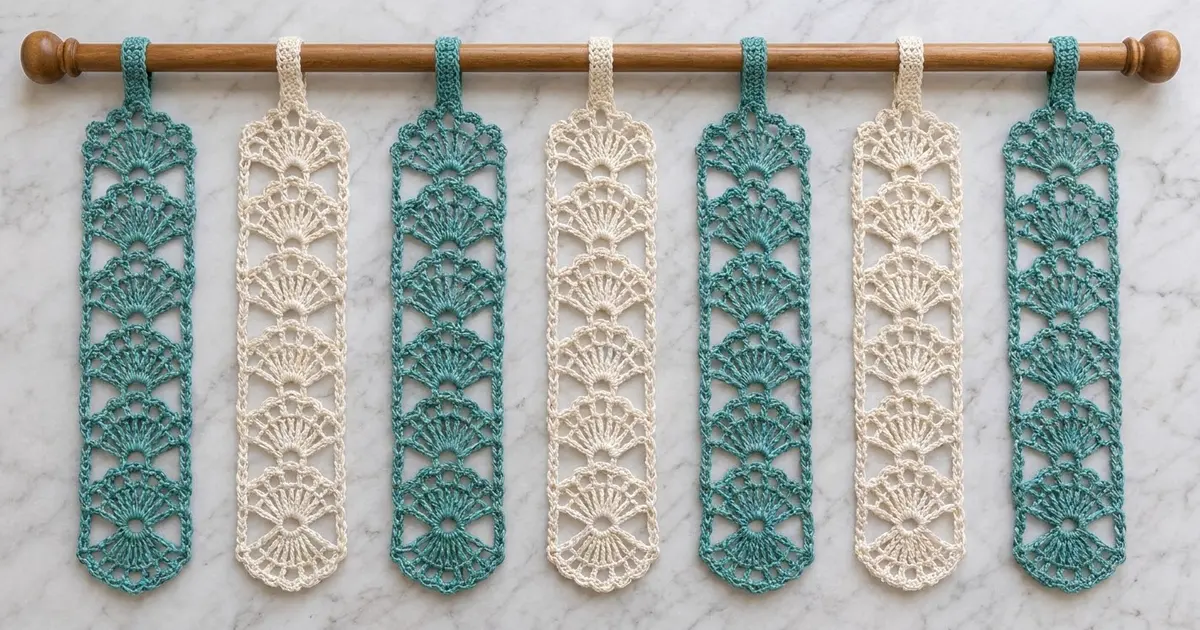
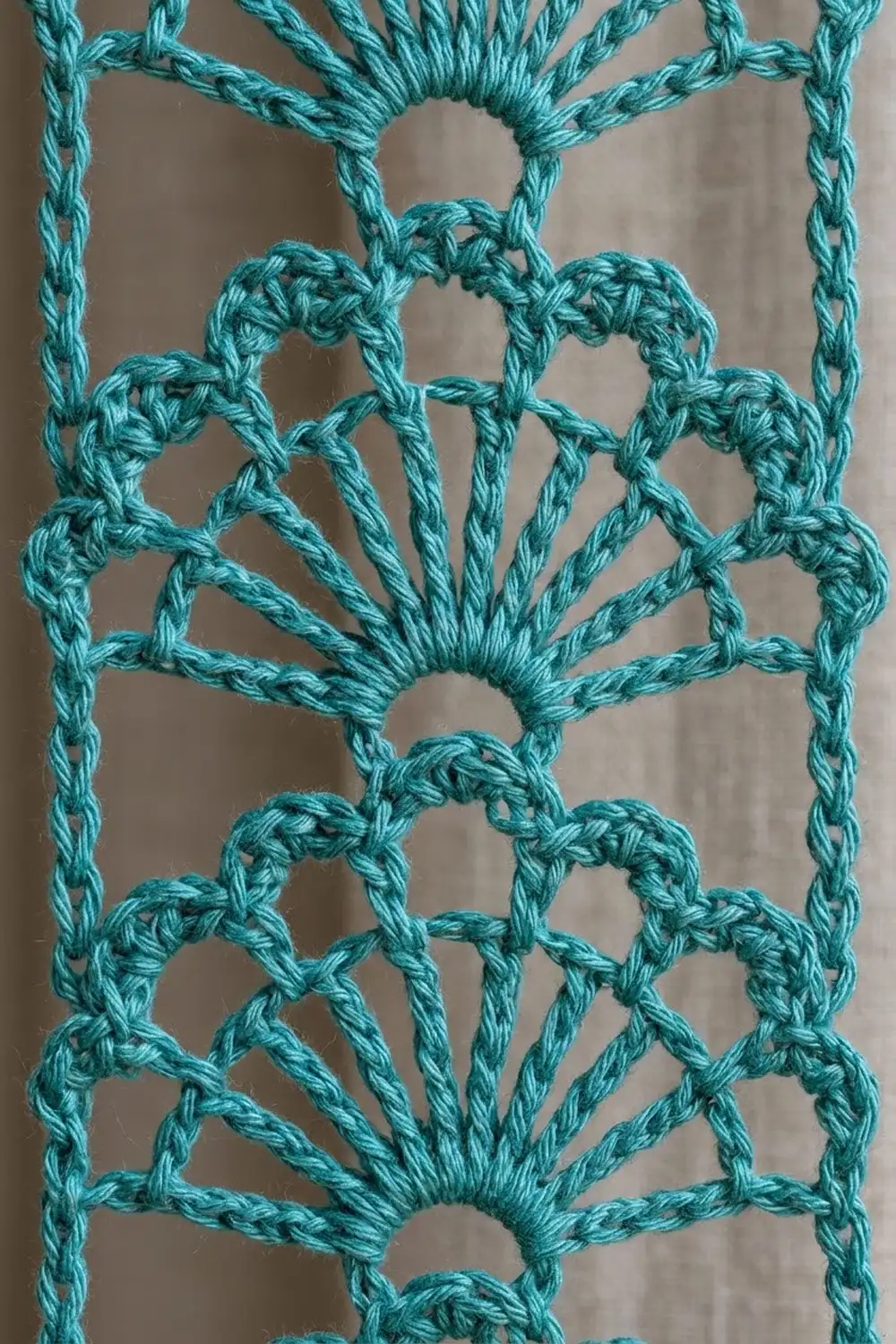
This curtain is made of seven long lace strips, and each strip is a column of open seashell fans. Every fan starts from a single stitch and spreads out into seven long spokes, then finishes with a row of small arches. The next fan grows straight up from the flat top of the one below, so the strip reads as one continuous column of shells from rod to floor.
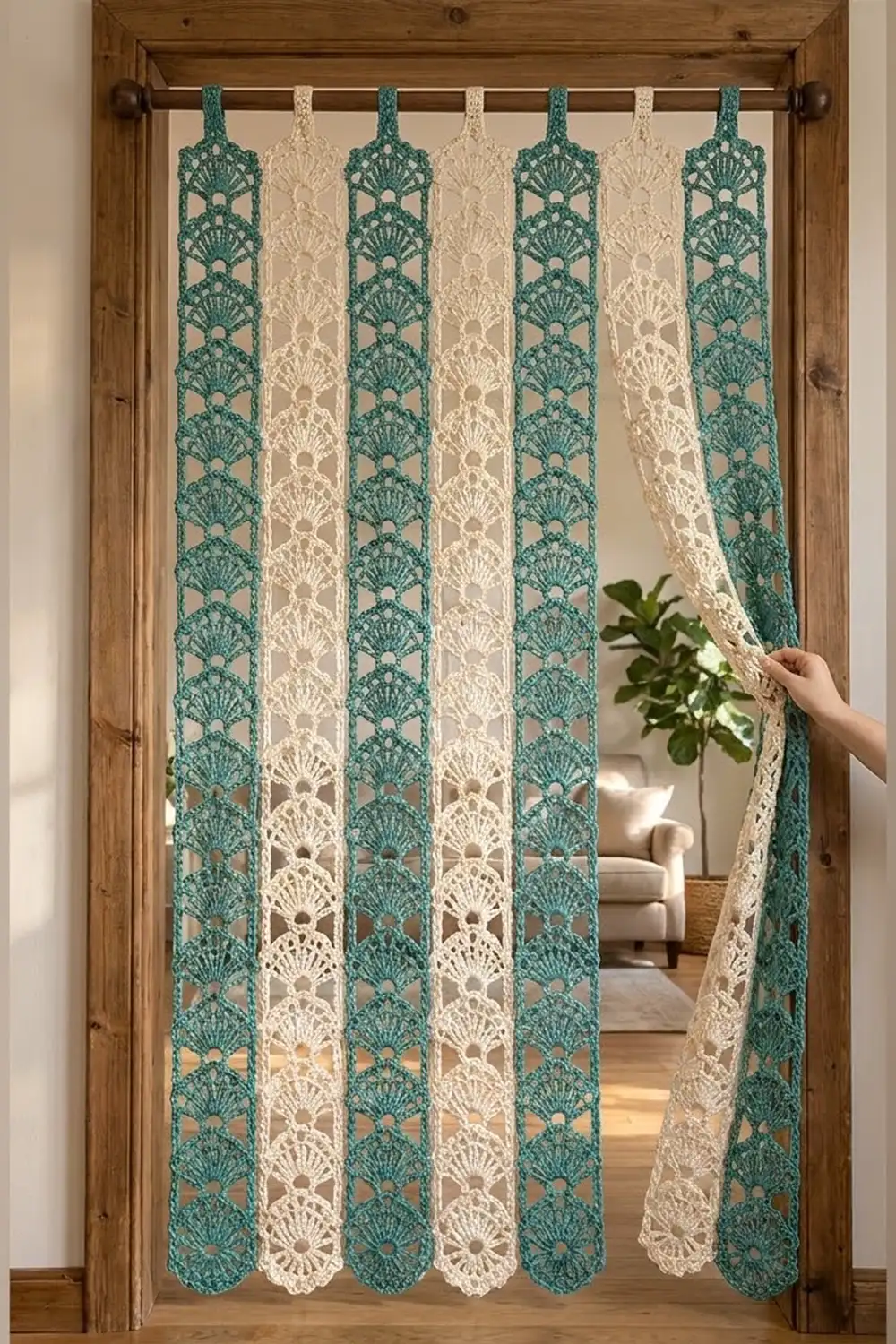
The sample alternates four teal strips with three cream ones. The strips are not sewn together. Each one hangs from the rod on its own, so they move apart when you walk through and fall back into line afterward. The look is coastal and airy, and it lets light through while still marking the doorway.
This pattern uses US crochet terms. Each finished strip measures 5.5 in (14.0 cm) wide and 78 in (198.1 cm) long, measured from the top fold of the rod pocket. With 1/4 in (0.6 cm) between strips, the seven strips cover 40 in (101.6 cm) of rod.
Each strip is worked flat, from the bottom up, in a 4-row fan repeat. You finish it with 16 rows of single crochet that fold over to make a rod pocket, then add a two-row border along the sides and bottom.
Finished Size and Construction
- Finished strip size: 5.5 in (14.0 cm) wide x 78 in (198.1 cm) long
- Skill level: Easy–Intermediate
- Terminology: US crochet terms
- Yarn weight: DK (#3), 100% cotton
- Hook: 4.0 mm (G-6)
- Number of pieces: 7 separate strips (4 teal, 3 cream)
- Layout: 7 strips side by side on one rod, not joined to each other
- Strip body before border: 4.5 in (11.4 cm) wide x 75.25 in (191.1 cm) long
- Rod pocket: 16 rows worked 4 in (10.2 cm) tall, folded to 2 in (5.1 cm)
- Border depth: 0.5 in (1.3 cm) on each long side, 0.75 in (1.9 cm) at the bottom
Materials
Choose a smooth, mercerized or combed DK cotton. Cotton gives the fans crisp definition and hangs straight under its own weight, while acrylic tends to curl at the edges of long strips. The quantities below assume roughly 115 m per 50 g ball.
- Teal: 900 g (about 2,070 m), for 4 strips
- Cream: 700 g (about 1,610 m), for 3 strips
Each strip uses about 200 g. The quantities above include a margin for your gauge swatch, the pocket seam, and dye-lot safety, so buy all of each color at once.
Tools:
– 4.0 mm (G-6) crochet hook
– Tapestry needle
– Stitch markers
– Measuring tape
– Rust-proof blocking pins and a long blocking surface
– Spray bottle
– Curtain rod, 1 in (2.5 cm) or less in diameter and at least 42 in (106.7 cm) long
Abbreviations (US Terms)
- ch – chain
- sc – single crochet
- dc – double crochet
- tr – treble crochet (yarn over twice)
- sk – skip
- sp – space
- st(s) – stitch(es)
- RS / WS – right side / wrong side
Special stitch, Fan: In the same stitch, work (tr, ch 1) 6 times, then 1 more tr. That gives 7 tr with 6 ch-1 spaces, all coming out of one stitch.
Note: The turning ch-4 counts as a tr and the turning ch-3 counts as a dc. The ch-1 at the start of sc rows does not count as a stitch.
Gauge and Checkpoints
Base gauge: 25 sc = 4.5 in (11.4 cm) with the 4.0 mm hook.
Repeat gauge: One fan repeat (Rows 2–5) = 2.5 in (6.4 cm) tall.
Pocket gauge: 16 rows of sc = 4 in (10.2 cm).
Work a test piece first: Row 1 plus two fan repeats. Pin it out, spray it lightly, and let it dry. It should then measure 4.5 in (11.4 cm) wide and 5.25 in (13.3 cm) tall.
Body checkpoints, measured flat and relaxed:
– Row 1 + 4 repeats: 10.25 in (26.0 cm)
– Row 1 + 10 repeats: 25.25 in (64.1 cm)
– Row 1 + 20 repeats: 50.25 in (127.6 cm)
– Row 1 + 30 repeats: 75.25 in (191.1 cm)
If your work is too big: Go down one hook size (3.75 mm). If only the length is off, make the tr rows shorter by pulling up the first loop of each tr a little less.
If your work is too small: Go up one hook size (4.5 mm). If only the height is short, you can add a 31st repeat instead of changing hooks.
Never stretch a strip to hit a measurement. Cotton lace grows slightly once it hangs, so measure it lying flat.
Strip Pattern
Make 7 strips: 4 in teal and 3 in cream. All strips follow the same instructions.
Foundation
Ch 26.
Row 1 (RS): Sc in 2nd ch from hook and in each ch across. Turn. (25 sc)
The strip should measure 4.5 in (11.4 cm) wide.
Fan Repeat
Row 2 (fan base): Ch 4 (counts as tr), tr in next st, ch 5, sk next 10 sts, Fan in next st (the 13th, center st), ch 5, sk next 10 sts, tr in last 2 sts. Turn.
Count: 4 side tr + 7 fan tr, 6 ch-1 sps, 2 ch-5 sps.
The 10 skipped stitches on each side leave the triangular openings beside each fan. The 2-tr columns form the side edges.
Row 3 (spokes): Ch 3 (counts as dc), dc in next tr, ch 3, dc in first fan tr, (ch 2, dc in next fan tr) 6 times, ch 3, dc in next tr, dc in top of turning ch. Turn.
Count: 4 side dc + 7 fan dc, 6 ch-2 sps, 2 ch-3 sps.
Each fan dc sits directly on top of a fan tr, which makes the spokes longer. The ch-2 spaces spread them into a fan shape.
Row 4 (arches): Ch 3 (counts as dc), dc in next dc, ch 2, sc in first fan dc, (ch 3, sc in next fan dc) 6 times, ch 2, dc in next dc, dc in top of turning ch. Turn.
Count: 4 side dc + 7 sc, 6 ch-3 arches, 2 ch-2 sps.
The six ch-3 arches make the scalloped top of the shell.
Row 5 (flat top, conversion row): Ch 1, sc in first 2 dc, sc in ch-2 sp, sc in next sc, (2 sc in next ch-3 arch, sc in next sc) 6 times, sc in ch-2 sp, sc in next dc, sc in top of turning ch. Turn.
Count: 11 sts worked one in each existing st (4 dc + 7 sc) + 14 sts added in spaces (1 in each ch-2 sp + 2 in each of the 6 arches) = 25 sc.
Row 5 brings you back to exactly 25 sc, which is the count Row 2 needs. That is what lets the fans stack without the strip widening or narrowing.
Rows 6–121: Repeat Rows 2–5 another 29 times, for 30 fan repeats in total. Do not fasten off.
Checkpoint: 75.25 in (191.1 cm) long and 4.5 in (11.4 cm) wide.
Rod Pocket
Rows P1–P16: Ch 1, sc in each st across. Turn. (25 sc per row)
After Row P16, fasten off and leave a 30 in (76.2 cm) tail for sewing. The pocket area should measure 4 in (10.2 cm) tall. If your rod is thicker than 1 in (2.5 cm), add 4 rows for each extra 1/2 in (1.3 cm) of rod diameter.
Make All Pieces
- Teal: 4 strips
- Cream: 3 strips
- Total: 7 strips, each with 30 fan repeats and 16 pocket rows
Layout across the rod, left to right:
| T | C | T | C | T | C | T |
T = teal, C = cream. With teal on both outer edges, the curtain is symmetrical.
Before you continue, lay all seven bodies side by side. They should match in length within 1/2 in (1.3 cm). If one is longer, re-block it before adding rows or pulling any out.
Joining (Rod Pocket and Hanging)
The strips are never seamed to each other. Each strip is closed only into its own rod pocket, and the rod is what holds the curtain together.
Closing the pocket: Fold Rows P1–P16 in half toward the WS so that Row P16 lies on top of Row P1. Thread the long tail onto the needle. Whipstitch each of the 25 sts of Row P16 to the matching st at the base of Row P1, working stitch to stitch: st 1 to st 1, and so on through st 25. Don’t skip any stitches or double up, or the pocket will twist.
Tension: Each whipstitch should lie flat. If you pull it hard enough to gather the sc, the pocket will pucker and the strip will hang crooked.
Checkpoint: The closed pocket is 2 in (5.1 cm) tall and 4.5 in (11.4 cm) wide, and a 1 in (2.5 cm) rod slides through it without catching.
You can add the border before or after closing the pocket because the border does not touch the pocket rows.
Border
Border gauge: Along the long sides, work 12 sc per fan repeat, which is 4.8 sc per inch. These are the row-end placements:
- Tr row end (Row 2): 5 sc
- Each dc row end (Rows 3 and 4): 3 sc
- Sc row end (Row 5): 1 sc
- Row 1 row end: 1 sc
Row 1 (RS): With RS facing, join yarn at the top of the right edge of the body, at the last Row 5 just below the pocket. Ch 1.
– Right side: Work 361 sc down the edge (1 + 30 x 12).
– Bottom: Work 3 sc in the first foundation ch, 1 sc in each of the next 23 ch, and 3 sc in the last ch, for 29 sc including both corner groups.
– Left side: Work 361 sc up to the base of the pocket.
Turn. Total: 361 + 29 + 361 = 751 sc.
Row 2 (WS): Ch 1.
– Left side: Sc in each of the 361 sc.
– Bottom: Sc in the first sc, then (sk 1, 5 dc in next sc, sk 1, sc in next sc) 7 times. The 29 sts become 8 sc + 35 dc = 43 sts, which is 7 shells.
– Right side: Sc in each of the 361 sc.
Fasten off. Total: 361 + 43 + 361 = 765 sts.
Why the math works: Each 2.5 in (6.4 cm) repeat gets 12 sc, so 30 repeats + Row 1 give 361 sc for 75.25 in (191.1 cm). That is the 4.8 sc per inch the edge needs to lie flat without ruffling or pulling in. At the bottom, the shell pattern uses 4 sts per shell plus 1 sc to close: 1 + (4 x 7) = 29, exactly the bottom count from Row 1. The shells skip the corner sc, so the corners round off into the first and last scallop.
Final size: The border adds 0.5 in (1.3 cm) to each side, so the width becomes 4.5 + 0.5 + 0.5 = 5.5 in (14.0 cm). The bottom grows by 0.75 in (1.9 cm), so the length below the pocket is 76 in (193.0 cm). With the 2 in (5.1 cm) pocket, the total is 78 in (198.1 cm).
Final Blocking
- Weave in all ends along the side columns, going back through your weaving once so the ends stay put in cotton.
- Lay each strip flat on a long surface. Floor mats or towels on a bed both work.
- Pin the side edges straight to 5.5 in (14.0 cm) wide, placing a pin about every 6 in (15.2 cm).
- Open each fan with your fingers, and pin the top of each arch row so the spokes radiate evenly.
- Pin out each bottom shell into a rounded scallop.
- Spray until damp but not dripping, and leave to dry completely.
- Measure each strip. It should be 78 in (198.1 cm) long, with all seven within 1/2 in (1.3 cm) of each other.
- Slide the strips onto the rod in the T–C–T–C–T–C–T order, spacing them 1/4 in (0.6 cm) apart.
Final Quality-Control Checklist
- Every strip has 30 fan repeats, with all fans centered and opening upward.
- Every Row 5 has 25 sc, with no drift in width along the strip.
- The side columns are straight and both are 2 sts wide all the way up.
- Each side border has 361 sc and the bottom has 7 even shells.
- The pocket is sewn stitch to stitch and is 2 in (5.1 cm) tall.
- All strips are 5.5 in (14.0 cm) wide and 78 in (198.1 cm) long after blocking.
- The color order is teal on both ends with cream alternating between them.
- No ends show on the RS.
Troubleshooting
The strip is getting wider or narrower: Recount Row 5. It must have exactly 25 sc, and the fan must go into the 13th stitch.
The fans lean to one side: You probably skipped 9 or 11 stitches instead of 10 in Row 2. Place a marker in the center stitch before you work the fan.
The side edges ruffle: You have too many border sc. Check that you are working 5 sc on tr row ends, not 6.
The side edges pull in: You have too few border sc, or your stitches are too tight. Use a hook one size larger for the border only.
The strips hang at different lengths: Re-block the longer strips, or remove a pocket row from the longer strip so they match.
The pocket twists: Unpick the seam and re-sew it stitch to stitch.
Care
Hand wash cold or machine wash on a gentle cycle in a mesh bag, then lay flat to dry and re-pin the edges. Do not hang the strips while they are wet, or they will stretch.
Final Notes
The measurement chain goes like this:
- Row 1 has 25 sc and measures 4.5 in (11.4 cm).
- Each fan repeat is 2.5 in (6.4 cm), and 30 repeats bring the body to 75.25 in (191.1 cm).
- The 16 pocket rows fold to a 2 in (5.1 cm) pocket.
- The border adds 0.5 in (1.3 cm) per side and 0.75 in (1.9 cm) at the bottom.
- Each finished strip is 5.5 in (14.0 cm) x 78 in (198.1 cm), and seven strips with 1/4 in (0.6 cm) gaps cover 40 in (101.6 cm) of rod.
If you check each stage against these numbers, your seashell curtain will hang straight.
Happy crocheting!