

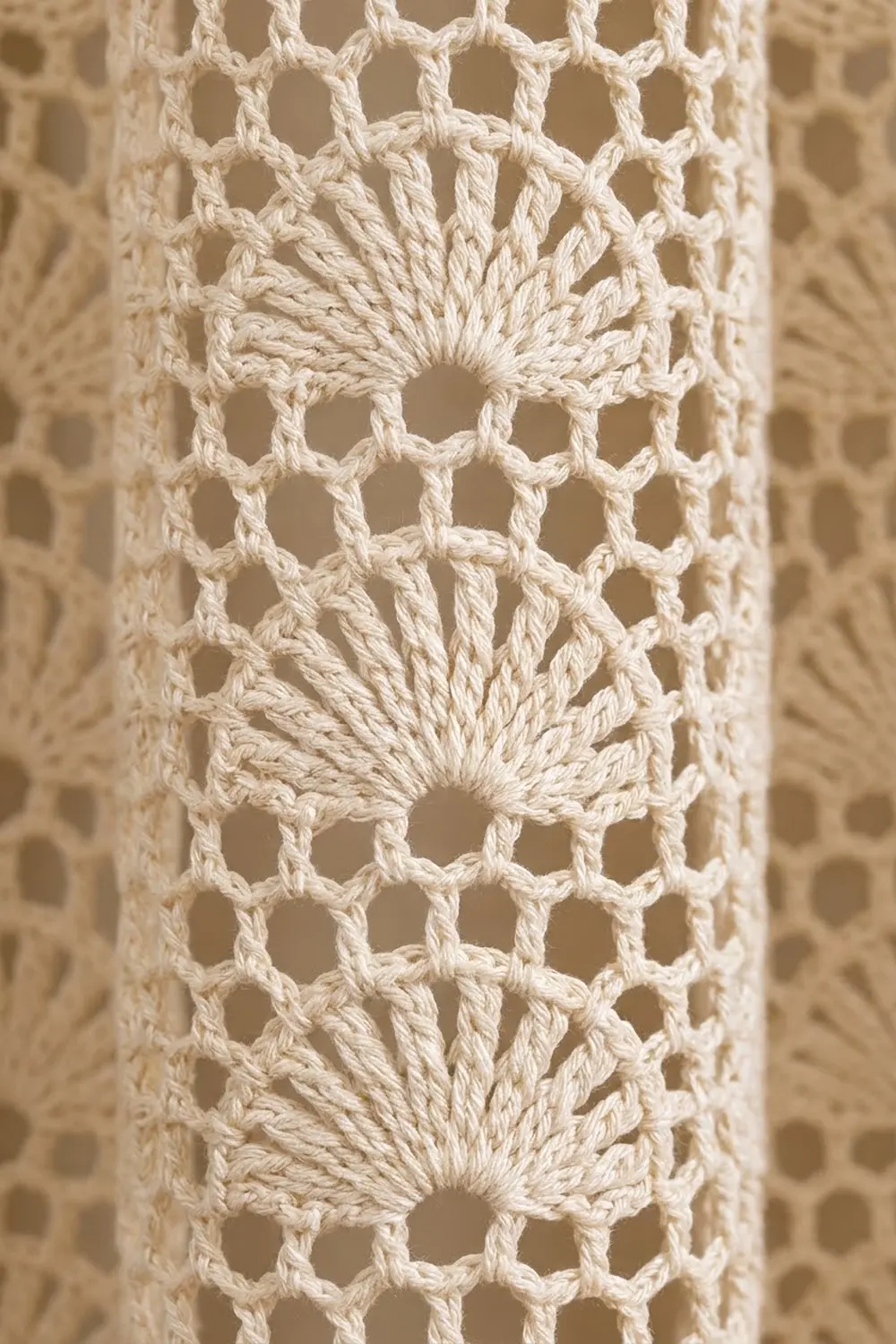
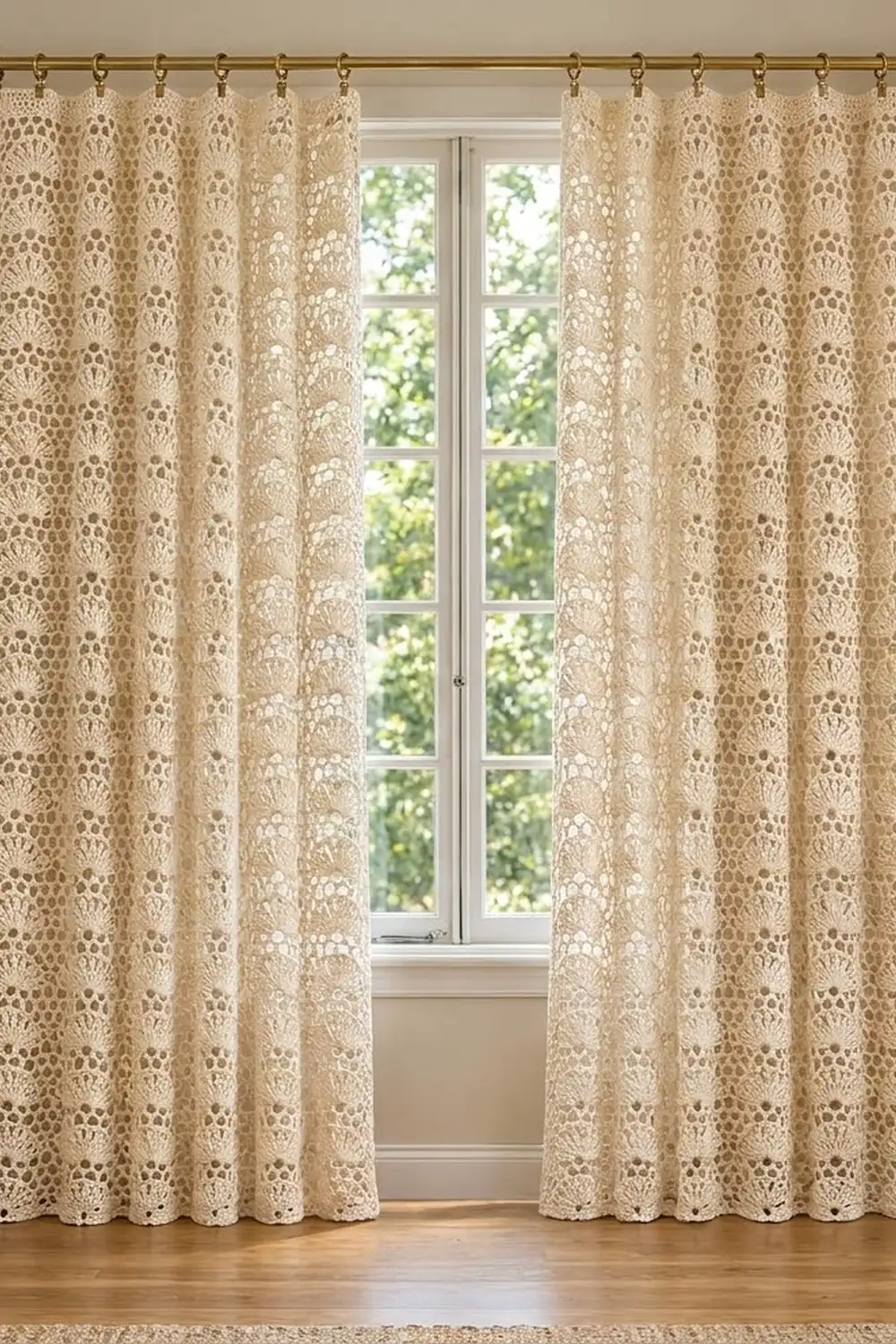
This floor-length curtain panel pairs an airy chain-loop mesh with columns of fan shells. The cream cotton lets light through, and the stacked fans give the panel a gentle vertical rhythm, a little coastal and a little vintage.
The panel is worked in one color, natural cream, which suits any room and shows off the lace. The pattern uses US crochet terms throughout.
Each panel measures 40¼ in (102.2 cm) wide and 84 in (213.4 cm) long after the border and blocking. Most windows need two panels, so you simply make a second identical panel. The two panels are never joined.
Construction is simple. You crochet one rectangle from the bottom up, starting with a foundation row, then repeating a 4-row shell-and-mesh pattern. Next comes a solid single crochet header for the clip rings, and finally a 4-round single crochet border all around.
Finished Size and Construction
- Finished size (one panel): 40¼ x 84 in (102.2 x 213.4 cm)
- Skill level: Intermediate
- Terminology: US crochet terms
- Yarn weight: Worsted (#4) cotton
- Hook: 5 mm (H-8)
- Number of pieces: 1 per panel (make 2 for a pair, hung separately)
- Layout: 9 shell columns across, 40 shell rows from bottom to top
- Piece size before border: 38¼ x 82 in (97.2 x 208.3 cm)
- Border depth: 1 in (2.5 cm) on every side
Materials
Yarn: Use a smooth worsted-weight cotton or cotton blend with about 180 m per 100 g. Cotton holds the shell shapes crisply and survives sunlight and washing better than acrylic. Avoid fuzzy or very splitty yarn, which blurs the mesh.
- Cream: 800 g (approx. 1,440 m) per panel; 1,600 g (approx. 2,880 m) for a pair
These quantities include a margin of roughly 15% for your gauge swatch and small differences in tension.
Tools:
- 5 mm (H-8) crochet hook
- Tapestry needle
- Scissors
- Stitch markers
- Measuring tape
- Rust-proof pins and a large blocking surface (foam mats, a bed, or a clean carpet with a towel)
- Spray bottle
- 10 to 12 curtain clip rings per panel
Abbreviations (US Terms)
- ch – chain
- sc – single crochet
- hdc – half double crochet
- dc – double crochet
- sk – skip
- sp – space
- st(s) – stitch(es)
- RS / WS – right side / wrong side
Special stitch – Shell: Work 7 dc in the same stitch. The shell opens upward like a fan.
Stitch positions: In this pattern each ch counts as one position, just like a stitch. Every row holds 153 positions, so counts stay consistent from row to row.
Gauge and Checkpoints
Body gauge: One 16-st pattern repeat = 4 in (10.2 cm) wide, so 4 positions = 1 in (2.5 cm). One 4-row repeat (Rows 2–5) = 2 in (5.1 cm) tall, so each pattern row is about ½ in (1.3 cm).
Border gauge: 16 sc and 16 rows = 4 in (10.2 cm), so 4 sc = 1 in (2.5 cm) and 4 rounds = 1 in (2.5 cm).
Test one piece first. Make a swatch before committing to a full panel. Ch 42 and work the pattern with 41 positions (2 shell repeats plus the edge mesh). Work Rows 0–1, then repeat Rows 2–5 twice. The swatch should measure 10¼ in (26.0 cm) wide and 4¾ in (12.1 cm) tall. Wet it, pin it, and let it dry before measuring.
Checkpoints for the full panel:
- After Row 1: width 38¼ in (97.2 cm); height ¾ in (1.9 cm)
- After 10 repeats: height 20¾ in (52.7 cm)
- After 20 repeats: height 40¾ in (103.5 cm)
- After 40 repeats: height 80¾ in (205.1 cm)
- After header: 38¼ x 82 in (97.2 x 208.3 cm)
- After border: 40¼ x 84 in (102.2 x 213.4 cm)
If your swatch is too big, go down to a 4.5 mm hook. If it is too small, go up to a 5.5 mm hook. Lace stretches when hung, so measure gently without pulling the swatch.
Panel Pattern
Foundation
Ch 154.
Row 0 (RS): Sc in 2nd ch from hook and in each ch across, turn. (153 sc)
Row 1 (WS, mesh set-up): Ch 2 (counts as hdc throughout), ch 3, sk 3 sc, sc in next sc; repeat from * 36 more times, ch 3, sk 3 sc, hdc in last sc, turn. (39 sts: turning ch, 37 sc, 1 hdc; plus 38 ch-3 sps = 153 positions)
The sc stitches now sit on every 4th position (positions 4, 8, 12 … 148). The shells in the next row land on these anchors.
Main Pattern (4-Row Repeat)
Row 2 (RS, shell row): Ch 2, [ch 3, sc in next sc] twice, Shell in next sc, sc in next sc; repeat from * 8 more times, [ch 3, sc in next sc] once, ch 3, hdc in top of turning ch, turn.
Count: 2 hdc (including turning ch), 28 sc, 9 shells (63 dc), 20 ch-3 sps = 153 positions.
Each shell replaces two ch-3 spaces and their center sc. The 7 dc fill the same 8 positions that “ch 3, sc, ch 3, sc” occupied below, so the width does not change.
Row 3 (WS, mesh row): Ch 2, ch 3, sc in next sc over the plain mesh; over each shell work ch 3, sk 3 dc, sc in 4th (center) dc, ch 3, sk 3 dc, sc in next sc. Continue across, ending ch 3, hdc in top of turning ch, turn. (39 sts, 38 ch-3 sps = 153 positions)
The center-dc anchor pins the top of each fan open and places a sc right above the shell’s center for the next shell row.
Row 4 (RS, mesh row): Ch 2, ch 3, sc in next sc; repeat from * 36 more times, ch 3, hdc in top of turning ch, turn. (39 sts, 38 ch-3 sps)
Row 5 (WS, mesh row): Repeat Row 4. (39 sts, 38 ch-3 sps)
Repeat Rows 2–5 another 39 times, for 40 shell rows in total. You finish on Row 161, a WS mesh row.
The shells always fall at positions 8–16, 24–32, and so on, so they stack straight up in 9 columns. Two mesh loops sit between each pair of columns, and two more sit at each side edge.
Checkpoint: The panel should measure 38¼ in (97.2 cm) wide and 80¾ in (205.1 cm) tall.
Header Band
Row 162 (RS, conversion row): Ch 1, sc in turning ch, 3 sc in next ch-3 sp, sc in next sc; repeat across, ending 3 sc in last ch-3 sp, sc in last hdc, turn.
Count: 39 sc worked 1-per-existing-stitch + 114 sc added in the 38 spaces (3 each) = 153 sc.
Rows 163–166: Ch 1, sc in each sc across, turn. (153 sc)
The header is 5 rows, or 1¼ in (3.2 cm), of solid fabric that grips clip rings without tearing the mesh. Do not fasten off; you will continue straight into the border.
Checkpoint: 38¼ x 82 in (97.2 x 208.3 cm).
Border
The border is 4 rounds of sc, 1 in (2.5 cm) deep. Work with the RS facing. In the counts below, “between corners” means the sts along a side, not including the corner sts. Each round has 4 corner sts in addition.
Side edge rule: Work 2 sc into the end of each pattern row (Rows 1–161) and 1 sc into the end of each sc row (Row 0 and Rows 162–166).
Per side: Row 0 gives 1, Row 1 gives 2, 40 repeats x 8 gives 320, and the header gives 5, for a total of 328 sc.
Round 1: Ch 1. Along the top, 3 sc in first st, sc in next 151 sts, 3 sc in last st. Rotate and work the side edge per the rule above (328 sc). Along the bottom, work into the free loops of the foundation ch: 3 sc in first ch, sc in next 151 ch, 3 sc in last ch. Work the second side (328 sc). Join with sl st to first sc.
Count: top and bottom 153 each between corners; sides 328 each; 4 corners; total 966 sc.
Round 2: Ch 1, sc in each sc around, working 3 sc in each corner sc. Join.
Count: top and bottom 155 each; sides 330 each; 4 corners; total 974 sc.
Round 3: Repeat Round 2.
Count: top and bottom 157 each; sides 332 each; 4 corners; total 982 sc.
Round 4: Repeat Round 2. Fasten off.
Count: top and bottom 159 each; sides 334 each; 4 corners; total 990 sc.
Why the math works: The body gauge of 4 positions per inch matches the sc gauge of 4 sc per inch. So the 153 top stitches span exactly 38¼ in (97.2 cm), and the 328 side stitches span exactly 82 in (208.3 cm). The border lies flat with no ruffling or cupping.
Each round adds 1 sc on each side of every corner, so each side gains 2 sts per round and the round total gains 8. Four rounds at 4 rounds per inch add 1 in (2.5 cm) on all edges. That brings the width to 40¼ in (102.2 cm) and the length to 84 in (213.4 cm).
Final Blocking
- Weave in all ends along the border or header, never across open mesh.
- Soak the panel in cool water with a little wool wash for 15 minutes.
- Press out the water gently. Roll the panel in towels in sections, without wringing.
- Lay it flat on your blocking surface. Working in sections is fine.
- Pin the corners to 40¼ x 84 in (102.2 x 213.4 cm) and check that the diagonals match.
- Pin each shell column straight, and nudge every fan open into a half-circle.
- Pin the header and border edges straight every 4 in (10.2 cm).
- Let the panel dry completely, then unpin it.
- If you can’t lay out the full length, hang the damp panel from its clips over a towel-lined floor and straighten the columns by hand while it dries.
Final Quality-Control Checklist
- Each pattern row holds 153 positions.
- There are 9 shell columns, all straight and vertically aligned.
- There are 40 shell rows, the same in both panels.
- Each fan has exactly 7 dc.
- The header has 5 solid sc rows of 153 sts.
- The border has 990 sc in Round 4.
- The panel measures 40¼ x 84 in (102.2 x 213.4 cm).
- Both panels match in length to within ½ in (1.3 cm).
- All ends are woven in securely.
Troubleshooting
Shells drift sideways: You skipped or added a mesh loop. Count 38 ch-3 sps on every mesh row.
Fans look flat or cupped: In Row 3, anchor the sc into the 4th (center) dc, not the 3rd or 5th.
Side edges wave: Use exactly 2 sc per pattern row-end. Use 1 sc per row-end if your rows are shorter than ½ in (1.3 cm), and adjust all counts to match.
Panel narrows toward the top: Your turning ch may be too tight. Make sure it counts as a full hdc and that the last hdc goes into its top.
Panel grows too long when hung: Cotton lace stretches. Block flat first, and consider 1 fewer repeat if your swatch stretched more than ¼ in (0.6 cm) when hung.
Border ruffles: Your sc gauge is looser than 4 sc per inch. Switch to a hook 0.5 mm smaller for the border.
Care
Hand wash or machine wash cold on a gentle cycle in a mesh bag, then reshape and dry flat. Avoid hot dryers, which can shrink cotton and distort the fans.
Final Notes
The measurement chain is short. Your swatch confirms 4 positions and 4 sc per inch. Row 1 sets the width at 38¼ in (97.2 cm). Forty 2 in (5.1 cm) repeats plus the foundation and header reach 82 in (208.3 cm). The 1 in (2.5 cm) border brings each panel to 40¼ x 84 in (102.2 x 213.4 cm). Make a second panel to the same counts, clip both to your rod, and enjoy the soft light filtering through the shells.
Happy crocheting!