
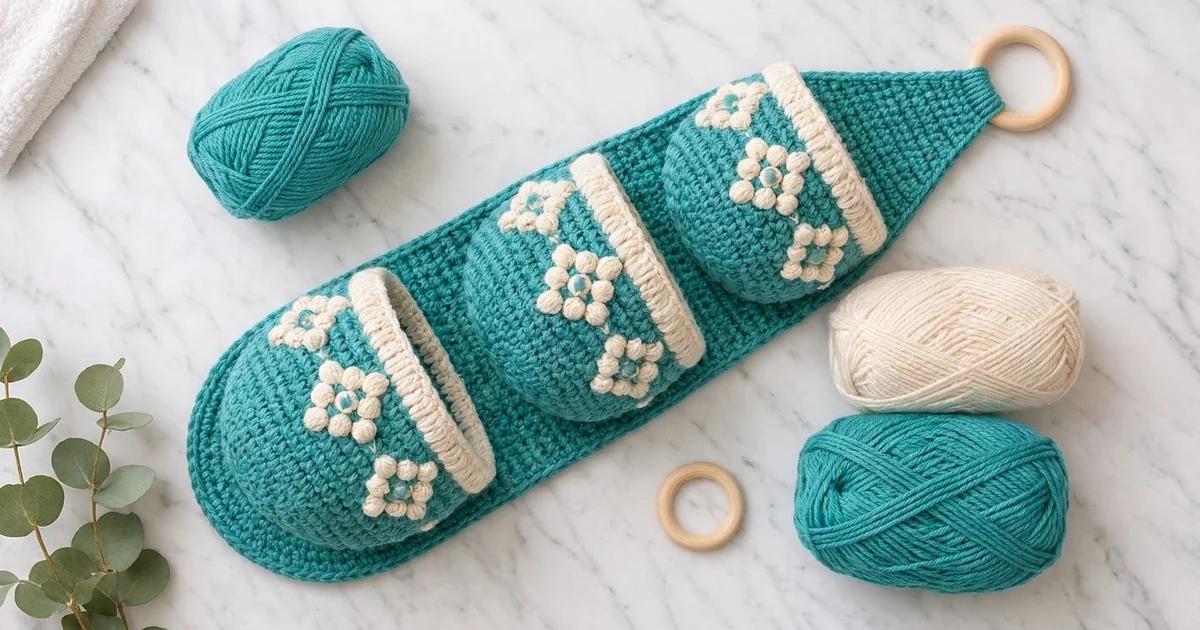
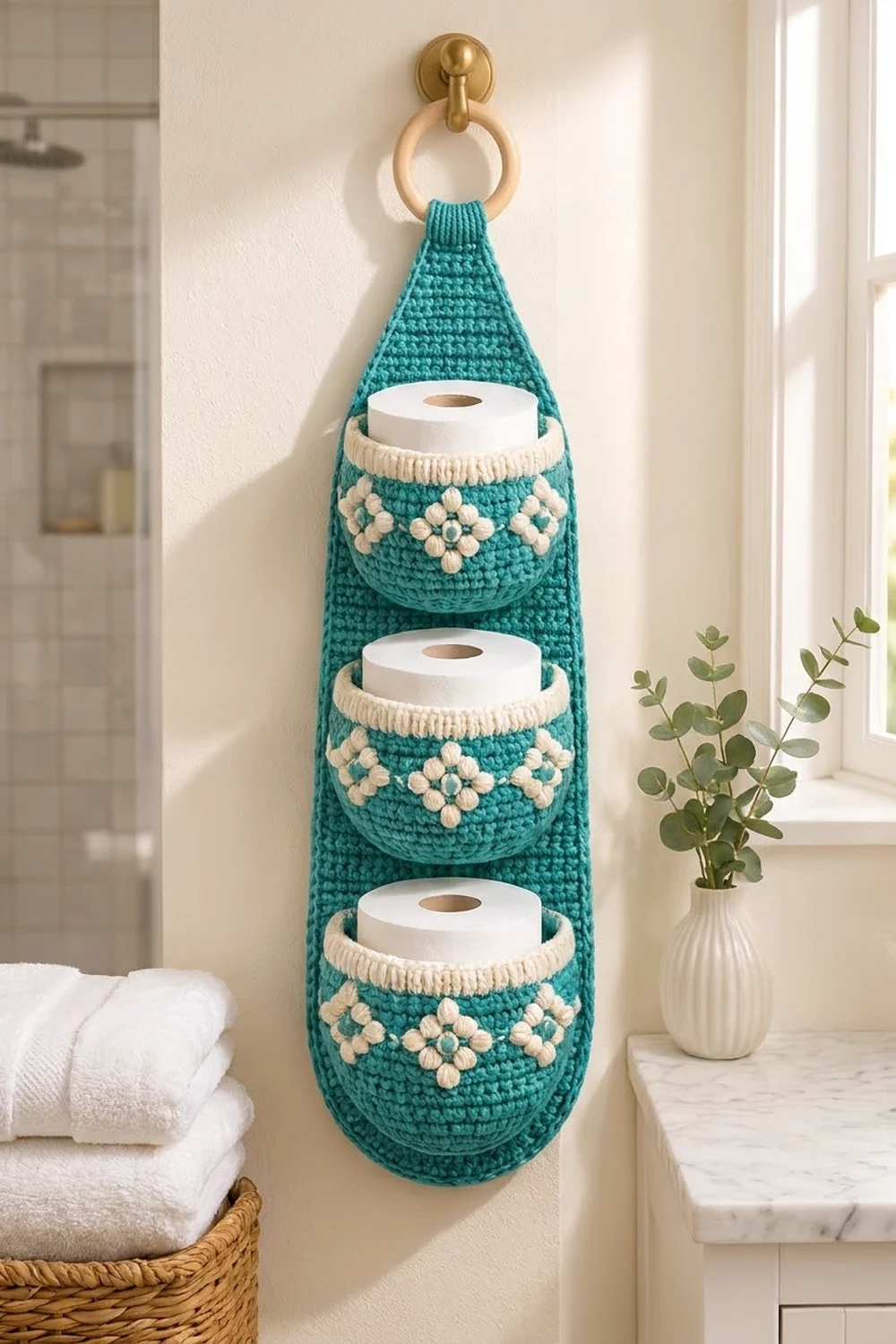
This hanging toilet paper holder keeps three spare rolls neatly within reach and adds a soft pop of color to a bathroom wall. A long teal backing panel hangs from a natural wooden ring. Three deep, round pockets are sewn to the front, one above the other.
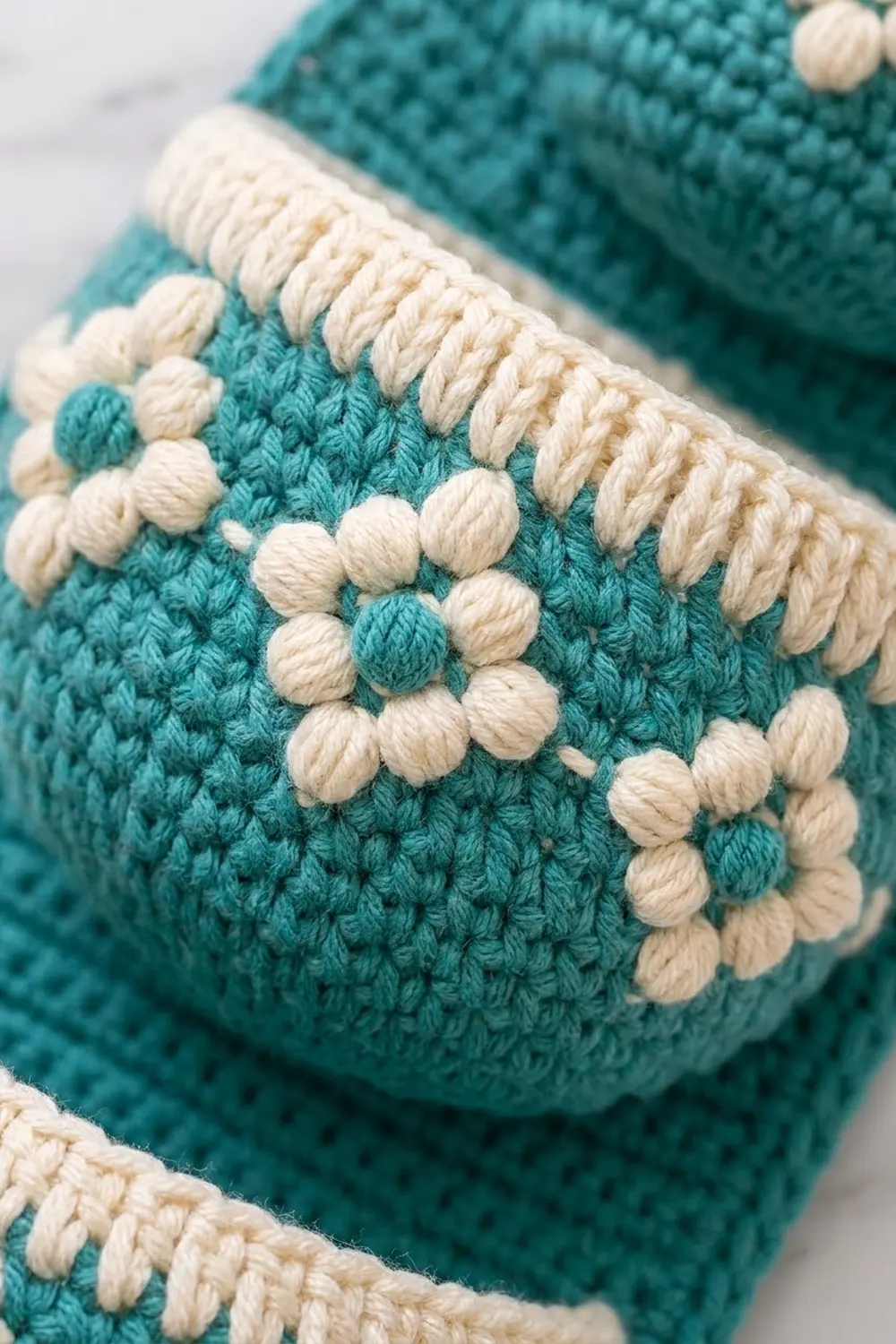
Each pocket has a band of raised cream bobbles arranged in little diamonds, and each diamond has a teal bobble in the center. Small cream dots link one diamond to the next, and a thick cream rim with a roped texture finishes each pocket. The style is fresh and coastal: teal, cream, and natural wood.
The pattern uses US crochet terms. The finished holder is about 6.75 in (17.1 cm) wide and 20.5 in (52.1 cm) long from the bottom edge to the top of the strap. With the ring, it is about 22 in (55.9 cm) long. Each pocket is about 4.75 in (12.1 cm) across and 4 in (10.2 cm) tall.
Here’s how it’s built. You work three pockets in joined rounds from the base up, turning for the bobble rounds so the bobbles pop to the outside. The panel is worked flat in rows from the bottom up. After you sew the pockets to the panel, you work a two-round border around the panel and fold the strap over the ring.
Finished Size and Construction
- Finished size: about 6.75 in (17.1 cm) wide x 20.5 in (52.1 cm) long; about 22 in (55.9 cm) long including the ring
- Skill level: Intermediate
- Terminology: US crochet terms
- Yarn weight: worsted (#4) cotton
- Hook: 4.5 mm (US 7)
- Number of pieces: 4 (1 backing panel, 3 pockets)
- Layout: 1 column of 3 pockets, centered on the panel
- Pocket size: 4.75 in (12.1 cm) across x 4 in (10.2 cm) tall
- Panel size before border: 6 in (15.2 cm) wide x 18.4 in (46.7 cm) from the bottom edge to the start of the strap
- Border depth: about 0.375 in (1.0 cm), 2 rounds
Materials
Use a smooth, firm worsted-weight cotton or cotton blend. Cotton holds the pocket shape well, and you can wash it. Avoid fuzzy or very stretchy yarns, because they make the bobbles less defined and the pockets will sag under the weight of a roll.
- Teal (main color): 350 g / about 595 m
- Cream (contrast color): 100 g / about 170 m
Both quantities include a safety margin of about 15 percent.
Tools:
- 4.5 mm (US 7) crochet hook
- 1 wooden ring, 2 in (5.1 cm) outer diameter
- Tapestry needle
- 6 or more stitch markers
- Scissors
- Measuring tape
- Rust-proof pins for blocking
Abbreviations (US Terms)
- ch – chain
- sc – single crochet
- inc – 2 sc in the same stitch
- sc2tog – single crochet 2 together (decrease)
- sl st – slip stitch
- rev sc – reverse single crochet (crab stitch), worked from left to right
- MR – magic ring
- st(s) – stitch(es)
- Rnd – round
- RS / WS – right side / wrong side
Special stitch – bobble: Yarn over, insert hook in the stitch, yarn over and pull up a loop, then yarn over and draw through 2 loops. Repeat 3 more times in the same stitch (5 loops on hook). Yarn over and draw through all 5 loops. A bobble counts as 1 stitch. Bobbles pop out on the side facing away from you, so you always work them on WS rounds.
Gauge and Checkpoints
Gauge: 16 sc x 18 rows = 4 in (10.2 cm) in single crochet worked flat.
Make one pocket first and use it as your gauge piece. It is small, and it tells you right away whether a roll will fit.
- After Rnd 8: the flat circle (48 sts) measures about 3.75 in (9.5 cm) across.
- After Rnd 12: the circumference (60 sts) measures 15 in (38.1 cm).
- Finished pocket: 4.75 in (12.1 cm) across and 4 in (10.2 cm) tall.
- Panel after Row 7: 6 in (15.2 cm) wide.
- Panel after Row 65: 14.4 in (36.6 cm) long.
- Panel after Row 83: 18.4 in (46.7 cm) long.
If your pieces come out too big, go down half a hook size. If they come out too small, go up half a hook size. A standard roll is about 4.5 in (11.4 cm) across and 4.1 in (10.4 cm) tall, so the pocket should be a little wider than the roll and slightly shorter than it.
Pocket (Make 3)
You work each pocket in joined rounds with the RS facing out. At the end of every round, join with a sl st to the first st and ch 1. The ch 1 does not count as a stitch. Start the next round in the same st as the join. Keep the seam lined up, because it becomes the back of the pocket.
Base and curve (teal):
- Rnd 1: 6 sc in MR, join. (6)
- Rnd 2: inc in each st, join. (12)
- Rnd 3: *sc 1, inc; rep from * around, join. (18)
- Rnd 4: *sc 2, inc; rep from * around, join. (24)
- Rnd 5: *sc 3, inc; rep from * around, join. (30)
- Rnd 6: *sc 4, inc; rep from * around, join. (36)
- Rnd 7: *sc 5, inc; rep from * around, join. (42)
- Rnd 8: *sc 6, inc; rep from * around, join. (48)
- Rnd 9: sc in each st, join. (48)
- Rnd 10: *sc 7, inc; rep from * around, join. (54)
- Rnd 11: sc in each st, join. (54)
- Rnd 12: *sc 8, inc; rep from * around, join. (60)
Spacing the last increases between even rounds is what gives the pocket its rounded bowl bottom instead of a sharp corner.
- Rnds 13–15: sc in each st, join. (60)
Bobble band: Join cream at the start of Rnd 16. In Rnds 16–20, carry the unused color inside the stitches by working over it. Turn after each join in these rounds. On WS rounds, you work the stitches in reverse order, so the counts below are given in the order you work them.
- Rnd 16 (WS): ch 1, turn. *With teal sc 5, with cream bobble, with teal sc 4; rep from * 5 more times, join. (60: 54 sc + 6 bobbles)
- Rnd 17 (RS): ch 1, turn. With teal, sc in each st, join. (60)
- Rnd 18 (WS): ch 1, turn. *With cream sc 1; with teal sc 2; with cream bobble; with teal sc 1, bobble, sc 1; with cream bobble; with teal sc 2; rep from * 5 more times, join. (60: 6 cream sc + 36 teal sc + 12 cream bobbles + 6 teal bobbles)
- Rnd 19 (RS): ch 1, turn. With teal, sc in each st, join. (60)
- Rnd 20 (WS): ch 1, turn. Repeat Rnd 16, then cut cream. (60)
- Rnd 21 (RS): ch 1, turn. sc in each st, join. (60)
The bobbles in Rnds 16 and 20 sit directly below and above the teal center bobble of Rnd 18. The two cream bobbles in Rnd 18 are 2 sts to either side of it, so together they form a diamond. The cream sc in Rnd 18 falls halfway between two diamonds and makes the linking dot.
- Rnd 22: do not turn. sc in each st, join. (60) Fasten off teal.
Rim (cream):
- Rnds 23–24: join cream. sc in each st, join. (60)
- Rnd 25: ch 1, rev sc in each st, join. (60) Fasten off and leave a 24 in (61.0 cm) tail for sewing.
The rim is 3 rounds of cream: 2 rounds of sc to build height and 1 round of rev sc for the roped edge. Weave in all ends except the sewing tail.
Backing Panel
Work in teal in rows. Ch 1 and turn at the end of each row. The turning ch does not count as a stitch.
Rounded bottom:
- Row 1: ch 13, sc in 2nd ch from hook and in each ch across. (12)
- Rows 2–7: 2 sc in the first st, sc to the last st, 2 sc in the last st. (Row 2: 14, Row 3: 16, Row 4: 18, Row 5: 20, Row 6: 22, Row 7: 24)
Checkpoint: 6 in (15.2 cm) wide.
Straight section:
- Rows 8–65: sc in each st. (24)
Checkpoint: 14.4 in (36.6 cm) long.
Taper:
- Row 66: sc2tog, sc 20, sc2tog. (22)
- Row 67: sc in each st. (22)
- Rows 68–83: repeat Rows 66–67, each time working 2 fewer sc between the decreases. Row 68: 20, Row 70: 18, Row 72: 16, Row 74: 14, Row 76: 12, Row 78: 10, Row 80: 8, Row 82: 6. Rows 69–83 (odd): no decrease, so each one keeps the count of the row before it. (Row 83: 6)
Checkpoint: 18.4 in (46.7 cm) long.
Strap:
- Rows 84–99: sc in each st. (6)
The strap is 1.5 in (3.8 cm) wide and 3.5 in (8.9 cm) long. Don’t fasten off. Keep the loop on a marker for the border.
Make All Pieces
- Teal: 1 backing panel and the bodies of 3 pockets
- Cream: bobble motifs and rims on 3 pockets
Layout (front view, top to bottom):
      [ ring ]
      [ strap ]
     /  taper  \
   | Pocket 3  |   rim on panel Row 62
   | Pocket 2  |   rim on panel Row 42
   | Pocket 1  |   rim on panel Row 22
    \_________/
Joining
Sew the pockets to the panel with the rim tails, using a whipstitch through both loops.
- Lay the panel RS up. Mark the 12 center stitches (sts 7–18) of Rows 22, 42, and 62. That leaves 6 stitches free on each side.
- Place Pocket 1 on the panel with the round seam at the back. Mark the 12 rim stitches centered on the seam: the last 6 and the first 6 sts of Rnd 25.
- Stitch to stitch: sew those 12 rim stitches to the 12 marked panel stitches of Row 22, 1 rim stitch to 1 panel stitch.
- Sew straight down the pocket’s back seam to Rnd 12. Then sew the 12 stitches of Rnd 12 centered on the seam to the panel in a gentle arc around Row 4.
- Repeat with Pocket 2 at Row 42 and Pocket 3 at Row 62.
Tension: pull each stitch snug, but not so tight that the panel puckers. The panel should still lie flat when you lift the pocket.
Size checkpoint: each pocket hangs about 0.625 in (1.6 cm) in from each panel edge. There is a gap of about 0.4 in (1.0 cm) between pockets. The top rim sits about 0.5 in (1.3 cm) below where the taper starts.
Border
Border gauge: 4 sc per 1 in (2.5 cm), the same as the body gauge. Row ends are shorter than stitches (18 rows vs 16 sts per 4 in), so work 8 sc into every 9 row ends.
Rnd 1 (teal): with the loop from Row 99, ch 1. Work the sections below in order, then join with a sl st to the first sc.
- Strap top (Row 99): 3 sc in the first st, sc 4, 3 sc in the last st. (10)
- Side 1 (99 row ends): *sc in each of the next 8 row ends, skip 1; rep from * 10 more times. (88)
- Bottom (12 foundation ch loops): 2 sc in the first loop, sc 10, 2 sc in the last loop. (14)
- Side 2: work as Side 1. (88)
Total: 10 + 88 + 14 + 88 = 200.
Rnd 2 (teal): ch 1, rev sc in each st, join. (200) Fasten off.
Why the math works: 99 rows at 18 rows per 4 in come to 22 in (55.9 cm). 88 sc at 4 sc per inch also come to 22 in (55.9 cm), so the long edges stay flat with no ruffling or pulling. The corner stitches are already inside the strap-top and bottom counts, so they aren’t counted twice.
Fold the strap: pass the strap through the wooden ring to the WS. Fold it so Row 99 meets Row 84 on the back and whipstitch it in place. About 1.75 in (4.4 cm) of strap shows above the taper.
Final Blocking
- Wet the whole holder in cool water and gently squeeze it out. Don’t wring it.
- Roll it in a towel to remove extra water.
- Pin the panel flat, RS up, at 6.75 in (17.1 cm) wide and 20.5 in (52.1 cm) long.
- Put a toilet roll wrapped in a plastic bag into each pocket so the pocket dries in a round shape.
- Shape each rim with your fingers so it stands straight up.
- Leave it until it is completely dry, then remove the pins and rolls.
Final Quality-Control Checklist
- Every pocket has 60 sts in each round from Rnd 12 through Rnd 25.
- Each pocket shows 6 diamonds, each with a teal center bobble.
- All bobbles point outward.
- The pocket seams are hidden against the panel.
- The panel is 6.75 in (17.1 cm) wide along its whole straight section.
- The border has exactly 200 sts and lies flat.
- The strap is firmly sewn and the ring doesn’t slip.
- All ends are woven in securely.
Troubleshooting
- Bobbles point inward: you worked them on a RS round. Rip back and turn so the WS faces you.
- Diamonds don’t line up: check your stitch count after each motif round. It must stay at 60.
- The roll won’t fit: your gauge is too tight. Go up half a hook size, or add a repeat of Rnd 11 before Rnd 12.
- The pocket is floppy: your gauge is too loose. Go down half a hook size.
- Border edges ruffle: skip 1 row end every 7 instead of every 9.
- Border edges pull in: work 1 sc into every row end.
- The panel bows outward: the pocket seams are too tight. Re-sew them with an even tension.
Care
Hand wash in cool water with mild soap and lay flat to dry, with a roll in each pocket. Keep the holder away from direct sources of moisture so it dries quickly between uses.
Final Notes
Each measurement leads to the next. Your gauge of 16 sc x 18 rows = 4 in (10.2 cm) gives a 60-stitch pocket that measures 15 in (38.1 cm) around and 4.75 in (12.1 cm) across. The 24-stitch panel is 6 in (15.2 cm) wide and 18.4 in (46.7 cm) long before the strap. The 200-stitch border adds about 0.375 in (1.0 cm) on each edge, so the finished holder is 6.75 in (17.1 cm) wide and 20.5 in (52.1 cm) long. Check these numbers as you go and the pockets will line up and hold their rolls neatly.
Happy crocheting!