

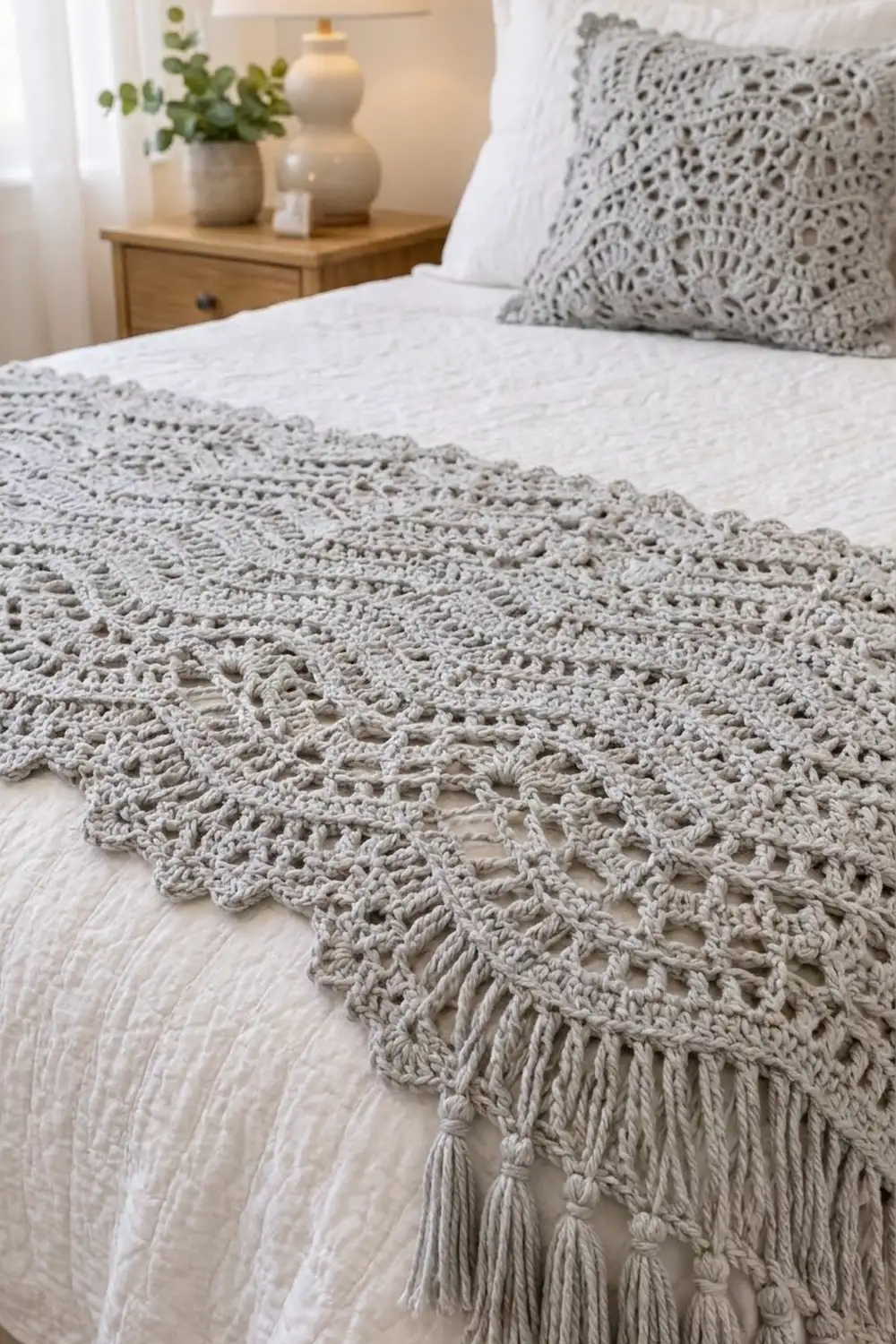
The Silver Tide Bed Runner is a long, wavy lace runner that lies across the foot of a bed. Soft ripples run its whole length. Solid double crochet bands alternate with airy mesh rows and fan rows, so the texture looks a little like low tide on sand.
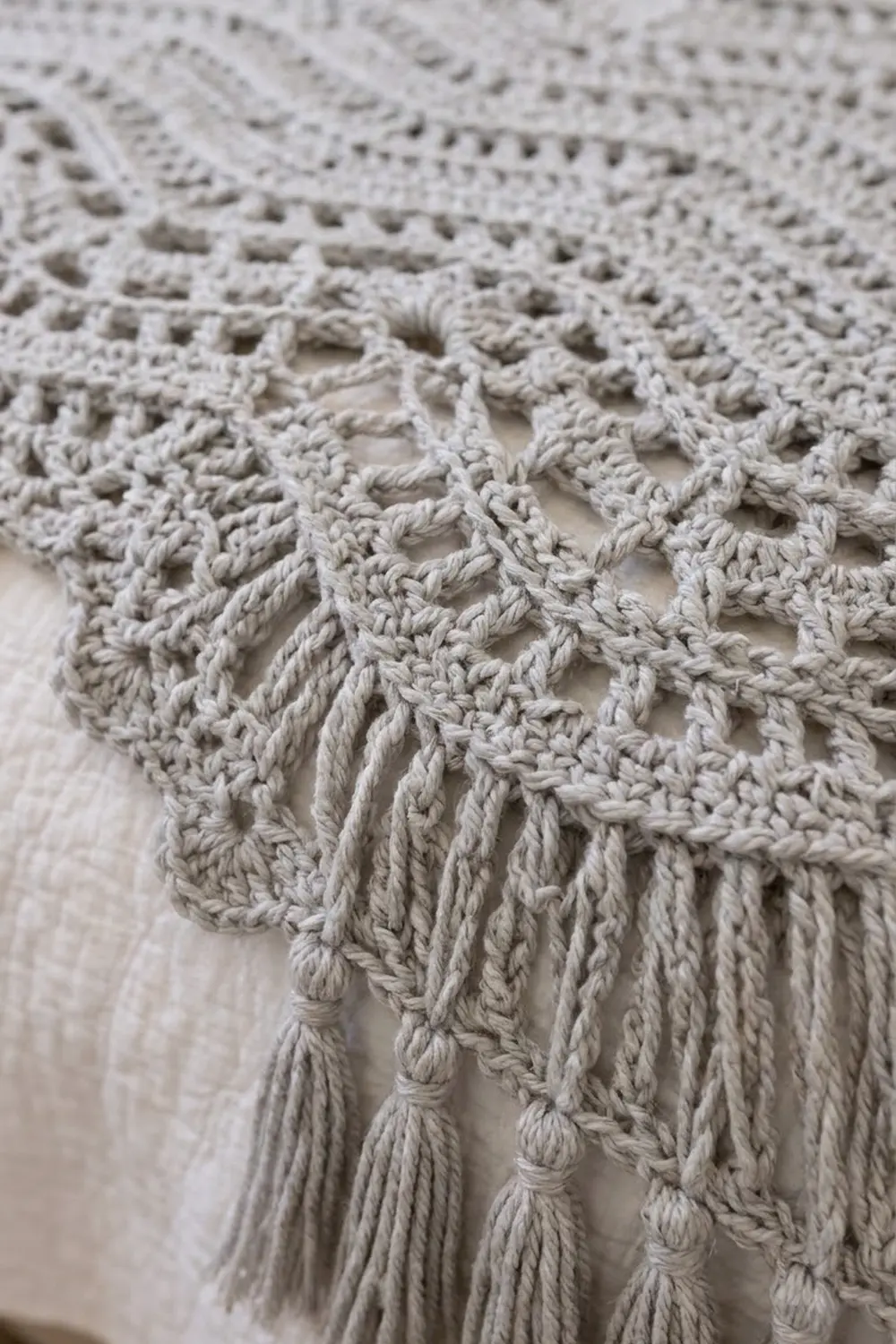
It is worked in a single light heather gray, which makes it easy to pair with white or neutral bedding. A small shell scallop edges both long sides. A row of plump tassels hangs from one long edge so it can drape over the end of the bed.
All instructions use US crochet terms. The finished runner measures about 89 x 19 in (226.1 x 48.3 cm) without the tassels and about 89 x 24 in (226.1 x 61.0 cm) with them.
The runner is made in one piece. You work rows back and forth along the full length, using a 14-stitch ripple repeat that never changes the stitch count. Next you work a two-round border with scallops on the long sides, and to finish you add the tassels to one long edge.
Finished Size and Construction
- Finished size: 89 x 19 in (226.1 x 48.3 cm), plus 5 in (12.7 cm) tassels
- Skill level: Intermediate
- Terminology: US crochet terms
- Yarn weight: Worsted (#4, medium)
- Hook: 5.5 mm (US I-9)
- Number of pieces: 1
- Layout: One long rectangle, worked lengthwise in rows
- Piece size before border: 88 x 17 in (223.5 x 43.2 cm)
- Border depth: 1 in (2.5 cm) on each long side, 0.5 in (1.3 cm) on each short side
Materials
Yarn: Use a smooth worsted-weight yarn with good stitch definition. An acrylic-wool or cotton-acrylic blend drapes nicely over a bed and is easy to wash. Avoid fuzzy yarns, because they hide the fan and mesh details.
- Light heather gray: 500 g / 1000 m (about 5 skeins of 100 g / 200 m)
- Body: about 650 m
- Border: about 60 m
- Tassels: about 145 m
These quantities include a margin of about 15% for swatching and dye-lot safety. Buy every skein from the same dye lot.
Tools:
- 5.5 mm (US I-9) crochet hook
- Yarn needle
- Scissors
- Stitch markers (at least 25)
- A 5 in (12.7 cm) tall piece of stiff card for the tassels
- Tape measure
- Blocking mats or a large clean floor area, rustproof pins, and a spray bottle
Abbreviations (US Terms)
- ch: chain
- sc: single crochet
- dc: double crochet
- dc2tog: double crochet 2 together (1 st made from 2)
- dc3tog: double crochet 3 together (1 st made from 3)
- sk: skip
- st(s): stitch(es)
- sp: space
- rep: repeat
Special stitches:
- Fan: 7 dc in the same st.
- Shell: 5 dc in the same st.
- Peak: the center st of each wave, where stitches are increased.
- Valley: the low point of each wave, where stitches are decreased.
Counting rule: Every ch-1 in the body counts as 1 st. Every row of the body has 309 sts. The ch-2 at the start of a row is a turning chain only. It does not count as a st and is never worked into.
Gauge and Checkpoints
Gauge: In Row A (the solid ripple row), 14 sts (one peak-to-peak wave) = 4 in (10.2 cm). Eight pattern rows = 4 in (10.2 cm) tall, so each pattern row is about 0.5 in (1.3 cm).
Test one piece first. Before you chain 310, make a swatch. Ch 30 and work Rows 1–9 below over 29 sts (2 wave repeats). The swatch should measure about 8.25 in (21.0 cm) wide and 4.25 in (10.8 cm) tall after a light steam.
- Swatch too big: Go down to a 5 mm (H-8) hook.
- Swatch too small: Go up to a 6 mm (J-10) hook.
- Width right but height wrong: Check the height of your dc. Pull the first loop up to full height rather than changing hooks.
Body checkpoints (measure flat, peak to peak, without stretching):
- After Row 1: about 88 in (223.5 cm) long
- After Row 9: 4.25 in (10.8 cm) tall
- After Row 17: 8.25 in (21.0 cm) tall
- After Row 25: 12.25 in (31.1 cm) tall
- After Row 33: 16.25 in (41.3 cm) tall
- After Row 35: 17 in (43.2 cm) tall
Body
The body uses a 14-st repeat plus 1 edge st, for 309 sts (22 waves). Place a marker in every peak st on Row 2 and move it up as you go. Markers make each wave easy to track along such a long row.
Foundation: Ch 310 loosely. If your chain tends to be tight, use a hook one size larger for the chain only.
Row 1 (RS): Sc in 2nd ch from hook and in each ch across. Turn. (309 sts)
Row 2 (Row A, solid ripple): Ch 2 (does not count as a st), dc2tog over first 2 sts. Dc in next 5 sts, 3 dc in next st (peak), dc in next 5 sts, dc3tog over next 3 sts (valley). Rep from * 20 more times. Then dc in next 5 sts, 3 dc in next st, dc in next 5 sts, dc2tog over last 2 sts. Turn. (309 sts)
How the count works: the edges use 2 + 2 sts and make 1 + 1. Each repeat uses 14 sts and makes 14 (5 + 3 + 5 + 1). The peak adds 2 and the valley removes 2, so the count stays at 309 and the waves form.
Row 3 (Row B, lace ripple): Ch 2, dc2tog over first 2 sts. [Dc in next st, ch 1, sk next st] twice, dc in next st; (dc, ch 1, dc) in next st (peak); [dc in next st, ch 1, sk next st] twice, dc in next st; dc3tog over next 3 sts. Rep from * 20 more times. Then work the leg, peak, and leg once more, and dc2tog over last 2 sts. Turn. (309 sts)
Each leg uses 5 sts and makes 5 (3 dc + 2 ch). Each peak makes 3. This creates the open mesh bands.
Row 4 (Row A): Work as Row 2. Work into each st and each ch-1 so that every ch counts as 1 st. (309 sts)
Row 5 (Row C, fan row): Ch 2, dc2tog over first 2 sts. Ch 1, sk next 2 sts, sc in next st, ch 1, sk next 2 sts; fan in next st (peak); ch 1, sk next 2 sts, sc in next st, ch 1, sk next 2 sts; dc3tog over next 3 sts. Rep from * 20 more times. Then work the leg, fan, and leg once more, and dc2tog over last 2 sts. Turn. (309 sts)
Each leg uses 5 sts and makes 3 (ch, sc, ch). The fan makes 7 and the valley makes 1, so each repeat still makes 14. The legs are shorter than the fans, which gives each fan its open, rising arch.
Rows 6–33: Rep Rows 2–5 seven more times. That makes eight 4-row repeats in total. (309 sts on every row)
Row 34 (Row A): Work as Row 2. In each fan from the previous row, the 4th (center) dc becomes the peak st. (309 sts)
Row 35: Ch 1 (does not count), sc in each st across. (309 sts) Do not fasten off.
Check: the body is 88 x 17 in (223.5 x 43.2 cm).
Border
Border gauge: Along the long edges, 4 sts = about 1.15 in (2.9 cm), so one scallop covers 4 sts. On the short edges, work 4 sc per 1 in (2.5 cm) of row ends.
Round 1: With the RS facing, ch 1 and work along the top long edge. Sc in each of 309 sts, then ch 2 for the corner. Along the short edge, work 1 sc in the end of Row 35, 2 sc in the end of each of Rows 34–2 (33 rows = 66 sc), and 1 sc in the end of Row 1. That gives 68 sc. Ch 2 for the corner. Along the bottom long edge, sc in each of the 309 foundation ch loops, then ch 2. Along the second short edge, work 68 sc as before, then ch 2. Join with sl st to the first sc.
- Per side: long sides 309 sc each, short sides 68 sc each. The corners are ch-2 spaces only, so there are no separate corner stitches.
- Total: 754 sc + 4 ch-2 sps.
Round 2: Sl st into the next ch-2 corner sp (top left corner). Work (sc, ch 2, sc) in the corner sp. Along the long side, sc in first sc, sk 1 st, shell in next st, sk 1 st, sc in next st. Rep from * 76 more times, for 77 shells. In the corner sp, work (sc, ch 2, sc). Along the short side, sc in each of 68 sc. Work the next corner, the second long side, and the second short side in the same way. Join with sl st to the first sc.
- Long sides: 1 corner sc + 78 sc + 385 dc (77 shells) + 1 corner sc = 465 sts each
- Short sides: 1 corner sc + 68 sc + 1 corner sc = 70 sts each
- Total: 1070 sts + 4 ch-2 sps
Why the math works: each scallop uses 4 sts and needs 1 starting sc, so a long side needs 4 x 77 + 1 = 309 sts. That matches the 309-st body exactly. Each corner sc is counted only once, as part of the side it begins or ends. Fasten off and weave in the ends.
Tassel fringe (one long edge only): Choose the bottom (foundation) edge. Wrap yarn 12 times around the 5 in (12.7 cm) card. Slide a 10 in (25.4 cm) strand under the wraps at the top and tie it tightly. Cut the wraps at the bottom. Wrap a second strand 6 times around the bundle, 0.75 in (1.9 cm) below the top, to form the neck. Knot it and hide the ends inside the tassel. Make 39 tassels.
Use the top-tie tails to attach one tassel to the center (3rd) dc of shells 1, 3, 5, and so on through shell 77. That places a tassel on every other shell, about 2.25 in (5.7 cm) apart. Knot the tails on the WS and bury them. Trim all tassels to an even 5 in (12.7 cm).
Final Blocking
- Lay the runner on mats or a clean floor with the RS up and the tassels hanging free past the edge.
- Pin the long sides to 89 in (226.1 cm). Pin the short sides to 19 in (48.3 cm).
- Pin the top of each shell so the scallops sit in a smooth curve.
- Ease each wave so the peaks line up with the markers, and keep peak-to-peak spacing at 4 in (10.2 cm).
- Open each fan so its 7 dc spread evenly.
- Mist until damp, or steam lightly from above for acrylic blends. Do not press.
- Leave it to dry completely before unpinning.
- Steam the tassels and comb them straight with your fingers. Retrim if needed.
Final Quality-Control Checklist
- Every body row has 309 sts.
- There are 22 peaks and 21 full valleys in each row, and the peaks line up row to row.
- Each fan sits directly above a peak.
- Round 1 has 309 / 68 / 309 / 68 sc.
- Round 2 has 77 shells on each long side.
- There are 39 tassels, all 5 in (12.7 cm) long and evenly spaced.
- After blocking the runner measures 89 x 19 in (226.1 x 48.3 cm).
- All ends are woven in securely.
Troubleshooting
- Waves drift or lean: You likely missed a peak or a valley. Count back to your markers and frog to the error.
- Stitch count is off by 2: Check for a peak made as 2 dc instead of 3, or a valley worked as dc2tog instead of dc3tog.
- Foundation edge pulls in: The chain is too tight. Remake it with a larger hook, or block the edge harder.
- Scallops ruffle: Use 4 dc in place of 5 in each shell, keeping the count of 77 shells.
- Short ends flare: Work 3 sc per 2 dc row ends on Round 1 in place of 2 per row. Keep the same count on both ends.
- Tassels look thin: Wrap 14 times in place of 12. Allow about 15 m extra yarn.
Care
Machine wash cold on a gentle cycle inside a mesh bag, or hand wash, depending on the yarn label. Dry flat and reshape the waves and tassels while damp.
Final Notes
Each measurement depends on the one before it:
- 14 sts = one 4 in (10.2 cm) wave.
- 22 waves give an 88 in (223.5 cm) body length, and 35 rows give 17 in (43.2 cm) of height.
- The 309-st edges support exactly 77 scallops.
- The border brings the runner to 89 x 19 in (226.1 x 48.3 cm), with 5 in (12.7 cm) tassels below.
If your swatch is correct, the rest of the measurements will be too.
Happy crocheting!