

The Snowstar Lace Table Runner is made from star-shaped lace motifs joined into one airy strip. Each motif has a small open center ring surrounded by sixteen spokes. Eight are solid, ribbed spindle petals and eight are slender double-chain spokes, and every spoke ends in a tiny three-picot trefoil.
The runner is worked in one color, a soft cream cotton, so the texture does all the work. Short doubled chain bars join neighboring motifs. Where four motifs meet, those bars frame rounded open windows, so the runner looks like a row of snowflakes caught in a net. Three chunky cream tassels hang from each short end.
This pattern uses US crochet terms. The finished runner measures 18 in x 36 in (45.7 cm x 91.4 cm) before tassels, or about 18 in x 46 in (45.7 cm x 116.8 cm) with 5 in (12.7 cm) tassels at both ends.
Here is how it comes together. You crochet the first motif on its own. The other 17 motifs are joined as you go in their final round. One light chain edging round steadies the outside edge, and the tassels go on last.
Finished Size and Construction
- Finished size: 18 in x 36 in (45.7 cm x 91.4 cm), without tassels
- Skill level: Intermediate
- Terminology: US crochet terms
- Yarn weight: Worsted weight (#4) cotton
- Hook: 4.0 mm (US G-6)
- Number of pieces: 18 motifs + 6 tassels
- Layout: 3 motifs wide x 6 motifs long
- Motif size: 6 in (15.2 cm) from trefoil tip to opposite trefoil tip
- Size before border: 18 in x 36 in (45.7 cm x 91.4 cm)
- Border depth: about 0 in (0 cm). The edging is worked along the tip line, so it steadies the edge without making the runner larger.
Materials
Yarn: Choose a smooth, mercerized or combed worsted-weight cotton. It shows off the petal ribs and picots, and it blocks crisply. Acrylic will work, but it relaxes more and the trefoils lose definition.
- Cream: 250 g (440 m), for example 5 balls of 50 g / 88 m
- Motifs: about 144 g (252 m), roughly 8 g (14 m) per motif
- Edging: about 15 g (26 m)
- Tassels: about 42 g (74 m), roughly 7 g (12 m) each
These quantities include a margin of about 25% for swatching and tension differences.
Tools:
- 4.0 mm (US G-6) crochet hook
- Tapestry needle
- Scissors
- Stiff card 5.5 in (14.0 cm) tall, for tassels
- Rustproof pins and a blocking board at least 20 in x 38 in (50.8 cm x 96.5 cm)
- Spray bottle
- Measuring tape
Abbreviations (US Terms)
- ch – chain
- sl st – slip stitch
- sc – single crochet
- hdc – half double crochet
- dc – double crochet
- st(s) – stitch(es)
- rnd – round
- RS – right side
Special stitches:
- Picot: ch 3, sl st in 3rd ch from hook.
- Trefoil: [picot] 3 times, then sl st in the last spine ch made before the picots. This pulls the three picots into a cluster.
- Picot join (PJ): ch 1, sl st in the named picot of the finished motif, ch 1, sl st in the first of these 2 ch. Use it in place of one picot.
- Short bar (SB): ch 2, sl st in the named picot of the finished motif, ch 2, sl st in the first of these 4 ch. Use it in place of one picot.
- Long bar (LB): ch 5, sl st in the named picot of the finished motif, ch 5, sl st in the first of these 10 ch. Use it in place of one picot. It makes a doubled chain bar about 1.75 in (4.4 cm) long.
Gauge and Checkpoints
Make one full motif and block it before you start the runner. Gauge matters here because the motifs join tip to tip, so any error is repeated 18 times.
- After Rnd 2: the ring measures 2 in (5.1 cm) across, with a center hole of about 0.5 in (1.3 cm).
- Spine check: 10 ch measure about 1.75 in (4.4 cm).
- After Rnd 3, blocked: the motif measures 6 in (15.2 cm) from trefoil tip to opposite trefoil tip.
If your motif is too big, go down to a 3.75 mm (US F-5) hook. If it is too small, go up to a 4.5 mm (US 7) hook. Change hooks before you change any chain counts, because the joining bars are sized to a 6 in (15.2 cm) motif.
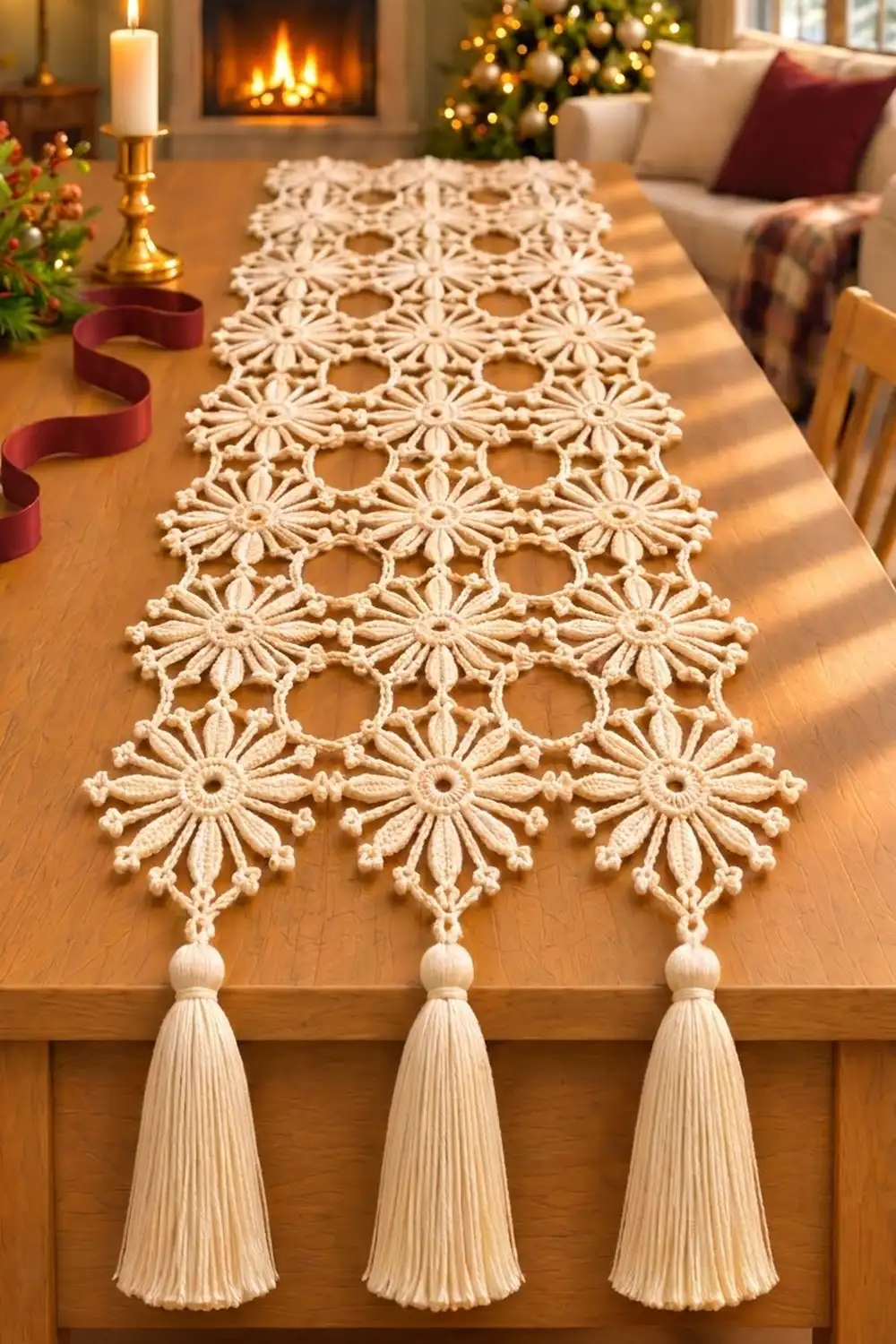
Motif
Make 1 motif this way. You will make the other 17 later and join them in Rnd 3 as you go.
Rnd 1: Ch 6, sl st in first ch to form a ring. Ch 1, work 16 sc in ring, sl st in first sc. (16 sc)
Rnd 2: Ch 1, 2 sc in each sc around, sl st in first sc. (32 sc)
The ring now measures 2 in (5.1 cm). Count the sc in groups of four. Each group makes 1 petal and 1 chain spoke.
Rnd 3: Begin in the sc that holds the joining sl st. This is sc 1 of the first group.
Petal (worked over sc 1 and sc 2):
- Spine: From sc 1, ch 10.
- Tip: Work a trefoil. The gathering sl st goes in the 10th spine ch.
- Side 1: Working down the spine chains toward the ring: sc in next ch, hdc in next ch, dc in next 5 ch, hdc in next ch, sc in last ch. (9 sts) Sl st in sc 2.
- Side 2: Rotate the petal and work into the free loops on the other side of the same spine, toward the tip: sc in first ch, hdc in next ch, dc in next 5 ch, hdc in next ch, sc in next ch. (9 sts) Sl st in the base of the trefoil.
- Center rib: Ch 9 and lay the chain along the RS center of the petal. Sl st in sc 2 again.
This makes a pointed, two-sided spindle. The dc in the middle make it widest at the center, and the laid chain gives it a raised rib.
Chain spoke (worked over sc 3 and sc 4):
- Sl st in sc 3, ch 10, work a trefoil (gathering sl st in the 10th ch), ch 9, sl st in sc 4.
This makes the slim double-chain spoke with a matching trefoil tip.
- Sl st in the next sc. This is sc 1 of the next group.
Repeat steps 1–7 seven more times. On the last repeat, leave out step 7 and fasten off after the sl st in sc 4 (sc 32).
Count after Rnd 3: 8 petals, 8 chain spokes, 16 trefoil tips, 48 picots. Each petal has 9 + 9 side sts. All 32 ring sts are used.
Reading the motif as a square: The petals point to 12, 3, 6, 9 o’clock and the four diagonals. Imagine a square around the motif. Each side has 5 tips, and that count includes the 2 diagonal corner petals: corner petal, spoke, center petal, spoke, corner petal. Four sides x 5 tips − 4 shared corners = 16 tips, which checks out.
Make All Pieces
Make 18 motifs in cream. Motif 1 is made as written above. Motifs 2–18 join in Rnd 3. Make the 6 tassels at the end, after blocking.
Layout (3 wide x 6 long). Work along each row in order:
[ 1] [ 2] [ 3]
[ 4] [ 5] [ 6]
[ 7] [ 8] [ 9]
[10] [11] [12]
[13] [14] [15]
[16] [17] [18]
Joining
Join as you go. Work Rnd 3 of each new motif as written until you reach a tip that faces a finished motif. On that tip, replace one picot of the trefoil with the right join. On each side that touches a neighbor, the joins work like this:
- Center petal tip: PJ into the middle picot of the neighbor’s facing center petal. Use it in place of the middle picot. These two tips touch.
- Two spoke tips: SB into the middle picot of each neighbor’s facing spoke tip. Use it in place of the middle picot. There is about 0.5 in (1.3 cm) between these tips.
- Two corner petal tips: LB into the outer picot of the neighbor’s facing corner petal. Use it in place of your corner petal’s outer picot on that side. There is about 1.75 in (4.4 cm) between these tips.
That gives 5 connections per shared side, one for each of its 5 tips. The connections are all tip to tip, so no extra stitches are added along the seam.
When a corner petal touches two neighbors, as on Motifs 5, 6, 8, and so on, use one outer picot for each LB. The middle picot stays free. Where four motifs meet, the four LBs form a ring. That ring frames the rounded open window seen in the finished runner.
Tension: Work bars at the same tension as your chains. If you pull them tight, they pucker the motifs. If you leave them loose, the runner sags and the windows lose their shape. Make the PJ snugly so the center tips sit point to point.
Size checkpoint: After Motifs 1–3, the strip should measure 18 in (45.7 cm) wide. After two rows (Motifs 1–6), it should measure 18 in x 12 in (45.7 cm x 30.5 cm). Measure lightly pinned. If you are 0.5 in (1.3 cm) or more off, check your motif gauge again before you go further.
Border
The edging is one round worked along the outside tips. It sets the edge length so the runner can’t stretch out of shape on the table.
Border gauge: a ch-7 matches the 1.17 in (3.0 cm) gap between neighboring tips on one motif. 8 sc fill a long bar.
Starting counts: Each long side has 6 motifs x 5 tips = 30 tips. Each short side has 3 motifs x 5 tips = 15 tips. The 4 outer corner tips are shared by a long side and a short side.
Rnd 1: With RS facing, join yarn with sc in the middle picot of the outer corner tip of Motif 1. Then, all the way around:
- ch 7 between two tips on the same motif
- 8 sc over the long bar between two tips on neighboring motifs
- 1 sc in the middle picot of each tip
At the end, sl st in first sc and fasten off.
Per long side: 30 sc in tips + 24 ch-7 spaces (4 per motif x 6) + 5 bars of 8 sc = 30 + 168 + 40 = 238 sts, corner sc included.
Per short side: 15 sc in tips + 12 ch-7 spaces (4 per motif x 3) + 2 bars of 8 sc = 15 + 84 + 16 = 115 sts, corner sc included.
Round total: (2 x 238) + (2 x 115) − 4 shared corner sc = 702 sts. Check: 86 tips, then 86 gaps (72 ch-7 spaces + 14 bars), so 86 + 504 + 112 = 702.
Why the math works: Each gap gets a chain or stitch count that matches its real length. Because of that, the edging lies flat along the tips at 18 in x 36 in (45.7 cm x 91.4 cm). It neither draws the edge in nor ruffles it.
Tassels (Make 6)
- Wrap yarn 40 times around a 5.5 in (14.0 cm) card.
- Slide a 12 in (30.5 cm) tie strand under the wraps at the top and knot it tightly.
- Cut the loops at the bottom.
- Wrap a separate strand around the tassel 0.75 in (1.9 cm) below the top. Wrap it 8–10 times so it forms a rounded head, then knot it and bury the ends inside.
- Trim the tassel to 5 in (12.7 cm).
Use the tie strand to attach one tassel to the outer center petal tip of each end motif: Motifs 16, 17, and 18 at one end, and Motifs 1, 2, and 3 at the other.
Final Blocking
- Weave in all ends along spines or chain bars, not through the trefoils.
- Soak the runner in cool water for 10 minutes, then press out the water in a towel. Do not wring it.
- Lay it flat on the board and pin the four outer corners to 18 in x 36 in (45.7 cm x 91.4 cm).
- Pin the 16 tips of every motif evenly, opening each trefoil.
- Pin each window round. Use one pin in each long bar to open it gently.
- Spray lightly and leave it until completely dry, 24 hours or more. Comb the tassels straight while they are damp.
Final Quality-Control Checklist
- [ ] 18 motifs, each with 8 petals, 8 chain spokes, and 16 trefoils
- [ ] Every motif measures 6 in (15.2 cm) across
- [ ] 5 connections on every shared side (1 PJ, 2 SB, 2 LB)
- [ ] Open windows where four motifs meet are even and round
- [ ] Border has 238 sts per long side and 115 sts per short side
- [ ] Runner measures 18 in x 36 in (45.7 cm x 91.4 cm)
- [ ] 6 tassels, each 5 in (12.7 cm), three at each end
- [ ] All ends woven in and invisible from the RS
Troubleshooting
- Petals curl: Your dc are too tight against the spine. Work the stitches a little looser, or use a hook one size larger for the petal sides only.
- Center ring ruffles: Your Rnd 2 is too loose. Go down a hook size for Rnds 1–2.
- Motif cups: The spokes are pulling. Make the chains more relaxed, and pin it out hard when blocking.
- Windows are lopsided: One long bar has the wrong count or tension. Count 5 + 5 ch and redo that bar.
- Edge waves: Your ch-7 spaces are too loose. Rework the edging with ch 6, or use a smaller hook.
- Edge pulls in: Your chains are too tight. Use ch 8 or a larger hook.
- Tassels splay: Wrap the head tighter, then steam and trim.
Care
Hand wash in cool water with mild soap and dry flat. Pin it again to 18 in x 36 in (45.7 cm x 91.4 cm) if the trefoils relax.

Final Notes
Everything rests on one measurement chain. The ring is 2 in (5.1 cm). That gives a motif of 6 in (15.2 cm), with 5 tips per side. Three motifs make 18 in (45.7 cm) of width, and six make 36 in (91.4 cm) of length. The edging adds 238 and 115 sts per side without changing the size, and the 5 in (12.7 cm) tassels finish it at about 46 in (116.8 cm). If you check the first motif carefully, the rest follows.
Happy crocheting!