

This strand curtain turns a plain window into a quiet winter forest. Fourteen cream cords hang from a curtain rod, and each one carries seven small green trees, each topped with a cream star. Neighboring cords are staggered, so the trees form a soft diagonal pattern across the glass.
The palette is just two colors: deep forest green and warm cream. Each tree has three ruffled tiers that overlap like real branches. The stars sit right on the cord, so each tree looks threaded onto its strand. A matching green tieback lets you gather one side like a fabric curtain.
The pattern uses US crochet terms. The finished curtain hangs 60 in (152.4 cm) below the base of each hanging loop. The strands are spaced 2.5 in (6.4 cm) apart, so the panel spans about 32.5 in (82.6 cm) from the first strand to the last. It suits a window about 36 in (91.4 cm) wide.
You will make 14 slip-stitch cords, 98 trees, 98 stars and one tieback. Stars are sewn onto trees, and each star-and-tree unit is sewn onto a cord at a marked stitch. The tieback gets a single-round border.
Finished Size and Construction
- Finished curtain: 60 in (152.4 cm) drop × about 32.5 in (82.6 cm) between the outer strands
- Skill level: Easy to intermediate (simple stitches, lots of repeats)
- Terminology: US crochet terms
- Yarn weight: Worsted (#4)
- Hooks: 5.0 mm (H-8) for cords; 4.0 mm (G-6) for trees, stars and tieback
- Number of pieces: 14 cords, 98 trees, 98 stars, 1 tieback (211 pieces)
- Layout: 14 strands across, 7 tree units per strand, odd and even strands offset
- Tree size: about 3.25 in (8.3 cm) wide × 2.5 in (6.4 cm) tall
- Star size: about 1.5 in (3.8 cm) point to point
- Tieback size before border: 2 in × 16 in (5.1 cm × 40.6 cm)
- Tieback border depth: 0.25 in (0.6 cm)
Materials
Use a smooth worsted cotton or cotton blend, about 180 m per 100 g. Cotton stretches less than acrylic, so the cords hold their length.
- Forest green: 550 g (990 m) for 98 trees and the tieback
- Cream: 300 g (540 m) for 14 cords and 98 stars
These quantities include a margin of about 20% for tails, swatching and differences in gauge.
Tools:
- 5.0 mm (H-8) and 4.0 mm (G-6) crochet hooks
- Tapestry needle
- Locking stitch markers (at least 14)
- Measuring tape
- Rustproof pins and a blocking board or towel
- Steam iron or garment steamer
- Curtain rod, 1 in to 1.25 in (2.5 cm to 3.2 cm) in diameter
Abbreviations (US Terms)
- ch – chain
- sl st – slip stitch
- sc – single crochet
- hdc – half double crochet
- dc – double crochet
- FLO – front loop only
- st(s) – stitch(es)
- RS / WS – right side / wrong side
Back-bump slip stitch: Turn the chain over so the ridge of bumps on the back faces you. Insert the hook under one back bump only and work a sl st. This makes a round, rope-like cord with no loose loops.
Gauge and Checkpoints
- Trees, stars, tieback (4.0 mm hook): 18 sc and 20 rows = 4 in (10.2 cm) in sc.
- Cords (5.0 mm hook): 16 back-bump sl sts = 4 in (10.2 cm) along the cord.
Make one tree and one 40-stitch test cord before anything else. Checkpoints:
- Tree after Row 3: 5 sc = 1.1 in (2.8 cm) wide
- Tree after Row 7: 9 sc = 2 in (5.1 cm) wide
- Tree after Row 11: 13 sc = 2.9 in (7.4 cm) wide; body 1.8 in (4.6 cm) tall
- Test cord: 40 sl sts = 10 in (25.4 cm)
If your pieces are too big, go down one hook size. If they are too small, go up one size. Cord gauge matters most, because every tree position is counted at 4 sts per 1 in (2.5 cm).
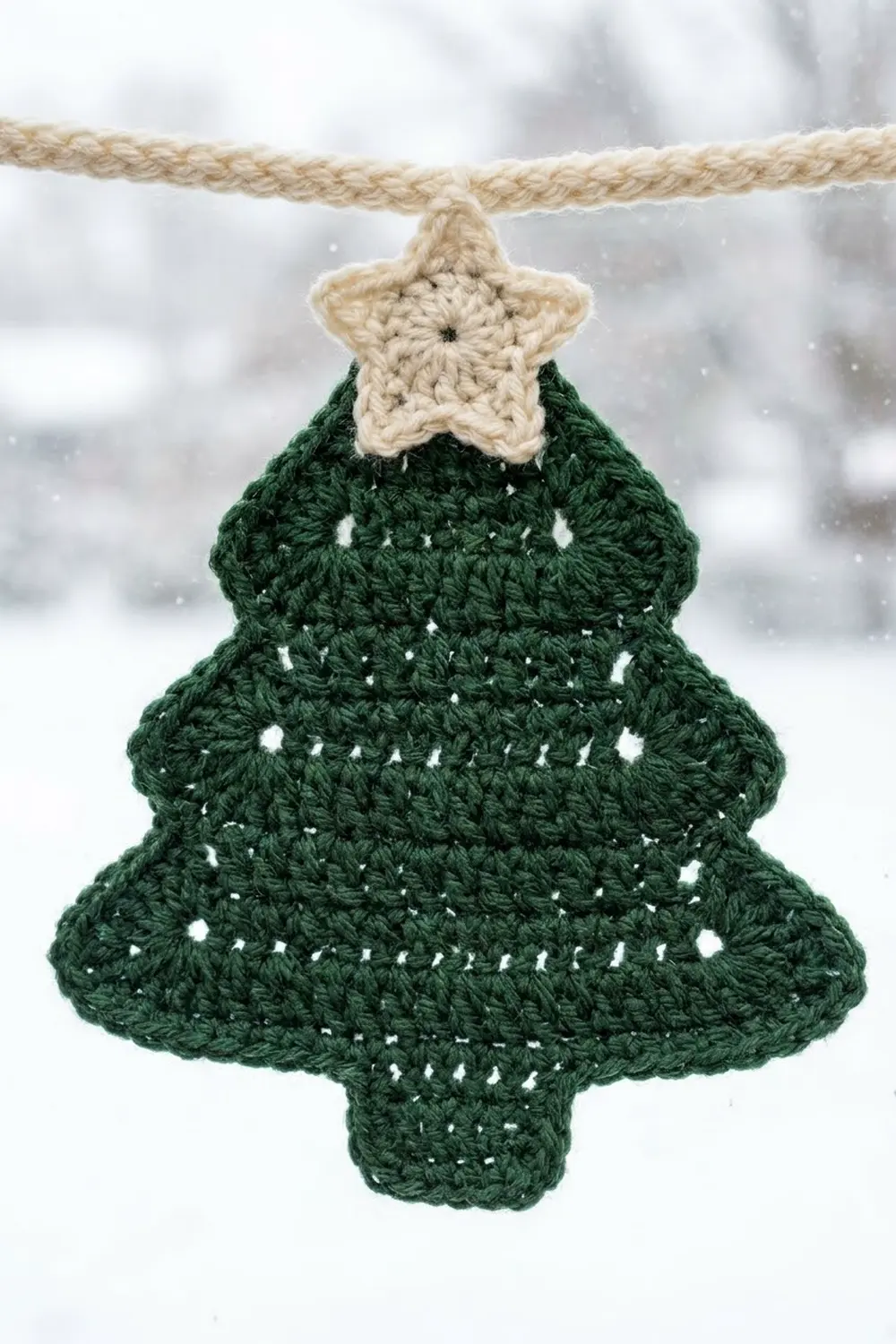
Tree (make 98)
Use forest green and the 4.0 mm hook. The side facing you on even rows is the RS, and every ruffle sits on the RS.
Tier 1
Row 1 (WS): Ch 2, 3 sc in 2nd ch from hook. (3 sc)
Row 2 (RS): Ch 1, turn, 2 sc in first st, sc in next st, 2 sc in last st. (5 sc)
Row 3 (WS): Ch 1, turn, sc in each st across. (5 sc)
Row 4 (RS, ruffle): Ch 2 (does not count), turn. Working in FLO, 2 dc in each st across. (10 dc)
Tier 2
Row 5 (WS): Ch 1, turn. Working in the unused loops of Row 3: 2 sc in first st, sc in next 3 sts, 2 sc in last st. (7 sc)
Row 6 (RS): Ch 1, turn, 2 sc in first st, sc in next 5 sts, 2 sc in last st. (9 sc)
Row 7 (WS): Ch 1, turn, sc in each st across. (9 sc)
Row 8 (RS, ruffle): Ch 2 (does not count), turn. Working in FLO, 2 dc in each st across. (18 dc)
Tier 3
Row 9 (WS): Ch 1, turn. Working in the unused loops of Row 7: 2 sc in first st, sc in next 7 sts, 2 sc in last st. (11 sc)
Row 10 (RS): Ch 1, turn, 2 sc in first st, sc in next 9 sts, 2 sc in last st. (13 sc)
Row 11 (WS): Ch 1, turn, sc in each st across. (13 sc)
Row 12 (RS, ruffle): Ch 2 (does not count), turn. Working in FLO, 2 dc in each st across. (26 dc)
Row 13 (WS): Ch 1, turn. Sl st in the unused loop of each st of Row 11. (13 sl st) Fasten off, leaving a 10 in (25.4 cm) tail for sewing.
Each ruffle row has twice as many stitches as the sc row below it (5 to 10, 9 to 18, 13 to 26), which creates the gentle wave. Each new tier grows from the loops behind a ruffle, so every ruffle overlaps the top of the tier below.
Star (make 98)
Use cream and the 4.0 mm hook.
Rnd 1: Make a magic ring, ch 1, 10 sc in ring, sl st in first sc to join. (10 sc, about 0.75 in / 1.9 cm across)
Rnd 2: [Ch 4, sl st in 2nd ch from hook, sc in next ch, hdc in next ch, skip next sc, sl st in next sc] 5 times. The last sl st lands in the joining st. (5 points)
Fasten off, leaving an 8 in (20.3 cm) tail. The star should measure about 1.5 in (3.8 cm) point to point.
Cord (make 14)
Use cream and the 5.0 mm hook.
Hanging loop: Ch 16, sl st in first ch to form a ring. (16 ch, about 4 in / 10.2 cm around)
Cord chain: Ch 240.
Cord return: Turn the chain over. Sl st in the back bump of the 2nd ch from hook and in each back bump up to the hanging loop, then sl st in the base of the loop. (240 sts, including the end ch)
Fasten off and weave in the ends. The cord is 240 sts, or 60 in (152.4 cm), long below the loop and about 0.25 in (0.6 cm) thick.
Marking positions: Count stitches down from the base of the loop; stitch 1 is the first stitch below the loop. There are 4 sts per 1 in (2.5 cm).
- Odd strands (1, 3, 5, 7, 9, 11, 13): stitches 20, 50, 80, 110, 140, 170, 200
- Even strands (2, 4, 6, 8, 10, 12, 14): stitches 36, 66, 96, 126, 156, 186, 216
On every strand the units are 30 sts, or 7.5 in (19.1 cm), apart. Even strands start 16 sts, or 4 in (10.2 cm), lower than odd strands.
Make All Pieces
- Forest green: 98 trees (7 per strand × 14 strands) + 1 tieback
- Cream: 98 stars + 14 cords
Layout grid (T = star-and-tree unit centered at that depth; . = bare cord). Depth is measured from the base of the hanging loop. Strands run 1 to 14, left to right.
Depth                Strands 1-14
5 in (12.7 cm)       T.T.T.T.T.T.T.
9 in (22.9 cm)       .T.T.T.T.T.T.T
12.5 in (31.8 cm)    T.T.T.T.T.T.T.
16.5 in (41.9 cm)    .T.T.T.T.T.T.T
20 in (50.8 cm)      T.T.T.T.T.T.T.
24 in (61.0 cm)      .T.T.T.T.T.T.T
27.5 in (69.9 cm)    T.T.T.T.T.T.T.
31.5 in (80.0 cm)    .T.T.T.T.T.T.T
35 in (88.9 cm)      T.T.T.T.T.T.T.
39 in (99.1 cm)      .T.T.T.T.T.T.T
42.5 in (108.0 cm)   T.T.T.T.T.T.T.
46.5 in (118.1 cm)   .T.T.T.T.T.T.T
50 in (127.0 cm)     T.T.T.T.T.T.T.
54 in (137.2 cm)     .T.T.T.T.T.T.T
Joining
Star to tree: Center the star over the tip of the tree (Row 1) on the RS, with one point straight up. Using the star tail, whipstitch around the star’s center ring and through the tree tip.
Unit to cord: Lay the cord behind the tree so it runs down the tree’s center, with the star’s center over the marked cord stitch.
- With the star tail, sew through the star center and the marked cord stitch 3 times. Fasten off on the back.
- With the tree tail, work 2 small stitches through the center of Row 5 and the cord behind it.
- Repeat at the center of Row 9.
Sewing each tree at these three points keeps it from spinning or flipping. Catch only one strand of each cord stitch, and pull snug but not tight. Sewing too tightly gathers the cord and makes it shorter.
Size checkpoint: Hang each finished strand and measure it. It should still be 60 in (152.4 cm) below the loop, with units 7.5 in (19.1 cm) apart. If it is more than 0.5 in (1.3 cm) short, loosen the stitches near the short section.
Hanging: Slide the loops onto the rod in order from 1 to 14, spaced 2.5 in (6.4 cm) apart center to center. That gives 13 gaps × 2.5 in = 32.5 in (82.6 cm).
Border: Tieback and Its Edging
The curtain strands have no border. The tieback is the only piece that gets one.
Tieback body: With forest green and the 4.0 mm hook, ch 10.
Row 1: Sc in 2nd ch from hook and in each ch across. (9 sc)
Rows 2–80: Ch 1, turn, sc in each st across. (9 sc)
Do not fasten off. Check that the piece measures 2 in × 16 in (5.1 cm × 40.6 cm).
Border gauge: The short edges get 1 sc per st. Each long side is 16 in (40.6 cm) of row-ends, which fits about 72 sc at 18 sc per 4 in (10.2 cm), so a few row-ends are skipped.
Rnd 1 (RS): Ch 1, do not turn.
- Top short edge: 3 sc in first st of Row 80 (corner), sc in next 7 sts, 3 sc in last st (corner).
- Long side: Working in the row-ends of Rows 79 to 2, [sc in each of next 12 row-ends, skip 1 row-end] 6 times. (72 sc)
- Bottom short edge: Working in the foundation ch, 3 sc in first ch (corner), sc in next 7 ch, 3 sc in last ch (corner).
- Second long side: Repeat the long-side sequence. (72 sc)
Sl st in first sc to join. (170 sc)
Counts per side: The center sc of each 3-sc corner counts as the corner stitch of both sides it touches.
- Short sides: 1 corner + 1 + 7 + 1 + 1 corner = 11 sts each
- Long sides: 1 corner + 1 + 72 + 1 + 1 corner = 76 sts each
Why the math works: 2 × 11 + 2 × 76 = 174. Each of the 4 corner stitches is counted on two sides, so subtract 4 to get 170, which matches the round total. The 72 sc on each long side match the stitch gauge over 16 in (40.6 cm), so the edges lie flat without rippling.
End loops: Join yarn in the 4th (center) of the 7 middle sc on one short edge. Ch 10, sl st in the same st and fasten off. Repeat on the other short edge.
Finished tieback: about 2.5 in × 16.5 in (6.4 cm × 41.9 cm).
Final Blocking
- Weave in all tails through stitches of the same color.
- Pin each tree WS down to 3.25 in (8.3 cm) wide at the bottom ruffle, fanning the ruffles evenly.
- Pin each star to 1.5 in (3.8 cm), with one pin at each point.
- Steam lightly, holding the iron above the yarn without pressing. Let everything dry fully.
- Pin the tieback to 2.5 in × 16.5 in (6.4 cm × 41.9 cm), steam and let dry.
- After joining, hang the curtain for 24 hours. Steam each cord from top to bottom to relax any twist, then re-check the 60 in (152.4 cm) drop.
Final Quality-Control Checklist
- 14 cords, each 240 sts below a 16-ch loop
- 7 units per strand, at the correct odd or even stitch marks
- Every tree has 3 ruffled tiers of 10, 18 and 26 dc
- Every star has 5 even points, one pointing straight up
- Trees hang straight, sewn at 3 points
- All strands hang 60 in (152.4 cm)
- Tieback border totals 170 sc, lies flat and has 2 end loops
- No loose tails on the front
Troubleshooting
- Ruffles curl tightly: Your dc are too tight. Go up one hook size for the ruffle rows only.
- Tiers don’t overlap: The next tier was worked into the front loops. Each new tier must go into the unused loops behind the ruffle.
- Cord spirals: Steam it while it hangs, with a light weight at the bottom end. Next time, keep your sl st tension even.
- Trees spin: Add a fourth anchor stitch at Row 11.
- Uneven star points: Pin and re-steam. Check that each repeat skips exactly 1 sc.
- Strands differ in length: Recount the cord sts. Every 4 sts off makes a 1 in (2.5 cm) difference.
Care
Hand wash in cool water, roll in a towel to remove water and dry flat with the cords straightened. Rehang when dry and steam lightly if needed.
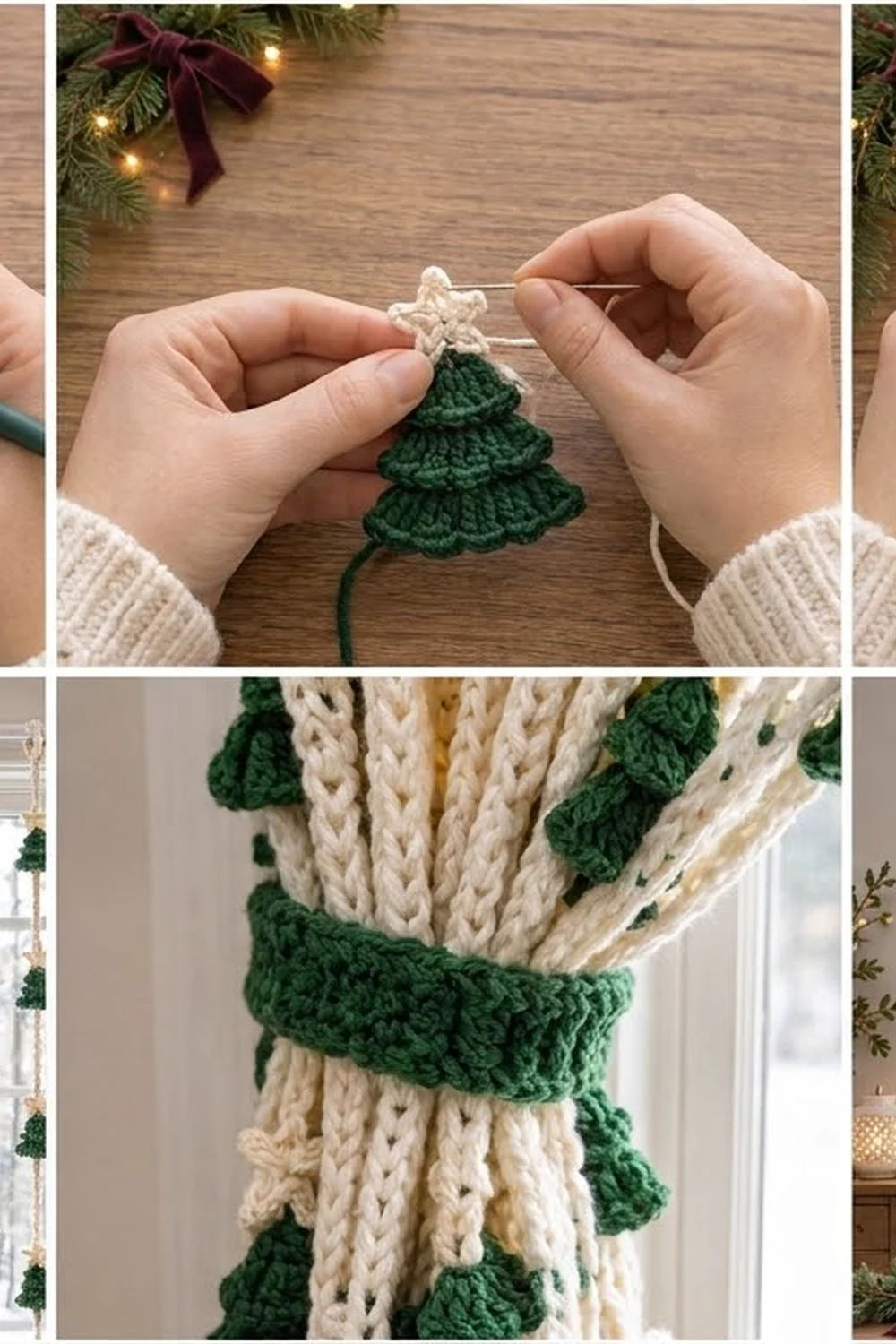
Final Notes
The measurement chain is short. Tree gauge sets the tree body at 2.9 in (7.4 cm) wide. Cord gauge of 4 sts per 1 in (2.5 cm) sets every unit position, and 240 cord sts give the 60 in (152.4 cm) drop. Fourteen strands at 2.5 in (6.4 cm) spacing span 32.5 in (82.6 cm). Check each link and the curtain will hang evenly.
Happy crocheting!