

This hanging holder keeps three spare rolls on display. Three round pockets hang one above the other on two slim cords, and the cords loop over a short wooden dowel. Each roll stands upright in its pocket, so grabbing a new one takes a second.
The color scheme is calm and earthy. The walls are oatmeal beige in a textured V-stitch, the rims have a terracotta-rust scallop, and each pocket’s front has a rust five-petal flower with a cream center and two cream leaves. It looks cottage-style and handmade and fits well in a neutral bathroom.
The pattern uses US crochet terms. The finished holder hangs about 22 in (55.9 cm) long and 5.25 in (13.3 cm) wide. Each pocket is 4.75 in (12.1 cm) across and 3 in (7.6 cm) tall.
You’ll make three pockets in the round, starting with a flat single-crochet base. Next come three flowers, six leaves and two slip-stitch cords. You sew the appliqués onto the pocket fronts, then stitch the cords down both sides of each pocket at measured intervals.
Finished Size and Construction
- Finished size: 22 in (55.9 cm) long including loops × 5.25 in (13.3 cm) wide
- Skill level: Easy+ (basic stitches, working in rounds, neat sewing)
- Terminology: US crochet terms
- Yarn weight: Worsted (#4), cotton or cotton blend
- Hook: 4.0 mm (G-6)
- Number of pieces: 3 pockets, 3 flowers, 6 leaves, 2 cords
- Layout: 1 column of 3 pockets, spaced 2.75 in (7.0 cm) apart
- Pocket size: 4.75 in (12.1 cm) diameter × 3 in (7.6 cm) tall
- Wall height before border: 2.25 in (5.7 cm)
- Border depth: 0.75 in (1.9 cm)
Materials
Use a smooth worsted cotton of about 155 m per 100 g. Cotton keeps its shape, takes the steam of a bathroom well and shows the V-stitch texture clearly. Acrylic also works, but the pockets will be softer.
- Color A, oatmeal beige: 70 g / 110 m (walls, bases, cords)
- Color B, terracotta rust: 25 g / 40 m (rims and flower petals)
- Color C, cream: 15 g / 25 m (flower centers and leaves)
These quantities include a margin of about 15–20 percent.
Tools:
– 4.0 mm (G-6) crochet hook
– Tapestry needle
– 4 locking stitch markers
– Scissors and a measuring tape
– Pins for blocking and placement
– Wooden dowel, 12 in (30.5 cm) long and about 0.5 in (1.3 cm) thick (optional, for hanging)
Abbreviations (US Terms)
- ch – chain
- sl st – slip stitch
- sc – single crochet
- hdc – half double crochet
- dc – double crochet
- BLO – back loop only
- MR – magic ring
- sp – space
- st(s) – stitch(es)
Special stitch – V-stitch (V-st): (dc, ch 1, dc) in the same stitch or space. Each V-st counts as 2 dc plus 1 ch-1 sp.
Shell: 4 dc in the same stitch.
Gauge and Checkpoints
Gauge:
– 16 sc and 17 rounds = 4 in (10.2 cm)
– 8 V-sts and 8 V-st rounds = 4 in (10.2 cm)
– 4 sl sts along a cord = 1 in (2.5 cm)
Make one complete pocket before you start the others. It’s a working gauge swatch.
Checkpoints:
– After Rnd 10, the flat base measures 4.75 in (12.1 cm) across.
– After Rnd 15, the wall measures 2.25 in (5.7 cm) from the base fold.
– After Rnd 17, the total wall height is 3 in (7.6 cm).
– A standard roll, about 4.5 in (11.4 cm) wide, drops in easily.
If the pocket is too big, go down to a 3.5 mm hook. If it’s too small or the roll binds, go up to a 4.5 mm hook. If only the base is off, change the hook for the sc rounds alone.
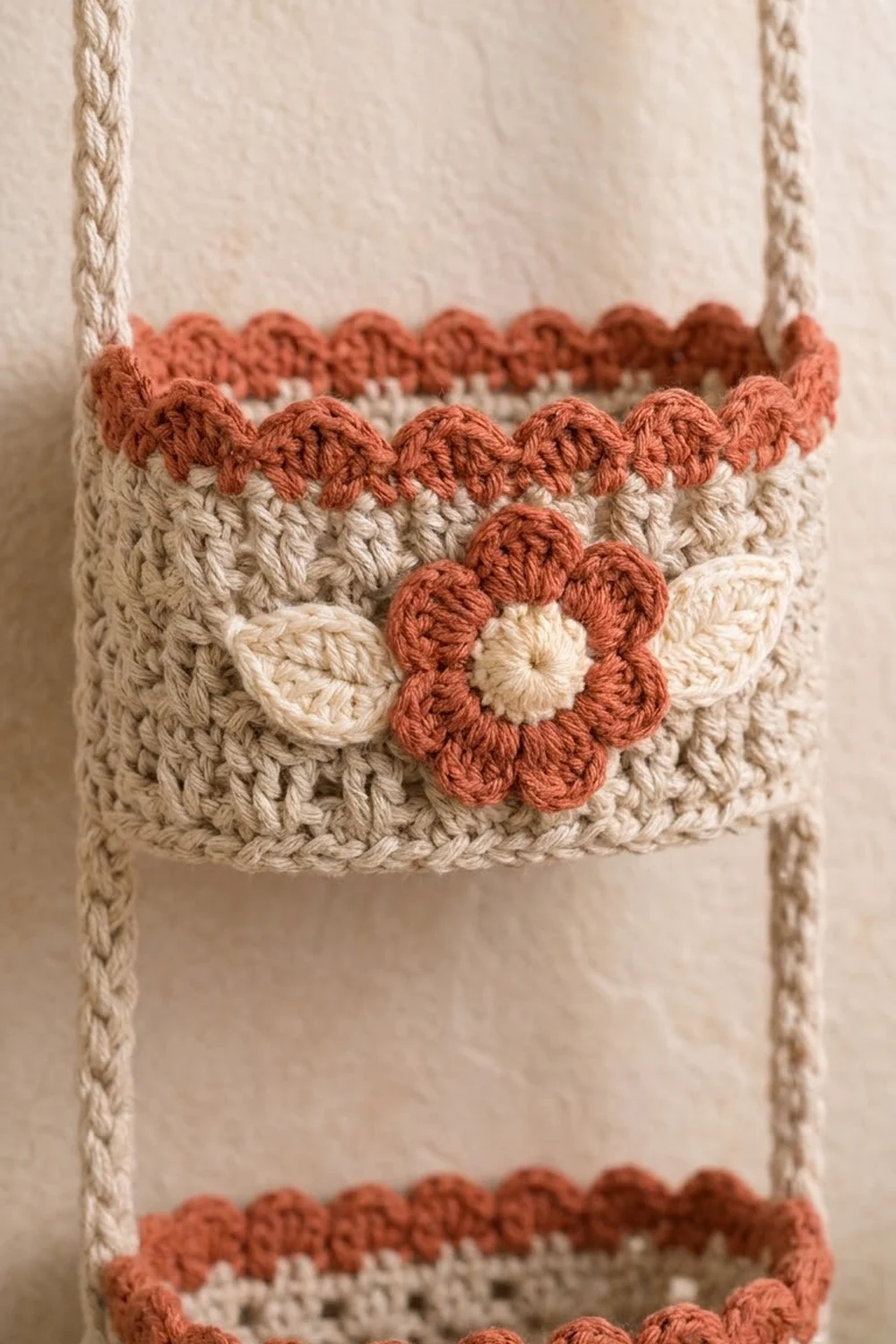
Pocket (Make 3)
Work in continuous joined rounds with Color A. Join each round with a sl st to the first stitch. The ch 1 at the start of the sc rounds doesn’t count as a stitch. All joins should line up in one column, which is later hidden under a cord.
Base
Rnd 1: In MR, ch 1, 6 sc. Join. (6 sts)
Rnd 2: Ch 1, 2 sc in each st around. Join. (12 sts)
Rnd 3: Ch 1, sc in next st, 2 sc in next st 6 times. Join. (18 sts)
Rnd 4: Ch 1, sc in next 2 sts, 2 sc in next st 6 times. Join. (24 sts)
Rnd 5: Ch 1, sc in next 3 sts, 2 sc in next st 6 times. Join. (30 sts)
Rnd 6: Ch 1, sc in next 4 sts, 2 sc in next st 6 times. Join. (36 sts)
Rnd 7: Ch 1, sc in next 5 sts, 2 sc in next st 6 times. Join. (42 sts)
Rnd 8: Ch 1, sc in next 6 sts, 2 sc in next st 6 times. Join. (48 sts)
Rnd 9: Ch 1, sc in next 7 sts, 2 sc in next st 6 times. Join. (54 sts)
Rnd 10: Ch 1, sc in next 8 sts, 2 sc in next st 6 times. Join. (60 sts)
Checkpoint: The base lies flat and measures 4.75 in (12.1 cm) across.
Wall
Rnd 11: Ch 1, sc in BLO of each st around. Join. (60 sts) This round turns the work upward and leaves a crisp ridge around the base.
Rnd 12: Ch 4 (counts as dc + ch 1), dc in the same st. Skip next st, V-st in next st 29 times, skip last st. Join to 3rd ch of beginning ch-4. (30 V-sts = 60 dc + 30 ch-1 sps)
Rnds 13–15: Sl st into the first ch-1 sp, ch 4, dc in same sp. V-st in each ch-1 sp around. Join. (30 V-sts per round)
Each V-st sits directly on top of the one below, so you get the stacked columns. Number the V columns 1–30, starting at the join. Place a marker in V 1 and another in V 16. These are the two cord positions.
Checkpoint: The wall measures 2.25 in (5.7 cm) from the base fold, and the circumference is about 15 in (38.1 cm). Fasten off Color A.
Rim Border
The border has two rust rounds in Color B. It sits on top of the V-stitch wall.
Border gauge: 16 sc = 4 in (10.2 cm). That matches the base, so the rim neither flares nor pulls in.
Rnd 16: Join Color B in the first dc of V 1. Ch 1, sc in each dc around, skipping all ch-1 sps. Join. (60 sc: 30 V-sts × 2 dc)
Each half of the pocket gets the same count:
– Front half (V 1–V 15): 30 sc (sts 1–30)
– Back half (V 16–V 30): 30 sc (sts 31–60)
Rnd 17 (conversion round): Ch 1. Sc in next st, skip next st, shell in next st 20 times. Join to first sc. (20 repeats × [1 sc + 4 dc] = 100 sts: 20 sc + 80 dc)
Each half gets the same count:
– Front half: sts 1–30 = 10 repeats = 10 scallops (50 sts)
– Back half: sts 31–60 = 10 repeats = 10 scallops (50 sts)
Why the math works: Each repeat uses exactly 3 stitches of Rnd 16. Each half has 30 stitches, and 30 ÷ 3 = 10, so every half ends on a complete scallop. The cords sit exactly in the gap between the last shell of one half and the first sc of the next, which keeps both sides symmetrical. Shells with 4 dc spread across a 3-stitch span give the rounded, slightly puffy edge without ruffling.
Checkpoint: Rnd 16 adds 0.25 in (0.6 cm) and Rnd 17 adds 0.5 in (1.3 cm), for a border depth of 0.75 in (1.9 cm). The total wall is 3 in (7.6 cm). Fasten off and weave in the ends.
Flower (Make 3)
Rnd 1 (Color C): In MR, ch 1, 10 sc. Join. (10 sts) Fasten off.
Rnd 2 (Color B): Join with a sl st in any sc. Ch 3, skip next sc, sl st in next sc 5 times. The last sl st lands in the joining stitch. (5 ch-3 loops)
Rnd 3: In each ch-3 loop work (sc, hdc, 3 dc, hdc, sc). Sl st to the first sc. (5 petals, 7 sts each = 35 sts)
The finished flower is about 2.25 in (5.7 cm) across. Leave a 10 in (25.4 cm) tail of Color B for sewing.
Leaf (Make 6)
Color C: Ch 7. Starting in the 2nd ch from the hook, work sc, hdc, dc, dc, hdc. Work 3 sc in the last ch. Rotate and work along the opposite side of the foundation chain: hdc, dc, dc, hdc, sc. Sl st to the first sc. (13 sts: 5 + 3 + 5)
Each leaf is about 1.5 in (3.8 cm) long and 0.75 in (1.9 cm) wide. For an optional center vein, surface sl st or backstitch with Color A from the base to the tip. Leave a 10 in (25.4 cm) tail.
Cord (Make 2)
Color A: Ch 8, sl st in the first ch to form the hanging loop. Ch 85 more.
Cord row: Sl st in the back bump of the 2nd ch from the hook and of each ch back to the loop. (84 sl sts)
Loop reinforcement: Work 12 sc into the hanging loop. Sl st into the base of the cord and fasten off.
Checkpoint: The cord below the loop measures 21 in (53.3 cm), which is 84 sl sts at 4 per inch. If it’s off, add or remove chains in groups of 4. Each group of 4 changes the length by 1 in (2.5 cm).
Make All Pieces
| Piece | Qty | Color |
|---|---|---|
| 3 | A (walls/base), B (Rnds 16–17) | |
| Flower | 3 | C (center), B (petals) |
| Leaf | 6 | C |
| Cord | 2 | A |
Layout grid (front view, top to bottom):
 [loop]                    [loop]
   |   4 in (10.2 cm) drop    |
   |  [ POCKET 1 + flower ]   |
   |   2.75 in (7.0 cm) gap   |
   |  [ POCKET 2 + flower ]   |
   |   2.75 in (7.0 cm) gap   |
   |  [ POCKET 3 + flower ]   |
   |   2.5 in (6.4 cm) tail   |
Sewing the Appliqués
Find the front center of each pocket: it’s V 8, halfway between the markers in V 1 and V 16. Pin the flower over V 8, centered on Rnds 13–14.
Tuck the base of one leaf under the petals on each side. Angle the tips outward and slightly upward. Whipstitch the leaves around their edges with their Color C tails. Then sew the flower down along the back of each petal with the Color B tail. Leave the petal tips loose so they stay dimensional.
Joining
Method: Whipstitch each cord to the outside of each pocket wall with Color A.
Cord map (sl sts counted from the loop end):
– Sts 1–16: free drop, 4 in (10.2 cm)
– Pocket 1: sts 17–28. Sts 17–18 run beside the scallop and stay free. Sts 19–28 are sewn.
– Sts 29–39: gap, 2.75 in (7.0 cm)
– Pocket 2: sts 40–51, with sts 42–51 sewn
– Sts 52–62: gap
– Pocket 3: sts 63–74, with sts 65–74 sewn
– Sts 75–84: tail, 2.5 in (6.4 cm)
Check the total: 16 + 12 + 11 + 12 + 11 + 12 + 10 = 84 sl sts.
Stitch-to-stitch logic: The sewn section of each pocket is 10 cord stitches, which cover 2.5 in (6.4 cm), the height from Rnd 11 to Rnd 16. Match them like this, working downward:
– 1 cord st to Rnd 16
– 2 cord sts to each of Rnds 15, 14, 13 and 12 (8 sts)
– 1 cord st to Rnd 11
The first cord runs over V 1, covering the column of round joins. The second runs over V 16, directly opposite.
Tension: Sew snugly, but don’t pucker the wall. Take two passes through the base ridge on Rnd 11 and through Rnd 16, because these points carry the weight of the roll.
Size checkpoint: Hang the holder from the dowel. It should measure 22 in (55.9 cm) from the top of the loops to the cord ends, and 5.25 in (13.3 cm) across the pockets including the cords.
Final Blocking
- Lightly mist the whole holder with water.
- Put a toilet roll, or a 4.5 in (11.4 cm) jar wrapped in a towel, in each pocket.
- Shape each base flat and each wall straight up.
- Pinch every rust shell into a round scallop.
- Pin the flower petals and leaves flat against the wall.
- Lay the holder flat with the cords straight and parallel, and pin them.
- Let it dry completely, then remove the forms.
Final Quality-Control Checklist
- Every base measures 4.75 in (12.1 cm) and sits flat.
- Every wall is 3 in (7.6 cm) tall with 30 V-sts.
- Rnd 16 has 60 sc, and Rnd 17 has 20 scallops (10 per half).
- Every flower has 5 even petals and a cream center.
- The leaves mirror each other on each pocket.
- The round joins are hidden under a cord.
- The gaps between pockets are equal, at 2.75 in (7.0 cm).
- All ends are woven in securely.
Troubleshooting
- The base cups or ruffles: Your rounds are too tight or too loose. Change hooks for Rnds 1–10.
- The wall leans or twists: Make sure each V-st sits in the ch-1 sp directly below it.
- The rim flares: Go down one hook size for Rnd 17.
- The pockets droop forward: Add a second line of stitching along the cord at Rnds 11 and 16.
- The cord is curly: Steam-block it straight before you sew.
- The roll won’t fit: Go up one hook size for the walls only.
Care
Hand wash in cool water and lay flat to dry, reshaping the pockets around a roll. Don’t tumble dry. Heat can distort the scallops.
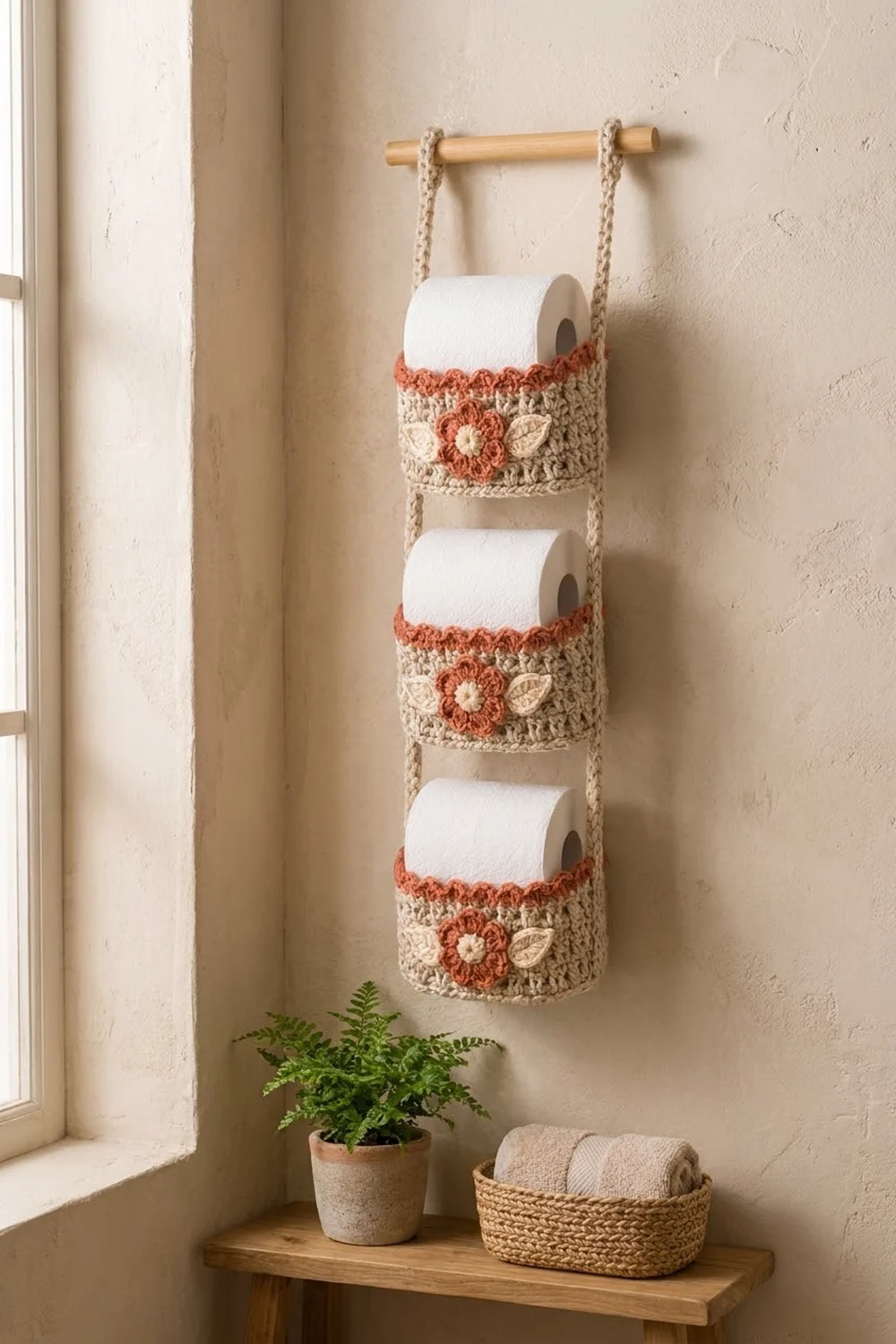
Final Notes
Every measurement builds on the one before it. The 60-stitch base sets a 4.75 in (12.1 cm) diameter, and the 30 V-sts keep that circumference up a 2.25 in (5.7 cm) wall. Rnd 16 converts back to 60 sc, which splits into two halves of 10 scallops each. Each pocket ends up 3 in (7.6 cm) tall, and the 84-stitch cords space the three pockets 2.75 in (7.0 cm) apart for a 22 in (55.9 cm) holder. If your first pocket hits its checkpoints, the rest will follow.
Happy crocheting!