

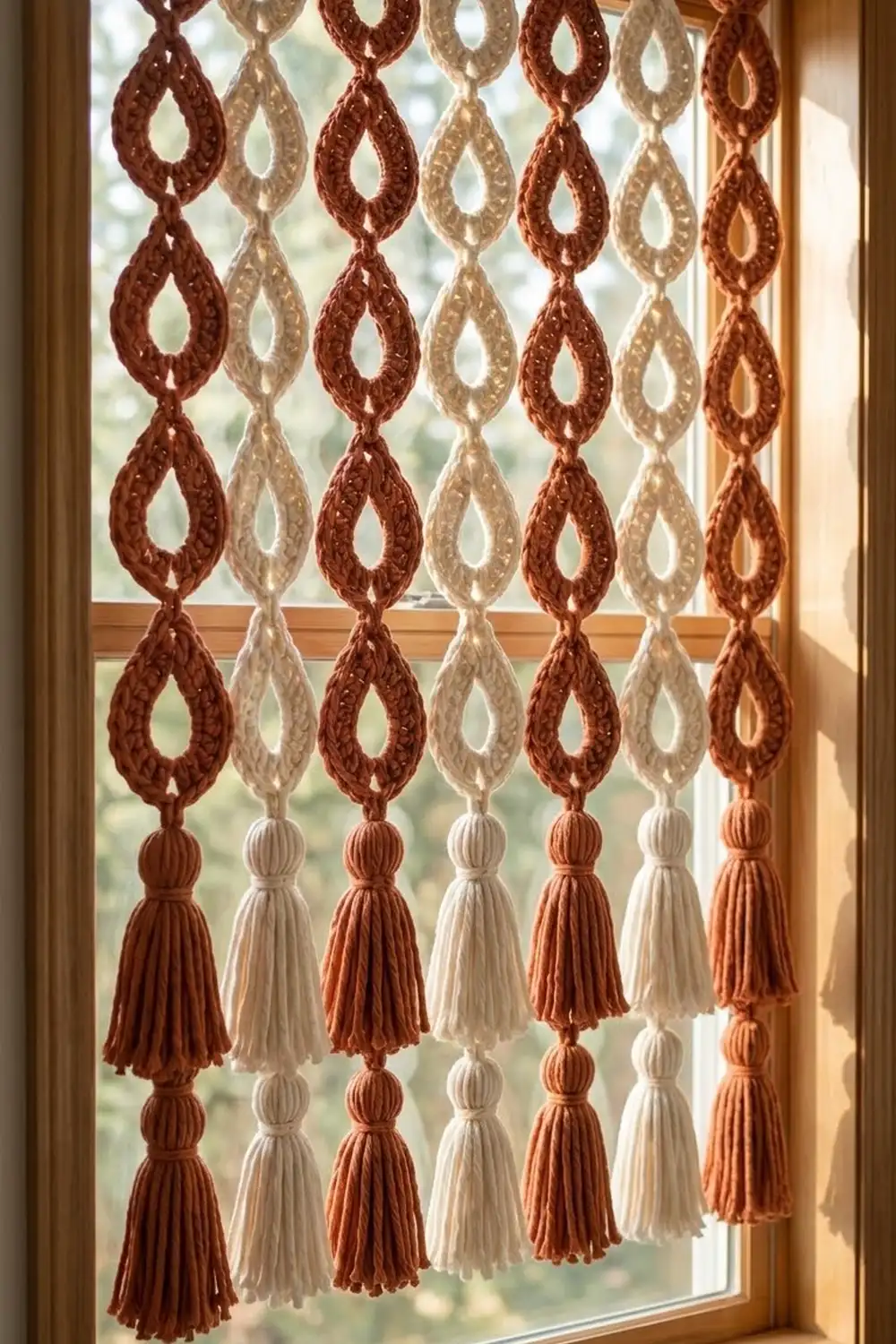
This curtain panel is a light, airy window hanging made from open teardrop motifs linked into vertical strands. Each strand ends in a small round ball and a full, heavy tassel. Hung in front of a sunny window, the open “eye” in each teardrop lets light through, which gives the panel a soft, macramé-like depth.
The panel alternates warm rust/terracotta and cream/ivory strands. Each strand is one solid color, so the colors read as clean vertical stripes. The style is boho and cozy, and it suits a kitchen window, doorway, or reading nook.
This pattern uses US crochet terms. The finished panel measures 26.4 in (67.1 cm) wide and 42 in (106.7 cm) long, including the header and tassels.
Construction is simple. You make 30 teardrop motifs and join them as you go into 6 strands of 5. You then add a stuffed ball and a tassel to the bottom of each strand. Finally, a folded header band with a rod pocket gathers all 6 strands across the top.
Finished Size and Construction
- Finished size: 26.4 in wide x 42 in long (67.1 x 106.7 cm)
- Skill level: Intermediate
- Terminology: US crochet terms
- Yarn weight: Bulky (#5)
- Hooks: 6.5 mm (K-10.5) for motifs and header; 5.5 mm (I-9) for balls
- Number of pieces: 30 teardrops, 6 balls, 6 tassels, 1 header band
- Layout: 6 strands across, 5 teardrops per strand
- Piece size: each teardrop 4.4 in wide x 5.6 in tall (11.2 x 14.2 cm); each ball 2 in (5.1 cm) across; each tassel 10 in (25.4 cm) long below the ball
- Size before border: 26.4 x 40 in (67.1 x 101.6 cm)
- Border depth: header band 2 in (5.1 cm) when folded
Materials
Choose a smooth, round bulky yarn with good stitch definition. A cotton blend or soft acrylic both work well. Avoid fuzzy or brushed yarns, because they blur the teardrop shape and mat in tassels. The amounts below assume a yarn of about 140 m per 100 g.
Yarn:
– Rust/terracotta: 310 g (430 m) for 15 teardrops, 3 balls, 3 tassels, and the header band
– Cream/ivory: 240 g (330 m) for 15 teardrops, 3 balls, and 3 tassels
These quantities include a margin of about 15%. That margin covers gauge differences and a tassel that needs re-cutting.
Tools:
– 6.5 mm (K-10.5) and 5.5 mm (I-9) crochet hooks
– Tapestry needle
– Sharp scissors
– Stitch markers
– Polyester fiberfill (a small handful) or matching yarn scraps for stuffing
– Stiff cardboard, 11 in (27.9 cm) long, for tassels
– Blocking mats, rust-proof pins, and a spray bottle or steamer
– Curtain rod, tension rod, or dowel up to 1 in (2.5 cm) in diameter
Abbreviations (US Terms)
- ch – chain
- sl st – slip stitch
- sc – single crochet
- hdc – half double crochet
- dc – double crochet
- inc – 2 sc in the same stitch
- dec – sc2tog (single crochet 2 together)
- MR – magic ring
- st(s) – stitch(es)
- sp – space
- Rnd – round
Special stitch – Joined Tip (JT): Work this into the ch-2 sp at the tip in Rnd 3. Work (sc, ch 1, sl st into the marked bottom-center sc of the motif above, ch 1, sc) all in the ch-2 sp. The ch 1, sl st, ch 1 replaces the ch-3 tip loop, so the stitch count does not change.
Gauge and Checkpoints
Gauge: 10 sc and 11 rows = 4 in (10.2 cm) with a 6.5 mm hook, worked in rows.
Make one complete teardrop before anything else. This single motif tests your gauge, your tension, and the shaping.
Checkpoints:
– After Rnd 1: The ring lies flat and measures about 3 in (7.6 cm) across.
– After Rnd 3: When pinned to shape, the motif measures 4.4 in wide x 5.6 in tall (11.2 x 14.2 cm).
– Ball: about 2 in (5.1 cm) across when stuffed.
– Strand of 5 motifs: 28 in (71.1 cm) long.
– Header Row 1: 66 sc measure 26.4 in (67.1 cm).
If your motif is too big: go down to a 6 mm (J-10) hook.
If your motif is too small: go up to a 7 mm hook.
Re-check with a fresh motif after any hook change. Width matters most, because each strand must match its 4.4 in (11.2 cm) slot in the header.
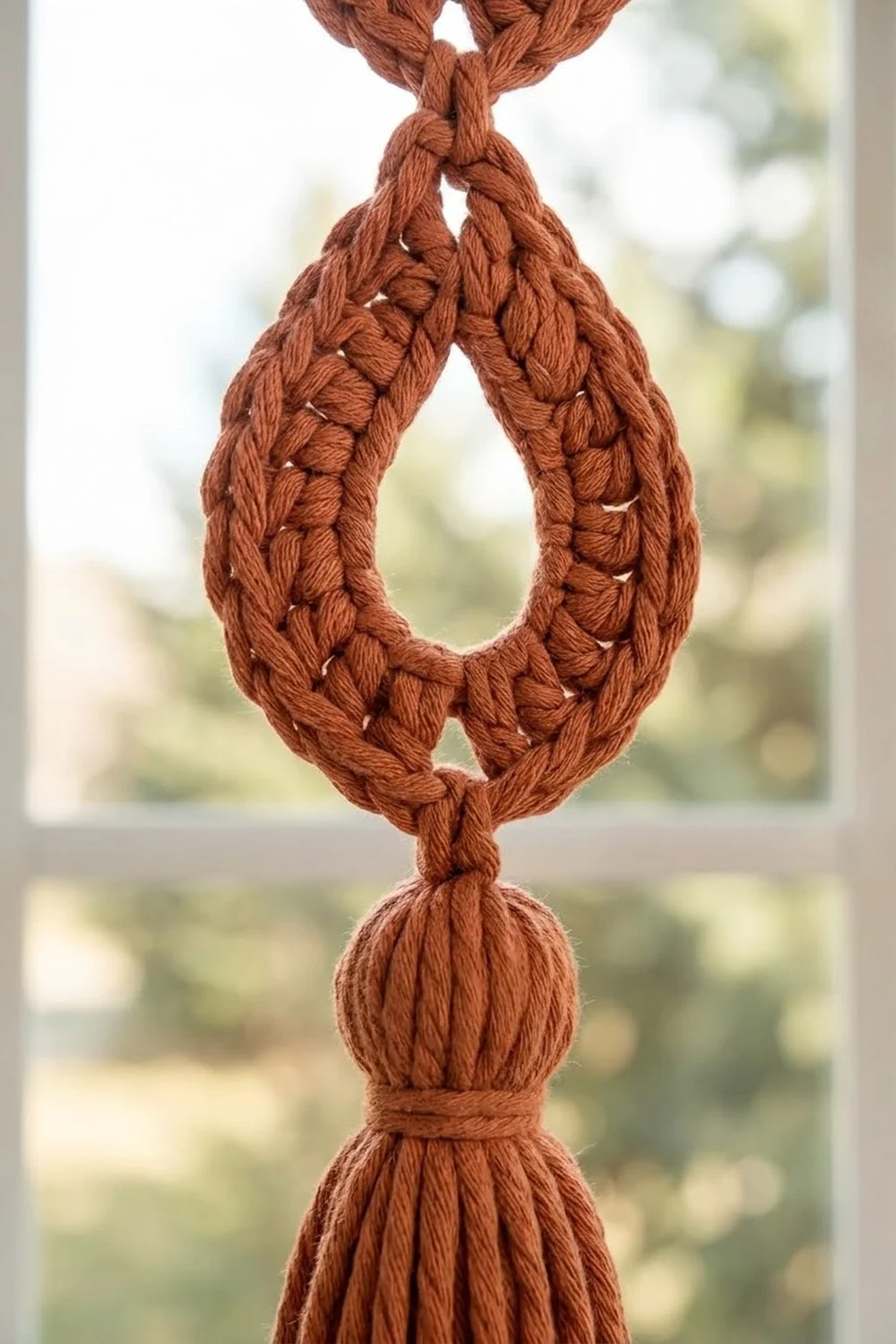
Teardrop Motif (make 30)
Work in joined rounds and do not turn. The open chain ring forms the eye. Stitch heights then shape the motif: short stitches make the pointed top and tall stitches with increases make the round bottom.
Rnd 1: Ch 24 and sl st to the first ch to form a ring. Ch 1, then sc in each ch around. Sl st to the first sc. (24 sc)
Number these sts 1–24. St 1 will become the tip.
Rnd 2: Ch 1. Skip st 1 for now. Work the round as follows:
– sc in the next 2 sts (sts 2–3)
– hdc in the next 3 sts (sts 4–6)
– dc in the next 2 sts (sts 7–8)
– 2 dc in each of the next 9 sts (sts 9–17)
– dc in the next 2 sts (sts 18–19)
– hdc in the next 3 sts (sts 20–22)
– sc in the next 2 sts (sts 23–24)
– (sc, ch 2, sc) in st 1 to form the tip
Sl st to the first sc.
(34 sts + 1 ch-2 tip sp)
The count works like this: 7 side sts + 18 bottom dc + 7 side sts + 2 tip sc = 34. The 9 increases are centered on st 13, which sits directly opposite the tip, so the motif stays symmetrical.
Rnd 3 (trim round): Ch 1, then:
– sc in the first 7 sts
– [2 sc in the next st, sc in the next st] 9 times over the 18 bottom dc (27 sc)
– sc in the next 7 sts
– sc in the next sc
– (sc, ch 3, sc) in the ch-2 sp
– sc in the last sc
Sl st to the first sc and fasten off. (45 sc + 1 ch-3 tip loop)
This is a conversion round, not a growth round. It works out as 34 sc worked one per existing stitch, plus 9 extra sc at the bottom curve, plus 2 sc worked into the tip space: 34 + 9 + 2 = 45.
Marker: Place a marker in the 21st sc of Rnd 3. This is the bottom-center sc, and it is where the next motif joins.
Joined motifs: For motifs 2–5 of each strand, work Rnd 3 exactly as written, except replace the (sc, ch 3, sc) with the Joined Tip. The count stays 45 sc.
Ball Motif (make 6)
Use the 5.5 mm hook so the fabric is firm enough that stuffing does not show through. Work in continuous spiral rounds, and mark the first stitch of each round.
- Rnd 1: 6 sc in MR. (6)
- Rnd 2: inc in each st around. (12)
- Rnd 3: [sc, inc] 6 times. (18)
- Rnds 4–6: sc in each st around. (18)
- Rnd 7: [sc, dec] 6 times. (12)
Stuff the ball firmly now.
- Rnd 8: dec 6 times. (6)
Fasten off and leave a 12 in (30.5 cm) tail. Do not close the top hole completely. The tassel tie will pass through both the top and bottom holes.
Tassel (make 6)
- Wrap yarn 30 times around the 11 in (27.9 cm) cardboard. Cut along one edge. This gives you 30 strands, each 22 in (55.9 cm) long.
- Cut a 16 in (40.6 cm) tie strand. Lay it under the center of the bundle and knot it tightly.
- Thread both tie ends onto a needle. Pass them up through the ball, from the Rnd 1 hole out through the Rnd 8 hole.
- Pull the ties until the folded bundle seats snugly against the bottom of the ball.
- Let the strands fall around the ball’s base. Wrap a separate length of matching yarn around the tassel neck 0.5 in (1.3 cm) below the ball. Knot it, then bury the ends inside the tassel.
- Trim the skirt evenly to 10 in (25.4 cm) below the ball.
Make All Pieces
Every piece within a strand is one color. Make the following:
- Rust: 15 teardrops, 3 balls, 3 tassels, 1 header band
- Cream: 15 teardrops, 3 balls, 3 tassels
Layout (left to right):
ROW 1 (top motifs): RUST  CREAM RUST  CREAM RUST  CREAM
ROW 2:              RUST  CREAM RUST  CREAM RUST  CREAM
ROW 3:              RUST  CREAM RUST  CREAM RUST  CREAM
ROW 4:              RUST  CREAM RUST  CREAM RUST  CREAM
ROW 5:              RUST  CREAM RUST  CREAM RUST  CREAM
BALL + TASSEL:      RUST  CREAM RUST  CREAM RUST  CREAM
Joining
Method: Join as you go. Each strand is built from the top down.
- Make motif 1 exactly as written, with a free ch-3 tip loop. Mark its bottom-center sc.
- Work motif 2 through Rnd 2. In Rnd 3, use the Joined Tip and sl st into motif 1’s marked sc.
- Repeat for motifs 3, 4, and 5. Each one joins its tip to the marked sc of the motif directly above it.
Stitch-to-stitch logic: Every join is one tip connected to one bottom-center sc. The joins stay on the centerline, so each strand hangs straight and the points nest neatly into the rounded bottoms.
Ball and tassel: Use the ball’s tie ends to tie onto the marked bottom-center sc of motif 5. Knot securely, leaving no gap. Weave the ends back down into the ball.
Tension: Keep the ch 1 on each side of the joining sl st relaxed. If you pull it tight, the tip curls forward. If it is too loose, the strand sags at each join.
Size checkpoint: Lay one finished strand flat without stretching it. The 5 motifs should measure 28 in (71.1 cm). With the ball and tassel, the strand should reach about 40 in (101.6 cm).
Border: Header Band
The header is the panel’s only border. It is worked in rust at the same gauge as the motifs: 2.5 sc per in (10 sc per 4 in).
Foundation: Ch 67.
Row 1: Sc in the 2nd ch from the hook and in each ch across. Turn. (66 sc)
Checkpoint: the row measures 26.4 in (67.1 cm).
Rows 2–11: Ch 1, sc in each st across. Turn. (66 sc each row)
The band now measures 4 in (10.2 cm) tall. Each short side is 11 rows.
Row 12 (closing and joining row): Fold the band in half lengthwise so Row 11 meets the foundation chain. Ch 1. Working through both layers, sc in each st across (Row 11 st together with the matching foundation ch).
At the 6th, 17th, 28th, 39th, 50th, and 61st sts, also insert your hook through the ch-3 tip loop of a top motif before you complete the sc. Attach the strands left to right in layout order. (66 sc)
Fasten off. The folded band is 2 in (5.1 cm) deep, and the fold forms a rod pocket that fits a rod up to 1 in (2.5 cm) in diameter.
Per-side counts:
– Bottom edge: 66 sc
– Top fold: 66 sts
– Each short side: 11 rows, folded to about 2 in (5.1 cm)
Why the math works: Each strand gets an 11-stitch section. At 2.5 sc per in, 11 sc = 4.4 in (11.2 cm), which equals one motif’s blocked width. Six sections give 6 x 11 = 66 sc, or 26.4 in (67.1 cm).
Each strand hangs from the center stitch of its section (st 6 of 11). That places the outer strands 2.2 in (5.6 cm) in from the band ends, which is exactly half a motif width. The teardrops therefore sit edge to edge with no gaps or crowding.
Final Blocking
- Before assembly, mist each teardrop lightly or hover steam over it. Do not press, especially with acrylic.
- Pin each motif to a 4.4 x 5.6 in (11.2 x 14.2 cm) teardrop outline. Pin the tip into a sharp point and round out the bottom curve. Open the center eye evenly.
- Let the motifs dry completely before joining.
- After assembly, hang the panel on its rod. Mist the header lightly and smooth it flat with your hands.
- Steam the tassels and comb them gently with your fingers. Retrim the skirts to 10 in (25.4 cm) if needed.
- Let the panel hang for 24 hours so the strands settle to their full 42 in (106.7 cm) length.
Final Quality-Control Checklist
- The panel has 30 teardrops: 15 rust and 15 cream.
- Every motif has 45 sc in Rnd 3, with a sharp tip and an open eye.
- Each strand has 5 motifs joined tip to bottom-center.
- Each strand measures 28 in (71.1 cm) before the ball and tassel.
- All 6 balls are firm, round, and about 2 in (5.1 cm) across.
- All 6 tassels have 30 folded strands and are trimmed to 10 in (25.4 cm).
- The header has 66 sc per row and 12 rows, and measures 26.4 in (67.1 cm) wide.
- The strands are attached at sts 6, 17, 28, 39, 50, and 61, and the colors alternate starting with rust.
- All ends are woven in securely.
Troubleshooting
Motif cups or bowls: Rnd 3 is too tight. Loosen your sc slightly or go up half a hook size.
Bottom curve ruffles: Your dc are too loose. Check that Rnd 2 has exactly 9 increases.
Tip is rounded instead of pointed: Pin the tip sharply while blocking. Also check that the tip sp is ch 2 in Rnd 2 and ch 3 in Rnd 3, not longer.
Strand twists: The Joined Tip went into the wrong stitch. Re-mark the 21st sc of Rnd 3 and rejoin.
Header is wider than 26.4 in (67.1 cm): Work the header with a 6 mm (J-10) hook.
Tassel is lopsided: Re-seat the tie at the exact center of the bundle, then retrim the skirt.
Stuffing shows through the ball: Use the 5.5 mm hook or a smaller one, and stuff with matching yarn scraps instead of fiberfill.
Care
Hand wash in cool water and lay flat to dry, then reshape the motifs and comb the tassels. Dust gently with a hair dryer on the cool setting between washes.
Final Notes
The measurement chain is straightforward:
– 45-stitch teardrops block to 4.4 x 5.6 in (11.2 x 14.2 cm).
– Five joined motifs make a 28 in (71.1 cm) strand.
– A 2 in (5.1 cm) ball and a 10 in (25.4 cm) tassel bring each strand to 40 in (101.6 cm).
– A 2 in (5.1 cm) header with 66 sc, which is 11 sc per strand, holds all 6 strands at 26.4 in (67.1 cm) wide.
The finished panel is 26.4 x 42 in (67.1 x 106.7 cm).
Optional: for a wider window, add strands in pairs. Each added strand needs 11 more header stitches and adds 4.4 in (11.2 cm) of width.
Happy crocheting!